
✓ Selected newborns and young infants
This is the age group in which Plastibell is most commonly used. Appropriate anatomy, medical stability, device sizing and a trained operating clinician are still required.

Plastibell is a device-based circumcision technique used mainly in selected newborns, infants and some children. It is not automatically the right technique for every child, and this page should not be interpreted as recommending Plastibell as the routine method for adult circumcision.


Plastibell is most commonly considered for selected newborns and young infants. It may also be used in selected children, but age, anatomy, device sizing and anaesthesia must be assessed individually.
Plastibell circumcision uses a small, appropriately sized plastic bell that sits over the glans and underneath the foreskin. A ligature is secured around the foreskin within a groove on the device.
The ligature compresses the foreskin at that level. The tissue beyond the ligature subsequently dries and separates as part of the healing process, and the plastic ring normally detaches after remaining in place temporarily.
This differs from conventional surgical circumcision, where the foreskin is surgically removed and the skin edges are generally closed directly, often with absorbable sutures.
The Plastibell method has an established role in neonatal and infant circumcision, but the fact that a device is available does not mean it is appropriate for every patient. Correct sizing, anatomy, surgical judgement and parent understanding of ring aftercare are essential.
These are assessment principles, not an online eligibility test.
This is the age group in which Plastibell is most commonly used. Appropriate anatomy, medical stability, device sizing and a trained operating clinician are still required.
Plastibell may be considered in some children when an appropriate device size is available and the surgeon considers the method suitable. Age alone should not be used to choose the technique.
With increasing age, anaesthesia, device retention, discomfort, activity and ring-related issues need greater consideration. Conventional surgery may be preferable.
Adult circumcision is assessed separately. Conventional surgery, laser-assisted cutting or an adult-specific device technique may be considered according to anatomy and clinical findings.
Hypospadias, an unusual urinary opening, significant curvature, buried penis or another congenital abnormality requires specialist assessment before circumcision because foreskin may be needed for reconstruction or the operative plan may differ.
Active local infection, significant illness, known bleeding disorder or an important personal or family bleeding history must be assessed before elective circumcision proceeds.
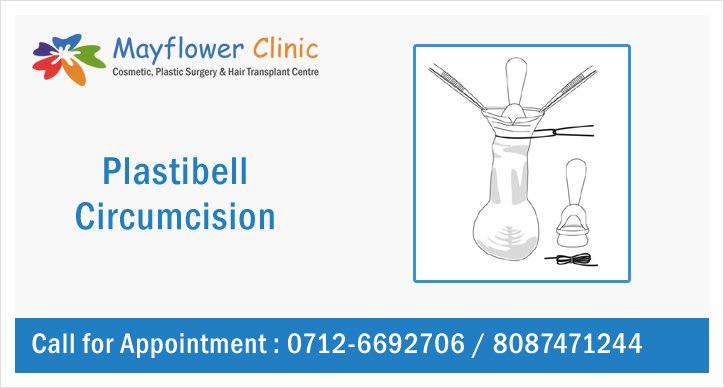
Educational illustration/image from the existing Mayflower Clinic circumcision media library. Actual device size and operative technique are selected clinically.
The defining feature of Plastibell circumcision is that the plastic ring remains temporarily after the procedure rather than being removed before the patient leaves.
Parents should therefore be prepared for a wound that looks different from a sutured surgical circumcision. Mild swelling and local tenderness can occur, and the tissue immediately beyond the ligature changes as it separates.
The ring should be observed but not manipulated. Separation time varies. If it remains beyond the timeframe given by the treating surgeon, becomes displaced, appears embedded or causes concerning swelling, medical review is appropriate.
Pulling, rotating, cutting or forcing a retained Plastibell ring can cause bleeding or tissue injury. Contact the treating team instead.
Adults have different anatomy, indications, healing expectations and practical needs from newborns and infants. Adult technique selection may depend on foreskin scarring, recurrent infection, frenulum anatomy, diabetes or other medical conditions, previous circumcision, desired contour and the anaesthesia plan.
Exact steps vary with age, indication and anaesthesia requirements.
The discussion may involve cultural or religious preference, pathological phimosis, recurrent inflammation or another clinical concern. In children, normal developmental non-retractability should not automatically be labelled disease.
The urinary opening, glans, foreskin, curvature and surrounding anatomy are examined. Suspected congenital abnormalities can change or postpone the plan.
Device size, age, anatomy, indication, anaesthesia and the family's ability to manage ring aftercare are considered. Plastibell is one option, not an automatic choice.
Pain-control planning is age-specific. The patient is prepared using the appropriate sterile technique, and the surgeon reconfirms anatomy before the device is applied.
The bell protects the glans beneath the foreskin. The ligature is secured in the device groove and the foreskin is managed according to the planned Plastibell technique.
Parents or carers receive written instructions covering pain medicines, cleaning, nappies or clothing, ring observation and when to call the clinic.
The device remains temporarily while healing progresses. Do not interfere with the ring. Follow the surgeon's review instructions and contact the clinic earlier if warning signs appear.
The operating team's written instructions take priority over generic internet advice.
Follow the exact bathing and cleaning instructions given at discharge. Do not scrub the healing area or apply unprescribed antiseptics, powders or traditional remedies.
Change nappies carefully when applicable. For older children, soft loose clothing can reduce rubbing and discomfort.
Give only the medicine and dose advised for the patient's age and weight. Increasing or uncontrolled pain requires review.
Passing urine is an important recovery check. Marked difficulty or inability to pass urine requires prompt medical advice.
Do not twist, pull, cut or forcibly remove the Plastibell. Contact the treating team if its position changes or separation is delayed.
Also review the Mayflower Patient Care Guide while following the procedure-specific instructions given by the surgeon.
The device does not detach on an identical day in every patient. Age, ring size and healing can affect timing.
Plastibell reduces bleeding through ligature compression but does not make circumcision free of bleeding risk.
A ring can remain longer than expected, shift position or become impacted and may require clinical removal or other treatment.
Increasing redness, fever, pus, foul discharge or progressive swelling requires medical assessment.
As with other circumcision techniques, too much or too little residual skin, asymmetry or contour concerns can occasionally occur.
Pain, swelling, delayed healing, urinary difficulty and uncommon surgical complications remain possible even with correct technique.
For a medical emergency, use the appropriate emergency service rather than relying on website forms or social-media messages.
Plastibell is most commonly associated with circumcision in newborns and young infants and may be considered in selected children. It should not be assumed to be the routine or default adult circumcision method.
No. Suitability depends on age, penile anatomy, foreskin condition, device sizing, medical history and the reason for circumcision. Some babies or children require another technique.
An appropriately sized plastic bell is positioned over the glans beneath the foreskin. A ligature is secured around the foreskin in the device groove, allowing the tissue beyond the ligature and the ring to separate during healing.
Yes. Unlike conventional circumcision in which the wound is closed immediately, the Plastibell ring normally remains temporarily and separates during the healing process.
It commonly separates over several days, but timing varies with age, device size and healing. Follow the operating surgeon's expected timeframe rather than trying to remove the ring yourself.
Contact the treating team for advice. A retained or impacted ring can require examination and should not be cut, pulled or forcibly removed at home.
It can be used in selected older children in some circumstances, but age, anatomy, appropriate device sizing and anaesthesia become increasingly important. Conventional surgical circumcision may be preferable in many older children.
No circumcision method should be described as painless. Appropriate anaesthesia and pain relief are planned according to age and circumstances, and tenderness can occur during recovery.
Possible problems include bleeding, infection, swelling, pain, retained or displaced ring, inappropriate ring position, too much or too little foreskin removal, delayed healing and other uncommon circumcision complications.
Further assessment is important when penile anatomy is unusual, hypospadias or another congenital abnormality is suspected, there is active infection or significant illness, or there is a bleeding disorder or relevant bleeding history.
Keep the area clean according to the written instructions, change nappies carefully when applicable, use only prescribed or recommended medicines and ointments, observe urination and avoid pulling or rotating the device.
Seek prompt advice for persistent bleeding, inability or marked difficulty passing urine, rapidly increasing swelling, severe uncontrolled pain, fever, spreading redness, pus or foul discharge, concerning colour change, or displacement of the ring.
This page uses cautious wording because Plastibell outcomes, complications and ring-separation patterns vary between age groups and clinical settings.
Different pages answer different age, technique and recovery questions.
The decision is made after examining age, penile anatomy, foreskin condition, indication for circumcision and device suitability. If Plastibell is not appropriate, the consultation can explain the reasonable alternatives rather than forcing one technique.

Case of the Month: Grade 3 Gynecomastia…

The Science of Facial Aging: Why Wrinkles,…