
Residual / redundant skin
Too much skin may remain, or the residual skin may be uneven. The key question is whether it causes a persistent functional, hygiene or contour problem after healing.

A second operation should not be automatic. Revision circumcision is considered only after examining the previous circumcision, identifying the exact problem, and deciding whether surgery is likely to offer a meaningful functional, hygiene, scar or contour benefit.


“Revision surgery begins by understanding why the first result is causing concern. The safest plan is the smallest correction that addresses the real problem while preserving healthy skin, function and future scar quality.”Dr. Pawan Shahane, M.Ch. Plastic Surgery / Founder, Mayflower Clinic, Nagpur
Revision circumcision is a secondary operation performed after an earlier circumcision when a persistent, clinically meaningful problem remains. The concern may be functional, hygiene-related, scar-related or cosmetic, but the decision should be based on physical examination rather than appearance in the early healing period.
Patients may present with several different post-circumcision concerns, and each requires a different assessment and correction plan.
Some concerns are minor and need reassurance only. Others can involve redundant skin, a true skin bridge, a tight or irregular scar, recurrent inflammation, painful tethering or a stable contour problem. Revision is planned only when the likely benefit outweighs the risks of another operation.
These are reasons to be examined, not a checklist that automatically means another operation is needed.
Too much skin may remain, or the residual skin may be uneven. The key question is whether it causes a persistent functional, hygiene or contour problem after healing.
An irregular circumcision line or asymmetric skin distribution may be assessed after swelling and scar maturation no longer explain the appearance.
A true healed skin bridge can attach shaft skin to the glans and may cause pulling, trapped debris or discomfort. This differs from a temporary adhesion.
Raised, tight, painful, irregular or repeatedly inflamed scar tissue may need review. The available healthy skin determines how much scar can safely be revised.
Repeated inflammation, moisture trapping or hygiene difficulty can sometimes be related to residual skin or scar folds and should be clinically assessed.
Buried penis, adhesions, tight scar, infection or other penile-skin conditions may look like an “incomplete circumcision” but can require a different treatment plan.
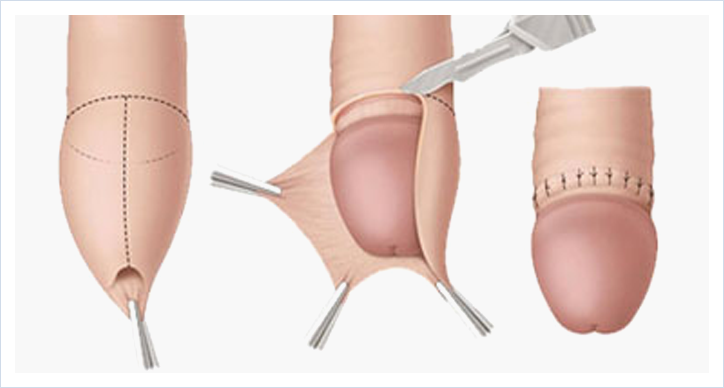
Non-graphic educational illustration. Revision surgery is individualized and may not resemble a standard first-time circumcision.
Revision surgery has less margin for guesswork because skin has already been removed and scar tissue may alter blood supply, movement and contour. The surgeon must assess the amount and distribution of remaining skin before deciding what can safely be corrected.
Depending on the problem, revision may involve selective removal of residual skin, release of a skin bridge, excision or rearrangement of scar tissue, and re-formation of the circumcision line. The goal is not to make the skin “as tight as possible”; excessive removal can create new functional and scar problems.
Important limitation: a second operation cannot promise perfect symmetry, an invisible scar, a particular sensation or an exact cosmetic outcome. Scar behaviour, anatomy and healing biology remain individual.
If available, bring the date of surgery, operative notes, prescriptions, infection history and any previous treatment. Explain what bothers you now and whether the concern is appearance, pain, hygiene, tightness, recurrent inflammation or another symptom.
Dr. Shahane assesses residual skin, scar position, symmetry, tethering, adhesions or skin bridges, inflammation, available skin and any signs suggesting a different diagnosis. A revision is recommended only if there is a clear target for correction.
If healing is immature, observation may be safer. If revision is appropriate, the intended correction, scar position, limitations, anaesthesia, setting, activity restrictions and likely follow-up are discussed before consent.
The operation is tailored to the identified problem. Surgery is personally performed by Dr. Pawan Shahane. Closure may use absorbable sutures and/or other wound-closure methods depending on the case.
Swelling, bruising, tenderness, mild ooze and increased sensitivity can occur. Keep the area clean and dry as instructed, take prescribed medicines correctly and avoid friction or pressure.
Work, exercise and sexual activity are restarted according to wound healing and the extent of revision. Do not use a calendar alone as proof that the wound is ready for friction or strenuous activity.
The scar softens and the contour continues to change after the wound has closed. Follow-up is used to monitor healing and distinguish normal scar maturation from a persistent problem.
Wash only as instructed, avoid aggressive rubbing, and pat the area dry. Wash hands before touching the dressing or wound.
Supportive or loose clothing may be advised depending on the dressing and swelling pattern. Follow the surgeon's specific instructions rather than improvising.
Use prescribed pain relief, antibiotics or topical care only as directed. Tell the clinic about drug allergies, anticoagulants or bleeding disorders before surgery.
Avoid cycling, vigorous sport, heavy lifting or activities that rub or stretch the healing area until cleared.
Sex and masturbation should wait until the wound is fully healed and the surgeon has cleared return. Premature friction can cause pain, bleeding or wound disruption.
Follow-up allows assessment of the wound, scar, urinary symptoms and return to activity. Review is especially important if the correction was more extensive.
Any penile skin surgery can bleed or become infected. Risk is reduced by careful technique and aftercare but cannot be eliminated.
Scars can widen, thicken, remain visible or heal unevenly. Wound separation and delayed healing are possible.
Temporary or persistent altered sensitivity, numbness or discomfort can occur after surgery around a previously operated area.
Revision can improve a correctable problem but cannot guarantee perfect symmetry or an exact appearance.
Previous skin removal or scar position can limit how much further tissue can safely be removed or rearranged.
Persistent scar, recurrent tethering, residual contour concerns or another complication can occasionally require additional treatment.
Emergency note: the website and WhatsApp line are not emergency services. Severe bleeding, inability to pass urine, rapidly worsening swelling, severe systemic illness or other urgent deterioration requires immediate in-person medical care.
The current project inventory does not provide a circumcision-specific verified quotation for ID 162. To avoid fabricating a procedure claim, the cards below identify verified Google reviewers from the clinic's general review inventory and direct visitors to the original Google wording.
Verified Google reviewer in Mayflower Clinic's general review inventory. This page does not assign a circumcision procedure or invent a quotation.
Verified Google reviewer in Mayflower Clinic's general review inventory. Read the original wording on the clinic's Google Business Profile.
Verified Google reviewer in Mayflower Clinic's general review inventory. No procedure is attributed beyond what the source inventory supports.
Revision circumcision is a secondary operation used to correct a specific problem after a previous circumcision. The exact surgery depends on examination and may involve residual skin, scar tissue, a skin bridge or another healing or contour concern.
No. Residual skin by itself does not automatically require surgery. Revision is considered when examination shows a functional, hygiene, recurrent-irritation, scar or clearly persistent contour problem and the expected benefit justifies another operation.
A mature penile skin bridge may require surgical division or revision, depending on its size, symptoms and anatomy. A clinical examination is needed because a true skin bridge is different from a temporary adhesion.
Selected contour irregularities may be improved by removing or redistributing skin and revising scar tissue, but symmetry and scar appearance cannot be guaranteed. The surgeon must first assess available skin and the cause of the irregularity.
If the first operation is recent, swelling and scar maturation can temporarily distort appearance. Unless there is an urgent complication, the surgeon may advise observation until healing is sufficiently mature to judge whether a persistent problem remains.
Anaesthesia depends on age, medical history and the extent of correction. Local, regional or general anaesthesia may be considered, and the final plan is confirmed after examination.
Many selected revisions can be planned as day-care surgery, but the setting and observation period depend on the complexity of the correction, anaesthesia and the patient's health.
Recovery varies with the extent of revision. Swelling, bruising and sensitivity are expected early, while full wound and scar maturation takes longer. Activity and sexual restrictions should follow the surgeon's individual instructions.
Sex and masturbation should be avoided until the wound is fully healed and the surgeon has cleared return to sexual activity. Standard adult circumcision guidance commonly uses at least several weeks, but revision cases can require an individualized interval.
Potential risks include bleeding, infection, wound-healing problems, swelling, pain, altered sensation, scar problems, asymmetry, contour dissatisfaction, urinary difficulty, anaesthesia-related complications and the possibility of further revision.
Prompt medical review is important for persistent or heavy bleeding, fever, rapidly increasing redness or swelling, pus or foul discharge, wound opening, severe increasing pain, difficulty passing urine or concerning dark colour change.
The distinction is made by examination. Temporary swelling, sensitivity and scar firmness can be part of normal healing, while persistent residual skin, a mature skin bridge, recurrent inflammation, tight scar tissue or a stable contour problem may justify discussion of revision.
Medical content is intentionally conservative. These references support the general indications, complications, recovery and red-flag guidance; individual treatment still requires examination.
Start with an examination rather than assuming another circumcision is required. The consultation can determine whether the issue is normal healing, residual skin, scar tissue, a skin bridge, recurrent irritation or another problem—and whether observation or revision is the safer next step.

Case of the Month: Grade 3 Gynecomastia…

The Science of Facial Aging: Why Wrinkles,…