
★★★★★
“I wanted a sharp tip, and I was having a broad nose… His technique is very good.”

“Nose reshaping” is the everyday name for rhinoplasty. This page explains it without surgical jargon: which features may be refined, why breathing and support matter, what a realistic result looks like, and which focused guide fits your concern.


Ask a simple question about this page or select a suggested question.
Bridge, width, tip, nostrils, crookedness, breathing and previous surgery lead to different assessment pathways. The sections below help you identify the right guide.
See the concern map →This local page guide uses prewritten, medically reviewed answers. It cannot examine you, diagnose a condition, recommend surgery, calculate candidacy or replace consultation.
“A useful plan begins with one question: what is bothering the patient, and which structure is actually creating that appearance? The answer may be the bridge, bones, septum, middle vault, tip, nostrils, chin relationship—or a combination. We should not change parts that do not need changing.”— Dr. Pawan Shahane, M.Ch. Plastic Surgery
Nose reshaping is an umbrella term. For one person it may mean smoothing a hump. For another it may mean narrowing a broad upper nose, refining a heavy tip, improving a crooked axis, building a low bridge, reducing nostril flare or combining external change with treatment of a deviated septum or weak nasal valve.
The visible nose is a connected structure. Nasal bones form the upper third, paired cartilages support the middle vault, tip cartilages shape the lower third, the septum supports the centre, and the skin-soft-tissue envelope must adapt over everything underneath. A change at one level can affect another level.
That is why a good consultation is not based only on “make it smaller” or “make it sharper.” It translates the patient’s words into anatomy, then decides what can be modified while protecting breathing, strength, skin blood supply and a natural relationship with the rest of the face.
Patient words are useful, but the same word can describe different structures. These six common concerns lead to different evaluations.
The prominence may be bony, cartilaginous or mixed. Radix depth, tip projection and middle-vault support influence how the profile should be changed.
Hump-removal guide →Width may come from the nasal bones, middle vault, broad tip, nostrils or alar base. Narrowing every level is neither necessary nor always safe.
Wide-nose guide →Visible deviation may involve bone, the dorsal or caudal septum, middle vault, tip or the underlying facial midline. Breathing must also be assessed.
Crooked-nose guide →Tip width, definition, support, projection and rotation are related but different. Skin thickness and cartilage strength affect how much definition can show.
Cosmetic-planning guide →Height and width must be separated. Reducing a high profile is different from narrowing a broad bony vault or augmenting a low bridge.
Bridge-planning guide →The septum, turbinates and internal or external nasal valves may need functional assessment. Appearance and airflow can be planned together when appropriate.
Septorhinoplasty guide →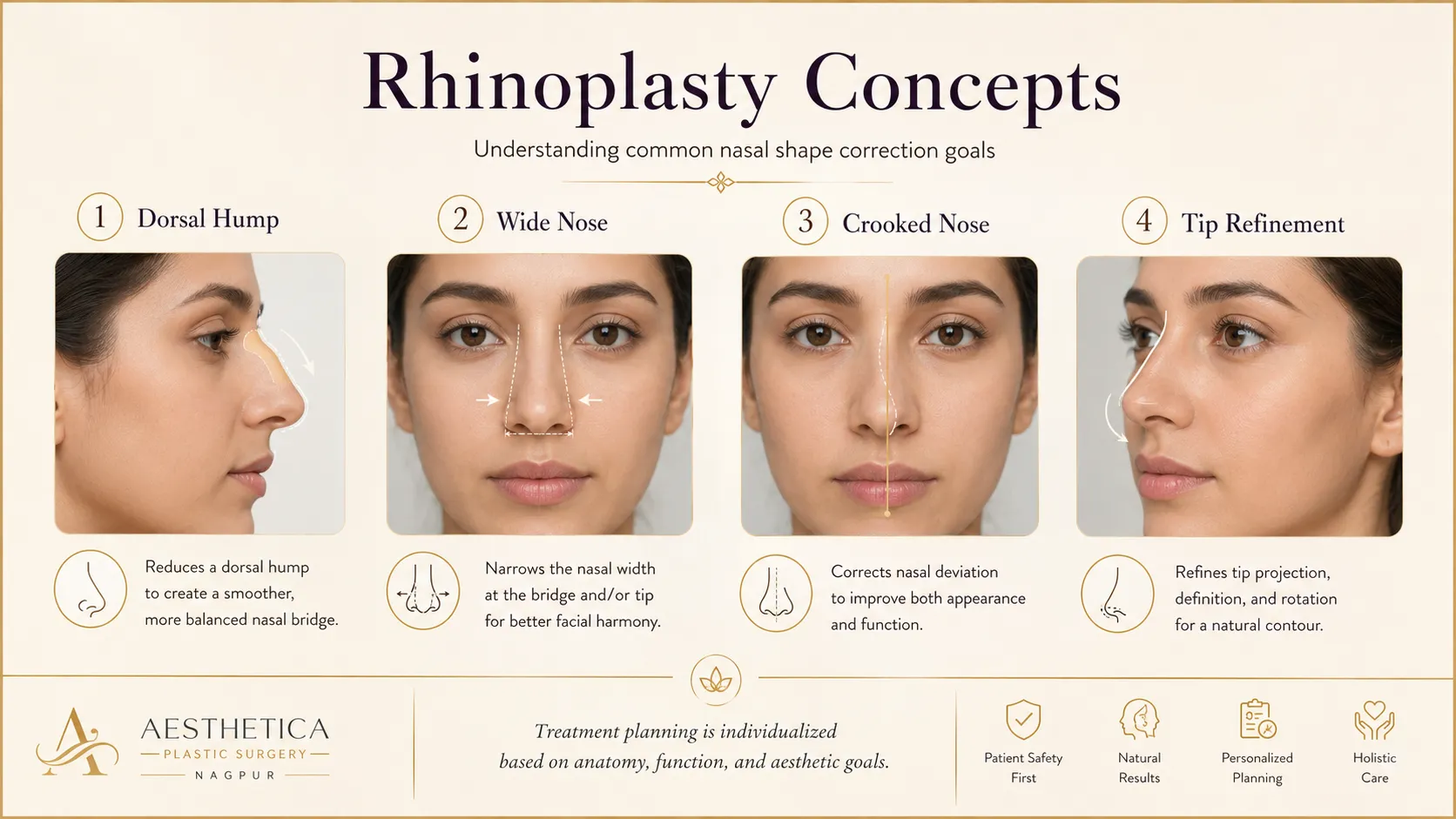
Rhinoplasty planning is a balance between contour change and structural preservation. “More reduction” is not automatically a better result.
| Area | Possible goal | What the surgeon must protect | Common limitation |
|---|---|---|---|
| Bridge and hump | Lower a prominence, smooth the profile or alter height. | Stable dorsal lines, middle-vault width and internal nasal-valve support. | Skin, radix and tip relationships determine how much change looks balanced. |
| Nasal bones | Narrow a broad upper nose or realign selected deviation. | Symmetry, airway, stable sidewalls and controlled bony healing. | Facial asymmetry and bone shape can limit perfect straightness or narrowness. |
| Middle vault | Correct width, contour shadow or collapse. | Internal nasal valves and smooth bridge-to-tip continuity. | Over-resection can create pinching, inverted-V shadow or breathing problems. |
| Tip | Refine width, projection, rotation, support or definition. | Tip blood supply, cartilage strength, airway and natural movement. | Thick skin may soften visible definition; swelling may persist longer. |
| Nostrils / alar base | Reduce flare or width in selected patients. | Natural curvature, symmetry, scar position and external valve function. | Over-reduction can look pinched and cannot correct width arising higher in the nose. |
| Septum and valves | Improve support and selected structural obstruction. | Adequate cartilage, mucosal health and stable airflow pathways. | Breathing symptoms may have multiple causes and are not guaranteed to resolve completely. |
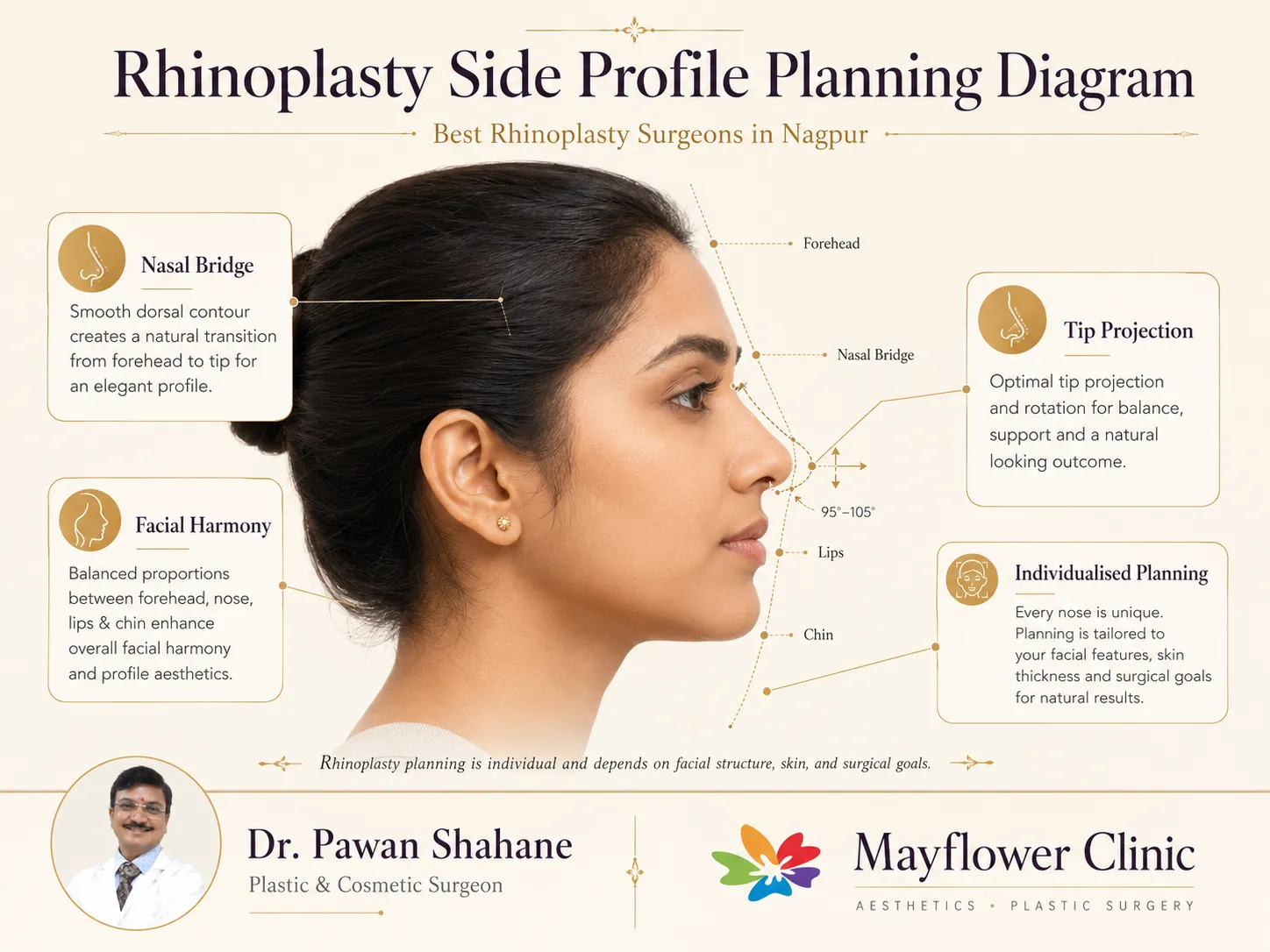
A profile concern can be influenced by the forehead-radix relationship, nasal length, tip projection, upper lip and chin. A frontal concern may relate to facial midline, cheek width, nasal bones, middle vault, tip or nostril base. The smile can change tip position and nostril display.
Consultation commonly uses standardised photographs from frontal, profile, oblique and basal views. These images help the patient and surgeon name the concern accurately, compare proportions and explain trade-offs. Digital simulation can support communication, but it does not predict exact healing.
Use the dominant concern to read the focused guide. Consultation may show that more than one pathway overlaps.
Start here for a broad overview of goals, techniques, risks and recovery.
Open pillar page →Bridge, tip, nostrils, facial harmony and natural-looking aesthetic decisions.
Open cosmetic guide →A routing guide for cosmetic, septal, traumatic, reconstructive and revision needs.
Open nasal-surgery guide →Combined assessment of septum, valves and visible nasal form.
Open septorhinoplasty guide →Persistent shape, support, scar or breathing concerns after earlier rhinoplasty.
Open revision guide →Profile imbalance may reflect relative projection rather than the nose alone.
Open profile-balance guide →Mayflower MX Lift Rhinoplasty is the clinic’s name for an individualised structural planning concept used in selected patients when the tip-support system, controlled rotation or projection, bridge-to-tip relationship and overall facial balance need coordinated attention.
It is not one standard manoeuvre and is not required for every nose. The “MX Lift” name does not mean the tip should be lifted as much as possible. Some patients need support without visible rotation; others may need deprojection, refinement, straightening, augmentation or airway work rather than lift.
Important: the concept does not promise maximum rotation, scar-free surgery, faster healing, permanent immunity from ageing or a guaranteed appearance.
This is an overview of decision-making rather than a repeat of the detailed surgery-day page.
Bring a short list: front-view width, profile hump, tip, nostrils, crookedness, breathing, trauma or previous surgery. Photos of somebody else are less useful than explaining what you notice on your own face.
The surgeon examines proportions, skin, cartilage, nasal bones, septum, valves, nostrils, facial asymmetry and breathing. Medical history, medicines, smoking, prior procedures and expectations are reviewed.
Standardised photographs and, where appropriate, simulation help explain priorities and trade-offs. The agreed plan should include realistic limits, scars, graft possibilities, airway implications and alternative pathways.
Investigations, medication instructions, fasting, consent, transport and postoperative support are organised according to health and procedure complexity.
Read the detailed procedure-day guide →Bone, cartilage, septum, middle vault, tip or nostril structures are addressed only as required. The sequence and graft use vary; no single operation fits every nose.
Splints, tape or selective internal support may be used. Elevation, medication, wound care, activity restrictions and urgent-contact instructions are followed exactly.
The bridge often settles earlier than the tip. Swelling can fluctuate, especially in the morning or after activity. Final appraisal waits until the tissues have substantially matured.
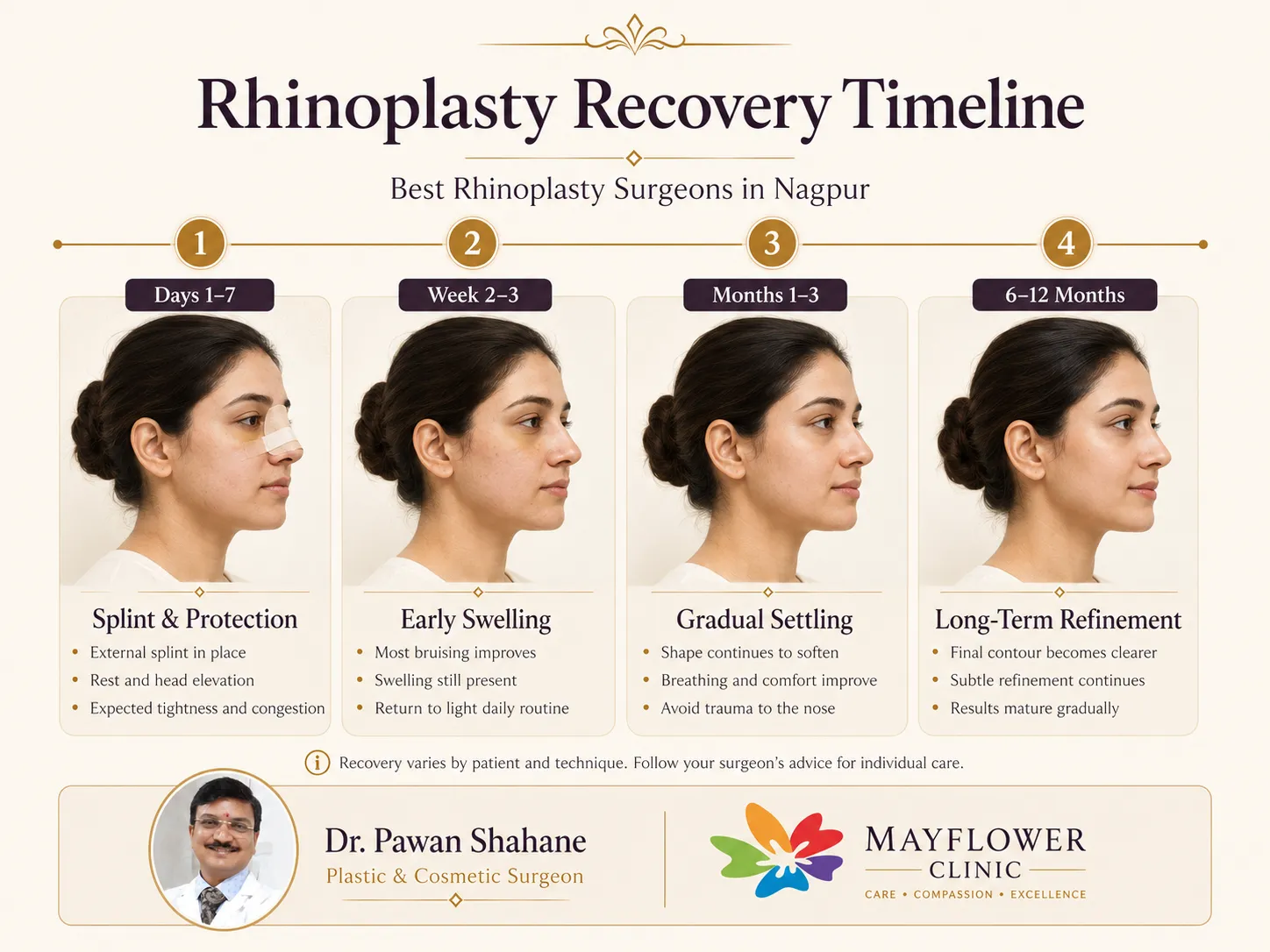
Early bruising and swelling commonly improve over the first weeks. Many patients feel socially presentable before the nose is fully refined. Tip swelling, firmness or altered sensation can last much longer than the visible splint.
Rest, head elevation, prescribed care and protection of splints or dressings. Nasal blockage from swelling is common.
Splint or sutures may be reviewed or removed according to the operation. Bruising and obvious swelling usually begin to reduce.
Activity increases in stages. Glasses, exercise and contact-risk instructions are individualised. Contours continue to settle.
Fine tip definition, softness and minor asymmetries continue to evolve. Thick skin and revision surgery may take longer.
Good counselling includes limitations before surgery, not only possibilities.
Faces are naturally asymmetric. A crooked nose can often be improved, but a mathematically straight nose cannot be guaranteed.
Computer images are communication tools. Skin, scar forces, cartilage behaviour and healing prevent an exact digital prediction.
Skin thickness, bone width, cartilage strength and airway support set safe limits. Over-reduction can look unnatural or weaken breathing.
A splint-off photograph is an early healing stage. Swelling and tissue adaptation continue for months.
Allergy, turbinate swelling, sinus disease and other causes may coexist. Structural surgery treats only the problems it is designed to address.
Results can be long-lasting, but ageing, injury, scar maturation and normal tissue changes continue through life.
Rhinoplasty is real surgery. The possibility and importance of each risk vary, and some complications may require additional treatment or revision.
Anaesthesia complications, bleeding, infection, nausea, medication reactions, poor wound healing and scarring.
Temporary or persistent blockage, valve narrowing, septal perforation, altered smell, dryness or breathing dissatisfaction.
Prolonged swelling, numbness, skin discoloration, asymmetry, irregularity, visible scar, graft visibility or an unsatisfactory appearance.
Uncontrolled bleeding, rapidly increasing swelling, worsening breathing difficulty, severe or escalating pain, repeated vomiting, fainting, fever or concerning discharge, chest pain, new visual symptoms, or any sudden deterioration. Follow the written emergency instructions provided by the treating team.
Individual experiences do not predict another person’s outcome. Review wording is shown as submitted and has been shortened for readability.
“I wanted a sharp tip, and I was having a broad nose… His technique is very good.”
“I’m very happy with my rhinoplasty surgery.”
“From the initial consultation to the post-operative care, Dr. Shahane demonstrated exceptional skill, professionalism, and genuine care.”
These answers are educational. Personal suitability requires examination, photographs, airway assessment and medical review.
Yes. Nose reshaping is the patient-friendly term commonly used for rhinoplasty. It may involve cosmetic refinement, functional correction, reconstruction after injury, or a combination, depending on the structures involved and the person’s goals.
Rhinoplasty may alter the bridge, nasal bones, middle vault, tip, nostril or alar-base width, projection, rotation, asymmetry and selected internal structures. The plan depends on facial proportions, skin and soft tissue, cartilage strength, airway anatomy and realistic priorities.
It can reduce selected dimensions such as a prominent hump, excessive projection, bridge height, tip volume or alar-base width. A safe plan is not simply to make every part smaller; support, skin behaviour, facial balance and breathing must be protected.
A broad appearance may come from wide nasal bones, a broad middle vault, tip shape, nostril width or several levels together. Each level is assessed separately because bone narrowing, tip refinement and alar-base reduction address different structures and have different limitations.
A localised hump can sometimes be the main focus, but the radix, nasal length, tip projection, middle-vault support and the possibility of an open roof must still be considered. The aim is a smooth, stable profile rather than isolated removal without structural planning.
It may improve visible deviation caused by nasal bones, the septum, middle vault or tip. Perfect straightness cannot be promised because cartilage memory, facial asymmetry, scar forces, previous trauma and healing can influence the final alignment.
Yes, when both concerns are present, a combined septorhinoplasty or functional rhinoplasty plan may address the septum, nasal valves and external shape together. Cosmetic change alone should not be assumed to fix obstruction; the airway needs its own examination.
Planning should not use one universal ideal. The surgeon studies frontal, profile, oblique and basal views, facial proportions, expression, skin thickness, cultural and personal identity, breathing and the changes the patient actually notices. Simulation can support discussion but is not a guarantee.
Mayflower MX Lift Rhinoplasty is Mayflower Clinic’s name for an individualised structural planning concept used in selected patients when tip support, controlled rotation or projection and overall nasal balance need coordinated attention. It is not a fixed operation, is not required for every patient and does not guarantee a maximum lift or a particular result.
Neither approach is universally better. Closed rhinoplasty uses incisions inside the nostrils, while open rhinoplasty adds a small columellar incision for wider exposure. The choice depends on the work required, previous surgery, grafting, tip complexity and the visibility needed for safe correction.
Many patients plan roughly one to two weeks away from public-facing work, but this varies with bruising, swelling, the operation performed and the nature of the job. Exercise, spectacles, travel and contact-risk activities may need longer restrictions according to the surgeon’s instructions.
A major part of early swelling settles over weeks, but the tip and fine contours change gradually over many months. Full refinement can take around a year and sometimes longer after thick skin, extensive tip work or revision surgery.
Risks include bleeding, infection, anaesthesia complications, scarring, numbness or altered sensation, prolonged swelling, asymmetry, contour irregularity, breathing difficulty, septal perforation, skin or wound-healing problems, dissatisfaction and possible revision surgery. Individual risk is discussed after examination.
Injectable or thread-based treatments cannot narrow nasal bones, remove tissue, correct major deviation or reliably treat structural airway problems. They can add volume or create temporary optical changes in selected cases and carry important vascular and skin risks, so they are not a simple substitute for surgery.
Start with the concern you notice most: hump or high bridge, broad nose, crookedness, tip or nostril shape, breathing difficulty, previous surgery, trauma or facial-profile imbalance. This page links to focused guides, but an in-person assessment is needed to identify the structures involved and whether surgery is appropriate.
Medically reviewed for Mayflower Clinic on 20 July 2026. External references are educational and do not replace individual advice.
A consultation can identify whether your concern comes from the bridge, bones, septum, middle vault, tip, nostrils, airway or facial-profile relationship, and explain the safest realistic options.
Medical Disclaimer: All surgical procedures carry inherent risks, and individual outcomes vary based on anatomy, skin type and healing biology. Surgical results are not guaranteed. Formal in-person consultation with Dr. Pawan Shahane is required before any surgical decision. This page is for general educational purposes only and does not constitute medical advice or a treatment recommendation.
Surdham Complex, Dhantoli, Nagpur — 440012, Maharashtra, India
Monday–Saturday
11 AM–6 PM
Sunday closed

Case of the Month: Grade 3 Gynecomastia…

The Science of Facial Aging: Why Wrinkles,…