0712 6692706 / 0712 3551170 / +91 8087471244   |   contact@mayflowerclinic.in
M.Ch. Plastic Surgery · Nagpur

Cosmetic Nose Surgery in Nagpur—Refinement That Still Looks Like You.

Cosmetic rhinoplasty is not simply about making a nose smaller. It is a personalised operation that may refine the bridge, tip, width, nostrils, projection or rotation so the nose sits more quietly within the whole face—while respecting identity, support and breathing.

This page focuses on the aesthetic decision: what can be changed, what should be preserved, how frontal and profile goals differ, and why a natural result depends on facial balance rather than a standard “ideal nose.”

Dr. Pawan Shahane, M.Ch. Plastic Surgery
Reviewed by Dr. Pawan Shahane, M.Ch. Plastic Surgery21+ years surgical practice · Ex-Asst. Prof. GMC Nagpur · IAAPS Member · 9 yrs ThreeBestRated Nagpur
Dr. Pawan Shahane discussing cosmetic nose surgery and facial balance at Mayflower Clinic Nagpur
The consultation starts with your face—not a template. Frontal, profile, oblique and smiling views are assessed before deciding whether any bridge, tip, nostril or support change is appropriate.
21+Years surgical practice
M.Ch.Plastic Surgery
9 YearsThreeBestRated Nagpur
0 DelegationSurgery led personally
Page Guide

Quick Answer

Ask a simple question about natural appearance, facial balance, tip or bridge refinement, breathing protection or Mayflower Max-Lift™. The guide matches your question locally in your browser and points to the relevant section.

● Private · On-page · No login
Choose a suggested question or type a topic. All core answers are also visible below for visitors and search agents.

This page guide cannot examine, diagnose, recommend surgery, calculate candidacy or replace consultation. It does not assess photographs or symptoms.

Will my nose look natural?

A natural result comes from proportionate change, stable support and respect for the patient’s existing features—not from copying a standard nose. Skin thickness, facial asymmetry and healing also influence how refined the result appears.

See the facial-balance framework ↓

Can the tip be refined without changing my identity?

Often yes. Tip sutures, support grafts or selective cartilage reshaping may improve definition or position while preserving individual character. The bridge, nostrils, upper lip and smile must still be reviewed together.

See concerns that may be addressed ↓

Is a smaller nose always better?

No. Excessive reduction can weaken the middle vault, pinch the tip, narrow the airway or make the chin and other features appear more prominent. The aim is better proportion, not the smallest possible nose.

Read realistic limits ↓

Can breathing be protected?

Airway assessment should be part of cosmetic planning. Septal alignment, internal nasal valves, middle-vault width, turbinate findings and tip support are considered before reduction or narrowing steps.

See airway-aware planning ↓

Why do front and profile goals differ?

Profile surgery changes height, hump, radix, projection and rotation. Frontal surgery focuses more on bony width, middle-vault lines, tip shape and nostril balance. Improving one view does not automatically improve every view.

Review the four-view assessment ↓

Does everyone need Mayflower Max-Lift™?

No. It is a clinic-specific structural and dynamic planning framework for selected noses with tip-support or smiling-tip concerns. Some patients need conservative bridge work, nostril refinement or no tip elevation at all.

Read the Max-Lift section ↓

Can asymmetry be made perfect?

Meaningful improvement may be possible, but perfect symmetry is not a responsible promise. The nasal bones, septum, cartilage, facial midline, jaw and soft tissues may all contribute to visible asymmetry.

See limitations and risks ↓

How long until the result looks settled?

The splint is commonly reviewed around one week and many patients plan 7–14 days for early social recovery. Fine swelling—especially at the tip—continues to improve for months; final assessment commonly takes 6–12 months or longer.

See the recovery snapshot ↓
Aesthetic rhinoplasty

Cosmetic nose surgery is a whole-face proportion decision

Because the nose sits in the centre of the face, even a small structural change can alter how the eyes, lips, cheeks and chin are perceived. This is why cosmetic rhinoplasty should begin with a clear description of the patient’s concern—not with a fixed list of manoeuvres.

One person may want a localised hump softened. Another may feel the tip is broad in photographs, the bridge is too wide from the front, the nostrils flare on smiling, or the nose projects too far from the face. These concerns require different examinations and may not need the same operation.

The consultation also distinguishes a true nasal problem from a relative one. For example, a small chin can make the nose appear more projected; a low radix can make a modest dorsum look like a hump; facial asymmetry can make a straight nose look off-centre.

  • Your own priorities are ranked: “must improve,” “acceptable as it is,” and “do not change.”
  • Identity, sex-, age- and culture-related preferences are discussed without applying a universal beauty template.
  • Breathing and structural support are examined even when appearance is the main concern.
  • Limitations from skin thickness, scars, asymmetry and healing biology are explained before surgery.
Planning principle

The best aesthetic change is often the one people cannot isolate

“The goal is not to make the nose announce that it has been operated. The goal is to reduce the feature that draws attention while preserving the person’s identity, expression and nasal support.”
Mayflower Clinic cosmetic-rhinoplasty planning principle
Concerns assessed

What cosmetic nose surgery may address

These are planning categories, not a promise that every concern can—or should—be changed in one operation.

Dorsal hump or high bridge

Bony, cartilaginous or mixed prominence is assessed in relation to the radix, supratip, tip and chin.

Read the hump guide →

Broad nasal bones or bridge

Frontal width may involve the bony vault, middle vault or both; narrowing plans must protect dorsal lines and airway support.

Read the bridge guide →

Broad, bulbous or undefined tip

Tip cartilage shape, skin thickness, support and projection determine whether sutures, grafting or selective reshaping may help.

Read the wide-nose guide →

Drooping, over-rotated or under-supported tip

Static and smiling views reveal whether position, support, projection or muscle pull is contributing to the concern.

See dynamic tip planning ↓

Wide nostrils or alar flare

Nostril width, alar curvature, sill, tip width and smiling change are evaluated before any alar-base reduction.

See technique choices ↓

Crooked or asymmetric appearance

Nasal bone, septal, middle-vault, tip and whole-face asymmetry are separated to define realistic correction limits.

Read the crooked-nose guide →
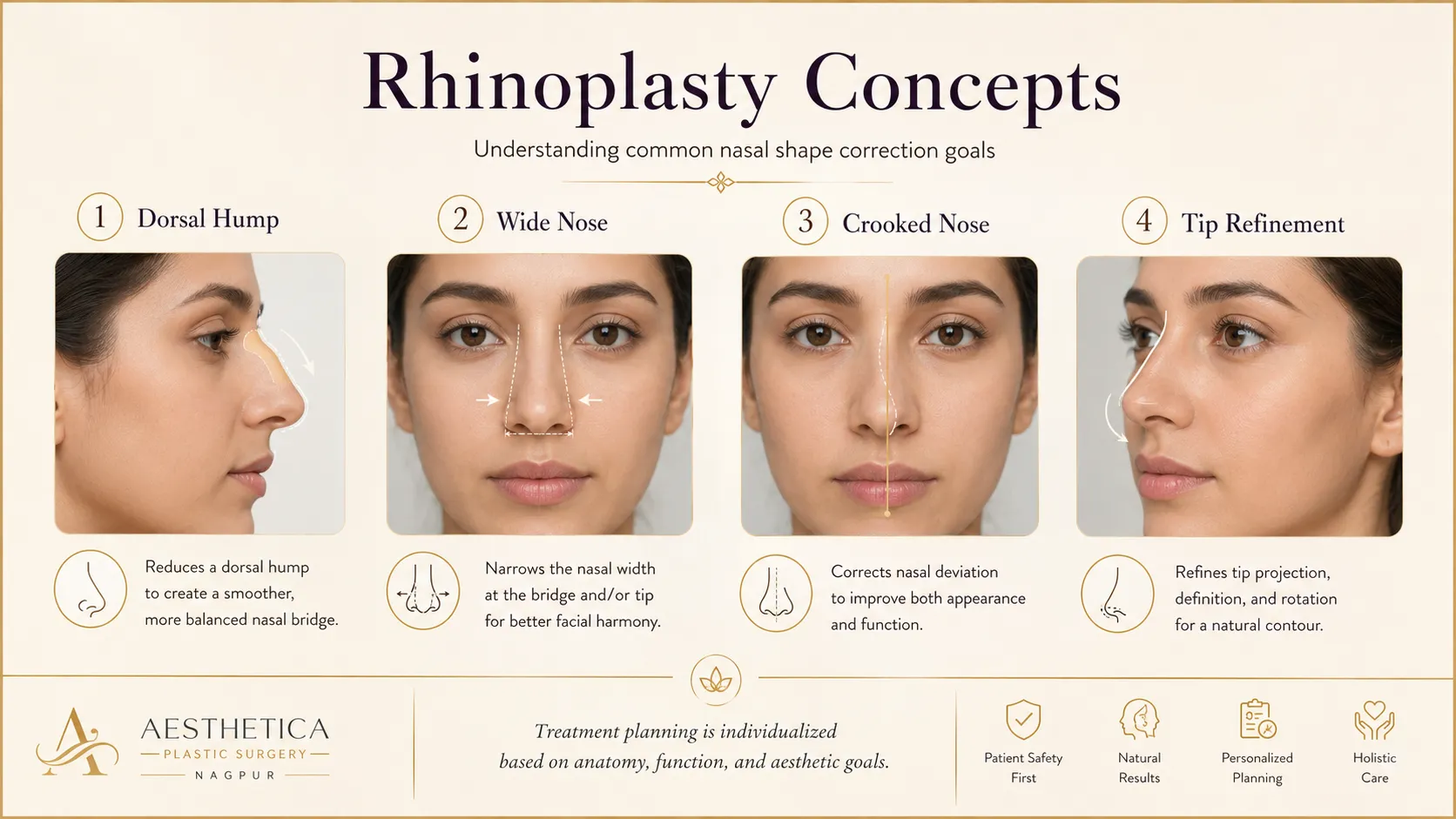
Educational diagram showing cosmetic rhinoplasty concerns including nasal hump, wide nose, crooked nose and tip refinement
Different concerns may arise from different anatomical zones. A “nose job” is not one standard operation.
Personalised design

Planning begins with relationships—not isolated measurements

Photographs and clinical examination help compare the nasal shape with the forehead, eyes, cheeks, lips, chin and jawline. Measurements can support communication, but they do not define a universal attractive nose.

Three questions guide the plan:
Which feature attracts unwanted attention? Which changes would improve proportion? Which features should remain unchanged so the face still feels familiar?
  • Radix and bridge: where the nose begins, its height and its dorsal line.
  • Projection and rotation: how far the tip sits from the face and its relationship with the upper lip.
  • Tip and nostrils: definition, symmetry, support, width and behaviour during smiling.
  • Chin relationship: a relatively small or prominent chin may change how nasal projection is perceived.
  • Skin envelope: thin skin may reveal minor irregularities; thick skin may limit very sharp definition.
Explore nose-and-chin profile planning
Four-view assessment

A nose can look different from the front, profile, oblique view and while smiling

Frontal view

Assesses bony width, middle-vault lines, tip width, nostril visibility, alar-base width and deviation from the facial midline.

Profile view

Assesses radix, hump, bridge height, supratip, tip projection, rotation and the nose–lip–chin relationship.

Oblique view

Shows transition lines, sidewall contour, tip shape and subtle asymmetry that may not be obvious from a single photograph.

Dynamic smiling view

Reveals tip descent, nostril flare, upper-lip interaction and muscle pull that static photographs may miss.

Standardised photography

Consistent lighting, head position and focal distance reduce distortion and make planning discussions more reliable.

Existing facial asymmetry

Eye, cheek, jaw and lip asymmetry should be documented because it can influence how nasal alignment is perceived after surgery.

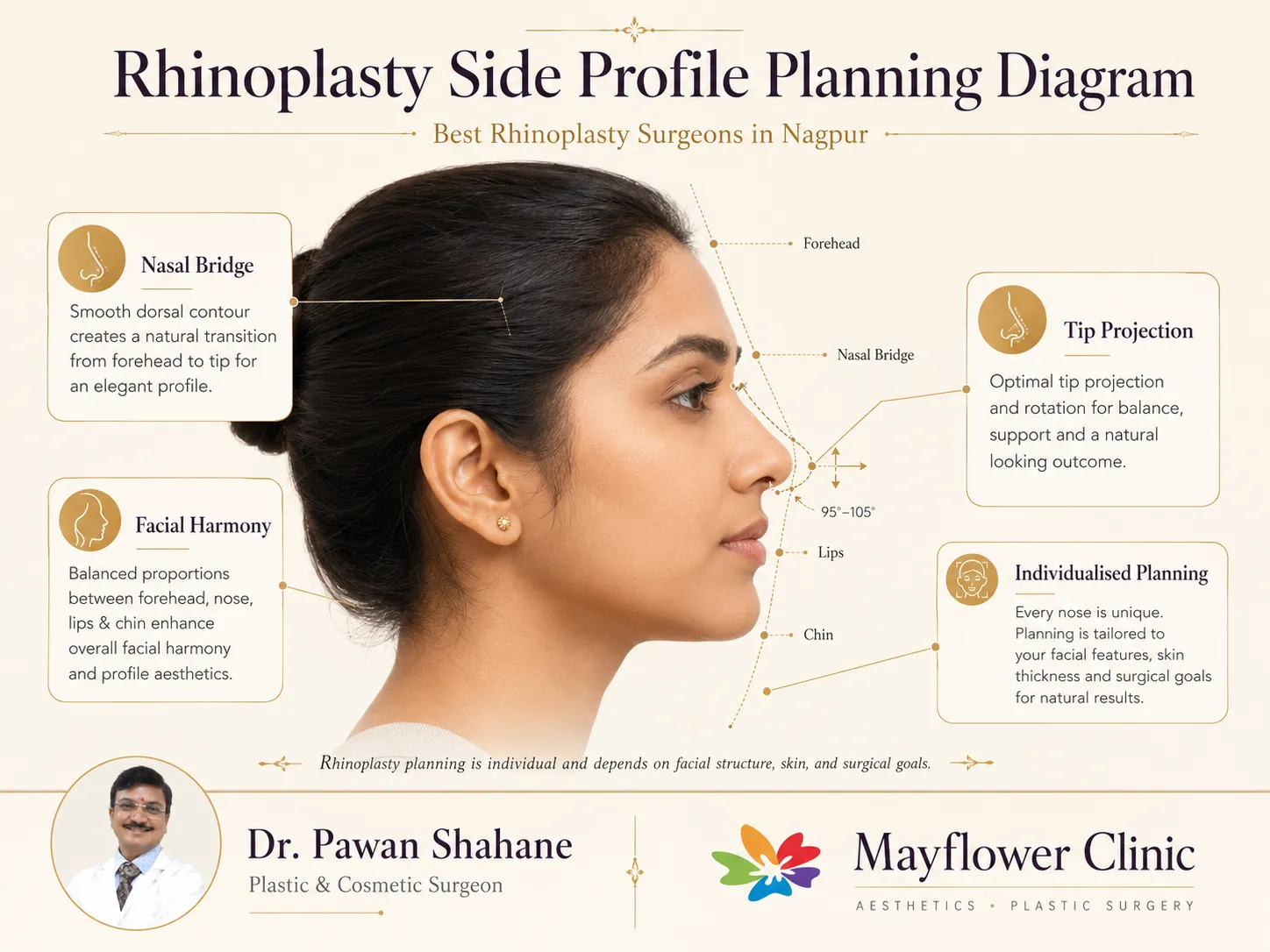
Rhinoplasty side profile planning diagram showing radix, bridge, supratip and tip relationships
The bridge and tip are planned as a continuous profile rather than unrelated targets.
Technique follows the goal

Structural choices behind an aesthetic change

Open versus closed rhinoplasty describes access—not the artistic result. The actual aesthetic plan may combine several structural choices.

  • Controlled reduction: conservative modification of bone or cartilage where true excess exists.
  • Augmentation: adding support or height when the bridge, radix or tip is under-projected.
  • Osteotomies: controlled nasal-bone repositioning for width, open-roof or alignment concerns.
  • Tip sutures and grafts: shape and support selected tip cartilages without relying on aggressive removal.
  • Middle-vault support: spreader grafts, spreader flaps or preservation choices when needed for contour and airway.
  • Alar-base refinement: selected nostril or alar-width correction with careful scar and symmetry planning.
Clinic-specific planning framework

Mayflower Max-Lift™ Rhinoplasty

Mayflower Max-Lift™ Rhinoplasty is Dr. Pawan Shahane’s structural and dynamic planning framework for selected patients whose concerns include weak tip support, a drooping or under-projected tip, or tip descent during smiling.

It is not a single stitch or a promise to rotate every tip upward. Depending on anatomy, the plan may include support grafting, controlled tip positioning, smiling-tip analysis, selective assessment of depressor septi pull, and airway safeguards.

Structural tip supportDynamic smile assessmentControlled projectionSelective rotationAirway safeguardsWhole-face planning

The framework may be relevant to primary, facial-profile and selected revision cases. The exact surgical components are decided only after examination.

Form and function

Why an aesthetic page still discusses breathing

Cosmetic goals do not remove the need for functional examination. A narrower or lower nose may look attractive in a drawing but could become unstable or obstructed if key support areas are not respected.

Before cosmetic rhinoplasty, the assessment may include the septum, turbinates, internal and external nasal valves, middle vault, nostril shape and tip support. Previous trauma, allergy symptoms, mouth breathing, exercise limitation or prior nasal surgery should be disclosed.

  • Reduction should not create avoidable collapse of the middle vault or nasal valve.
  • Existing obstruction may require septoplasty, valve support or another functional step.
  • A cosmetic result cannot be judged only from photographs; breathing symptoms and examination matter.
  • Not every blocked nose is corrected by rhinoplasty; sinus, allergy or turbinate problems may need separate evaluation.
Cosmetic rhinoplasty with septoplasty
Patient journey

From “what bothers me?” to a defined surgical plan

1
Consultation

Describe the concern in your own words

Bring unedited photographs or examples only to explain a preference—not as a promise that another person’s nose can be copied.

2
Examination

Assess face, nose, skin and airway

Frontal, profile, oblique, basal and smiling views are reviewed with palpation and internal nasal assessment.

3
Priorities

Separate essential goals from optional changes

The plan records what should improve, what may improve only partly and which features should remain untouched.

4
Design

Choose structural techniques

Open or closed access, reduction, augmentation, osteotomies, grafts, tip sutures and functional steps are selected as required.

5
Safety

Medical and anaesthesia preparation

Medication, smoking, health conditions, laboratory tests, fasting, escort and postoperative support are planned.

6
Surgery

Perform the agreed operation

Intraoperative findings may require safe adjustments, but the procedure remains guided by the documented goals and structural plan.

7
Follow-up

Protect, review and allow refinement

Splint care, swelling, breathing and activity are reviewed early; the final aesthetic judgment is delayed until tissues settle.

8
Long term

Assess outcome against realistic goals

The result is judged by proportion, stability, breathing, scar quality and whether the agreed concern improved—not by perfect symmetry.

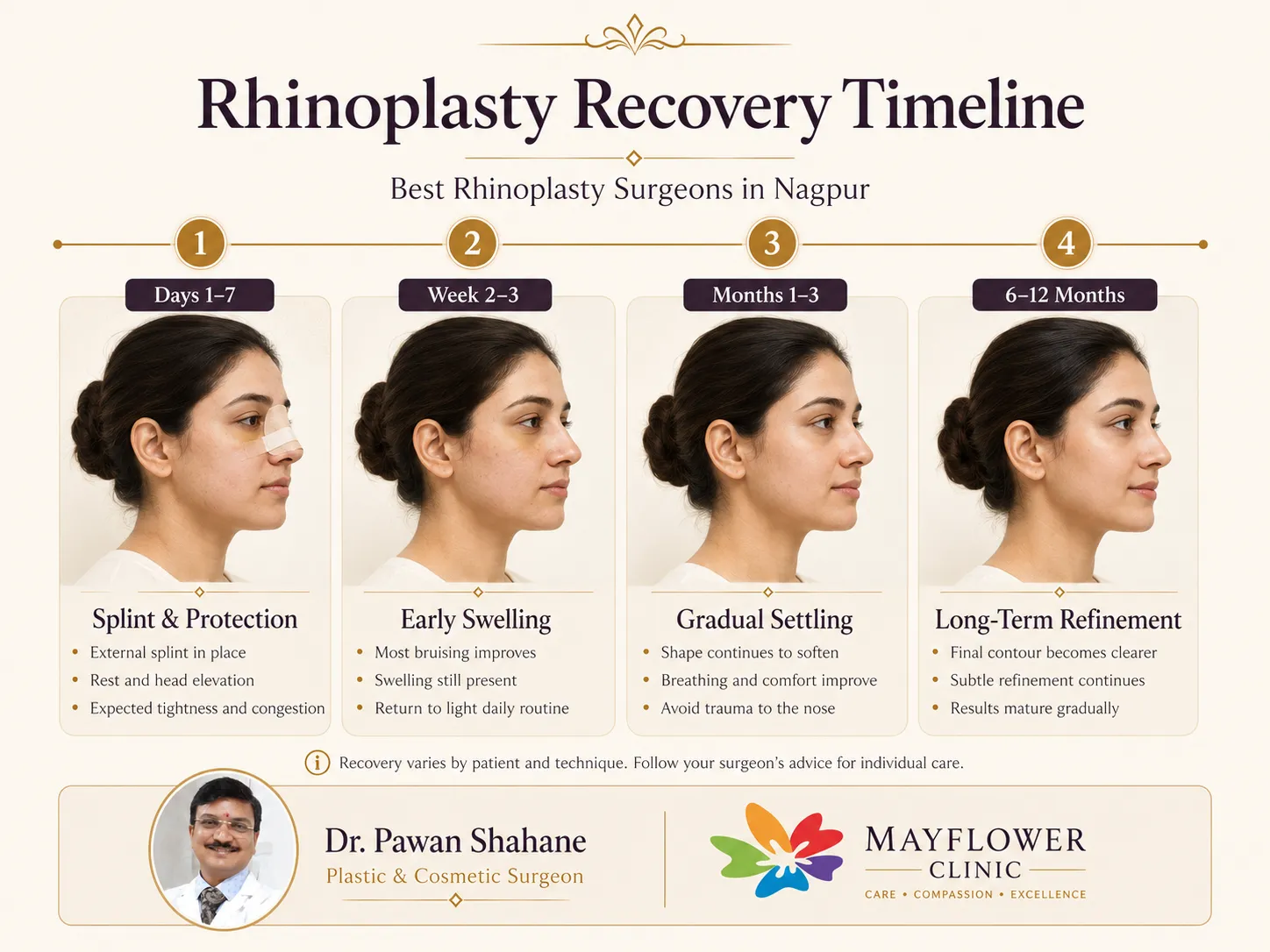
Rhinoplasty recovery timeline showing splint review, return to work and long-term refinement
Recovery has two clocks: visible social recovery and slower internal refinement.
Recovery snapshot

The nose looks presentable before it is fully healed

Many patients plan about 7–14 days away from public-facing work, but the exact schedule depends on bruising, bone work, swelling, occupation and the surgeon’s review. Tip swelling and firmness may remain after the splint is removed.

  • First days: congestion, swelling, facial pressure and mild blood-stained drainage can occur.
  • Around one week: splint and selected sutures may be reviewed or removed.
  • Weeks 2–4: visible bruising usually improves; the nose may still look wide or uneven from swelling.
  • Weeks 4–6: strenuous exercise often remains restricted until clearance.
  • Months 3–12+: bridge and tip definition continue to refine; revision and thick-skin cases may take longer.
Read the complete rhinoplasty recovery timeline
Informed consent

Realistic limits, trade-offs and risks

Cosmetic rhinoplasty can create meaningful improvement, but it cannot guarantee perfect symmetry, a copied celebrity nose or a result unaffected by ageing and healing.

Residual asymmetry or contour difference

Small differences can remain or become more visible as swelling resolves.

Bleeding, infection or delayed healing

Uncommon complications may require medication, drainage, extra care or additional procedures.

Breathing change or valve weakness

Support loss, scar tissue or pre-existing obstruction may affect airflow and occasionally require correction.

Skin and scar limitations

Thin skin may show minor edges; thick skin may limit sharp definition; an open approach leaves a small columellar scar.

Numbness, firmness and prolonged swelling

These may persist for months, particularly around the tip and after extensive or revision surgery.

Dissatisfaction or revision

A secondary procedure may be considered only after adequate healing when a persistent functional or aesthetic concern remains.

Unpredictable healing biology

Scar contraction, bone movement, cartilage memory and individual tissue response can influence the final shape.

Psychological expectation mismatch

Surgery is not a reliable solution for every body-image concern; motivation and expectations are part of candidacy assessment.

Verified Google review excerpts

Patient experiences with rhinoplasty care

Short excerpts are shown from the clinic’s verified Google review inventory. Individual results and experiences vary.

★★★★★
“From the initial consultation to the post-operative care, Dr. Shahane demonstrated exceptional skill, professionalism, and a genuine care for my well-being.”
N
Nishant MenghareGoogle review · Rhinoplasty
★★★★★
“I'm very happy with my rhinoplasty surgery.”
S
Shyama MesharamGoogle review · Rhinoplasty
★★★★★
“I wanted a sharp tip, and I was having a broad nose.”
K
Kajal MeshramGoogle review · Rhinoplasty
Frequently asked questions

Cosmetic nose surgery questions

What is cosmetic nose surgery?
Cosmetic nose surgery, or aesthetic rhinoplasty, reshapes selected parts of the nose to improve proportion with the face. The plan may involve the bridge, tip, nasal width, nostrils, projection or rotation while protecting structural support and breathing.
How is cosmetic rhinoplasty different from functional nasal surgery?
Cosmetic rhinoplasty is led by appearance goals, while functional nasal surgery primarily addresses obstruction or structural breathing problems. Both may be combined when the same patient has aesthetic and airway concerns. Read the broader nasal surgery guide for the umbrella view.
Can cosmetic nose surgery make my nose smaller?
Selected dimensions can often be reduced, but making every part smaller may weaken support or create imbalance. The surgeon evaluates width, height, projection, skin thickness, tip support and facial proportions before recommending reduction.
Can the nasal tip be refined without changing my whole face?
Tip-focused refinement may be possible when the bridge and other proportions are already suitable. Even then, the tip is assessed in relation to the upper lip, bridge, nostrils, chin and smile so that isolated change does not create a new imbalance.
Can wide or flared nostrils be narrowed?
Selected alar-base or nostril-width concerns may be treated with carefully planned excisions or repositioning. Scar placement, nostril shape, tip width and the risk of over-narrowing must be considered.
Can a nasal hump be removed without changing the tip?
Sometimes a localised hump can be treated with limited additional change. In other noses, reducing the bridge alters the apparent relationship with the radix and tip, so modest tip support or middle-vault reconstruction may be needed for a continuous natural profile.
Will cosmetic rhinoplasty preserve my ethnic and personal identity?
Identity preservation should be discussed explicitly. Planning should respond to the patient’s own goals, anatomy and cultural preferences rather than applying a single imported ideal or standard nose.
Can breathing become worse after cosmetic nose surgery?
Breathing can be affected if the septum, middle vault, internal nasal valve or tip support is weakened. A preoperative airway examination and support-preserving plan are therefore important even when the main goal is cosmetic.
Is open or closed rhinoplasty better for cosmetic nose surgery?
Neither approach is universally better. Closed rhinoplasty uses internal incisions, while open rhinoplasty adds a small columellar incision for wider exposure. The choice depends on the required changes, anatomy, revision status and surgeon’s plan.
What is Mayflower Max-Lift Rhinoplasty?
Mayflower Max-Lift Rhinoplasty is a clinic-specific structural and dynamic planning framework for selected noses that need tip support, controlled elevation or improved smile behaviour. It is not a single manoeuvre, not required for every patient and does not promise maximum rotation or faster healing.
Can nose filler replace cosmetic rhinoplasty?
Filler can camouflage selected contour differences by adding volume, but it cannot make a nose smaller, narrow nasal bones or permanently correct major structural concerns. Nasal injections also have uncommon but serious vascular risks and require careful medical assessment.
How long is recovery after cosmetic nose surgery?
Many patients plan roughly 7–14 days for splint removal and early social recovery, while strenuous activity is restricted longer. Swelling—especially at the tip—continues to refine for months.
When can I judge the final cosmetic rhinoplasty result?
The early shape is visible after splint removal, but it is not the final result. A more reliable assessment commonly takes 6–12 months, and thick skin, extensive tip work or revision surgery may take longer.
Can facial or nasal asymmetry be made perfectly equal?
Perfect symmetry is not a realistic surgical promise. Pre-existing facial asymmetry, bone shape, skin thickness, healing and scar behaviour can leave small differences even after meaningful improvement.
What determines the cost of cosmetic nose surgery in Nagpur?
Cost depends on the anatomical problem, primary or revision status, open or closed approach, bone work, graft requirements, functional correction, anaesthesia, facility and follow-up needs. A written estimate should follow examination and a defined surgical plan.
Medical review

Patient-information references

Reviewed 20 July 2026. These references support general education on facial proportion, candidacy, airway assessment, risk, recovery and expectation management. They do not replace individual examination.

American Society of Plastic SurgeonsRhinoplasty overview, candidates, procedure, safety and recovery.
Open source →
AAO-HNS Clinical Practice GuidelineImproving nasal form and function after rhinoplasty; includes airway and expectation considerations.
Open source →
Inter-ethnic facial-dimension reviewSupports avoiding one universal neoclassical ideal across diverse populations.
Open source →
Psychosocial factors systematic reviewSupports careful assessment of motivation, expectations and psychological readiness.
Open source →
Private, surgeon-led consultation

Discuss the change you want—and the features you want to preserve

Bring your concerns, medical history and questions. The consultation should define a proportionate, structurally responsible plan before any decision about cosmetic nose surgery.

Medical Disclaimer: All surgical procedures carry inherent risks, and individual outcomes vary based on anatomy, skin type, previous surgery and healing biology. Surgical results are not guaranteed. Formal in-person consultation with Dr. Pawan Shahane is required before any surgical decision. This page is for general educational purposes only and does not constitute medical advice or a treatment recommendation.