
True localised hump
A distinct prominence arising from bone, cartilage or both, with otherwise proportionate radix and tip relationships.

A dorsal hump is not simply “extra bone.” It may be bony, cartilaginous or mixed, and its appearance changes with radix height, tip projection and facial proportions. Planning therefore focuses on the complete profile line—and on preserving a stable, breathable middle vault.

Ask a simple question about nasal humps, technique choices, breathing protection or recovery. The guide matches your question to the medically reviewed information on this page.
General education only. This guide cannot examine your nose, diagnose a condition or recommend a surgical plan; an in-person consultation is required.
“A hump should be reduced only after deciding where the profile ought to begin at the radix, how it should flow across the middle vault, and how it should meet the tip.”— Dr. Pawan Shahane, M.Ch. Plastic Surgery
A nasal or dorsal hump is a convex prominence along the bridge that is most noticeable in side-profile or three-quarter photographs. It may be sharply localised, broadly distributed or associated with a long, overprojected or drooping nose.
In some people, the prominence is mainly bony. In others, it is cartilaginous or mixed. A low radix—the upper bridge between the eyes—can create a relative or “pseudo” hump, while reduced tip projection can make an otherwise modest dorsum appear larger.
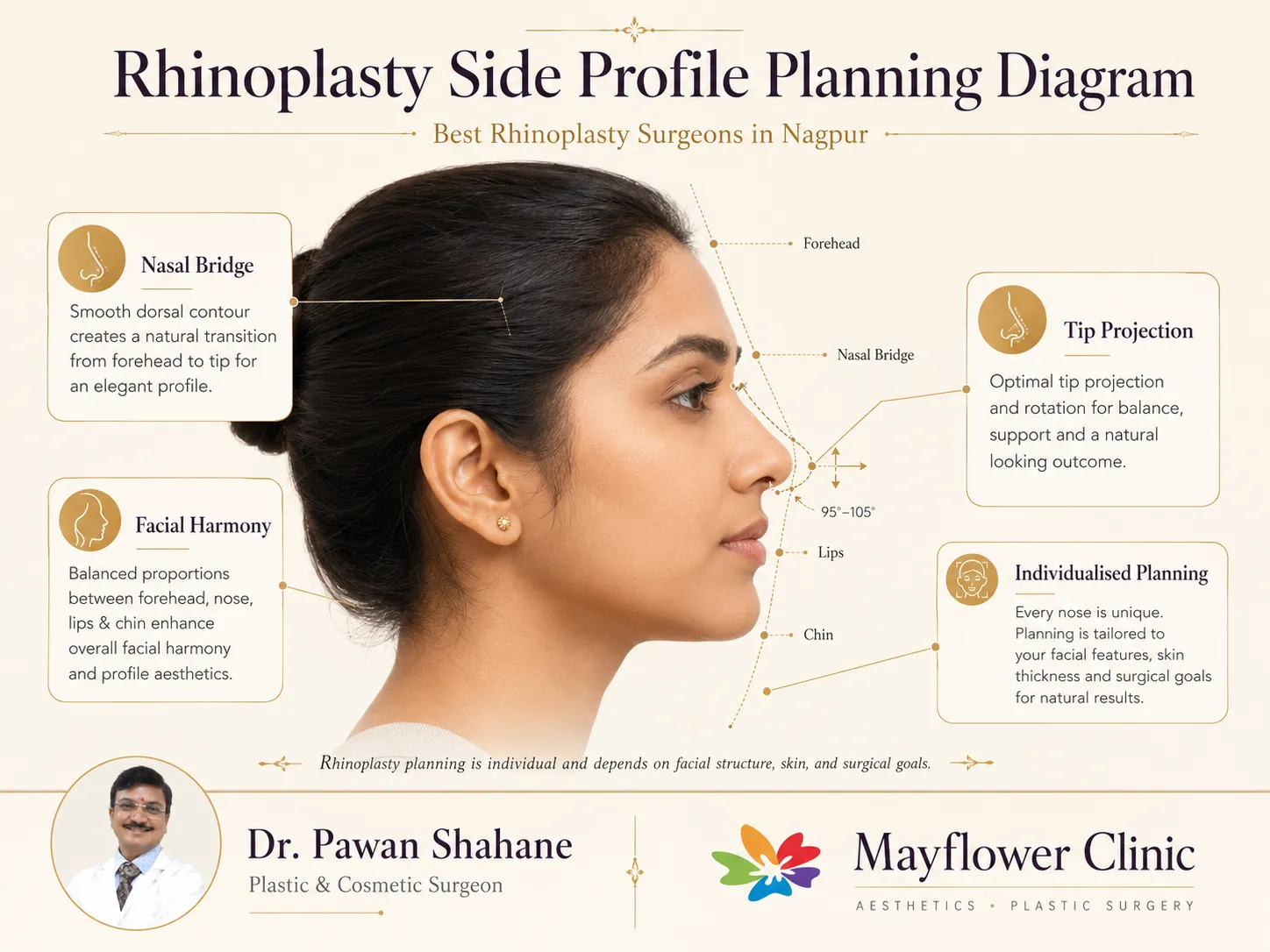
For this reason, nasal hump removal in Nagpur is planned from standardised photographs and direct examination. The target is controlled profile refinement while protecting the dorsal aesthetic lines, middle-vault support and nasal airway.
Two noses can show a similar side-profile bump but need very different plans. The prominence is interpreted in relation to the upper bridge and tip rather than measured in isolation.
A distinct prominence arising from bone, cartilage or both, with otherwise proportionate radix and tip relationships.
The bridge begins too low between the eyes, making the central dorsum look relatively high even when the hump itself is modest.
An under-projected or drooping tip can make the bridge appear dominant. Hump-only reduction may worsen the tip–bridge relationship.
The dorsal prominence occurs with overall nasal length or projection, so a broader structural plan may be needed for proportion.
The bridge transitions from nasal bone in the upper third to cartilage in the middle vault. Many humps cross this junction, which is why a single “shaving” step may not create a controlled, stable line.
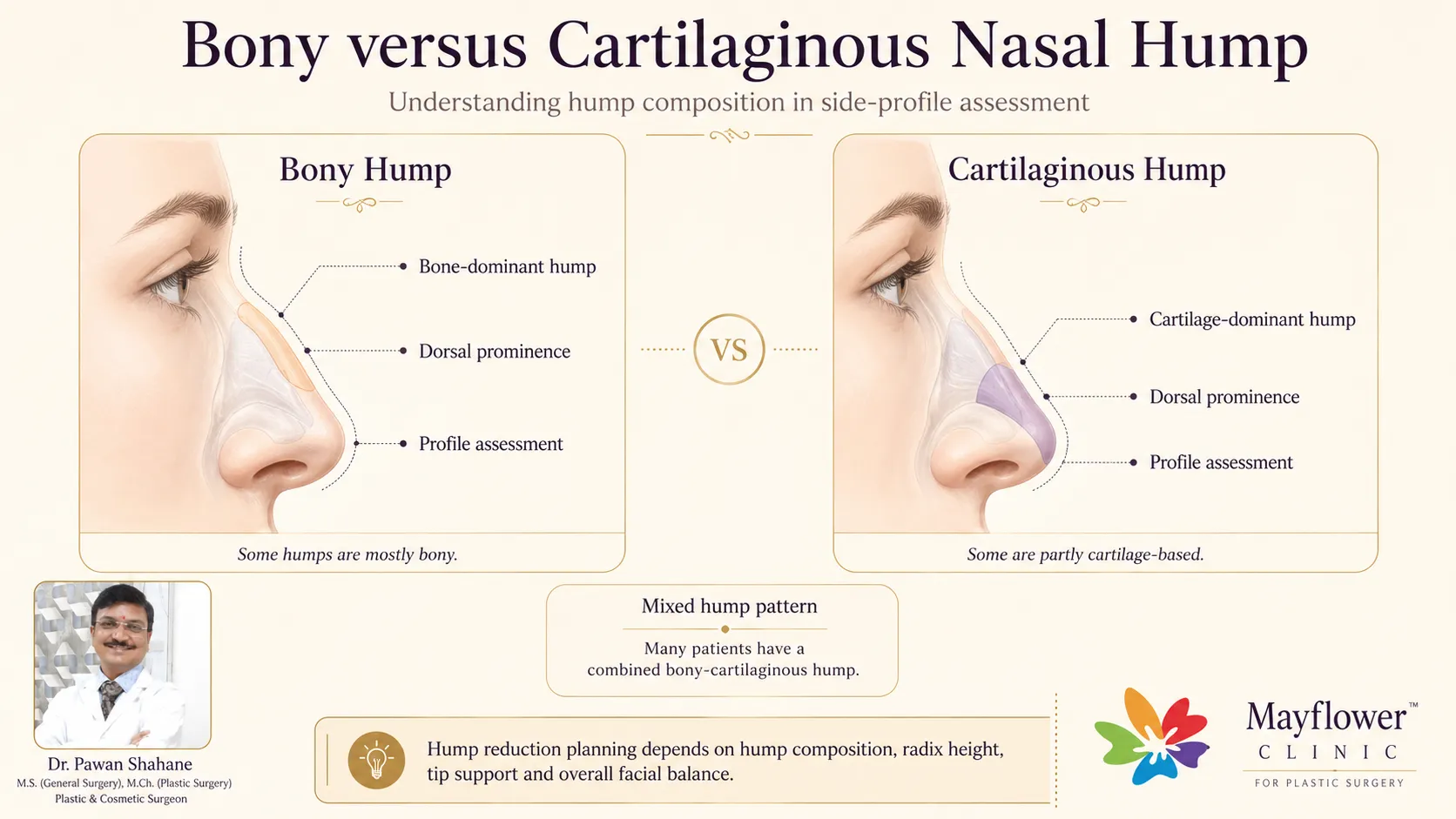
Often located in the upper dorsum. Small irregularities may be refined with rasping; larger reductions can require controlled bone work and open-roof management.
More related to the dorsal septum and upper lateral cartilages. Reduction must preserve or reconstruct the middle vault and internal nasal valve region.
The common combined pattern. Bone and cartilage may need different amounts of refinement to maintain smooth dorsal aesthetic lines.
There is no universally superior method. The approach is selected according to hump height, nasal bone shape, septal anatomy, deviation, skin thickness, airway findings and the degree of profile change requested.
| Approach | Basic concept | Where it may fit | Planning priorities |
|---|---|---|---|
| Controlled rasping | Gradual smoothing of a small, localised bony prominence or surface irregularity. | Selected minor bony humps where the expected roof gap is limited. | Avoid over-rasping, flattening and visible irregularity—especially under thin skin. |
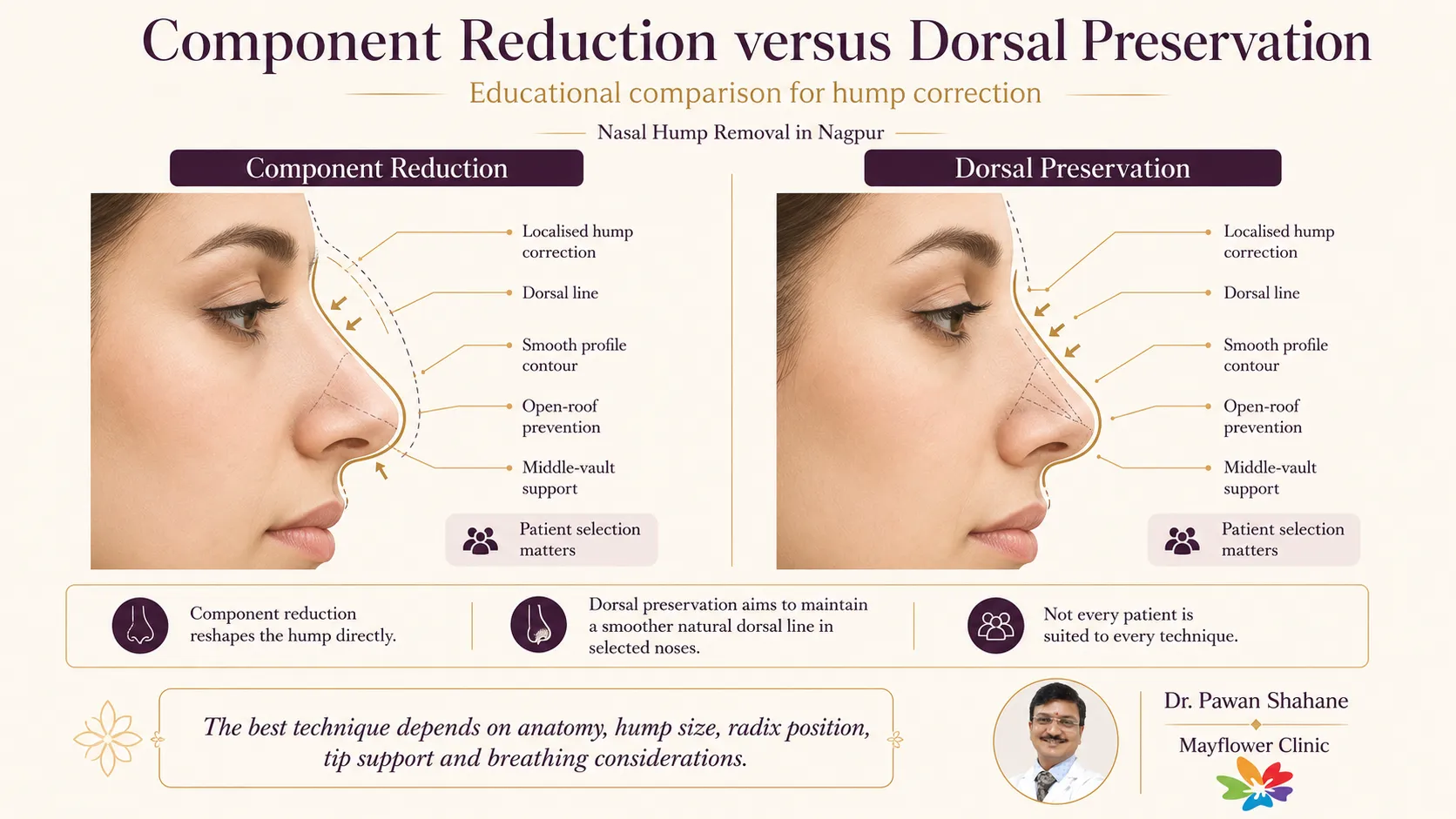
| Component dorsal reduction | Bone, upper lateral cartilages and dorsal septum are treated as separate components. | Mixed humps needing precise control of each anatomical element. | Open-roof closure, smooth profile transition and middle-vault reconstruction when required. |
| Dorsal preservation | The natural dorsal surface is retained and lowered or reshaped using push-down, let-down or related techniques. | Selected primary noses with favourable dorsal anatomy and a suitable hump pattern. | Case selection, control of recurrence or deviation, nasal base anatomy and airway assessment. |
| Hybrid or reconstructive plan | Preservation principles are combined with targeted surface or structural reconstruction. | Complex anatomy, asymmetry, mixed deformity or when a single method does not address every segment. | Stable dorsal lines, support, symmetry, breathing and realistic reduction rather than technique labels. |
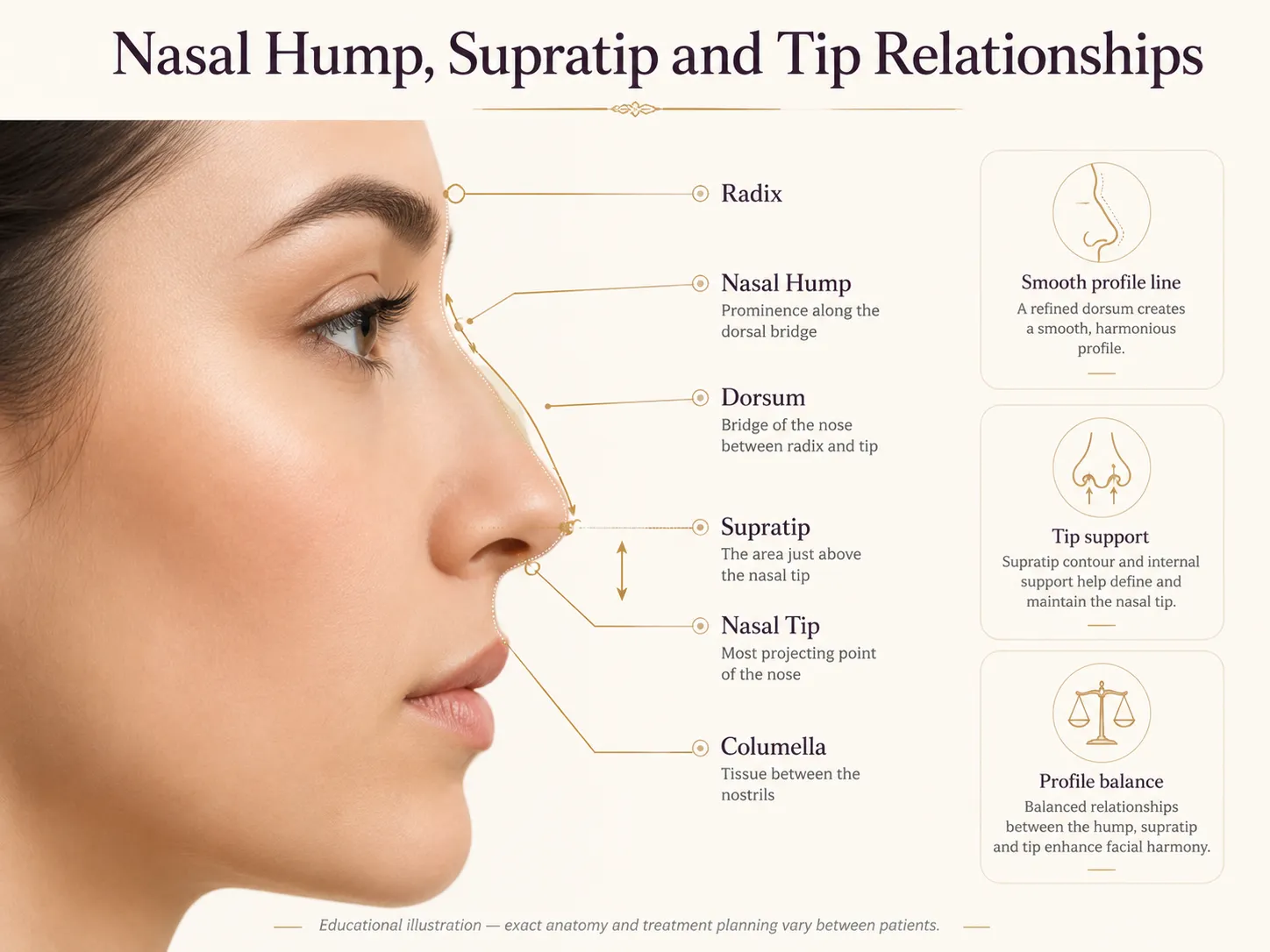
A technically reduced hump can still look unbalanced when the surrounding segments are ignored. A low radix can exaggerate the original hump. A high radix can make the bridge look heavy. A drooping tip can remain dominant after reduction, while excessive lowering can create a scooped or flattened profile.
Defines where the bridge appears to begin and how prominent the central dorsum looks.
Should appear smooth and controlled from the brow region toward the tip from frontal and oblique views.
The junction before the tip should be refined without creating an artificial step, dip or retained prominence.
May be preserved or modestly adjusted so the new bridge line does not make the tip look disproportionately long, droopy or prominent.
A small chin can make the nose appear larger, so the entire profile is discussed without automatically recommending combined surgery.
Traditional removal of a sizeable hump can leave the bony roof open and can separate the upper lateral cartilages from the dorsal septum. These changes must be anticipated rather than treated as an afterthought.
The expected gap after bony reduction is estimated so the nasal bones can be mobilised or refined appropriately.
When indicated, bone cuts allow the side walls to move inward and close the roof while maintaining a balanced frontal contour.
Selected reconstructive methods may help support the upper lateral cartilages, dorsal lines and internal nasal valve region.
Pre-existing obstruction, septal deviation and valve support are examined so cosmetic refinement does not compromise breathing.
We clarify whether the main concern is a profile bump, nasal length, drooping tip, bridge width, asymmetry or breathing.
The bridge, radix, septum, middle vault, tip support and nasal airway are examined together.
The technique follows the anatomy—not the popularity of a surgical label.
Relevant tests, medicines, smoking status, fasting and transport are reviewed before surgery.
The planned dorsal work is performed through an open or closed approach, with structural reconstruction as required.
Follow-up focuses on splint care, bruising, pressure avoidance, sleep position and warning signs.
The bridge may look wider, firmer or uneven during early swelling. Final contour judgement is deferred until tissues have matured.
Most patients plan social downtime for visible swelling and bruising during the early postoperative period. The bridge can remain firm or puffy after the splint is removed, and the tip often settles more slowly than the upper dorsum.
Recovery also depends on whether the procedure involved limited rasping, osteotomies, septal work, middle-vault reconstruction or tip modification. Individual instructions take priority over generic timelines.
Keep the head raised as advised to reduce swelling and accidental pressure.
Do not rest spectacles on the healing nasal bones until cleared.
Bruising and healing skin may pigment; use protection after your surgeon permits.
Avoid contact sports, forceful rubbing and situations where the nose may be struck.
Use prescribed cleaning, saline or medicines exactly as directed.
Contact the clinic for heavy bleeding, worsening one-sided swelling, fever, severe pain or breathing concern.
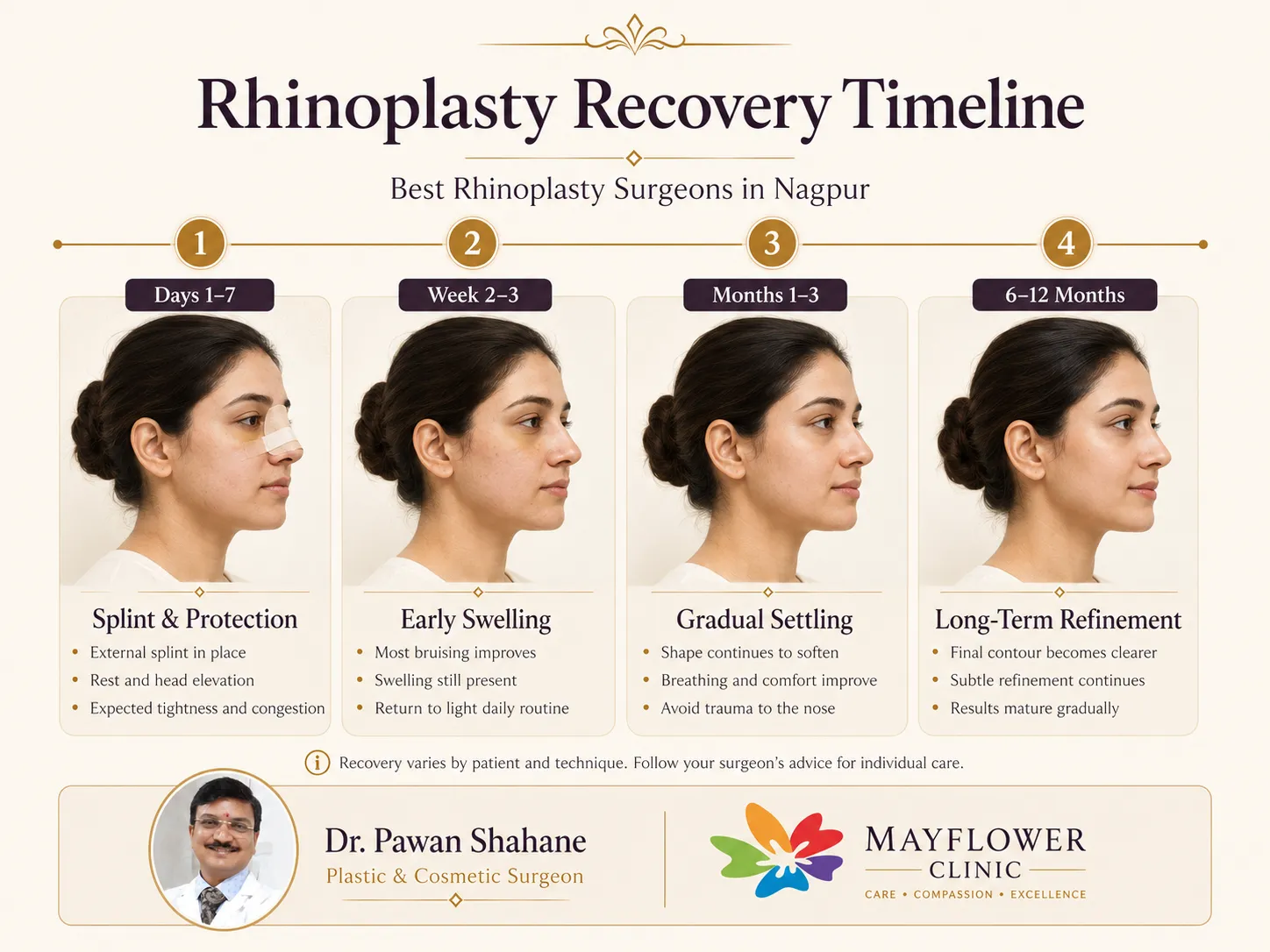
Bruising, congestion and pressure are expected to vary.
Many patients feel comfortable resuming desk work as visible swelling improves.
Exercise and spectacles are resumed only when specifically cleared.
Firmness and subtle asymmetry can continue to improve.
Final timing varies with skin thickness, tip work, osteotomies and healing biology.
These are general educational milestones, not a promise of an individual recovery schedule.
The bridge can be made straighter or less convex while retaining a profile suited to the face and the patient's preference.
Bridge width, nasal bone width and middle-vault width require separate analysis and sometimes additional osteotomy planning.
Faces and nasal bones are naturally asymmetric, and healing can differ between sides.
After hump reduction, a drooping tip, low radix, small chin or wide bridge may become more visually noticeable unless planned beforehand.
Profile shape is individual. Some patients prefer a straight line, while others retain a gentle natural convexity.
Swelling can temporarily hide or exaggerate contour. Fine dorsal definition takes time to mature.
These excerpts reflect individual experiences. They do not predict another patient's surgical result.
“I am very happy with my nose surgery, rhinoplasty. It's been 3 weeks and results are awesome. I wanted a sharp tip, and I was having a broad nose.”
“From the initial consultation to the post-operative care, Dr. Shahane demonstrated exceptional skill, professionalism, and a genuine care for my well-being.”
“He explains everything and how to take care. He support at every stage and do the surgery as planned.”
Review wording is reproduced as an excerpt from the clinic's verified review inventory; spelling and grammar may reflect the original reviewer.
No. A visible profile bump may be a true bony or cartilaginous prominence, but a low radix, limited tip projection or a drooping tip can also make the dorsum look relatively prominent. Profile analysis is needed before deciding what should be reduced.
The upper part of a dorsal hump is usually related to the nasal bones, while the lower part may involve the upper lateral cartilages and dorsal septum. Many humps are mixed, so the surgical plan may treat bone and cartilage differently.
Selected small, localised bony irregularities may be refined with controlled rasping. Whether osteotomies are needed depends on hump size, nasal bone width, the expected open-roof gap and the desired frontal-view contour.
Component reduction treats the bony cap, upper lateral cartilages and dorsal septum as separate elements. It can provide precise control, but the surgeon must also plan how to close the bony roof and reconstruct or preserve the middle vault.
Dorsal-preservation techniques lower or reshape the nasal dorsum while keeping much of the natural bridge surface and dorsal aesthetic lines intact. Push-down and let-down methods are examples, but they are suitable only for selected anatomy.
No. Hump shape, nasal bone anatomy, radix position, deviation, previous surgery, airway findings and the amount of reduction all influence suitability. A reconstructive or hybrid approach may be more appropriate in some noses.
Removing a larger bony hump can leave a gap between the nasal bones, similar to opening the roof of a structure. Controlled osteotomies or other reconstructive steps may be used to close and smooth this area.
The middle vault includes the upper lateral cartilages, dorsal septum and internal nasal valve region. After reduction, spreader grafts, spreader flaps or preservation techniques may be considered to maintain smooth dorsal lines and protect airway support.
It can if support around the internal nasal valve or middle vault is weakened. Functional examination and support-preserving reconstruction are therefore part of planning, especially when a large hump, narrow middle vault or pre-existing obstruction is present.
Not automatically. The apparent length and size of the nose depend on the radix, bridge height, tip projection, tip rotation and chin relationship. Hump reduction alone can sometimes make the tip look relatively more prominent or droopy.
Sometimes no tip surgery is required. In other cases, modest tip support, rotation or projection adjustment may be needed so the new bridge line joins the tip naturally. The aim is proportion, not routine alteration of every nasal part.
Bruising and obvious swelling usually improve during the early weeks, but the bridge and tip continue to settle gradually. Fine profile definition may evolve over several months, and the final assessment is not made during the early swollen phase.
No. Fillers can camouflage selected mild contour differences by adding volume above or below a prominence, but they do not remove bone or cartilage and they make the nose larger rather than smaller. Nasal injections also require careful risk discussion.
A natural result depends on conservative reduction, smooth transition from radix to dorsum to tip, stable middle-vault support, skin thickness and healing. The intended change should be discussed using photographs and realistic profile goals.
Each page explains a different nose concern so you can understand whether the issue is profile height, frontal width, deviation, breathing or a combination.
These sources support the concepts of profile analysis, component dorsal reduction, preservation rhinoplasty and middle-vault reconstruction. They are provided for transparency and professional reading, not as personal medical advice.
Bring the profile photographs or concerns that bother you. Dr. Pawan Shahane will assess whether the prominence is bony, cartilaginous, relative or mixed—and explain the amount of refinement that can be considered without sacrificing support or breathing.

Case of the Month: Grade 3 Gynecomastia…

The Science of Facial Aging: Why Wrinkles,…