
Linear deviation
The bridge and tip are displaced mainly toward one side while the axis remains relatively straight. Bone and septal repositioning may both be relevant.

A crooked nose may involve displaced nasal bones, an asymmetric middle vault, a bent septum, a deviated tip—or all of them together. Correction therefore begins by locating each level of deviation and planning a connected structural repair rather than simply forcing the bridge toward the facial midline.


Ask a simple question about visible deviation, a deviated septum, C- or S-shaped noses, breathing protection, techniques or recovery. The guide matches your question to the medically reviewed information on this page.
General education only. This guide cannot examine your nose, diagnose obstruction or recommend an operation; an in-person consultation is required.
“The nose is not straightened by moving one part toward the centre. The bones, septum, middle vault and tip must be aligned as a connected structure while the airway remains supported.”— Dr. Pawan Shahane, M.Ch. Plastic Surgery
A visibly crooked nose may lean mainly to one side, curve in a C-shape, change direction in an S-shape or show a tip that sits away from the upper bridge. The deviation can be congenital, develop during facial growth, follow injury or remain after previous nasal surgery.
The visible axis is only one part of the assessment. The surgeon also examines whether the nasal septum is bent, whether one nasal bone is longer or more displaced, whether the middle vault is narrow or collapsed, and whether the caudal septum is pulling the tip or nostrils off centre.
Some patients seek correction mainly for appearance. Others also report one-sided blockage, difficulty during exercise, snoring or a sense that one nasal passage works less effectively. The treatment plan must separate cosmetic concerns from functional causes while recognising where they overlap.
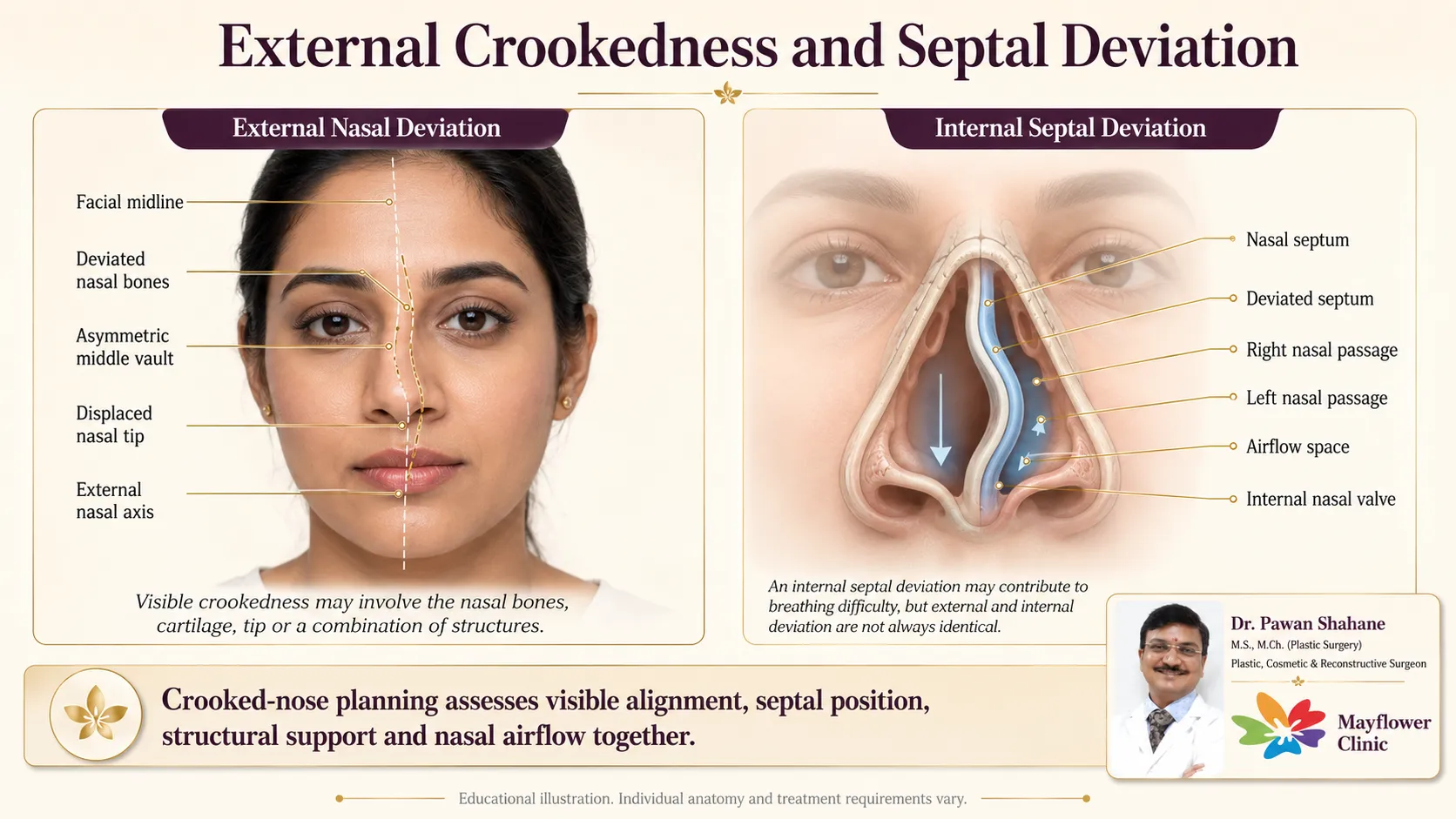
External nasal deviation describes how the nose sits on the face. The bony upper third, cartilaginous middle third and tip may follow different axes. This is assessed from the front, basal and oblique views.
Septal deviation describes bending or displacement of the internal wall that divides the nasal passages. It may affect the dorsal septum, deeper posterior septum, caudal septum or several regions at once.
A visibly crooked bridge or tip may exist even when airflow is reasonably comfortable.
Internal obstruction can be substantial without obvious visible crookedness.
Many structural cases involve both appearance and breathing, requiring an integrated plan.
The pattern is described by tracing the nasal axis from the upper bridge to the tip. This helps identify where the direction changes and which structures are responsible.
The bridge and tip are displaced mainly toward one side while the axis remains relatively straight. Bone and septal repositioning may both be relevant.
The nasal axis bends gradually in one direction. The concave and convex sides may need different release, support and camouflage strategies.
The axis changes direction between the upper bridge, middle vault and tip. These cases often require multi-level structural correction.
The upper bridge may be near the midline while a displaced caudal septum, asymmetric lower lateral cartilage or scar pulls the tip aside.
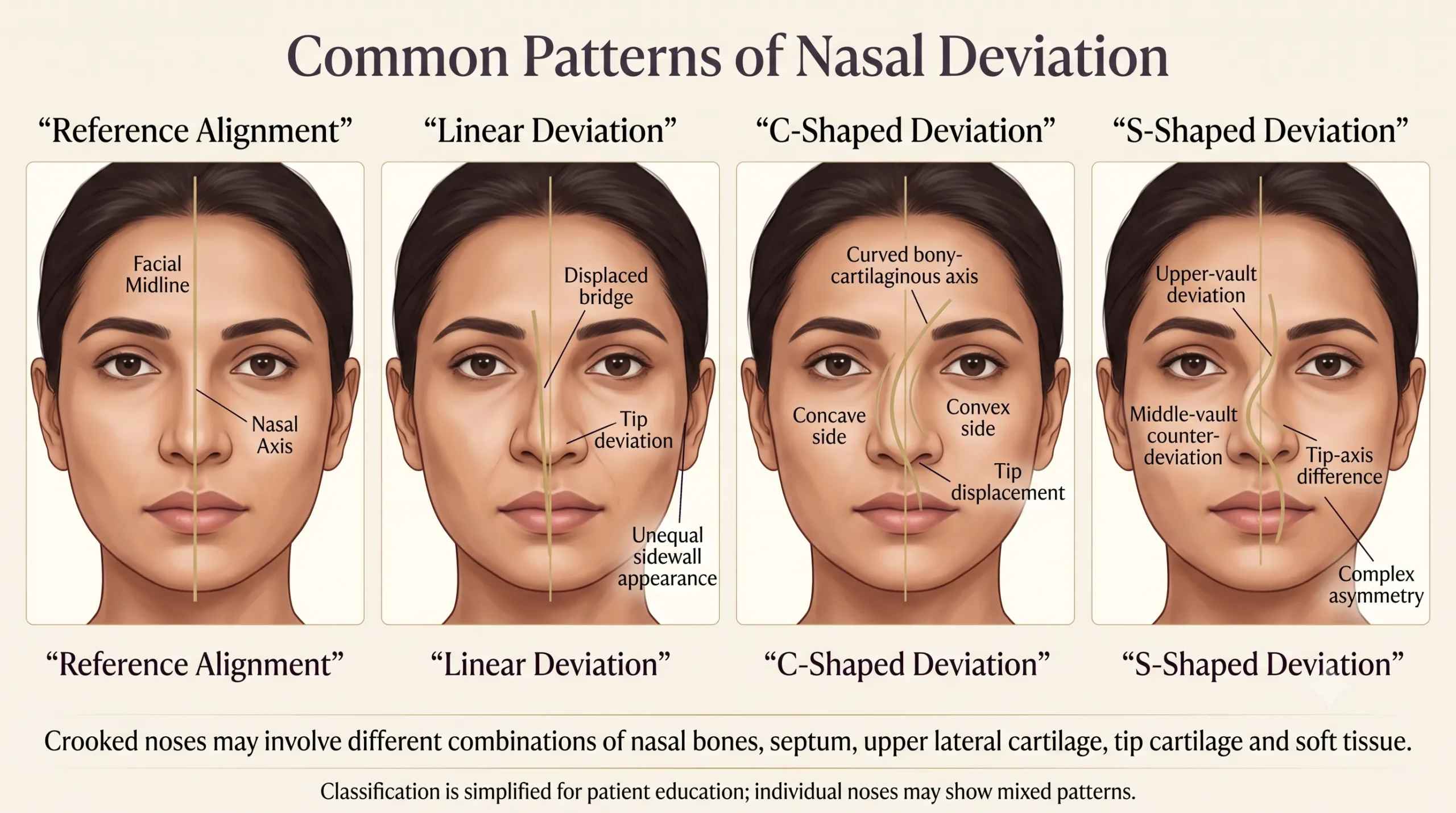
Identifying the dominant cause prevents over-treating one part while leaving another part responsible for the deviation.
One bone may be displaced, longer, steeper or healed in a different position after trauma, producing upper-third deviation.
Upper lateral cartilages and the dorsal septum can create unequal sidewall height, width or internal-valve support.
A high septal deviation can push the bridge off axis and may be difficult to correct without preserving adequate support.
The front-lower septum can displace the columella and tip, contributing to nostril asymmetry and blockage.
Unequal lower lateral cartilages, weak support or scar can make the tip point away from the bridge axis.
Differences in the orbital, cheek, maxillary, dental or chin midline can make a centred nose appear off centre—or vice versa.
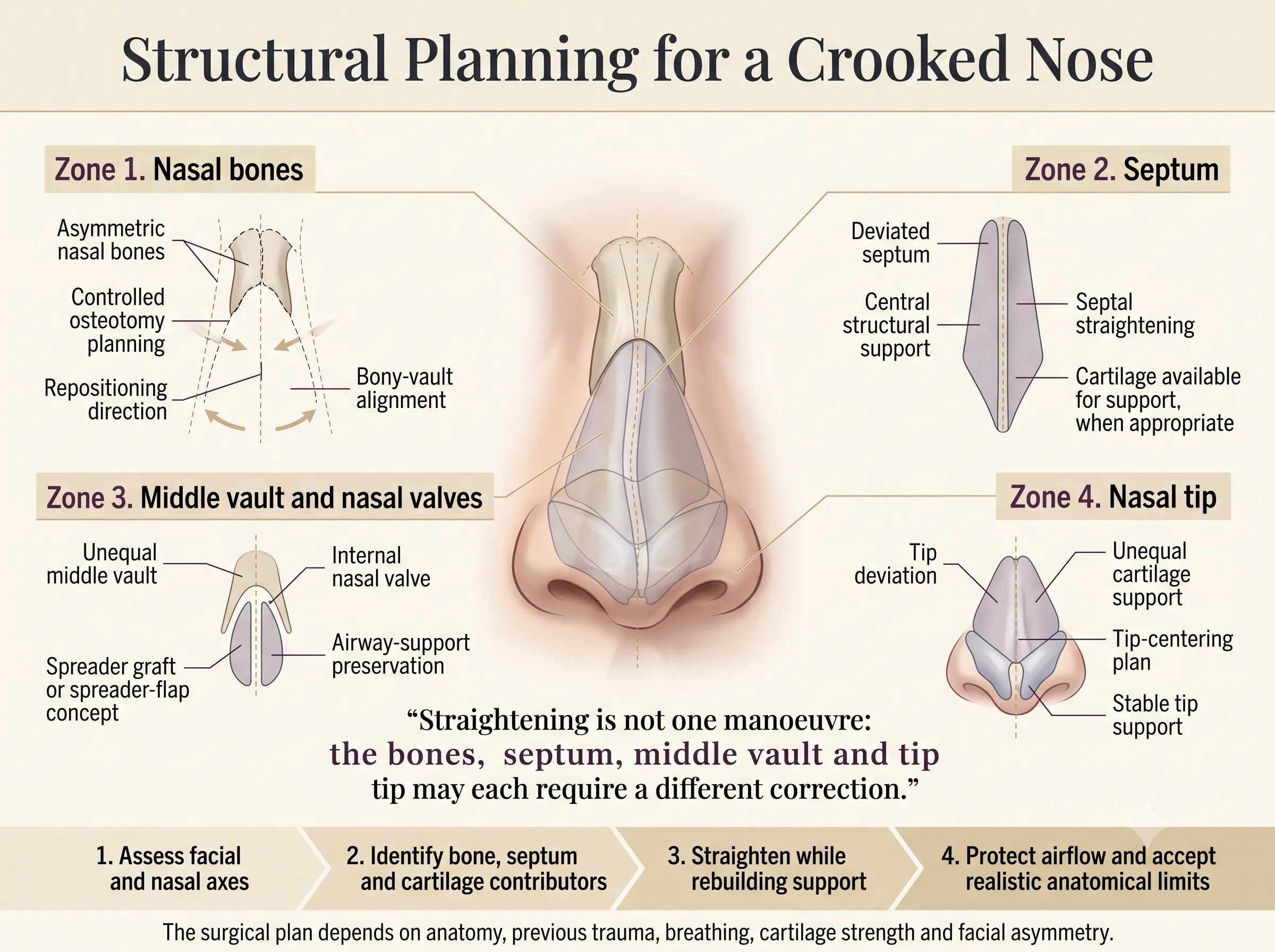
In a complex crooked nose, moving only the nasal bones can leave the middle vault or tip off axis. Straightening therefore follows a sequence based on the patient’s anatomy.
Scar, cartilage tension and septal attachments may need controlled release before the nose can be repositioned.
Enough L-strut support must be preserved or reconstructed while deviated septal segments are corrected.
When indicated, controlled osteotomies allow the upper bridge to move toward a better axis.
Spreader grafts, spreader flaps or asymmetric supports may help align sidewalls and protect the internal nasal valve.
Caudal septal repositioning, sutures or cartilage support may be needed so the tip follows the corrected bridge.
These are planning tools, not a fixed recipe. A patient may need only some of them, and the exact combination is decided after examination.
| Structural level | Common finding | Possible surgical tools | Function to protect |
|---|---|---|---|
| Nasal bones | Upper bridge shifted, twisted or healed after trauma | Precise osteotomies, controlled repositioning, limited contour refinement | Stable bony vault and smooth dorsal sidewalls |
| Dorsal septum | High septal bend contributing to visible deviation | Conservative scoring or resection, grafting, selected reconstruction | Strong dorsal support and adequate internal valve |
| Middle vault | Unequal sidewall height, narrowing or collapse | Spreader grafts, spreader flaps, asymmetric grafting, sutures | Dorsal aesthetic lines and airflow pathway |
| Caudal septum | Columella or tip pulled off centre | Repositioning, fixation, caudal septal extension or replacement support in selected cases | Tip support, nostril balance and nasal base stability |
| Nasal tip | Asymmetric domes, weak support or rotational deviation | Selective sutures, cartilage grafts, support correction | Tip stability without excessive stiffness or pinching |
| Nasal valve / sidewall | Dynamic collapse or narrow internal angle | Spreader support, batten grafts or other valve-preserving reconstruction | Comfortable breathing and sidewall stability |
A crooked nose can have one narrow side and one wider side. Simply making both sides look equal without assessing airflow can create or worsen obstruction.
The location and severity of septal deviation are examined rather than assuming every symptom comes from the visible bend.
The narrow angle between septum and upper lateral cartilage is assessed before middle-vault narrowing or straightening.
Nostril support and dynamic sidewall collapse are checked, especially in post-traumatic or previously operated noses.
Allergy, swelling and turbinate enlargement can influence symptoms and may require separate medical or surgical consideration.
Long-standing deviation is held by bone position, cartilage memory, skin and scar forces. Even after careful correction, small residual asymmetries may remain or become visible as swelling settles.
The forehead, nose, dental centre and chin may not share one exact vertical axis. Planning seeks the most harmonious relationship rather than one arbitrary line.
Previously bent cartilage can exert recurrent forces. Structural support and fixation reduce risk but cannot eliminate biological variability.
Swelling, scar contraction, skin thickness and minor shifts during healing influence the final contour and symmetry.
The plan is built around the pattern of crookedness, breathing findings and realistic priorities—not around a standard operation name.
Discuss when the deviation began, trauma, prior surgery, breathing symptoms and which views cause the greatest concern.
Frontal, oblique, profile, basal and dynamic views are compared with palpation and internal examination.
The surgical plan identifies which structures are responsible and which stable support must be preserved.
Septal, bony, middle-vault and tip work are performed in the sequence required by the individual deformity.
Bruising, congestion and asymmetrical swelling can temporarily make the nose look less straight than the intended result.
Bridge swelling improves earlier, while the tip and sidewalls continue to refine more slowly.
The result is judged after meaningful swelling has resolved and tissues have stabilised—not during the early postoperative phase.
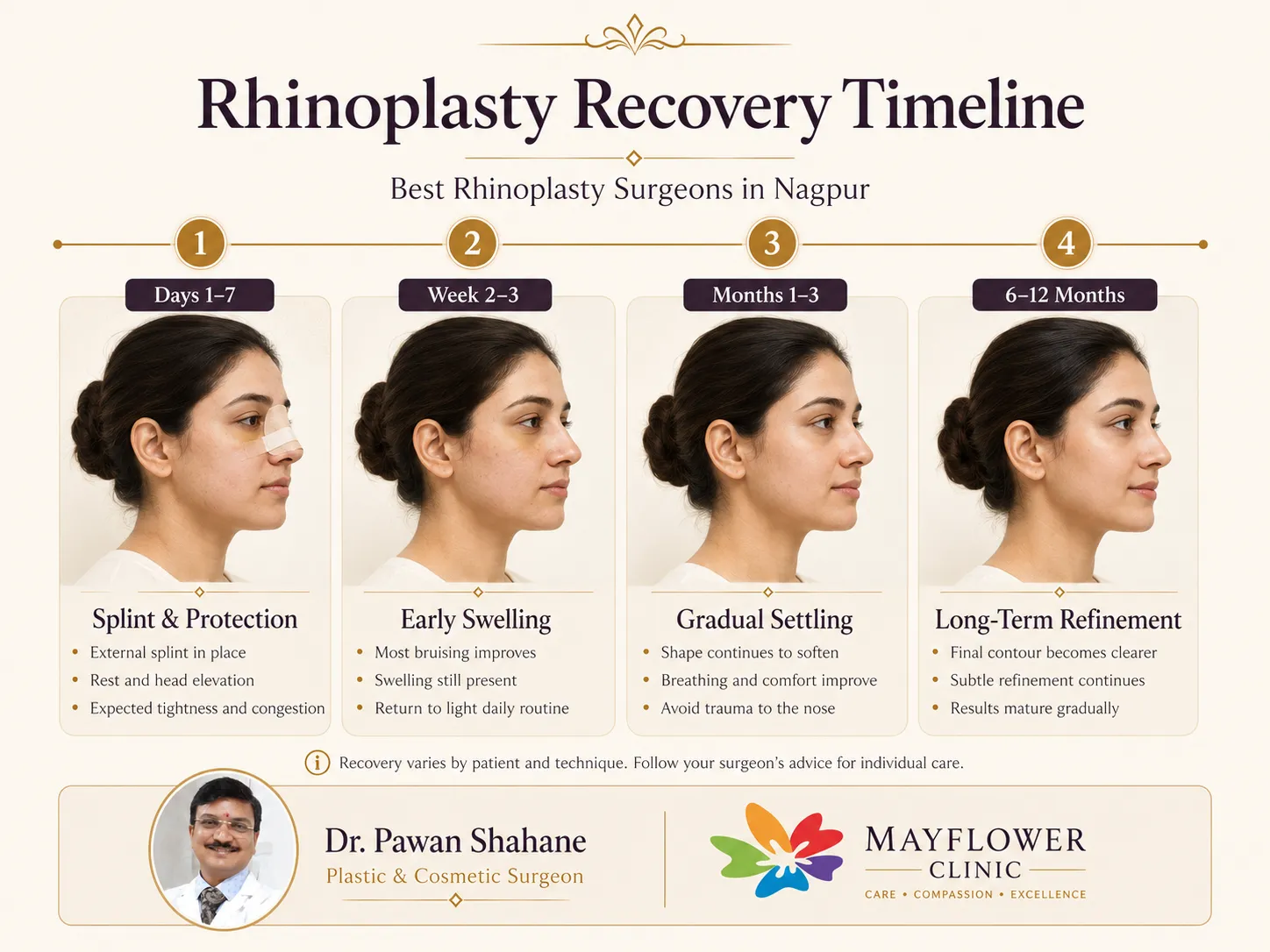
Immediately after surgery, swelling is rarely equal on both sides. One side may look fuller, the tip may appear shifted and the nasal passages may feel congested. These early differences are not a reliable measure of the final alignment.
Splint, congestion, bruising and pressure sensation are common. Follow the prescribed cleaning and medication instructions.
Many patients become socially comfortable as obvious bruising and swelling improve, although the nose remains visibly swollen.
Bridge definition and breathing continue to evolve. Tip stiffness and side-to-side swelling may persist.
Fine alignment, scar behaviour and tip refinement become clearer. Complex or revision noses may settle more slowly.
Use the advised head elevation and avoid sleeping with pressure on the side of the nose during the early period.
Do not press, massage or attempt to manually straighten the nose unless specifically instructed.
Follow instructions about glasses resting on the nasal bones, particularly when osteotomies have been performed.
Walking usually resumes early, but strenuous exercise, bending and contact activities are restarted in stages.
Protect healing skin and bruised areas from strong sun exposure according to postoperative guidance.
Contact the clinic for heavy bleeding, increasing one-sided pain or swelling, fever, breathing distress or any concern after trauma.
This page is prepared for the clinic’s deviated-nose patient result.
Short excerpts from verified reviews in the clinic’s review inventory. Individual experiences do not predict another patient’s result.
“Best experience of rhinoplasty, my sister was having depressed nose and broad nose. We met with Dr. Shahane and discussed the issue. We got best result.”
“He explains everything and how to take care. He support at every stage and do the surgery as planned.”
“From the initial consultation to the post-operative care, Dr. Shahane demonstrated exceptional skill, professionalism, and a genuine care for my well-being.”
Review excerpts are reproduced from the clinic’s verified inventory. Surgical outcomes vary and are not guaranteed.
The answers below are general educational guidance. A physical examination is required to identify the actual pattern and cause of deviation.
No. A crooked nose describes visible external deviation, while a deviated septum is an internal displacement of the wall between the nasal passages. They often occur together, but either can exist without the other.
Yes. Asymmetric nasal bones, uneven middle-vault cartilage, tip displacement, scar tissue or facial asymmetry can create visible crookedness even when the internal septum is not the main problem.
A linear deviation shifts much of the nasal axis toward one side. A C-shaped nose bends mainly in one direction, while an S-shaped deviation changes direction along the bridge and may involve several structural levels.
It may improve breathing when obstruction is related to septal deviation, internal nasal-valve narrowing, sidewall collapse or structural asymmetry. Functional improvement depends on the exact cause and cannot be promised from appearance alone.
Sometimes, but not always. Septoplasty treats the internal septum. If the nasal bones, middle vault, sidewalls or tip are also deviated, external structural rhinoplasty steps may be required.
No. Osteotomies are considered when the bony nasal vault needs repositioning. A deviation centred mainly in cartilage, the caudal septum or the tip may need a different combination of techniques.
Spreader grafts are slim cartilage supports placed along the dorsal septum. In selected crooked noses, they can help align the middle vault, improve dorsal lines and support the internal nasal-valve region.
The caudal septum is the front-lower portion of the septum near the nostrils and columella. Its displacement can pull the nasal tip off centre, create nostril asymmetry and contribute to airflow symptoms.
Often it can be assessed and treated long after the injury. The plan depends on healed bone position, cartilage distortion, septal support, scar tissue, breathing symptoms and any previous procedures.
Perfect geometric symmetry cannot be guaranteed. Long-standing cartilage memory, facial asymmetry, skin thickness, scar behaviour and healing can leave small residual differences even after careful structural correction.
Yes. Differences in the eyes, cheeks, jaw, dental midline or chin can change how the nasal axis is perceived. Planning therefore uses the whole face rather than a single vertical line in isolation.
Neither is universally better. A closed approach may suit selected limited deviations, while an open approach can provide wider exposure for complex septal, middle-vault and tip reconstruction. Anatomy determines the choice.
A splint is commonly used for about a week, and visible bruising or swelling often improves over one to two weeks. Structural settling continues for months, with tip swelling usually taking longer than bridge swelling.
Some degree of recurrent deviation is possible because cartilage can retain memory and tissues heal with variable scar forces. Stable reconstruction, protection from trauma and appropriate follow-up help reduce this risk.
Bring any old photographs, details of previous injury or nasal surgery, and a clear description of breathing symptoms. Dr. Pawan Shahane will assess external alignment, septal support, nasal valves and realistic correction priorities.

Case of the Month: Grade 3 Gynecomastia…

The Science of Facial Aging: Why Wrinkles,…