0712 6692706 / 0712 3551170 / +91 8087471244   |   contact@mayflowerclinic.in

Mayflower Clinic logoCosmetic and Plastic Surgery · Dhantoli, Nagpur
M.Ch. Plastic Surgery · Bridge-specific planning

Nose Bridge Reduction in Nagpur — Narrowing Width Is Different From Lowering Height

A broad bridge on the frontal view, a high bridge on the profile and a dorsal hump are related—but they are not the same diagnosis. Safe planning identifies what is truly wide, what is prominent, what requires bone movement, and what must be supported to protect breathing.

Dr. Pawan Shahane
Reviewed by Dr. Pawan Shahane, M.Ch. Plastic Surgery21+ years surgical practice · Ex-Asst. Prof. GMC Nagpur · IAAPS Member · 9 yrs ThreeBestRated Nagpur
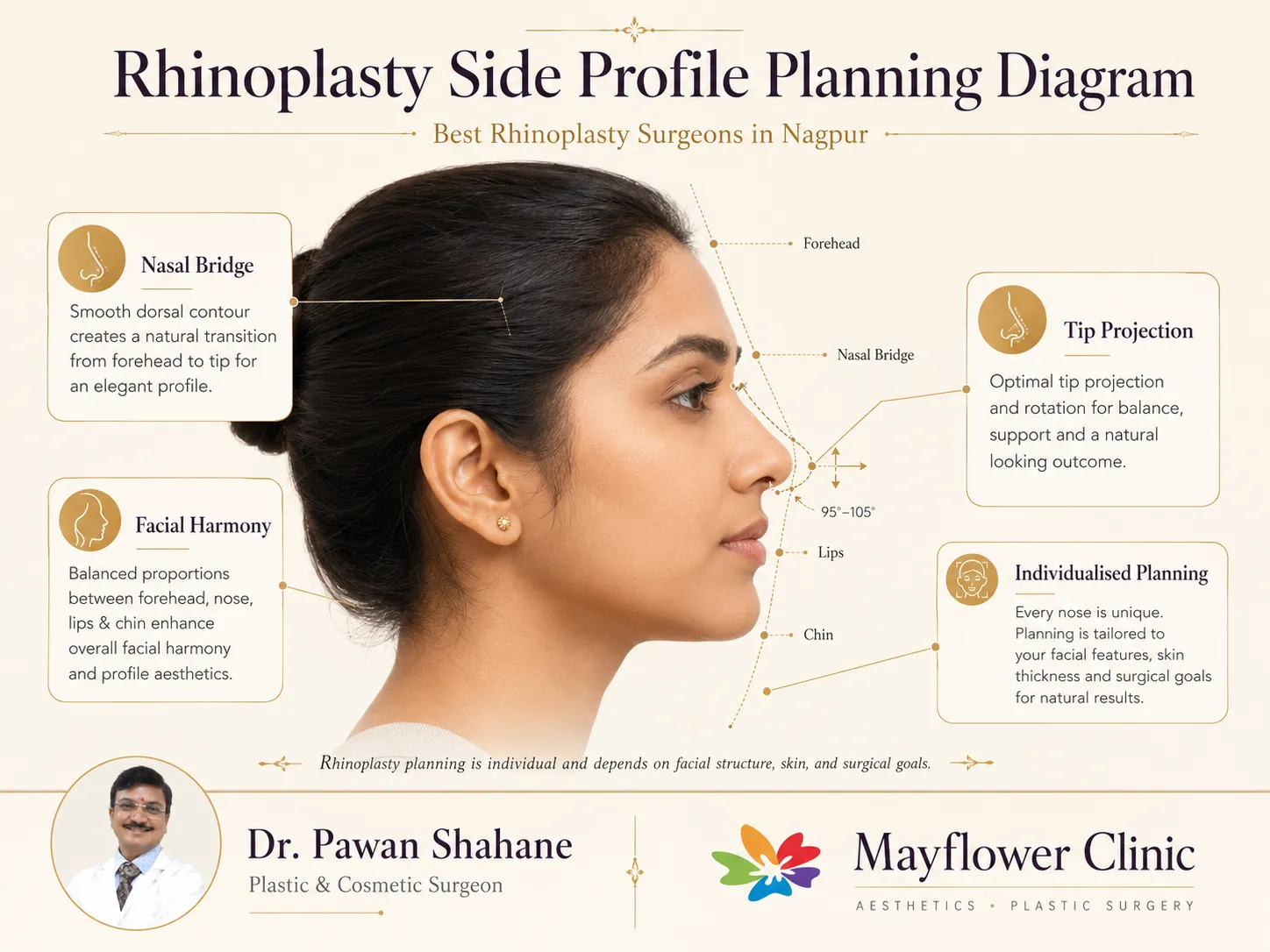
Mayflower Clinic · Nagpur Nose bridge height, profile and facial balance planning diagram
Bridge analysis uses more than one view. Frontal photographs show width and dorsal lines; profile photographs show height and hump prominence; oblique views reveal transitions and asymmetry.
21+ YearsSurgical practice
M.Ch.Plastic Surgery
9 YearsThreeBestRated Nagpur
0 DelegationSurgeon-led planning and surgery
The central principle

A bridge should not be reduced by label alone

“The important question is not simply whether the bridge looks large. We must identify whether the concern comes from height, width, a hump, asymmetry, skin, the middle vault or the relationship with the tip and face.”
— Dr. Pawan Shahane, M.Ch. Plastic Surgery
Quick answer

What does nose bridge reduction actually mean?

Nose bridge reduction may mean narrowing a broad bony vault on the front view, lowering or smoothing a high bridge on the side profile, or correcting a dorsal hump where bone and cartilage meet. The safe plan separates these goals first, because rasping, dorsal reduction, osteotomies and middle-vault support each solve a different structural problem.

Bridge width versus bridge height

Two different dimensions require two different plans

Many patients use “bridge reduction” to describe any prominent upper nose. The first consultation task is to separate frontal-view breadth from profile-view prominence.

QuestionFrontal-view bridge narrowingProfile bridge reduction
Main concernThe upper nose appears broad, the dorsal aesthetic lines are widely spaced, or the bony sidewalls flare laterally.The bridge projects too high, has a hump, or the profile transition from forehead to tip appears overly prominent.
Structure most involvedUsually the bony vault; sometimes the middle vault also contributes.Bone, cartilage or both along the nasal dorsum.
Typical surgical actionControlled bone mobilisation and repositioning with selected osteotomies when true bony width is present.Conservative smoothing, component reduction, dorsal preservation or another tailored reduction method depending on anatomy.
Important risk to avoidOver-narrowing, sidewall asymmetry, step deformity or airway compromise.Over-resection, an open roof, irregular dorsal lines, middle-vault collapse or an unnatural low bridge.
Can occur alone?Yes. A nose can be wide without being high.Yes. A nose can be high or humped without being broad.
Anatomical assessment

What is actually creating the “large bridge” impression?

The nasal bridge is not a single uniform block. The upper third is mainly bony; below it, the middle vault includes the upper lateral cartilages and septal relationship. The skin envelope, tip projection and facial width change how these structures are perceived.

  • Bony vault width: breadth and flare of the paired nasal bones.
  • Dorsal height: how far the bridge projects on profile.
  • Dorsal hump: a local prominence that may contain bone and cartilage.
  • Middle-vault width and support: the transition below the nasal bones and its relationship to the internal nasal valve.
  • Dorsal aesthetic lines: paired contour lines from the brow region toward the tip.
  • Septum and asymmetry: deviation can make one side look wider or higher.
  • Tip and facial proportions: a small or under-projected tip can make the bridge appear more dominant.
Important: lowering a bridge that is only wide can flatten the profile unnecessarily. Narrowing a bridge that is only high can create excessive constriction. The operation should match the measured problem.
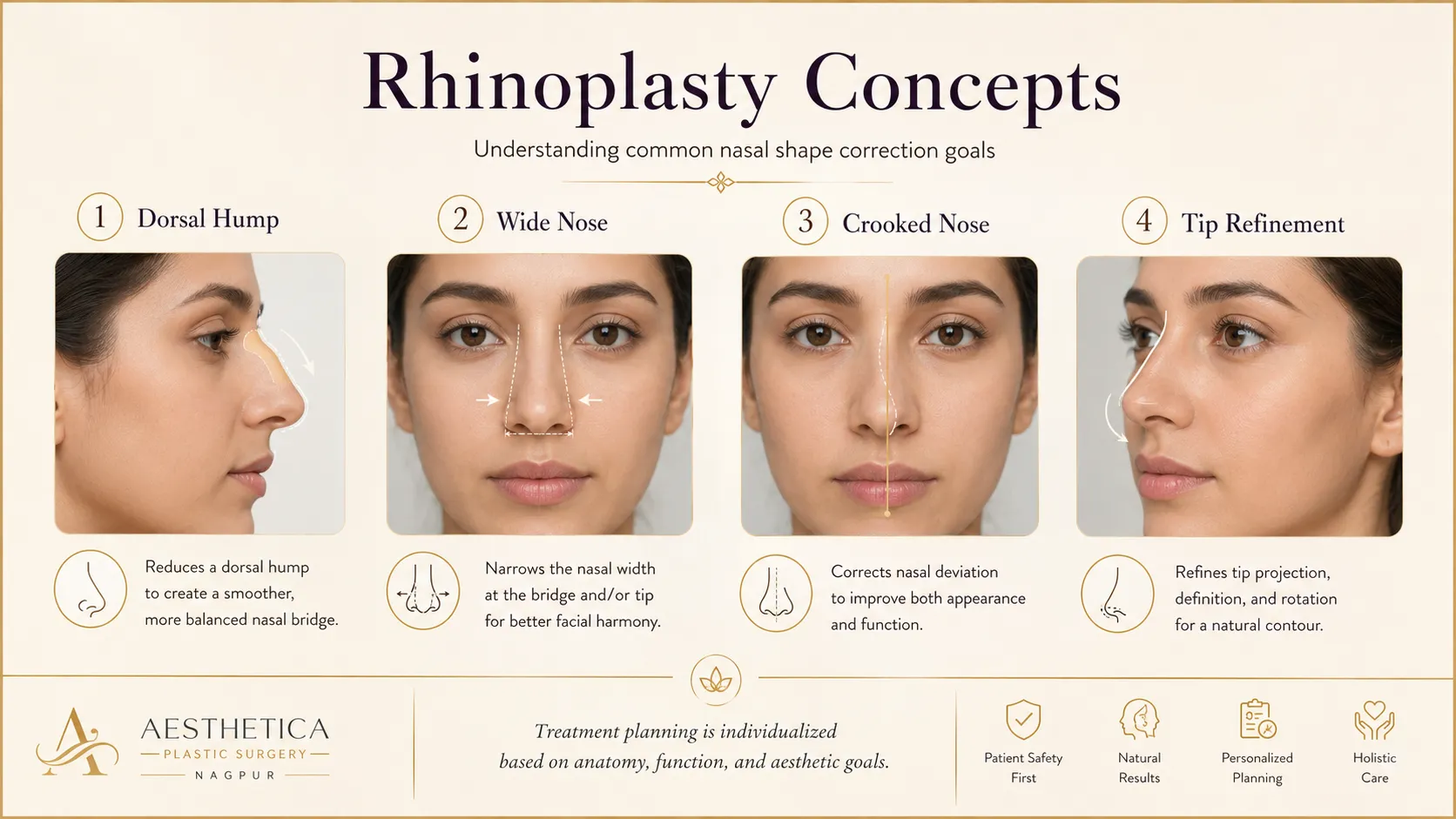
Nasal shape correction concepts showing bridge, hump, width and tip planning
Educational overview: bridge shape must be interpreted together with the tip, deviation and facial balance.
Rasping versus osteotomies

Surface smoothing is not the same as moving broad nasal bones

These techniques solve different structural problems. The choice is not based on which sounds simpler; it is based on what needs to change.

R

Rasping

A rasp can smooth a small bony ridge, fine contour irregularity or selected limited prominence. It removes surface bone gradually but does not reliably bring a broad bony base inward.

Best understood as: contour refinement, not a universal narrowing method.

O

Osteotomies

Osteotomies are controlled bone cuts that allow the nasal bones to be mobilised and repositioned. They may be used to narrow a broad vault, straighten bony deviation or close an open roof after dorsal reduction.

Best understood as: planned bone movement, not simply “breaking the nose.”

S

Support and reconstruction

After selected dorsal or middle-vault changes, support may be preserved or rebuilt using sutures, spreader flaps, spreader grafts or another technique chosen for the individual nose.

Best understood as: protecting smooth lines and nasal airflow.

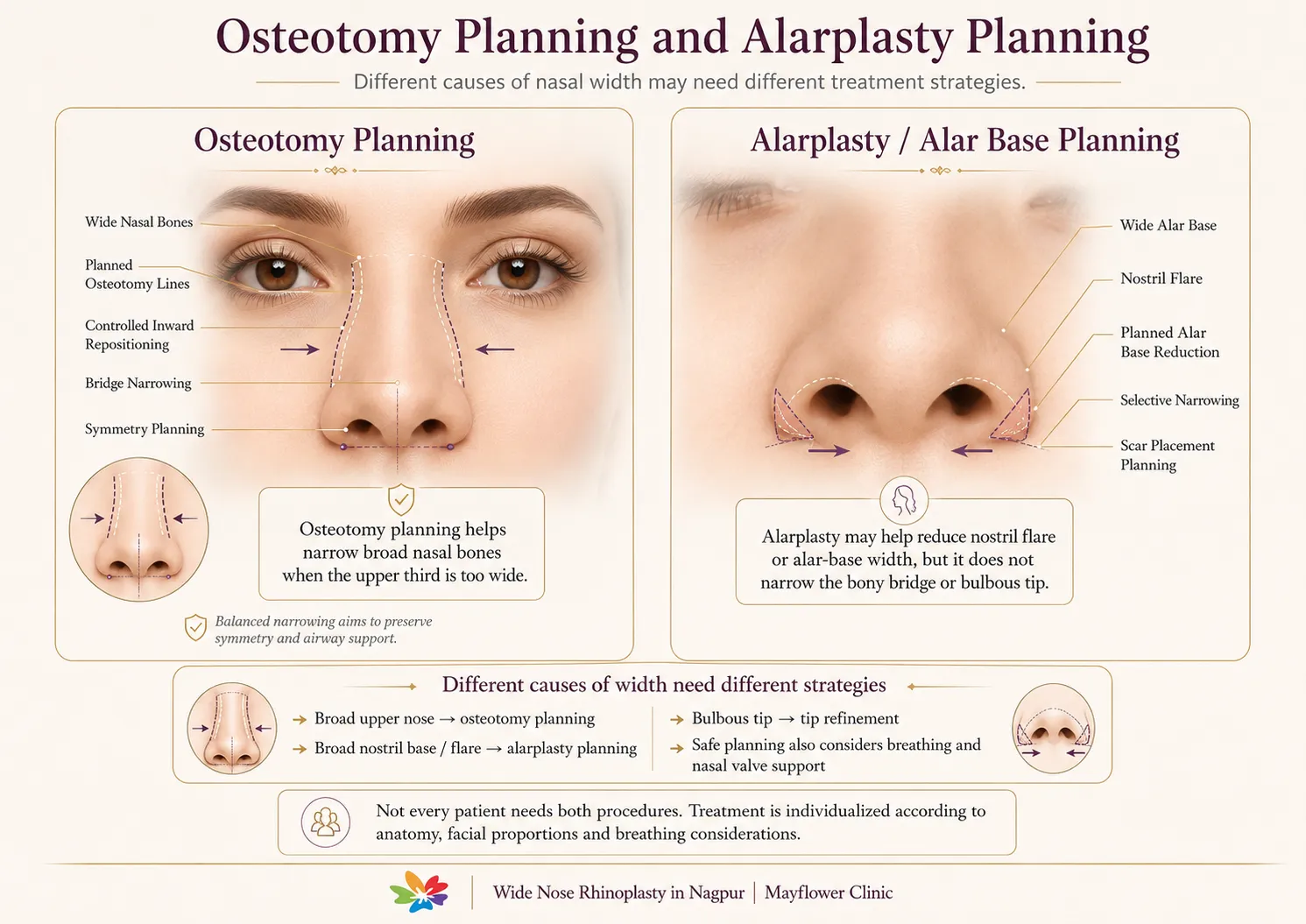
Osteotomy planning diagram for controlled narrowing of broad nasal bones
The osteotomy panel illustrates controlled inward bone movement. Alar-base planning shown in the same image is a separate lower-nose decision and is not automatically part of bridge reduction.
A frequent misconception

“Can you just rasp it down?”

That may be reasonable for a small isolated surface prominence. It is usually not enough when the frontal-view problem is the lateral position of the nasal bones. Aggressive rasping can also create an open roof or irregularity, making additional stabilisation necessary.

The safest answer comes after examining the bony base, dorsal height, skin, asymmetry and the intended profile.

Read the rhinoplasty surgical-planning guide →
Profile reduction: changes the bridge height or hump seen from the side.
Frontal narrowing: changes the bony width and dorsal lines seen from the front.
Dorsal hump overlap

Why hump reduction and bridge narrowing sometimes occur together

Removing a prominent dorsal segment can leave the bony roof open or change the relationship between the nasal bones and middle vault. That is why profile reduction may require additional repositioning and support.

1

Small isolated irregularity

Conservative rasping or smoothing may be sufficient when the bony vault is otherwise proportionate and stable.

2

Broad bony vault without major hump

Frontal narrowing may require osteotomies with limited intentional lowering of the bridge.

3

High or humped bridge without excess width

Profile reduction is planned carefully; major narrowing may not be necessary.

4

Hump plus broad vault

Dorsal reduction and controlled bone repositioning may be combined to restore a closed, smooth bridge.

5

Asymmetry or previous trauma

One side may require a different manoeuvre from the other; straightening can be more important than simple narrowing.

6

Weak middle vault or breathing symptoms

Support and airway correction become part of the plan rather than an afterthought.

Middle-vault support

A narrower bridge must still look continuous and breathe well

The middle vault lies below the nasal bones and helps form the internal nasal valve. Reduction that removes too much support can lead to an inverted-V shadow, pinching, irregular dorsal lines or new obstruction.

What may need protection

  • Keystone relationship between bone, septum and upper lateral cartilage.
  • Internal nasal valve angle and sidewall stability.
  • Straight, smooth dorsal aesthetic lines.
  • Adequate septal support.

How support may be managed

  • Preservation of existing upper lateral cartilage where possible.
  • Spreader flaps or spreader grafts in selected anatomy.
  • Suture techniques and asymmetry correction.
  • Septal correction when deviation affects support or airflow.
Realistic narrowing

The goal is proportional refinement—not the narrowest possible bridge

A bridge must remain stable, symmetric and compatible with the face and airway. More reduction is not automatically a better result.

Bone and facial width

A broad face may look balanced with a somewhat broader bridge. Bone thickness and the starting bony base limit safe inward movement.

Skin and soft tissue

Thicker skin can soften definition and prolong swelling; very thin skin may reveal small contour irregularities.

Pre-existing asymmetry

Perfect mirror symmetry cannot be promised. The two nasal bones, maxillary attachments and septum may differ before surgery.

Tip and alar base

A narrow bridge will not automatically refine a broad tip or nostril base. Those are separate anatomical decisions.

Airway dimensions

Excessive narrowing may compromise the internal nasal valve. Functional safety can limit the aesthetic change.

Healing variability

Swelling, scar behaviour and bone healing influence the final contour. Refinement evolves gradually.

Patient journey

From bridge diagnosis to long-term refinement

ConsultationFrontal, oblique, profile and basal assessment; breathing history and goals.
PlanningDefine width, height, hump, asymmetry and support requirements.
Procedure dayAnaesthesia and surgical approach follow the complete rhinoplasty plan.
Week 1Splint and wound review as advised; bruising and swelling are expected.
Weeks 2–6Gradual social recovery; protect the nose from pressure, impact and heavy activity.
3–12 monthsBridge swelling, sidewall definition and fine contour continue settling.
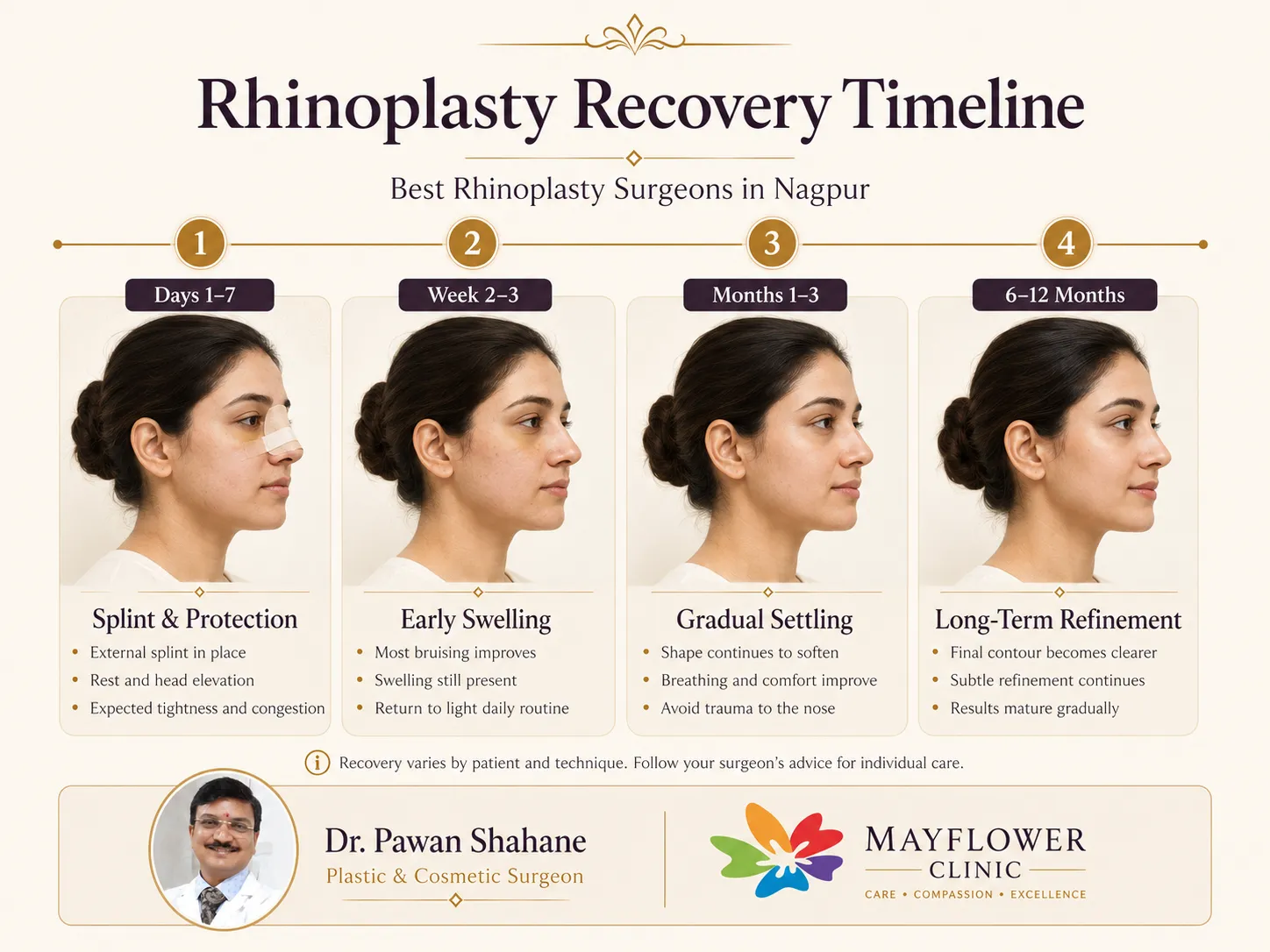
Rhinoplasty recovery timeline showing splint, swelling and gradual refinement
Recovery varies with the extent of bone work, skin, bruising, combined septal work and individual healing.
Preparation and aftercare

What to prepare before and protect after bridge surgery

1

Before surgery

Share medical conditions, medicines, supplements, smoking or nicotine use, prior nasal trauma, allergies and previous nasal procedures. Complete tests and anaesthesia review as advised.

2

First week

Keep the head elevated, protect the splint, follow cleaning and medication instructions, avoid nose pressure and attend the scheduled review.

3

Protect the bones

Avoid accidental impact, vigorous exercise and spectacles pressure for the period advised. Do not massage or press the bridge unless specifically instructed.

4

Manage swelling

Bruising and swelling are expected. Use only the cold-compress method and medicines advised by the surgical team.

5

Sun protection

Protect bruised or healing skin from strong sun and use sunscreen after the surgeon permits it, as pigmentation can persist in some skin types.

!

Report red flags

Contact the clinic for increasing pain, fever, persistent heavy bleeding, rapidly worsening swelling, skin colour change, visual symptoms or breathing difficulty.

Verified patient feedback

Rhinoplasty experiences shared on Google

These excerpts describe individual rhinoplasty experiences and do not guarantee the same outcome for another patient.

★★★★★ GOOGLE REVIEW
“I am very happy with my nose surgery, rhinoplasty. It's been 3 weeks and results are awesome. I wanted a sharp tip, and I was having a broad nose.”
Kajal Meshram · Rhinoplasty patient
★★★★★ GOOGLE REVIEW
“From the initial consultation to the post-operative care, Dr. Shahane demonstrated exceptional skill, professionalism, and a genuine care for my well-being.”
Nishant Menghare · Rhinoplasty patient
★★★★★ GOOGLE REVIEW
“He explains everything and how to take care. He support at every stage and do the surgery as planned.”
Kunal Thakur · Family review of rhinoplasty care
Frequently asked questions

Nose bridge reduction FAQs

Is nose bridge width the same as nose bridge height?

No. Width is judged mainly from the frontal and oblique views and reflects the breadth of the bony or middle nasal vault. Height is judged mainly from the profile and relates to dorsal projection or a hump. A nose may be wide without being high, high without being wide, or have both concerns.

Can rasping make a wide nose bridge narrower?

Rasping can smooth a small bony prominence or contour irregularity. It does not reliably move a broad bony vault inward. When true bony width is the concern, controlled osteotomies may be required after examination.

When are osteotomies used in nose bridge reduction?

Osteotomies are considered when the nasal bones need to be mobilised, narrowed, straightened or repositioned, or when an open roof created by dorsal reduction must be closed. Their pattern is selected according to bone width, shape, asymmetry and the planned change.

Is dorsal hump removal the same as nose bridge reduction?

Not exactly. Dorsal hump reduction lowers or smooths the profile. Bridge narrowing changes frontal-view width. The two may overlap, because reducing a hump can alter the dorsal roof and may require the nasal bones to be repositioned.

Can the bridge be narrowed without lowering it?

In selected noses, frontal-view narrowing can be planned with little or no intentional lowering of the profile. The feasibility depends on the bony vault, dorsal contour, skin, symmetry and how the middle vault will be supported.

Can the bridge be lowered without narrowing the nose?

A limited profile reduction may sometimes be performed without major narrowing. Larger dorsal reduction can create an open roof or change the relationship of the nasal sidewalls, so additional bone positioning may become necessary.

Why is middle-vault support important after bridge reduction?

The middle vault contributes to smooth dorsal lines and the internal nasal valve. After selected dorsal or bridge changes, support may be preserved or reconstructed with sutures, spreader flaps, spreader grafts or another tailored technique to reduce the risk of collapse or breathing difficulty.

Can nose bridge reduction affect breathing?

Yes. Excessive narrowing or loss of support can reduce the internal nasal valve area. Preoperative assessment should include the septum, nasal valves, sidewalls, prior trauma and current breathing symptoms so cosmetic changes are planned with airway protection.

Will nose bridge reduction make my whole nose look smaller?

It may make the upper nose appear narrower or less prominent, but the overall impression also depends on tip width, projection, alar base, facial width and skin thickness. Bridge surgery alone cannot correct every cause of a large-looking nose.

How much can a broad bridge realistically be narrowed?

The safe degree of narrowing is individual. Bone thickness, facial proportions, asymmetry, skin envelope, airway dimensions and structural support all limit how far the bridge should be moved. A balanced improvement is safer than pursuing an extremely narrow target.

How long does swelling last after nose bridge reduction?

A splint is commonly used during the early healing period. Bruising and obvious swelling usually improve over the first one to two weeks, while bridge definition, sidewall swelling and the final contour continue settling over several months.

Can nose bridge reduction results be guaranteed?

No. Surgical outcomes vary with anatomy, healing, scar behaviour, skin thickness and the extent of correction. Consultation should cover the intended change, limitations, asymmetry, risks and the possibility that further treatment may occasionally be considered.

Explore Mayflower Clinic

Clinic and surgeon information

Book Your Nose Bridge Assessment in Nagpur

Bring the frontal and profile concerns you want to discuss, along with details of any blockage, injury or previous nasal surgery. The consultation will distinguish bridge width from height and explain whether smoothing, dorsal reduction, osteotomies, support or no bridge surgery is appropriate.

Medical Disclaimer: All surgical procedures carry inherent risks, and individual outcomes vary based on anatomy, skin type, and healing biology. Surgical results are not guaranteed. Formal in-person consultation with Dr. Pawan Shahane is required before any surgical decision. This page is for general educational purposes only and does not constitute medical advice or a treatment recommendation.
Medical references used for this educational page
  1. Hontanilla B, et al. A Predictable Approach for Osteotomy in Rhinoplasty.
  2. Locketz GD, et al. Osteotomies—When, Why, and How?
  3. Samaha M, et al. Spreader graft placement in endonasal rhinoplasty.
  4. Rohrich RJ, et al. Component dorsal hump reduction and upper lateral cartilage integrity.
  5. Zeid NG, et al. Spreader grafts versus flaps for middle-vault reconstruction.