
What creates the visible contour?
Fat, skin, fibrous attachments, muscle, bone, posture and scars are separated before assuming that volume alone is the answer.

Fat transfer is not simply “moving fat.” It combines donor-area liposuction with careful volume placement elsewhere, so the result depends on two different anatomical sites, variable graft survival and a recovery plan that protects both.


Choose a common question. The answer appears only in your browser and points you to the relevant section.
Start here: fat transfer is body contouring, not weight-loss treatment. It removes selected subcutaneous fat from one area and uses part of it to add carefully planned volume elsewhere.
“The donor area should not be over-reduced, the recipient area should not be overfilled, and the plan must respect tissue capacity, blood supply, symmetry, future weight change and the specific safety rules of the body region.”Dr. Pawan Shahane, M.Ch. Plastic Surgery · Founder, Mayflower Clinic, Nagpur
Autologous fat transfer uses tissue taken from the same patient. In body contouring, selected fat is harvested from a donor area by liposuction, prepared, and placed into a recipient area where additional soft-tissue volume may improve proportion or correct a depression.
The donor and recipient areas must be assessed independently. The abdomen may appear to offer convenient fat, but loose skin, visceral fullness, previous scars or muscle separation can change the donor plan. Likewise, a recipient area may lack volume but still have limited tissue capacity or a safety boundary that restricts how much can be added.
Common goals include softening a contour indentation, improving a hip transition, adding selected volume after tissue loss, or combining donor-area refinement with a separate face, breast or buttock fat-transfer plan. The operation is personally planned and performed by Dr. Pawan Shahane after examination.
The procedure should solve a defined proportion problem without creating a new donor-site defect or exceeding recipient-site limits.
Fat, skin, fibrous attachments, muscle, bone, posture and scars are separated before assuming that volume alone is the answer.
A harvest area should tolerate liposuction and still blend smoothly with surrounding untreated tissues.
Skin tension, tissue quality, blood supply, scars and the exact anatomical plane determine safe capacity.
Some grafted fat will be reabsorbed. Overfilling to chase an exact promised final size can create risk or distortion.
Compression may be required over donor zones while direct pressure may need to be limited over the recipient site.
Limited donor fat, scarred tissues or a larger requested change may favour a staged plan rather than one extensive operation.
The correct plan is not based on one circled bulge or one requested injection point.
| Area / pathway | What may be considered | Key limitation | Dedicated page |
|---|---|---|---|
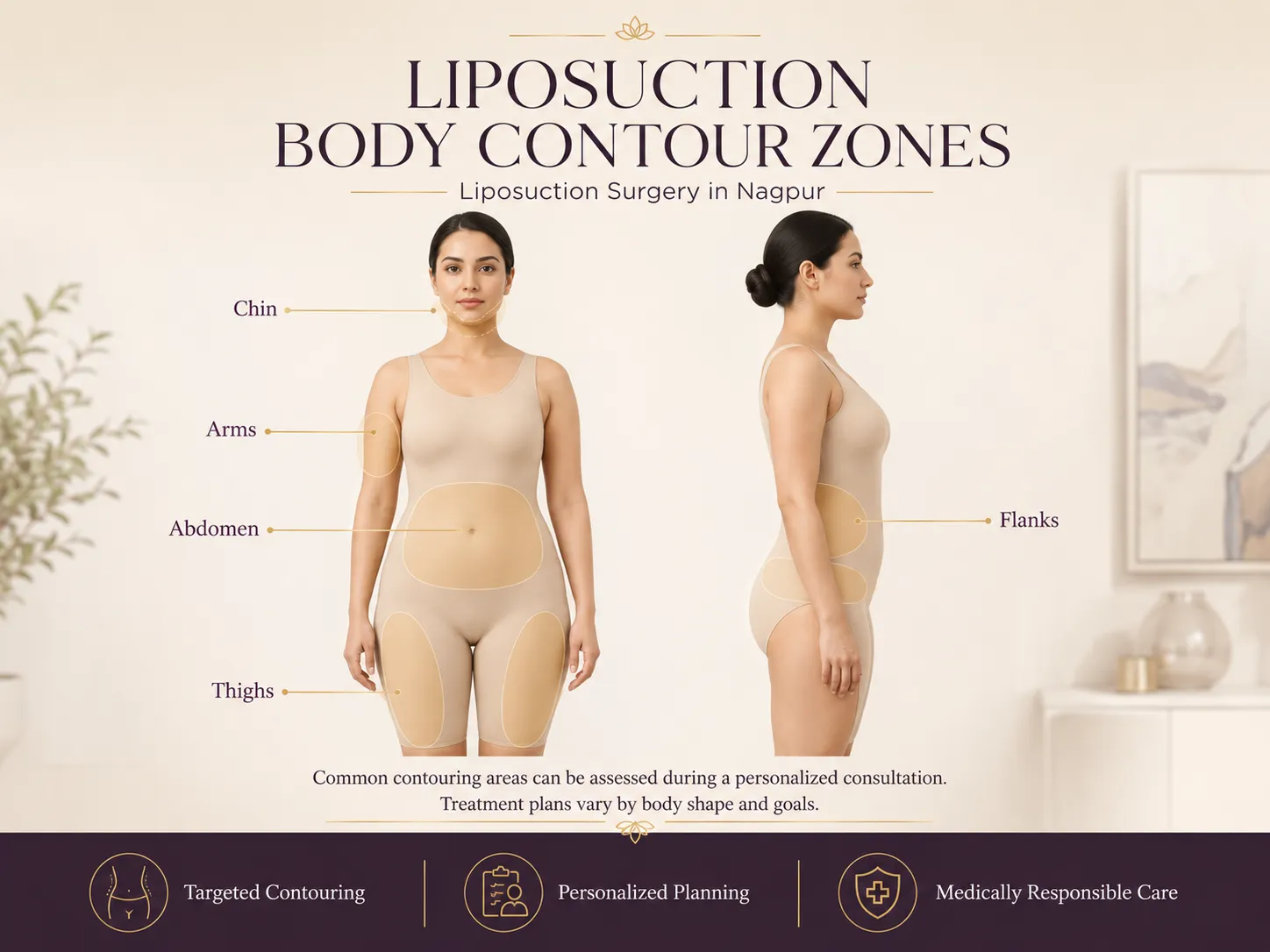
| Abdomen, flanks, back or thighs | Donor-area liposuction when localized subcutaneous fat is suitable | Loose skin, visceral fat and muscle laxity need different treatment | Liposuction guide |
| Hip dips or contour depressions | Small-volume layering to improve a selected transition | Not every indentation is safely or predictably correctable | This page |
| Buttocks | Gluteal fat grafting after separate anatomical and safety assessment | Recipient-site-specific fat-embolism risk and positioning restrictions | Buttock fat transfer |
| Breasts | Selected modest augmentation, contour correction or adjunctive shaping | Volume goals, imaging and breast-health considerations are different | Breast fat transfer |
| Face | Selected facial volume loss, asymmetry or reconstructive depressions | Small vessels and facial anatomy require a separate risk discussion | Facial fat transfer |
| Scar or reconstructive defect | Fat grafting may be considered as one part of reconstruction | The underlying scar, circulation and cause of the defect must be assessed | Scar management |
A reasonable candidate typically has a clear, limited contour concern; enough harvestable fat without risking donor-site hollows; stable health and weight; realistic expectations; and the ability to stop smoking and follow activity, garment and pressure instructions.
Suitability cannot be decided from a photograph because the surgeon needs to feel fat thickness, assess skin recoil, identify scars or hernias, compare standing and lying contours, and review medical and anaesthesia risk.
A broad timeline is useful, but the donor area, recipient area and operation extent determine the actual plan.
Goals are translated into a donor-recipient map rather than a request to “take fat from anywhere and put it here.”
Fat thickness, skin elasticity, scars, asymmetry, tissue capacity and safety-sensitive anatomy are evaluated.
Instructions depend on health, procedure extent and anaesthesia.
Liposuction removes selected subcutaneous fat while preserving smooth thickness and donor-site transitions.
Harvested material is handled to separate usable fat from excess fluid and unwanted components according to the surgical plan.
Fat is placed in planned tissue planes and distributed rather than deposited as one large pocket.
Early swelling exaggerates volume. Final assessment waits until donor swelling, recipient swelling and graft resorption have stabilized.
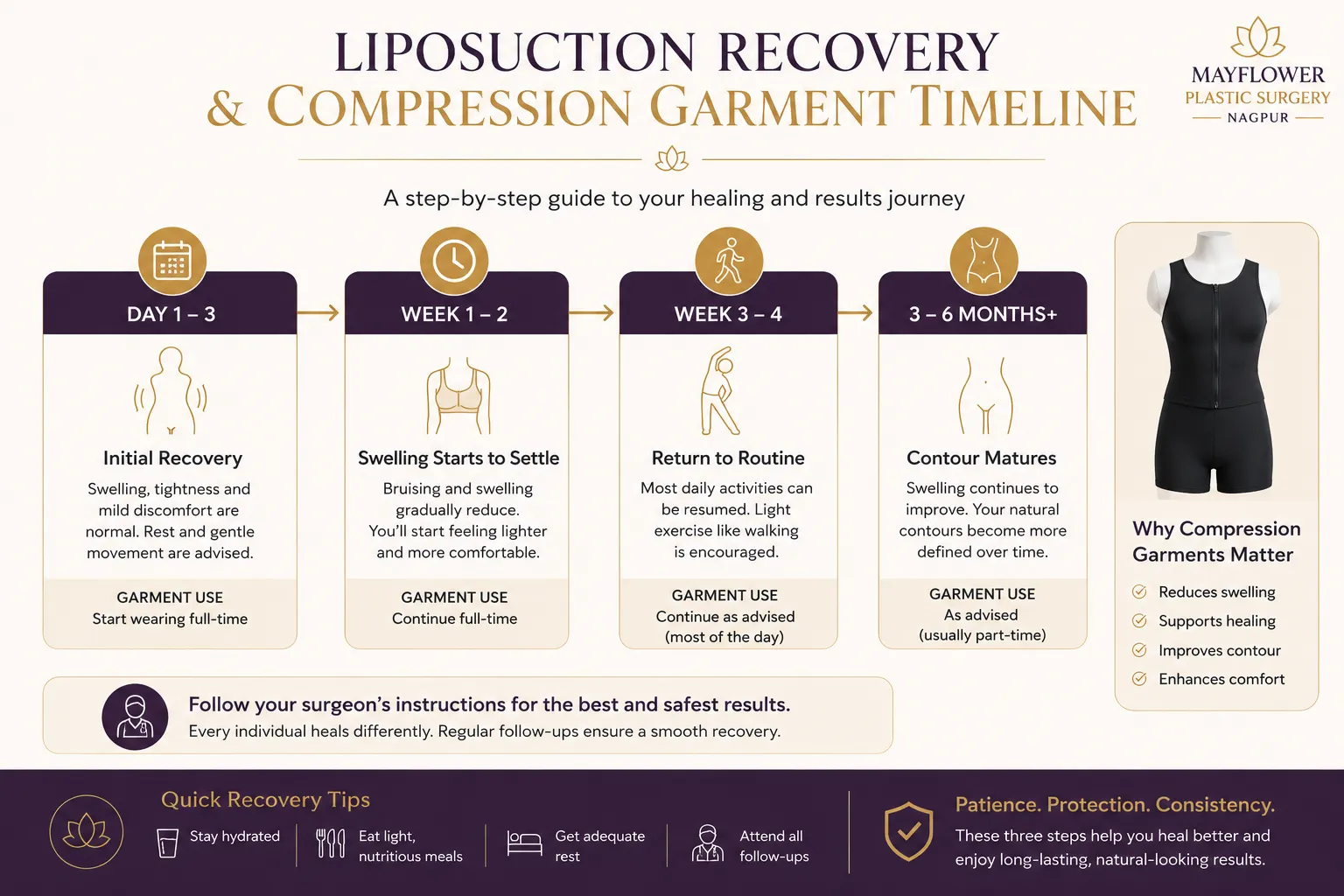
Individual recovery varies with the number of donor and recipient areas, anaesthesia, health and whether another operation is combined.
Walking begins early. Donor areas may feel bruised or tight; the recipient area often appears fuller than the final result.
Dressings and garments are checked. Sitting, sleeping or pressure restrictions depend on the recipient area.
Many limited-procedure patients can resume light work, but fatigue, swelling and modified posture may persist.
Bruising improves and exercise returns gradually after review. Firmness, numbness and uneven swelling may remain.
Residual swelling settles and retained fat becomes clearer. Some areas may continue changing for up to a year.
Short, frequent walking supports circulation. Avoid prolonged immobility unless specifically advised.
Donor garments should be smooth and supportive—not folded, painfully tight or causing colour change and numbness.
Follow site-specific sitting, sleeping, bra, padding or pressure instructions. Do not improvise devices.
Heavy lifting, strenuous exercise, travel and driving resume only after individualized clearance.
Donor and recipient swelling can be asymmetric. Do not judge the final contour during the first weeks.
Major weight loss or gain can change both transferred fat and the remaining fat in donor areas.
Fat transfer is surgery. It includes risks from liposuction, the graft-processing and placement steps, anaesthesia and the specific recipient region. Some risks are minor and temporary; others can require drainage, medicines, revision surgery or emergency treatment.
Bruising, seroma, numbness, loose skin, contour irregularity, asymmetry, pigmentation change, skin injury, infection and visible access scars.
Fat necrosis, oil cysts, nodules, infection, asymmetry, overcorrection, undercorrection, resorption and tissue-specific complications.
Bleeding, anaesthetic complications, allergic reactions, delayed healing, deep-vein thrombosis, pulmonary embolism and need for hospital care.
Exact fat retention, symmetry, skin response and final volume cannot be predicted precisely. A staged or revision procedure may be discussed.
Swelling, temporary overcorrection and gradual fat resorption make the first days and weeks a poor time to judge the outcome.
Transferred cells need to establish a blood supply. The retained proportion varies between patients, body areas and procedures.
Living retained fat can enlarge or shrink with future weight change, altering both the recipient and donor contours.
Human bodies are naturally asymmetric. Surgery aims for improvement, not mathematical identity between sides.
Removing donor fat can reveal laxity. Adding recipient volume cannot reliably correct significant loose skin.
A second, smaller procedure may be safer than one extensive operation when tissue capacity or donor fat is limited.
Surgery should not proceed when the expected change is too small, the risk is disproportionate or goals are not realistically achievable.
There is no responsible single price for “fat transfer” because a small reconstructive depression and multi-area cosmetic contouring involve very different donor work, transferred volume, anaesthesia, facility time and aftercare.
Cost is influenced by the number and size of donor zones, recipient site, liposuction complexity, previous surgery, anaesthesia, operating facility, investigations, garments, overnight monitoring, combination procedures and follow-up.
Mayflower Clinic provides a transparent written recommendation after examination. A larger operation is not automatically a better operation, and a low public headline price should not replace an itemized plan.
“Good Work on Cosmatic surgery.”
Verified Google review“Had a treatment for the injury and it was a great experience. It was like after removing stitches it looks as it was almost before the injury”
Verified Google review“Best cosmetic surgeon, I strongly recommend, him for all plastic surgery. He is very intelligent and guides you very well.”
Verified Google review · Excerpt retained verbatimQuick guidance · Detailed explanations below.
It is a two-site operation in which selected subcutaneous fat is removed by liposuction, prepared, and placed into another body area to improve proportion or correct a contour deficit. The plan must consider both the donor and recipient sites.
Common donor areas include the abdomen, waist, flanks, back or thighs, but the choice depends on available fat, skin quality, previous procedures and whether removal would improve rather than distort the donor contour.
Depending on anatomy and indication, fat may be considered for selected hip or buttock contour deficits, breast shaping, facial volume loss, scars or reconstructive depressions. Each recipient area has different limits and safety requirements.
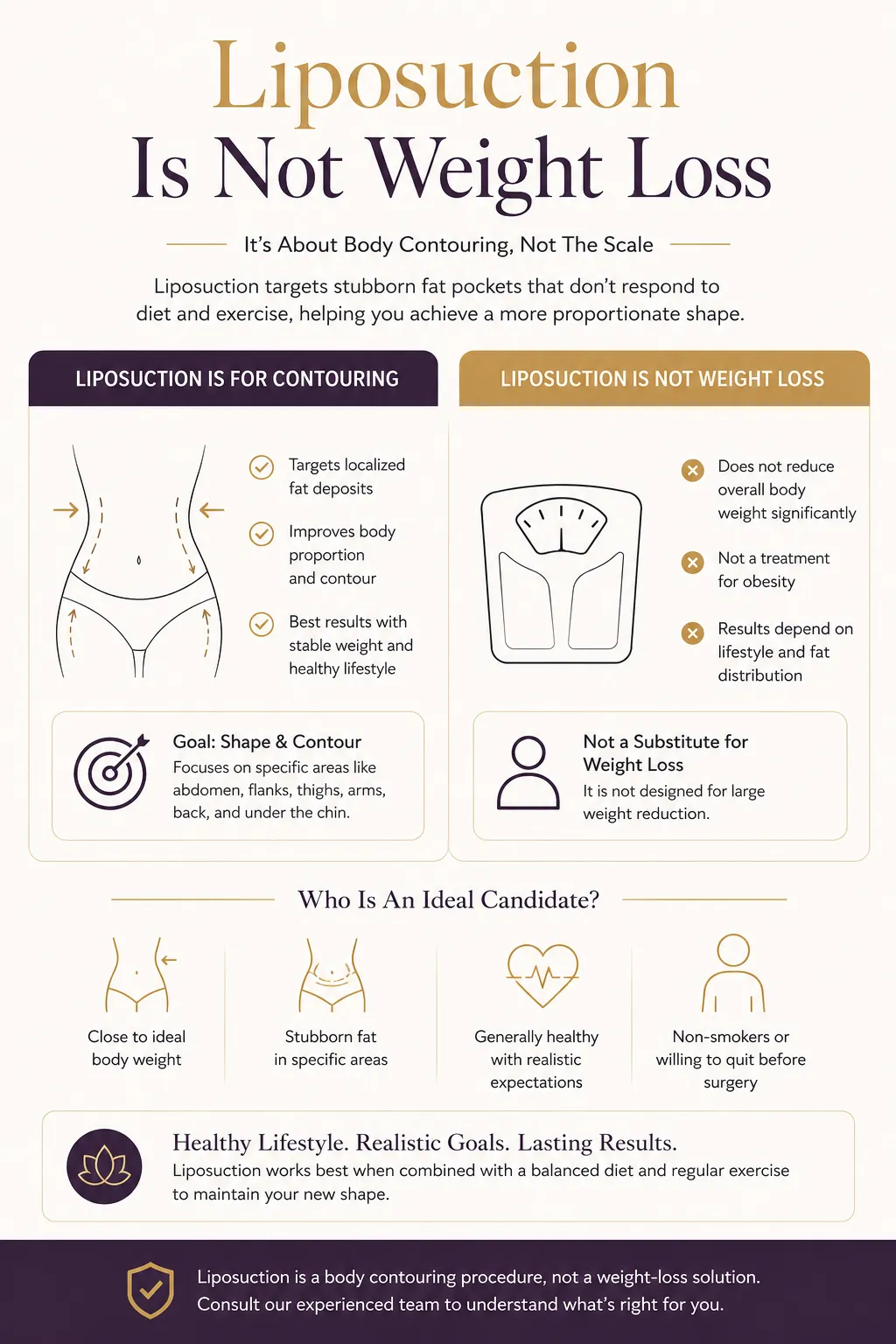
No. Fat transfer and liposuction are body-contouring procedures, not treatments for obesity or substitutes for nutrition, activity or medical weight management.
Potential candidates are medically fit, have enough donor fat, maintain a reasonably stable weight, have realistic goals and can follow the recovery plan. Smoking, unstable health, poor tissue quality or insufficient donor fat may make surgery unsuitable.
Fat survival varies and cannot be predicted precisely. Some volume is naturally reabsorbed during healing, which is why early swelling is not the final result and a staged or touch-up procedure may sometimes be discussed after full settling.
Fat transfer mainly adds selected volume. It does not reliably remove significant loose skin, repair abdominal muscle separation or eliminate cellulite. Skin-excision surgery or another pathway may be more appropriate when laxity is the main concern.
Recovery occurs at both donor and recipient sites. Bruising, swelling, soreness and temporary firmness commonly last several weeks; desk work may resume in roughly one to two weeks for a limited procedure, while full contour assessment takes several months.
Risks include bleeding, infection, fluid collection, fat necrosis, oil cysts, nodules, asymmetry, contour irregularity, donor-site dents, undercorrection, overcorrection, loss of transferred volume, anaesthesia complications, blood clots and revision surgery.
Gluteal fat grafting has recipient-site-specific risk, including life-threatening pulmonary fat embolism if fat enters large veins. It requires separate anatomical planning, technique safeguards and postoperative pressure precautions rather than being treated as routine generic fat transfer.
Fat that establishes a blood supply may remain long term, but the amount retained is variable and the contour can change with ageing, pregnancy and weight fluctuation. A permanent or exact-volume result cannot be promised.
Cost depends on donor and recipient areas, liposuction extent, transferred volume, anaesthesia, facility requirements, investigations, garments, combination procedures and follow-up. A written quotation follows examination rather than a one-price package.
References support general education. The exact donor-area, recipient-site, anaesthesia and aftercare protocol must be individualized by the treating surgical and anaesthesia teams. This page was prepared for medical review on 30 July 2026.
Bring a clear description of the donor and recipient areas that concern you, previous surgery details, medical and medicine history, weight changes, pregnancy plans and practical recovery constraints. Consultation should determine whether fat transfer, liposuction alone, skin surgery, another option or no procedure is the safest useful pathway.

Case of the Month: Grade 3 Gynecomastia…

The Science of Facial Aging: Why Wrinkles,…