
★★★★★
“Amazing experience with Dr Pawan Shahane. I recommend him for all cosmetic surgery… he is very kind in nature… I am happy with results and now feeling full of confidence.”
Jithin RajGeneral cosmetic-surgery testimonial
Fat-transfer breast augmentation combines liposuction from a suitable donor area with careful placement of processed fat into the breasts. It may offer a softer, subtler enhancement—but it cannot guarantee a cup size, perfect symmetry or complete fat survival.

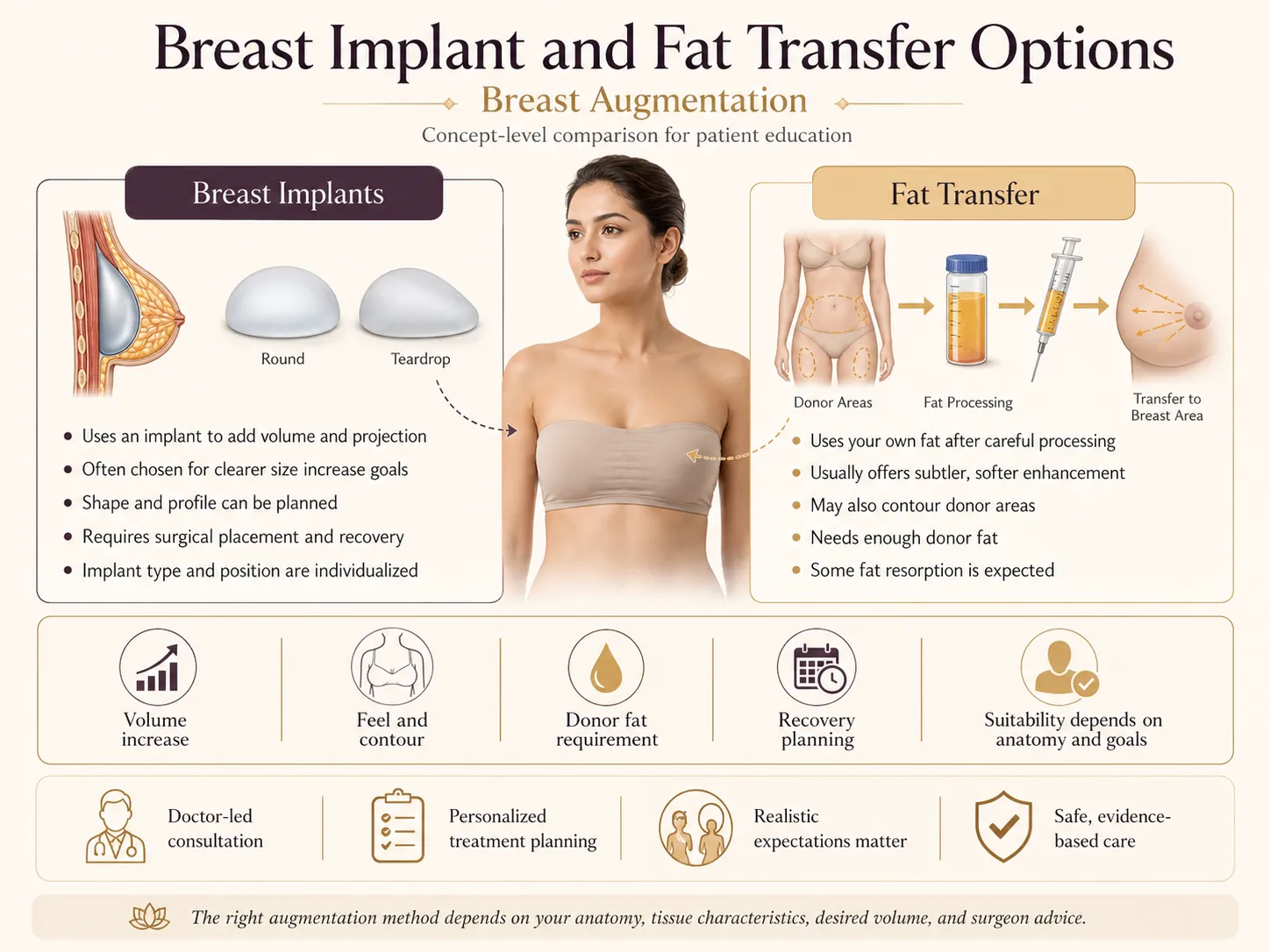 Fat transfer is one option—not automatically the best option
Ask a simple question about this page. The matcher runs only in your browser and takes you to the most relevant section.
This tool cannot examine you, diagnose a breast condition, recommend surgery, calculate candidacy or replace an in-person consultation.
“A good fat-transfer plan respects both sides of the procedure: the donor area must be contoured evenly, and the breast must receive only the amount of fat that its tissues can support. More injection does not automatically mean more lasting volume.”Dr. Pawan Shahane, M.Ch. Plastic Surgery · Founder, Mayflower Clinic, Nagpur
Autologous fat grafting uses tissue from your own body. Fat is removed through liposuction, separated from unwanted fluid and debris according to the surgeon’s technique, then placed in many small parcels through fine access points. These small parcels need contact with healthy recipient tissue so that some of the transferred cells can establish a blood supply.
The operation therefore has two treatment zones: the donor area and the breasts. A good breast result cannot justify an irregular donor contour, and an aggressive donor harvest cannot create unlimited breast volume. The available tissue envelope, skin quality, breast base, asymmetry and existing sagging all limit what can be achieved safely.
A small contour refinement is different from a large, precisely planned size increase.
Body habitus, donor quality and safe contouring limits determine what can be harvested.
Volume addition cannot substitute for skin removal and nipple repositioning when a lift is needed.
Symptoms, examination, family history and appropriate imaging must be addressed before cosmetic surgery.
Smoking, unstable weight, uncontrolled illness and medication risks may require delay or another plan.
Some resorption, asymmetry and staged correction may occur despite careful technique.
Dr. Shahane reviews breast shape, skin envelope, nipple position, asymmetry, previous surgery, donor fat, health, smoking, medicines and future pregnancy or weight plans.
Any lump, discharge, skin change or elevated breast-cancer risk requires appropriate evaluation. Imaging is based on age, history, symptoms and current screening recommendations.
The aim is not merely to collect fat. The donor contour and breast distribution are planned together, including where added volume may be useful and where it should be avoided.
Fat is removed through small access points using an individualized technique while the surgeon protects contour transitions and tissue quality.
The harvested material is handled to separate usable fat from unwanted fluid, oil and debris according to the operative protocol.
Fat is placed in fine, distributed deposits rather than one large pocket. The surgeon repeatedly evaluates shape, tissue tension and symmetry.
Early walking, wound care, garment instructions, breast support, activity restrictions and follow-up are tailored to the exact procedure.
Transferred fat is living tissue. Some cells establish a blood supply and persist; others do not and are gradually absorbed or may form areas of fat necrosis or oil cysts. Because healing biology differs, the surgeon cannot promise that every millilitre injected will remain.
Overfilling the breast is not a reliable solution. Recipient tissue has a limited capacity to support grafted fat, and excessive placement can increase the chance of poor survival, firmness, cysts or unevenness. A staged approach may sometimes be safer than trying to achieve a large change in one operation.
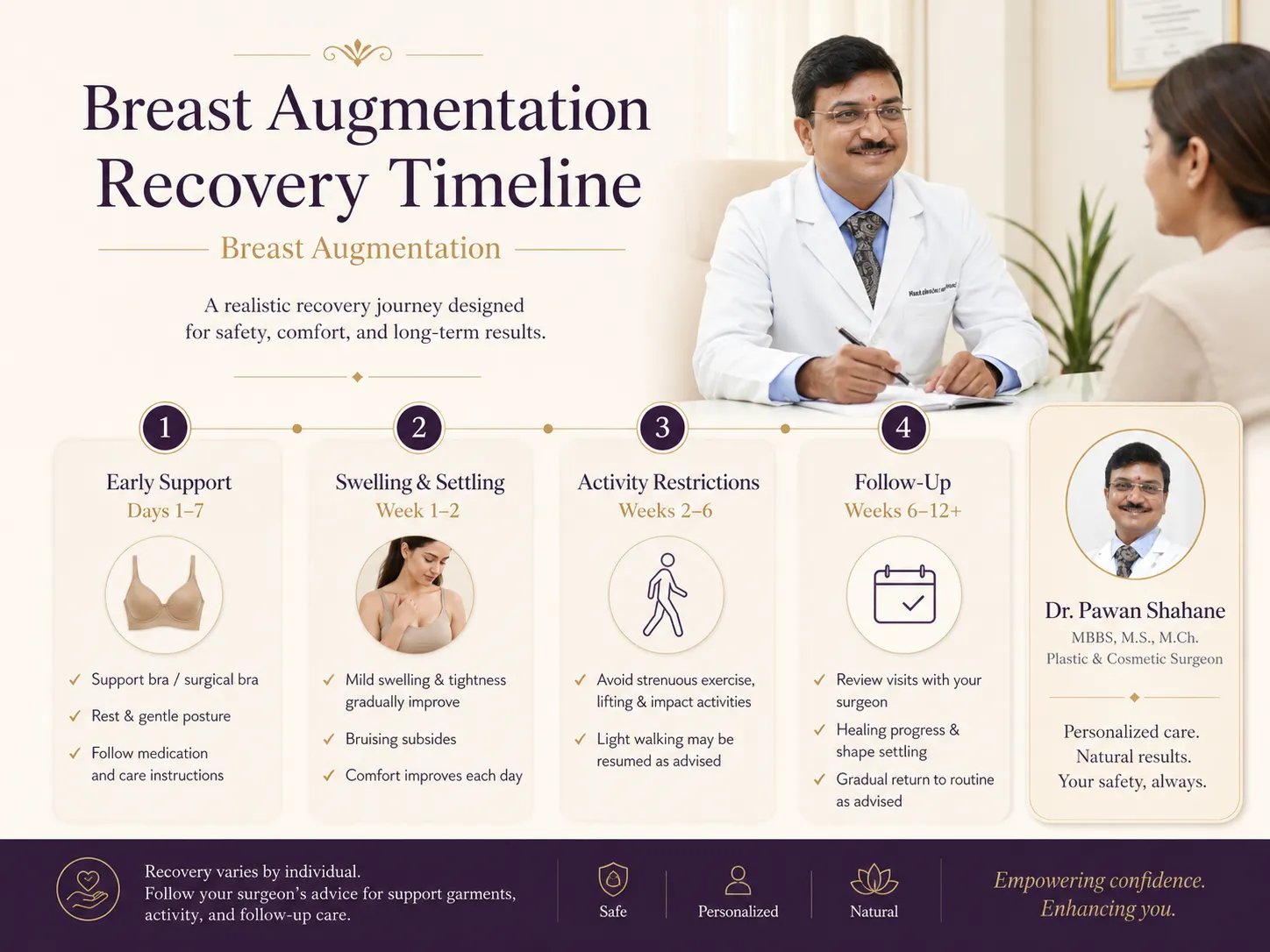
Soreness, swelling, bruising and tightness can affect both breasts and donor areas. Gentle walking and prescribed medicines are important.
Many patients gradually resume desk-based routine, but driving, lifting and work demands must be reviewed individually.
Activity increases progressively. Compression for donor sites and breast-support instructions should follow the surgeon’s protocol.
Swelling and firmness soften, donor contours refine and retained breast volume becomes easier to judge.
Massage, compression or pressure should not be improvised. Instructions depend on the breast and donor-site plan.
Increasing redness, fever, severe one-sided swelling, drainage, chest pain, breathlessness or calf pain needs prompt medical contact.
| Area | What should be discussed |
|---|---|
| Breast graft | Variable fat survival, under-correction, over-correction, asymmetry, lumps, fat necrosis, oil cysts, calcifications and possible additional surgery. |
| Donor area | Bruising, swelling, seroma, numbness, contour irregularity, loose skin, pigmentation change, access scars and dissatisfaction. |
| General surgery | Bleeding, infection, delayed healing, anaesthesia complications, medication reactions, thrombosis and pulmonary embolism. |
| Breast screening | Benign imaging changes may occur. Future radiologists should be told about fat grafting, and new breast symptoms still require proper evaluation. |
| Result limits | No guaranteed cup size, perfect symmetry, complete graft survival, permanent shape or exemption from ageing, pregnancy and weight change. |
One limited zone and circumferential multi-area liposuction are not comparable operations.
Graft volume, asymmetry, scar tissue, previous surgery and combination with a lift affect complexity.
Procedure duration, monitoring, day-care or overnight needs and anaesthesia requirements influence cost.
Medical testing and breast imaging are individualized rather than bundled into a misleading one-price offer.
Donor compression, medicines, dressings and follow-up should be stated clearly in the written quotation.
Future grafting cannot be assumed to be included unless it is specifically documented.
These are authentic general clinic testimonials. They are not presented as fat-transfer-breast-augmentation outcome evidence, and one person’s experience cannot predict another’s result.
“Amazing experience with Dr Pawan Shahane. I recommend him for all cosmetic surgery… he is very kind in nature… I am happy with results and now feeling full of confidence.”
Jithin Raj“Good experience. Highly skilled surgeon. Post op care and consultation was also done nicely… Thanks.”
Mahika Goel“I am happy with results. I recommend him for cosmetic surgery. His staff are also good… honest and explains everything well.”
Sandip BhudeBreast augmentation with fat transfer, also called autologous fat grafting or lipofilling, is a surgical procedure in which fat is removed by liposuction from a donor area, processed, and placed in small amounts into the breasts to refine volume and contour.
Fat transfer uses your own fat and is generally considered for a subtler volume change. Implants provide a separate device with more predictable size and projection choices. The better option depends on anatomy, desired change, donor fat, breast tissue, future screening considerations and willingness to accept each method’s trade-offs.
The increase is usually modest and cannot be promised in a precise cup size. Available donor fat, skin envelope, breast anatomy, safe recipient capacity and the amount of fat that survives all affect the final volume. A staged procedure may occasionally be discussed.
Common donor areas include the abdomen, waist, flanks, thighs or other localized fat deposits. The donor area must be suitable for safe liposuction, and the harvesting plan should improve contour rather than simply chase a volume target.
No. Some transferred fat is naturally reabsorbed during healing. The portion that establishes a blood supply may remain long term, but later ageing, pregnancy and weight change can alter both the breasts and donor areas. The final retained volume cannot be guaranteed.
Potential candidates are generally healthy adults seeking a modest, proportionate change, with enough donor fat, stable weight, realistic expectations and no untreated breast-health concern. Smoking, unstable weight, significant sagging, limited donor fat or elevated medical risk may change or rule out the plan.
Fat transfer adds selected volume but does not reliably remove excess skin or reposition a significantly low nipple. When sagging is the main concern, a breast lift may be more appropriate, sometimes with carefully selected volume addition.
Imaging is individualized according to age, symptoms, examination, personal and family history, and current breast-screening guidance. Any lump, nipple discharge, skin change or high-risk history should be evaluated before cosmetic surgery. Patients should later tell radiologists that fat grafting was performed.
The surgeon marks both donor and breast areas, performs liposuction, processes the harvested tissue, and places small parcels of viable fat through fine access points in several tissue planes. Anaesthesia and duration depend on the extent of liposuction, transfer plan, health and facility requirements.
Recovery involves both the breasts and donor areas. Swelling, bruising, soreness, firmness and temporary altered sensation are common. Light routine may resume gradually, while strenuous activity and pressure on treated areas are restricted until review. Final settling takes months rather than days.
Risks include infection, bleeding, anaesthesia complications, fat necrosis, oil cysts, calcifications, lumps, asymmetry, under-correction, over-correction, contour irregularity, donor-site problems, altered sensation and the possibility of revision or additional grafting. Serious complications are uncommon but must be discussed individually.
Fat grafting can produce benign changes such as oil cysts, fat necrosis or calcifications that may be visible on imaging. Experienced breast radiologists can usually assess these findings, but patients should keep records and inform the imaging team about the procedure.
It may be combined with a breast lift, reconstruction, scar correction or selected body-contouring surgery in appropriate patients. Combining procedures increases operative complexity and may change anaesthesia, recovery and risk, so the plan must be individualized.
Cost depends on the donor areas, liposuction extent, amount of grafting, anaesthesia, operating facility, investigations, garments, medicines, follow-up and whether another procedure is combined. A responsible quotation follows examination and should clearly state what is included.
References support general education. The exact evaluation, imaging, surgical and aftercare protocol must be individualized by the treating surgical, anaesthesia and breast-health teams.
Bring your health and medicine history, previous breast imaging, family history, previous surgery information and a clear description of the change you hope to achieve. Consultation should identify both what is possible and what should not be promised.
Medical Disclaimer: All surgical procedures carry inherent risks, and individual outcomes vary based on anatomy, skin type, breast health, donor-fat availability and healing biology. Surgical results are not guaranteed. Formal in-person consultation with Dr. Pawan Shahane is required before any surgical decision. This page is for general educational purposes only and does not constitute medical advice, diagnosis or a treatment recommendation. It is not for emergencies.

Case of the Month: Grade 3 Gynecomastia…

The Science of Facial Aging: Why Wrinkles,…