
Hypertrophic Scar
Raised, firm and sometimes red or itchy, but remains within the boundaries of the original wound.
A scar may be raised, growing, sunken, widened, dark, red, painful, itchy, tethered or tight enough to limit movement. The useful treatment depends on what type of scar it is, how old it is, where it lies, and what problem it is causing—not simply on choosing a cream, injection, laser or operation.


Consultation image used for patient education; the treatment plan is decided only after examination.
Select the description closest to your concern. This only guides you to the relevant section; it does not identify the scar type.
Scarring is a normal part of wound healing. The aim is therefore not to promise “scar-free” skin, but to decide whether the scar is maturing normally or whether it has become unusually thick, extended beyond the wound, widened, depressed, adherent, unstable, discoloured or restrictive.
The same visible line can require very different care. A red, itchy raised scar may need control of scar activity; a sunken acne scar may need release or resurfacing; a widened surgical scar may require tension analysis; and a burn scar crossing a joint may need rehabilitation or reconstructive release to protect movement.
At Mayflower Clinic, scar planning considers the cause of the wound, scar age, location, skin type, symptoms, previous recurrence, functional effect and the patient’s priorities. Treatment may be preventive, non-surgical, procedural, surgical or staged across several methods.
A scar can show more than one pattern—for example, raised and pigmented, or widened and tethered. The categories below help explain why one treatment cannot suit every patient.
Raised, firm and sometimes red or itchy, but remains within the boundaries of the original wound.
Extends beyond the original wound edges and may continue growing, itching, aching or recurring after treatment.
Sits below the surrounding skin, as may occur after acne, infection, trauma or tissue loss.
May result from tension, wound healing problems, anatomy, movement or scar location.
Colour may remain pink, red, brown, darker or lighter than the surrounding skin during or after maturation.
Feels stuck to deeper tissue and may create dimpling, pulling, discomfort or restricted glide.
Tightening across a joint, eyelid, mouth, neck, hand or other mobile area may limit function and require reconstructive planning.
New scars often change in colour, firmness and thickness for many months; premature aggressive treatment may not always be helpful.
A useful plan separates activity from appearance, and function from colour. It also distinguishes a scar that needs time and protection from one that needs active treatment. The least aggressive effective option is usually considered first, while recurrent keloids, deep tethering and contractures may require a combined or reconstructive plan.
The consultation is designed to identify the scar biology, the mechanical forces acting on it and the patient’s main concern.
Surgery, injury, burn, acne, infection, piercing or previous procedure; date of injury; wound complications; and how the scar has changed.
Itching, pain, tenderness, growth, redness, recurrent breakdown, sensitivity, tightness or sleep and clothing disturbance.
Height, width, colour, texture, pliability, adherence, wound-edge direction, tension and relationship to natural skin lines.
Movement across joints, eyelids, lips, neck, fingers or other mobile structures; grip, gait, clothing comfort and daily activity.
Personal or family history of keloids, previous treatment response, anatomical site, skin type and ongoing inflammation or tension.
Flattening, softening, colour improvement, release of tethering, better movement, better alignment or a less conspicuous scar—not erasure.
Recommendations are selected after examination. A treatment may be used alone, repeated, combined with another method or avoided when the expected benefit is limited.
Once the wound is appropriately closed, advice may include taping, hydration, protection from friction, and ultraviolet protection to reduce preventable irritation and colour change.1
Commonly considered after full skin closure for selected surgical, traumatic, hypertrophic or keloid-prone scars. Benefit varies and consistent use matters.1,5
Selected healed scars may benefit from guided massage, sensory retraining, stretching, splinting or physiotherapy—especially when stiffness or movement loss is present.
Pressure therapy may be used in selected burn or hypertrophic scars, usually within a supervised rehabilitation plan rather than as an unsupervised purchase.
Corticosteroid injections, sometimes combined with other agents, may be considered to reduce activity, thickness, itching or pain in selected hypertrophic scars and keloids.2,3
Selected scars may benefit from laser treatment for redness, texture, thickness or pliability. Where fractional CO₂ resurfacing is appropriate, Mayflower Clinic has the Femto Derma CO2 laser, Coherent USA, 70W RF metallic tube. Settings and aftercare must respect Indian skin pigmentation risk. Read the dedicated CO2 Laser Resurfacing guide →2,6
For selected atrophic or tethered scars, controlled needling, release beneath the scar or temporary volume support may be considered. Acne-scar planning is covered separately.
A widened, misaligned, depressed, unstable or restrictive scar may be revised, repositioned, released or reconstructed. Surgery creates a new scar and cannot guarantee non-recurrence.
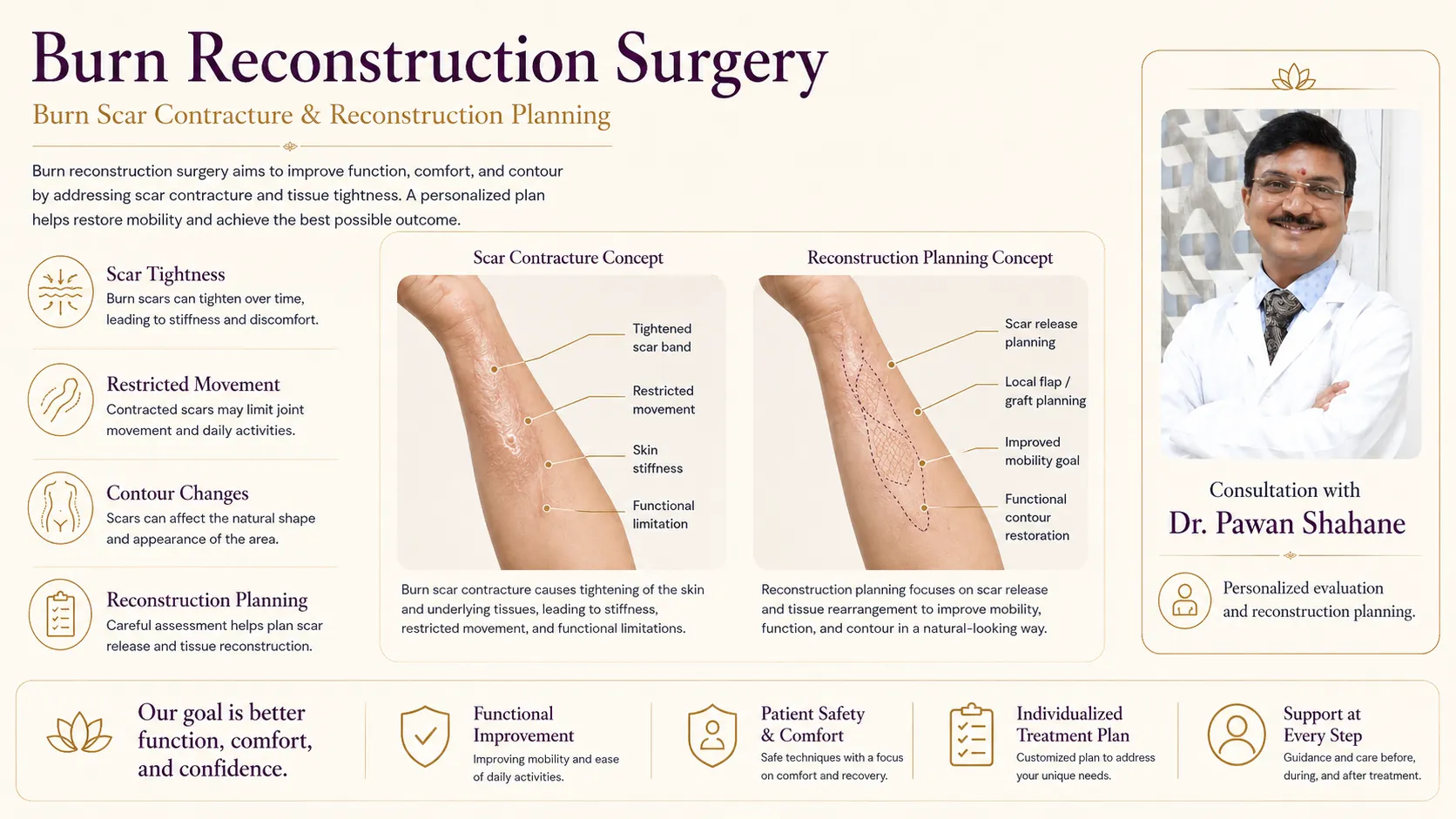
When scar tissue pulls across a joint or mobile structure, the priority may be movement, comfort and stable skin coverage. The plan can include therapy before and after any operation.
Note the injury or surgery date, wound problems, prior treatments, growth pattern, symptoms, medicines, allergies and any previous keloids.
Dr. Shahane examines the scar’s boundaries, colour, height, firmness, adherence, tension, skin type and functional effect.
The priority may be itch or pain relief, flattening, colour, texture, movement, stability, contour or alignment. More than one goal may require staged care.
Observation, silicone, rehabilitation, injection, device-based treatment or surgery is selected according to the likely benefit and risk.
Procedure-day instructions, anaesthesia, wound care and activity restrictions vary widely. Patients receive method-specific guidance.
Scar height, pliability, colour, symptoms and movement are reviewed. The next session is adjusted rather than automatically repeated.
Sun protection, pressure or silicone where advised, rehabilitation and scheduled reviews may continue for months.
Ultraviolet exposure can worsen redness or pigmentation. Use clothing and clinician-recommended sunscreen after the skin has healed.
Avoid scratching, peeling, harsh home acids, unprescribed injections and repeated friction over the scar.
Apply only on healed skin, follow cleaning instructions, and report persistent rash, maceration or breakdown.
Repeated treatment is scheduled according to healing. More frequent treatment is not automatically better.
Smoking can impair wound healing and may increase problems after surgical scar revision or reconstruction.
Increasing pain, warmth, discharge, fever, wound opening, ulceration or sudden rapid change requires medical review.
For the clinic’s general wound-care, activity, scar-care and warning-sign framework, read the Patient Care Guide →. Follow any procedure-specific instructions given to you in preference to general guidance.
Scar treatment often improves one or more measurable features—such as thickness, firmness, redness, pigmentation, depth, adherence, discomfort or range of movement. It cannot recreate normal uninjured skin.
Early visible change does not always represent the final result. Scars may continue evolving for 12–18 months or longer, and staged treatment may need months of review. Keloids can recur; depressed scars may need more than one technique; and surgical revision replaces the old scar with a new planned scar.
Possible treatment-related problems depend on the method and can include temporary redness, swelling, crusting, bruising, pain, infection, delayed healing, pigment change, skin thinning, visible small vessels, contour irregularity, recurrent scarring or need for additional treatment.
A raised scar that enlarges outside the original injury may be a keloid and should be assessed before excision or home treatment.
Persistent symptoms can indicate active scar tissue and may justify treatment even when appearance is not the main concern.
Scar tightness across the neck, mouth, eyelid, hand, elbow, knee, ankle or another joint requires functional assessment.
Ulceration, opening, pus, bad odour, warmth, increasing pain or fever may indicate a wound problem rather than simple scar maturation.
Unexpected bleeding, a new lump, persistent ulceration or a changing lesion without a clear injury history should not be assumed to be a scar.
Repeated recurrence after injection, laser or surgery needs a fresh diagnosis and combined plan rather than repeating the same step automatically.
A public single price can be misleading because scar management ranges from advice and topical care to repeated injections, laser sessions, rehabilitation or reconstructive surgery.
Keloid, hypertrophic, atrophic, widened, tethered and contracture scars require different resources.
One small earlobe scar differs from multiple acne scars, a long surgical scar or a burn crossing a joint.
Costs vary with method, number of sessions, consumables, dressings, anaesthesia and follow-up.
Operating-facility needs, reconstruction complexity, splinting and physiotherapy can affect the final quote.
These are verbatim Google review excerpts. Only the first review is injury-related; the other reviews are clearly labelled as different procedures and are shown for communication, planning and surgical-care experience—not as scar-treatment outcome claims.
“Had a treatment for the injury and it was a great experience. It was like after removing stitches it looks as it was almost before the injury”
“Best cosmetic surgeon, I strongly recommend, him for all plastic surgery. He is very intelligent and guides you very well. my son suffered from gynecomastia and so we get done surgery. …”
“I had my gynecomastia surgery done by Dr. Pawan Sahane, and I must say he did an excellent job. The procedure was smooth, well-managed, and done in the best possible manner. I am feeling much better and more confident now. I truly appreciate his skill, care, and professionalism.”
No treatment can reliably return injured skin to exactly how it looked before the injury. Scar management aims to make a scar flatter, softer, less red or dark, less symptomatic, less tethered, or less restrictive, depending on the problem.
A hypertrophic scar stays within the boundaries of the original wound, although it may be raised and firm. A keloid grows beyond the original wound edges and may continue enlarging, itching, or becoming painful.
Prevention and early care may begin after the wound has fully closed and the treating clinician confirms that the surface is healed. An established, symptomatic, rapidly changing, or movement-limiting scar should be assessed rather than treated with home remedies alone.
Silicone gel or sheeting is commonly considered for selected healed surgical, traumatic, hypertrophic, or keloid-prone scars. Evidence supports possible benefit, but results vary and correct timing, duration, skin tolerance, and adherence matter.
Intralesional corticosteroid injections may reduce thickness, itching, discomfort, and activity in selected hypertrophic scars and keloids. More than one session may be required, and risks such as thinning, visible vessels, or pigment change must be discussed.
Laser treatment cannot erase a scar. Selected laser or energy-based treatments may improve redness, texture, thickness, pigmentation, or pliability, but the device and settings must match the scar and the patient’s skin type.
No. Fractional CO2 laser may be useful for selected textural, atrophic, surgical, traumatic, or burn scars, but it is not the correct first step for every active keloid or unhealed wound. Pigment-change risk and aftercare are especially important in darker skin tones.
Surgical revision may be considered for selected widened, badly aligned, tethered, depressed, unstable, or function-limiting scars when the expected benefit justifies creating a new surgical scar. Timing depends on scar maturity, location, tension, and prior treatments.
Yes. Keloids have a meaningful risk of recurrence, particularly when excision is used alone. A specialist may recommend a combined plan before and after surgery rather than presenting excision as a guaranteed cure.
A scar contracture requires functional assessment. Therapy, splinting, pressure care, laser treatment, injections, or reconstructive release using techniques such as local tissue rearrangement or grafting may be considered according to severity and location.
Scar change is gradual. Many scars continue maturing for 12 to 18 months or longer, while active treatment often requires staged sessions and months of follow-up.
Cost depends on the scar type, size, location, number of areas, symptoms, treatment method, number of sessions, anaesthesia needs, consumables, and whether surgery or rehabilitation is required. Mayflower Clinic provides a case-specific quote after examination.
Treatment can be planned safely, but darker skin may have a greater tendency toward post-inflammatory pigmentation or keloid formation in some situations. Conservative settings, sun protection, staged treatment, and careful follow-up are important.
References support general scar-management principles. They do not replace examination or prescribe a treatment for an individual patient.
Medically reviewed: 29 July 2026 · Next planned review: July 2027 or earlier if major guidance changes.
For rolling, boxcar, ice-pick and mixed acne-scar patterns.
Facial scar alignment, contour, tethering and surgical revision options.
Function-first care for burn scars, tissue tightness and contractures.
How incision planning, tension and aftercare influence surgical scars.
Dedicated guide to fractional CO2 resurfacing, candidacy, downtime, pigment risk, aftercare and limitations.
Functional reconstruction after burns, injury, wounds and tissue loss.
Navigate treatment pages by concern rather than by device alone.
Adjunctive skin and microneedling pathway for selected patients; not a treatment for every scar and results are not guaranteed.
General wound care, activity guidance, scar care and warning signs to support procedure-specific instructions.
Arrange an in-person evaluation at Mayflower Clinic, Dhantoli.
Plastic, cosmetic, reconstructive and hair-restoration care in Nagpur.
Browse Mayflower Clinic’s complete procedure and treatment directory.
Qualifications, surgical experience, memberships and publications.
Clinic values, location, consultation pathway and patient support.
Bring the scar history, previous treatment records and your main concern. Dr. Pawan Shahane will explain whether the scar needs time, non-surgical care, a procedure, surgical revision or reconstructive planning.

Case of the Month: Grade 3 Gynecomastia…

The Science of Facial Aging: Why Wrinkles,…