Abdominoplasty in Nagpur — Skin, Muscle and Scar Planning in One Operation
A tummy tuck is considered when the abdominal concern is not just fat. It may involve stretched skin, a lower-abdominal overhang, previous scars, umbilical distortion or laxity of the abdominal wall after pregnancy or major weight change.
Quick answer: abdominoplasty removes selected excess abdominal skin and subcutaneous fat through a planned low scar. When examination confirms rectus diastasis or fascial laxity, the abdominal wall may also be tightened. It is not a weight-loss operation, and it is different from liposuction, which removes fat but does not excise substantial loose skin.
Reviewed by Dr. Pawan Shahane, M.Ch. Plastic Surgery21+ years surgical practice · Ex-Asst. Prof. GMC Nagpur & NKPSIMS · IAAPS Member · Personally performed surgery
Plan by anatomy—not by the shortest scar Skin excess, fascial laxity, navel position, old scars, fat distribution and healing risk determine the operation.
Authentic consultation photograph. No surgical result is implied.
21+ YearsSurgical and aesthetic practice
M.Ch.Plastic Surgery qualification
Doctor-LedPlanning, surgery and follow-up
Clear LimitsNo weight-loss or outcome-assurance claims
Page Guide
Quick Answer
Ask a simple question about loose skin, muscle repair, scars, mini versus full surgery or recovery. The matcher runs only in your browser and points to information already on this page.
Private · On-page · No login
Start here: tummy tuck planning separates four problems—fat, loose skin, fascial laxity and the scar pattern needed to correct them.
This guide cannot examine you, diagnose diastasis or hernia, recommend surgery, calculate candidacy, estimate patient-specific cost or replace consultation.
Weight loss?
No. It is contouring surgery.
Loose skin?
Selected excess skin can be removed.
Diastasis?
Fascial tightening may be added when indicated.
Liposuction?
May be combined selectively.
Scar?
Permanent; length follows anatomy.
Navel?
Often repositioned in a full procedure.
Recovery?
Measured in weeks, maturation in months.
Result?
Individual; no outcome can be assured.
The operation should match the abdominal layer that is actually causing the contour
“A flat abdomen cannot be planned from a photograph alone. The examination must separate skin excess, subcutaneous fat, fascial laxity, visceral fullness, old scars and possible hernia before deciding whether liposuction, abdominoplasty, a combined operation or no cosmetic surgery is appropriate.”
Dr. Pawan Shahane, M.Ch. Plastic Surgery · Founder, Mayflower Clinic, Nagpur
What the operation treats
Abdominoplasty is skin-envelope surgery with optional abdominal-wall tightening
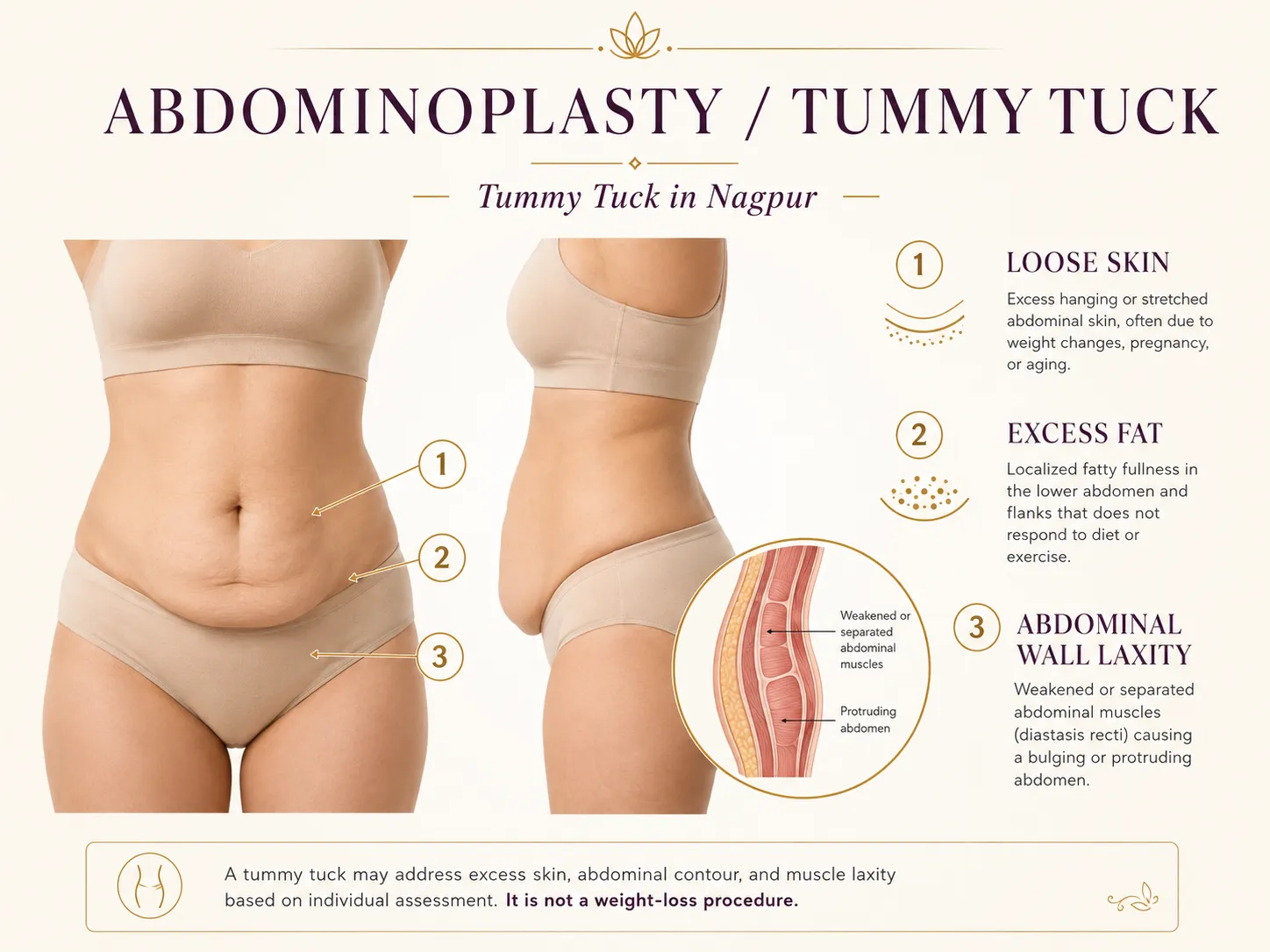
Pregnancy, ageing, previous surgery and major weight change can stretch the abdominal skin beyond its ability to contract. The result may be a fold below the navel, widened stretch marks, a distorted or hooded umbilicus, a low scar trapped in loose tissue, or a broad abdominal bulge that does not improve with exercise.
Abdominoplasty removes a planned segment of skin and subcutaneous tissue. In a full operation, the upper abdominal skin is advanced downward and the navel is brought through a new opening. If the fascial layer is lax or the rectus muscles are separated, sutures may be used to narrow and support the abdominal wall.
The procedure does not remove visceral fat from inside the abdomen, treat obesity or guarantee a completely flat contour. Rib-cage shape, pelvic width, spine posture, remaining subcutaneous fat, bowel distension and internal anatomy continue to influence the result.
Excess or hanging lower-abdominal skin
Skin laxity above and below the navel
Selected stretch marks within skin planned for removal
Rectus diastasis or fascial laxity when confirmed
Old lower abdominal or caesarean scars that may be incorporated
Localized flank or abdominal fat when liposuction is safely combined
Important distinction: a hernia is not the same as diastasis recti. A suspected hernia, pain, obstruction symptoms or an unexplained mass needs medical evaluation and may require additional imaging or another surgical pathway.
Three-layer assessment
Loose skin, fat and abdominal-wall laxity are different problems
Skin: pinchable, wrinkled or hanging tissue may require excision rather than suction alone.
Subcutaneous fat: fat outside the abdominal muscles may be reduced with liposuction in selected zones, but skin quality limits contraction.
Abdominal wall: the fascial layer may be widened or lax after pregnancy or weight change. Internal visceral fullness is deeper and is not removed by abdominoplasty.
Educational illustration. It does not diagnose an individual patient or promise a result.
Technique selection
Mini, full, extended, fleur-de-lis or lipoabdominoplasty?
The technique should be selected by the distribution of skin excess and laxity. Choosing a smaller operation only to shorten the scar can leave the main problem untreated.
◔
Mini abdominoplasty
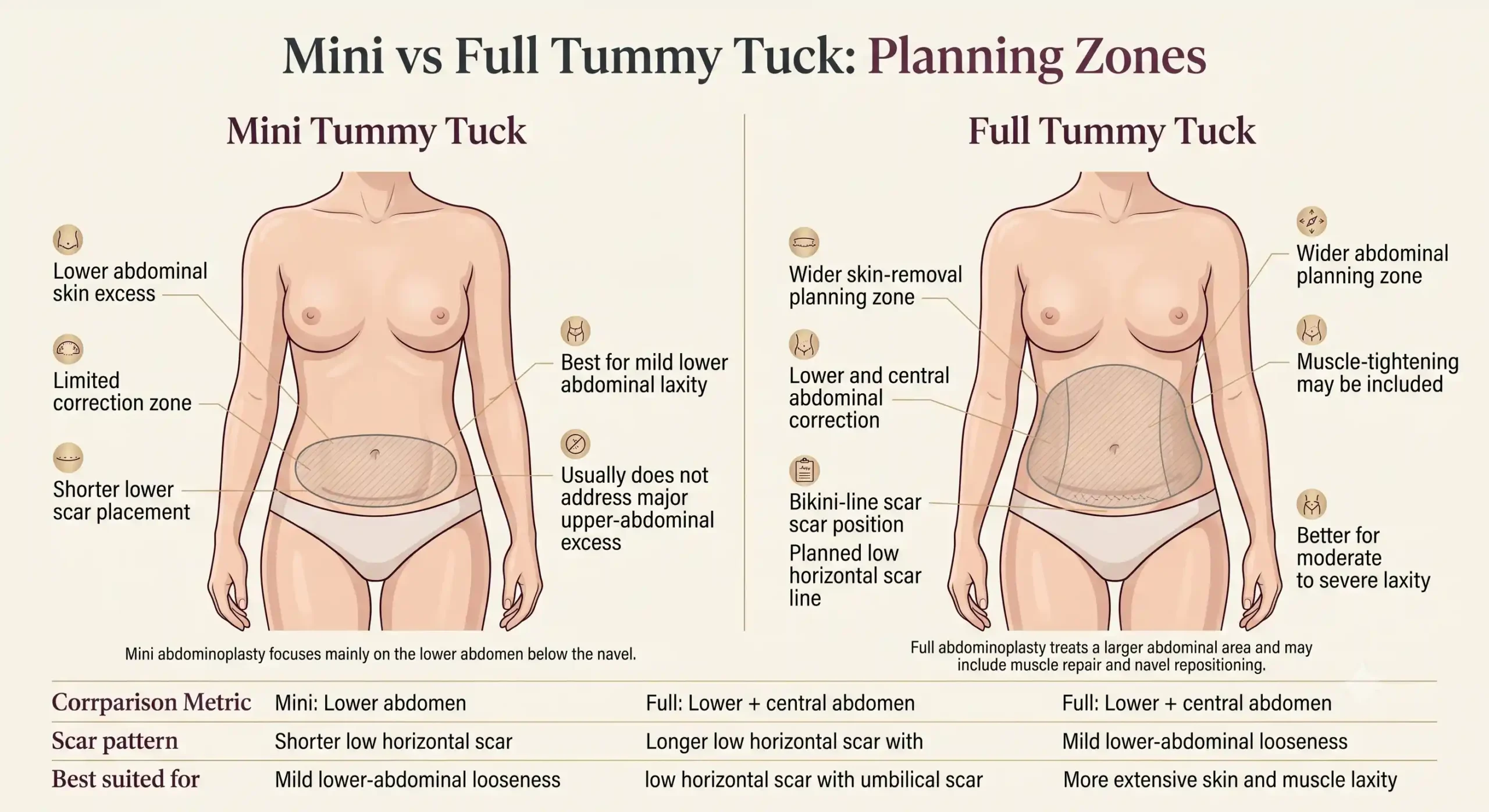
For limited lower-abdominal skin below the navel. The umbilicus is usually not fully repositioned, and upper-abdominal laxity may remain.
◎
Full abdominoplasty
Addresses skin above and below the navel, commonly with umbilical repositioning and fascial tightening when indicated.
↔
Extended abdominoplasty
Extends the low scar farther toward the flanks when skin excess continues laterally.
✦
Fleur-de-lis
Adds a vertical scar to reduce both side-to-side and top-to-bottom excess, often after major weight loss.
≈
Lipoabdominoplasty
Combines planned liposuction with skin removal and wall tightening. Vascular safety and the extent of suction must be considered together.
▱
Panniculectomy
Primarily removes a hanging pannus for functional or hygiene concerns. It is not automatically the same as comprehensive aesthetic abdominoplasty.
Mini versus full: the planning zone
Schematic only. Scar length, skin excision, fascial repair and umbilical management vary with anatomy.
Scar patterns should be discussed before consent
Mini
Shorter low scar, but only suitable for a limited lower-abdominal problem.
Full or extended
Low transverse scar; length expands with the width of skin that must be removed.
Fleur-de-lis
Adds a vertical midline scar to address horizontal laxity after major weight loss.
Consultation framework
Ten decisions before scheduling surgery
What is the main problem?
Skin, fat, diastasis, hernia, visceral fullness or a combination.
Is weight stable?
Major planned weight change can alter the operation and long-term contour.
Are pregnancies complete?
Future pregnancy can stretch the skin and fascial repair again.
Is nicotine involved?
Smoking, vaping and nicotine products increase wound-healing risk.
What scars already exist?
Caesarean, appendicectomy, laparoscopic and other scars may affect blood supply and design.
Is there a hernia?
A cough impulse, pain or focal bulge may need separate evaluation.
What is the clot risk?
Age, BMI, hormones, previous clots, immobility and combined surgery matter.
Is nutrition adequate?
Anaemia, protein deficiency or post-bariatric deficiencies can impair healing.
What scar is acceptable?
The patient must understand the likely length, position and maturation.
What help is available?
Transport, home support, drain care, childcare and leave from work should be arranged.
Procedure-day journey
From markings to the first postoperative review
1
Before admission
Medical, anaesthetic and thrombosis planning
History, medicines, allergies, nicotine, weight stability, pregnancy status, previous abdominal surgery and clot risk are reviewed. Tests are ordered according to the patient and facility protocol.
2
Before anaesthesia
Standing skin and scar markings
The low scar, estimated skin removal, midline, navel, zones for possible liposuction and old scars are marked while the patient is upright.
3
Operation begins
Anaesthesia and safety measures
Abdominoplasty is usually performed under general anaesthesia. Compression devices, antibiotics and blood-clot prevention are selected according to risk and protocol.
4
Surgical access
Low abdominal incision and tissue elevation
The incision follows the preoperative plan. Skin and fat are elevated only to the extent required for safe redraping and access to the fascia.
5
When indicated
Fascial plication and selective liposuction
Confirmed rectus diastasis or fascial laxity may be tightened with sutures. Liposuction can be added in selected areas while preserving tissue blood supply.
6
Contour creation
Skin redraping, excision and umbilical planning
Excess skin is removed with the patient positioned to permit a tension-aware closure. In a full procedure, the navel is delivered through a new skin opening.
7
Closure
Layered sutures, dressings and possible drains
Deep and superficial layers are closed. Drains may be placed, or other techniques may be used to manage dead space and fluid risk. A garment may be applied.
8
Recovery and discharge
Early walking, posture and first review
Mobilisation begins early with assistance. Discharge timing depends on pain control, walking, urine output, nausea, wound condition, procedure extent and home support.
Compare pathways
Liposuction, abdominoplasty or a combined operation?
Pathway
Main target
Skin removal
Fascial repair
Scar pattern
Key limitation
Liposuction
Localized subcutaneous fat
No formal excision
No
Small access points
Loose skin may remain or become more visible
Mini abdominoplasty
Limited lower-abdominal skin
Below navel
Limited or selected
Shorter low scar
Cannot fully correct upper-abdominal laxity
Full abdominoplasty
Skin above and below navel ± diastasis
Yes
When indicated
Low transverse + around navel
Longer recovery and permanent scar
Lipoabdominoplasty
Loose skin plus selected fat distribution
Yes
When indicated
As for planned abdominoplasty + small lipo access points
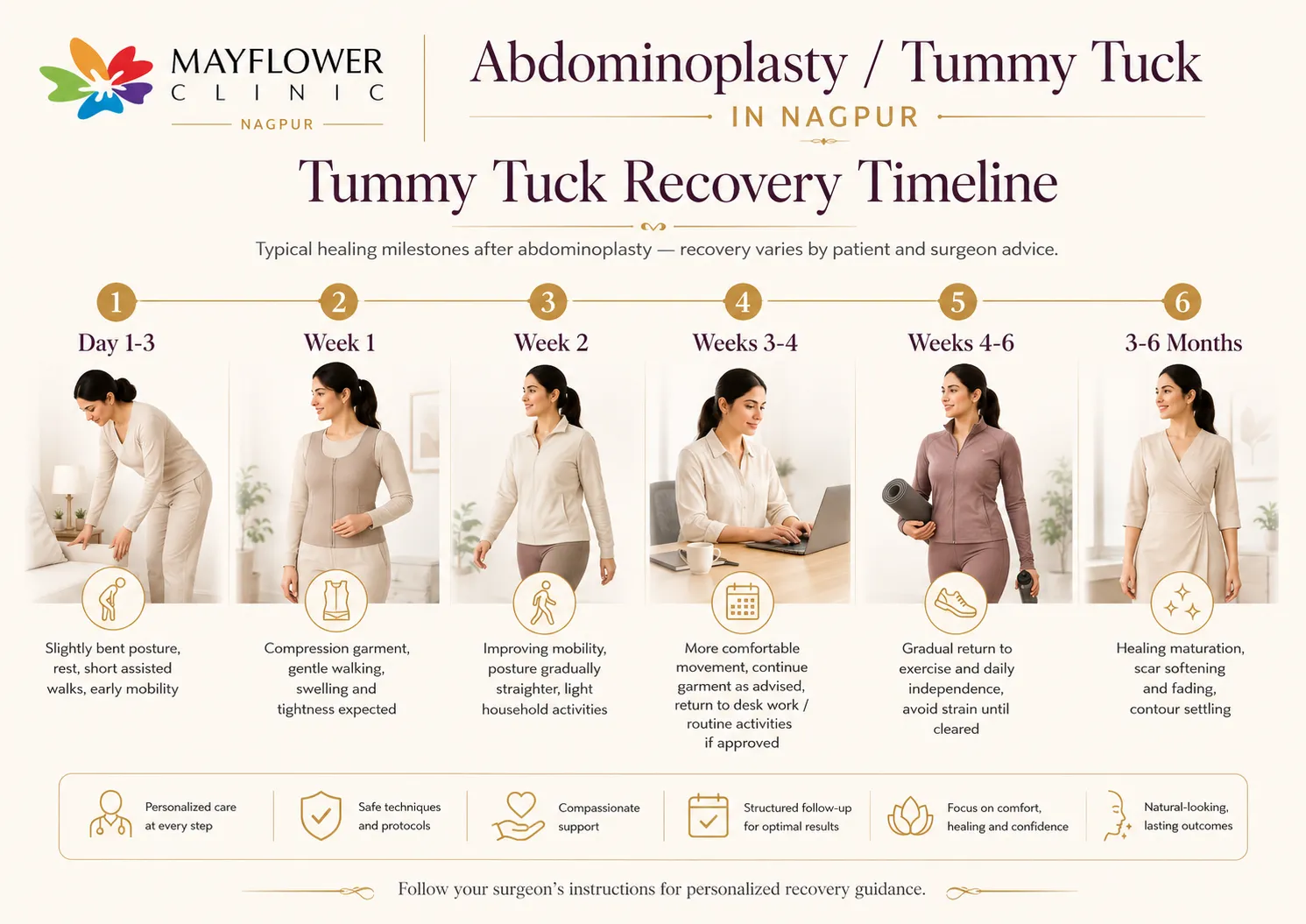
Healing is staged: mobility first, strength later, scars over months
Typical milestones only. The surgeon’s individual instructions override any general timeline.
Days 1–3
Assisted walking, slightly flexed posture, pain and nausea control, wound and drain observation, hydration and clot-prevention measures.
Week 1
Gentle walking increases. Swelling, tightness and fatigue are expected. Drain removal depends on output and surgeon protocol.
Week 2
Posture and independence improve. Light household activity may be possible, but lifting, sudden stretching and driving may remain restricted.
Weeks 3–4
Some patients return to desk-based work if comfortable and cleared. Garment use and wound care continue as advised.
Weeks 4–6+
Exercise and heavier activity restart gradually only after healing and fascial repair are assessed. Combined procedures may extend restrictions.
3–12 months
Residual swelling settles, sensation may evolve and scars soften and fade. Final contour and scar quality cannot be judged in the first few weeks.
Driving: do not drive until you can sit comfortably, wear a seat belt, perform an emergency stop without hesitation, are not using sedating medication, and have surgeon and insurer clearance.
Postoperative care
Six practical priorities after abdominoplasty
↗
Walk early and often
Short, supported walks help circulation. Prolonged bed rest is discouraged unless specifically ordered.
⌁
Protect the closure
Avoid sudden standing upright, twisting, heavy lifting and strain until tissue tension and repair are safe.
◫
Manage drains correctly
Record output, keep tubing secure and report blockage, sudden blood, odour or loss of suction.
▣
Use the garment as prescribed
It should support without folding, rolling, causing pressure injury or impairing breathing.
☼
Support healing
Follow nutrition, hydration, medicine and nicotine-avoidance instructions. Do not start supplements without checking interactions.
◎
Attend every review
Seroma, wound-edge problems, umbilical changes and thrombosis symptoms are safer when recognized early.
Safety and informed consent
Abdominoplasty is major surgery with local and systemic risks
Asymmetry, residual laxity, contour irregularity, dog-ears, widened or raised scars, navel distortion and possible revision.
General medical risks
Anaesthesia complications, drug reactions, persistent pain, altered sensation, deep-vein thrombosis, pulmonary embolism and rare serious cardiopulmonary events.
Seek urgent assessment
Chest pain, sudden breathlessness, coughing blood, fainting, one-sided calf pain or swelling, rapidly expanding abdominal swelling, uncontrolled bleeding, high fever, spreading redness, black or dusky skin, wound opening, persistent vomiting or worsening pain require prompt medical contact. For severe symptoms, use emergency services rather than WhatsApp.
Realistic results
What abdominoplasty can improve—and where limits remain
Reasonable goals
Remove a selected lower-abdominal skin overhang
Improve skin redraping above and below the navel
Narrow fascial laxity when appropriate
Improve clothing fit and abdominal contour
Incorporate some old lower scars
Variable outcomes
Amount of remaining stretch marks
Scar width, colour and fading
Navel shape and position
Residual numbness or tightness
Degree of waist definition
Not promised
Weight loss or treatment of visceral fat
An abdomen without visible scars
Correction of every stretch mark
Permanent resistance to pregnancy or weight change
A specific celebrity or digitally edited body shape
Early swelling, a flexed posture and tissue tightness can obscure the contour. Scar maturation commonly continues for many months, and no result can be assured.
Cost factors
What determines an abdominoplasty quote?
A single online price cannot show the difference between a mini, full, extended or fleur-de-lis operation, nor whether fascial repair, liposuction, hernia planning, overnight observation or extra medical preparation is needed.
Operation selected
Mini, full, extended, fleur-de-lis and lipoabdominoplasty involve different time and resources.
Anaesthesia and facility
Anaesthesiologist, operating theatre, monitoring, stay and nursing are part of safe planning.
Associated procedures
Liposuction, scar revision or another operation changes complexity and risk.
Tests, garments and follow-up
Preoperative assessment, medicines, compression garment, drains and reviews should be stated.
Patients travelling to Nagpur
Do not plan immediate return travel after major abdominal surgery
Complete evaluation first
Send medical history and previous-operative records through the clinic’s agreed privacy-safe pathway. Do not assume that photographs confirm diastasis, hernia or candidacy.
Arrange a local support person
Transport, walking assistance, meals, drain care and help with children or household work may be needed.
Stay for planned reviews
Long road or air travel, dehydration and immobility can compound clot risk. Return travel should occur only after the surgeon confirms the wound, mobility and medical status are appropriate.
Mayflower Clinic receives patients from Nagpur and the wider Vidarbha, Madhya Pradesh and Chhattisgarh referral belt. Travel convenience must not shorten observation or postoperative follow-up.
Patient experience
What patients say about consultation and care
These authentic testimonials concern other cosmetic-surgery experiences at Mayflower Clinic and are shown for general clinic-care context. They are not abdominoplasty outcome claims.
★★★★★
“Amazing experience with Dr Pawan Shahane. I recommend him for all cosmetic surgery. He is good in knowledge… and he is very kind in nature… I am happy with results and now feeling full of confidence.”
★★★★★
“Good experience. Highly skilled surgeon. Post op care and consultation was also done nicely… Thanks.”
★★★★★
“I am happy with results. I recommend him for cosmetic surgery. His staff are also good… honest and explains everything well.”
Patient questions
Abdominoplasty FAQs
What is abdominoplasty?
Abdominoplasty, commonly called a tummy tuck, is surgery that removes selected excess abdominal skin and subcutaneous fat. When examination shows abdominal-wall laxity or rectus diastasis, the fascial layer may also be tightened. It is body-contouring surgery, not a weight-loss operation.
How is abdominoplasty different from liposuction?
Liposuction primarily removes localized subcutaneous fat through small access points and depends on the skin's ability to contract. Abdominoplasty removes loose skin through a longer low abdominal incision and may tighten the abdominal fascia. The procedures can be combined in selected patients, but their goals, scars and risks differ.
Can a tummy tuck repair diastasis recti?
When clinically appropriate, the surgeon may place sutures in the abdominal fascia to bring the separated rectus muscle edges toward the midline. This is commonly described as muscle repair, although the tightening is usually performed in the fascial sheath rather than by cutting the muscle itself. Not every abdominal bulge is diastasis, so examination matters.
Who may be a suitable candidate for abdominoplasty?
Potential candidates are generally healthy adults with stable weight, excess abdominal skin, realistic expectations and willingness to accept a permanent scar and structured recovery. Pregnancy plans, smoking or nicotine use, obesity, uncontrolled illness, clotting risk, previous scars and nutritional status may change timing or suitability.
Should I wait until after pregnancy or weight loss?
Future pregnancy and major weight change can stretch the repaired tissues and reduce the benefit of surgery. Patients planning pregnancy or substantial weight loss are commonly advised to postpone abdominoplasty until those changes are complete and weight has been stable for an appropriate period decided during consultation.
What is the difference between mini and full abdominoplasty?
A mini abdominoplasty treats a smaller amount of lower-abdominal skin below the navel and usually does not require full umbilical repositioning. A full abdominoplasty addresses broader skin excess above and below the navel and commonly creates a new opening for the umbilicus. The correct operation is determined by anatomy, not by preference for a shorter scar.
What are extended and fleur-de-lis abdominoplasty?
An extended abdominoplasty lengthens the lower scar toward the flanks to treat wider skin excess. A fleur-de-lis operation adds a vertical midline scar to remove both horizontal and vertical laxity, often after major weight loss. These techniques trade longer scars for greater skin removal and require careful counselling.
Will the belly button be moved during surgery?
In a full abdominoplasty, the umbilicus usually remains attached to the abdominal wall while the surrounding skin is moved; a new skin opening is created and the umbilicus is brought through it. Mini procedures may not require this. Umbilical position, shape, blood supply and scarring are part of surgical planning.
Where is the abdominoplasty scar placed?
The main scar is generally placed low across the abdomen so it may be concealed by many underwear styles, but its exact height and length depend on existing scars, skin excess and body shape. Full procedures also create a scar around the umbilicus. Extended or fleur-de-lis techniques create longer or additional scars.
Is abdominoplasty a weight-loss treatment?
No. It removes a limited amount of skin and subcutaneous tissue to improve contour. It does not treat obesity, visceral fat or metabolic disease. Stable weight, nutrition and appropriate medical care are important before and after surgery.
How long does tummy tuck recovery take?
Recovery varies with the extent of surgery, associated liposuction, medical health and type of work. Early assisted walking begins soon after surgery; posture often straightens gradually. Desk work may require several weeks, while heavy lifting and strenuous exercise commonly wait about four to six weeks or longer until the surgeon gives clearance. Swelling and scar maturation continue for months.
Will I need drains or a compression garment?
Drains may be used temporarily to reduce fluid collection, although technique and surgeon preference vary. A compression garment is often advised for support and swelling control. The duration, drain care and bathing instructions must follow the individual postoperative plan rather than a generic schedule.
What are the main risks of abdominoplasty?
Risks include anaesthesia complications, bleeding or haematoma, seroma, infection, delayed healing, wound separation, skin or fat necrosis, numbness, pain, contour irregularity, asymmetry, unfavorable scars, umbilical problems, deep-vein thrombosis, pulmonary embolism and possible revision surgery. Personal risk varies and must be discussed during consent.
When should I seek urgent help after a tummy tuck?
Seek urgent medical assessment for chest pain, sudden breathlessness, coughing blood, one-sided calf swelling or pain, fainting, rapidly expanding abdominal swelling, uncontrolled bleeding, high fever, spreading redness, darkening skin, wound opening, persistent vomiting or pain that is worsening despite prescribed medication.
What determines the cost of abdominoplasty in Nagpur?
The quote depends on the operation selected, extent of skin removal, fascial repair, associated liposuction, anaesthesia, hospital or operating-facility charges, garments, tests, medicines, drains and follow-up. A final written estimate should follow examination and explain what is included; a single advertised price can be misleading.
References support general education. Technique, risk and recovery must be individualized. Inclusion of a source does not imply endorsement of any clinic or surgeon.
The consultation should identify whether your abdominal concern is mainly loose skin, subcutaneous fat, fascial laxity, a possible hernia, visceral fullness or a combination—and explain the scar and recovery required for a proportionate correction.
Medical Disclaimer: All surgical procedures carry inherent risks, and individual outcomes vary based on anatomy, skin quality, previous surgery, medical health and healing biology. Surgical outcomes cannot be assured. Formal in-person consultation with Dr. Pawan Shahane is required before any surgical decision. This page is for general educational purposes only and does not diagnose diastasis or hernia, establish candidacy, constitute medical advice or replace emergency care.
To provide the best experiences, we use technologies like cookies to store and/or access device information. Consenting to these technologies will allow us to process data such as browsing behavior or unique IDs on this site. Not consenting or withdrawing consent, may adversely affect certain features and functions.
Functional
Always active
The technical storage or access is strictly necessary for the legitimate purpose of enabling the use of a specific service explicitly requested by the subscriber or user, or for the sole purpose of carrying out the transmission of a communication over an electronic communications network.
Preferences
The technical storage or access is necessary for the legitimate purpose of storing preferences that are not requested by the subscriber or user.
Statistics
The technical storage or access that is used exclusively for statistical purposes.The technical storage or access that is used exclusively for anonymous statistical purposes. Without a subpoena, voluntary compliance on the part of your Internet Service Provider, or additional records from a third party, information stored or retrieved for this purpose alone cannot usually be used to identify you.
Marketing
The technical storage or access is required to create user profiles to send advertising, or to track the user on a website or across several websites for similar marketing purposes.