0712 6692706 / 0712 3551170 / +91 8087471244   |   contact@mayflowerclinic.in
Home / Body Contouring
Plastic Surgery · Nagpur · Decision Hub

Body Contouring in Nagpur — Choose the Path That Matches the Tissue, Not the Trend.

Body contouring is not one operation and it is not a weight-loss shortcut. A useful plan starts by separating localized subcutaneous fat, loose skin or abdominal-wall laxity, volume deficiency and a small non-surgical fat-reduction goal. This hub helps you understand those pathways before an in-person assessment.

Dr. Pawan Shahane, M.Ch. Plastic Surgery
Reviewed by Dr. Pawan Shahane, M.Ch. Plastic SurgeryPlastic & cosmetic surgeon · Mayflower Clinic, Dhantoli, Nagpur · IAAPS member
Body contouring consultation with Dr. Pawan Shahane at Mayflower Clinic Nagpur
Decision-first planning
Dhantoli · Nagpur
M.Ch. Plastic SurgerySurgeon-led assessment
Multiple PathwaysSurgical + non-surgical
Tissue FirstFat · skin · muscle · volume
Realistic PlanningLimits, risks & recovery discussed
Page Guide

Which explanation should you read first?

Select the description closest to your question. This only reveals prewritten educational guidance on this page; it does not diagnose you.

Private · On-page · No login

Localized fat: compare liposuction pathways

When the main issue is a pinchable subcutaneous fat pocket and skin quality is reasonably supportive, liposuction or a selected assisted-liposuction technique may be considered. Liposuction does not remove visceral fat and does not reliably correct substantial loose skin. See fat-removal options.

Loose skin or abdominal-wall laxity: liposuction alone may be insufficient

After pregnancy, major weight change or tissue stretching, the dominant issue may be excess skin and sometimes muscle/fascial laxity. Abdominoplasty addresses a different problem from liposuction and leaves a planned scar. See the tummy-tuck pathway.

Volume deficit or proportion: fat may sometimes be moved, not simply removed

Fat transfer is a two-site operation: fat is harvested from a suitable donor area and placed in selected recipient tissue. Donor availability, recipient capacity, safety limits and unpredictable partial fat resorption all matter. See fat transfer.

Non-surgical reduction: expect a different scale of change

Selected external-device treatments may be considered for small localized concerns when the patient accepts a more modest and variable response. These treatments do not treat obesity, significant loose skin or visceral fat. See non-surgical options.

Clinical limitation: an online page cannot reliably determine whether fullness is subcutaneous fat, visceral fat, skin laxity, muscle laxity, glandular tissue, edema or another condition.

Planning Principle

The first question is not “Which machine?”

“Body contouring becomes clearer when we first identify what is creating the contour: removable subcutaneous fat, loose skin, abdominal-wall laxity, a volume deficit, or a combination. Technique comes after that distinction.”
Dr. Pawan Shahane, M.Ch. Plastic Surgery · Mayflower Clinic, Nagpur
Decision Map

Four different contour problems can need four different pathways

These are educational categories, not a self-diagnosis tool. Many patients have more than one tissue issue.

01
Localized fat

Selected subcutaneous fat

Potential pathways include standard liposuction, VASER-assisted liposuction or laser-assisted lipolysis depending on anatomy, area, tissue quality, device availability and surgeon judgement.

Start with liposuction →
02
Loose skin / abdomen

Skin excess ± muscle laxity

Abdominoplasty can remove excess abdominal skin and may include abdominal-wall tightening when indicated. It is a larger operation with a scar and a different recovery profile.

Explore abdominoplasty →
03
Volume redistribution

Fat transfer / contour filling

Selected fat is harvested from a donor area, processed and placed into another area. The goal is proportion or contour correction—not weight loss—and some transferred fat may be resorbed.

Explore fat transfer →
04
Lower-downtime option

Non-surgical fat reduction

Selected devices may offer modest reduction for localized fat without surgery. Response depends on the technology, area and patient; substantial skin laxity or visceral fat will not be solved by these treatments.

Compare non-surgical options →
Compare the Goal

What each pathway is mainly designed to address

The same body area can need a different procedure depending on whether fat, skin, muscle or volume is dominant.

Primary concernWhat may be consideredWhat it does not reliably solveTypical recovery scale
Localized subcutaneous fatLiposuction; selected assisted-liposuction techniquesObesity, visceral fat, major skin excessDays to weeks, depending on extent
Loose abdominal skin ± wall laxityAbdominoplasty / tummy tuck; sometimes liposuction as an adjunctGeneral weight loss; scar-free tighteningWeeks with staged return to activity
Volume deficit or contour depressionFat transfer in selected donor/recipient areasGuaranteed fat survival or exact symmetryDonor + recipient sites both recover
Small localized fat concern, surgery not preferredSelected non-surgical device-based fat reduction where appropriateLarge-volume reduction, visceral fat, major laxityUsually less downtime, but multiple sessions may be needed
Body Contouring Directory

Choose the page closest to your concern

These pages have distinct search intent and should remain focused on their own anatomical or technical question.

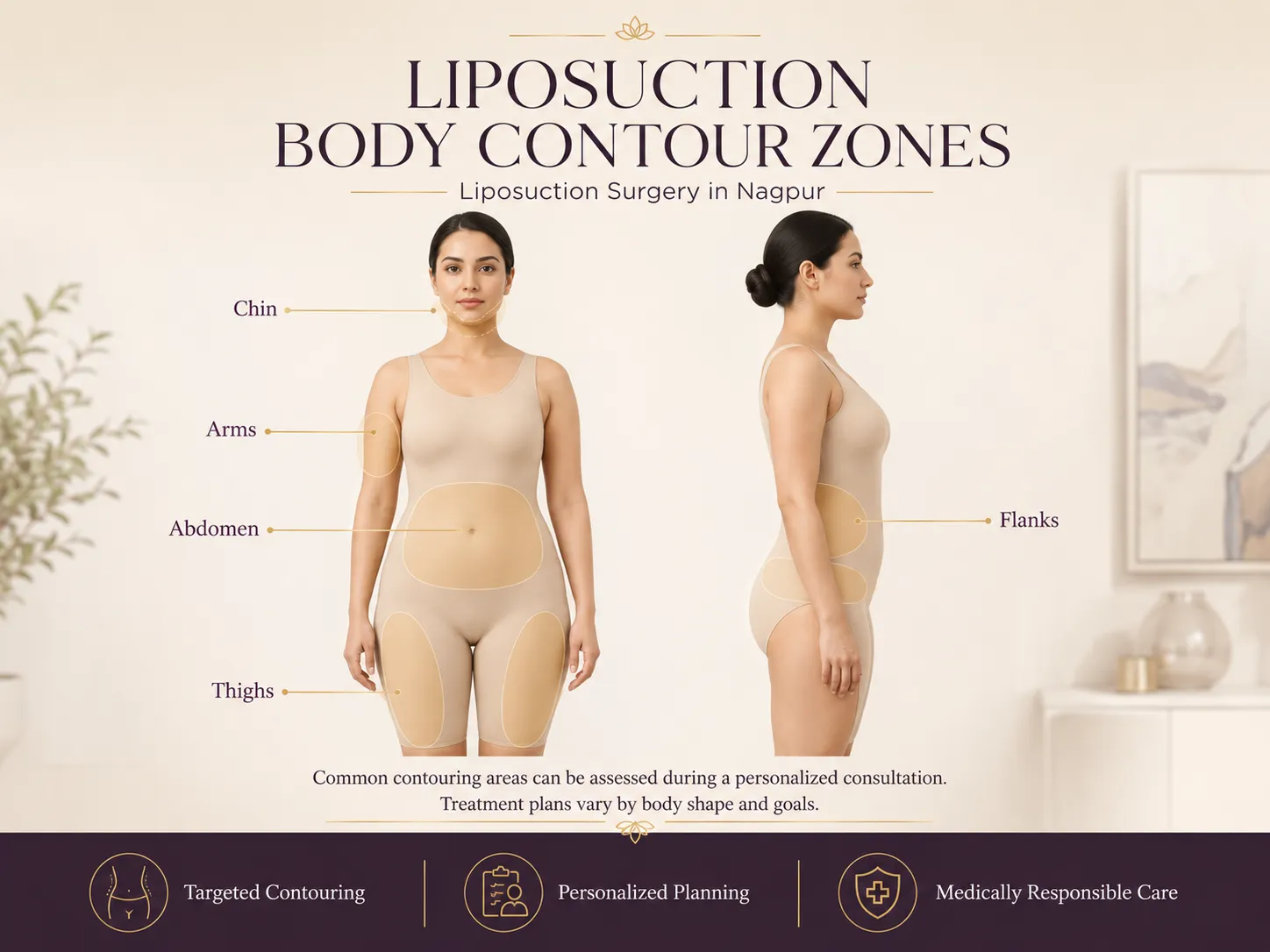
Educational illustration of common liposuction body contour zones
Educational body-zone illustration. Treatability depends on anatomy, skin quality, medical risk and the procedure selected.
Body Zones

A body area is not a diagnosis

A patient may describe “belly fat,” “love handles,” “arm fat” or a “double chin,” but the visible contour can come from different tissues. For example, abdominal prominence can involve subcutaneous fat, visceral fat, loose skin, muscle separation, posture, bloating or a combination.

Commonly assessed areas

  • Abdomen, waist and flanks
  • Hips and outer thighs
  • Inner thighs and knees
  • Upper arms and armpit region
  • Back and bra-line areas
  • Chin / neck in selected patients

What examination adds

  • Pinchable subcutaneous fat
  • Skin thickness and elasticity
  • Scars and previous surgery
  • Abdominal-wall laxity
  • Asymmetry and surrounding transitions
  • Medical, anaesthetic and clot risk
Realistic Limits

What body contouring cannot responsibly promise

Not a treatment for obesity

Liposuction and device-based contouring do not replace weight-management care and do not remove dangerous visceral fat around internal organs.

No guaranteed skin tightening

Skin may redrape after fat reduction when elasticity is good, but substantial loose skin may remain or become more visible.

No exact symmetry or perfection

Normal bodies are asymmetric. Swelling, tissue response, scar behaviour and healing biology can create residual differences or contour irregularity.

No permanent immunity from change

Future weight change, pregnancy, ageing and tissue stretching can alter a result even after a well-planned procedure.

Assisted technology is not automatically superior

VASER, laser and other devices are tools. A device name should not replace patient selection, anatomy, technique and safety planning.

Combining more is not always better

Large or multi-area operations increase procedure burden. Staging may be safer or more sensible in some patients.

Safety & Complications

Risks change with the pathway

This hub summarizes categories. The procedure-specific page and consultation should explain your individual risk profile in more detail.

Liposuction-type surgery

Bruising, swelling, seroma, numbness, contour irregularity, asymmetry, infection, skin injury, bleeding, anaesthetic complications, clots and possible revision.

Abdominoplasty

Wound-healing problems, seroma, infection, prominent scars, altered sensation, tissue blood-supply problems, clots, anaesthetic complications and revision.

Fat transfer

Donor-site contour issues plus recipient-site fat resorption, nodules, fat necrosis, asymmetry, infection and area-specific risks depending on where fat is placed.

Non-surgical devices

Temporary pain, swelling, bruising, numbness or skin change may occur; device-specific risks can include burns, pigment change, nerve symptoms or unexpected contour changes.

Seek urgent medical help for serious warning symptoms: new chest pain or breathlessness, fainting, severe or rapidly worsening pain, one-sided calf swelling/pain, uncontrolled bleeding, rapidly expanding swelling, high fever with worsening illness, or significant skin darkening/blistering after an energy-based procedure. Contact the clinic promptly for wound separation, pus, worsening redness, persistent vomiting, marked asymmetry or any concern that is escalating rather than settling.
Aftercare Overview

Recovery is procedure-specific, but several principles recur

Always follow your own written discharge instructions if they differ from a general website guide.

After liposuction

Early walking, hydration, wound care and compression when prescribed are common. Garments may be removed briefly for hygiene and skin checks according to the surgeon’s instructions. Lymphatic-drainage massage, when advised, is generally delayed until early healing is established rather than started immediately.

After abdominoplasty

Early assisted walking, posture guidance, drain/wound care if relevant, compression as prescribed and gradual activity progression are important. Lifting and strenuous exercise are restricted longer than after small-area liposuction.

After fat transfer

Both donor and recipient areas need care. Compression may be used on donor zones while direct pressure on the recipient site may be restricted depending on the body area and surgical plan.

After non-surgical treatment

Care varies by device. Follow instructions for skin cooling, moisturising, sun protection and activity. Report blistering, severe pain, progressive numbness or marked skin-colour change promptly.

Detailed recovery instructions are centralized in the Patient Care Guide.Use it together with your procedure page and the individualized instructions given at discharge.
Open Patient Care Guide
Consultation Checklist

A useful consultation should answer more than “Can this fat be removed?”

What is actually causing the contour?

  • Subcutaneous fat or visceral fat?
  • Loose skin or poor elasticity?
  • Abdominal-wall laxity or muscle separation?
  • A volume deficit needing addition rather than removal?
  • Glandular tissue, edema or another non-fat cause?

What trade-offs come with the proposed plan?

  • Expected scale of change
  • Incisions and scars
  • Anaesthesia and facility
  • Compression and aftercare
  • Time away from work/exercise
  • Possible need for staging or revision

What alternatives should be compared?

  • No procedure / weight stability first
  • Standard versus assisted liposuction
  • Abdominoplasty when skin is dominant
  • Non-surgical reduction for modest goals
  • Fat transfer when volume addition is the goal

What should be written down?

  • Exact areas and procedure
  • What is and is not included
  • Investigations and medicines
  • Garments, dressings and follow-up
  • Expected recovery milestones
  • Who to contact if a warning sign appears
Cost Factors

Body contouring cost in Nagpur depends on the actual plan

A single public package price can be misleading because a small localized treatment and a multi-area operation have very different requirements.

Procedure factors

  • Body area(s) and extent
  • Surgical or non-surgical route
  • Standard or assisted technique
  • Previous surgery or scar tissue
  • Combination or staged procedure

Safety/facility factors

  • Anaesthesia plan
  • Operating-facility requirements
  • Investigations and medical clearance
  • Possible overnight monitoring
  • Procedure duration and complexity

Recovery factors

  • Compression/support garments
  • Dressings and medicines
  • Scheduled postoperative reviews
  • Drain or wound care if needed
  • Whether additional treatment is planned later
Verified Patient Feedback

What patients have said about Dr. Shahane’s care

These verbatim Google review excerpts describe consultation or care experiences. They are not presented as body-contouring outcome claims and do not predict another patient’s result.

★★★★★
General cosmetic surgery
“Good Work on Cosmatic surgery.”
Ashish Barokar
Verified Google review
★★★★★
Injury / reconstruction
“Had a treatment for the injury and it was a great experience. It was like after removing stitches it looks as it was almost before the injury”
Maroti Nawghade
Verified Google review
★★★★★
Gynecomastia surgery
“Best cosmetic surgeon, I strongly recommend, him for all plastic surgery. He is very intelligent and guides you very well.”
Sachin Batra
Verified Google review · patient-authored wording
Questions Patients Often Ask

Body contouring FAQs

Visible questions below match the FAQ schema exactly.

What does body contouring mean?
Body contouring is an umbrella term for procedures that change body shape by addressing selected subcutaneous fat, excess skin, abdominal-wall laxity or a contour volume deficit. The appropriate pathway depends on the tissue causing the concern rather than on a single machine or technique.
Is body contouring a weight-loss treatment?
No. Liposuction and non-surgical fat-reduction methods are not treatments for obesity or substitutes for nutrition, activity or medical weight management. Body contouring is intended for shape and proportion in appropriately selected patients.
How do I know whether I need liposuction or a tummy tuck?
Liposuction mainly reduces selected subcutaneous fat. Abdominoplasty is considered when excess abdominal skin and sometimes muscle or fascial laxity are important parts of the problem. Examination is needed because many people have a mixture of fat, skin and abdominal-wall change.
Can liposuction tighten loose skin?
Some skin redraping can occur when elasticity is good, but liposuction does not reliably remove substantial loose skin. If skin laxity is the dominant problem, excisional surgery may be more appropriate.
What is VASER liposuction and is it always better?
VASER is ultrasound-assisted surgical liposuction. It can be useful in selected situations, but it is not automatically superior for every patient or body area. Technique selection should follow anatomy, tissue quality, safety and the contouring goal.
Is laser lipolysis the same as non-surgical fat reduction?
Not necessarily. The term laser lipolysis can refer to an internally delivered minimally invasive or surgical laser-assisted technique, while some external devices use energy without incisions. The exact device and whether fat is aspirated should be clarified before treatment.
When can non-surgical fat reduction be considered?
It may be considered for selected small localized fat concerns when a person understands that the change is usually more modest and less predictable than surgical fat removal. It does not treat obesity, significant loose skin or visceral fat.
What is fat transfer for body contouring?
Fat transfer removes fat from a suitable donor area using liposuction, processes it and places selected amounts into another area to improve proportion or a contour deficit. It is a two-site procedure with donor- and recipient-area limitations.
Which areas can be treated with body contouring?
Depending on anatomy and procedure, areas may include the abdomen, waist, flanks, hips, thighs, arms, armpit region, chin or neck, cheeks and selected donor or recipient areas for fat transfer. Not every technique is appropriate for every area.
What are the main risks of body-contouring procedures?
Risks vary by procedure and can include bruising, swelling, infection, fluid collections, numbness, asymmetry, contour irregularity, poor scarring, skin injury, anaesthetic complications, clots and the possibility of revision. Device-assisted and fat-transfer procedures also have technique-specific risks.
How long is recovery after body contouring?
Recovery varies greatly. A small non-surgical treatment may have little downtime, limited liposuction may require days to a couple of weeks for routine work, and abdominoplasty or multi-area surgery generally requires a longer staged recovery. Swelling and final contour can continue changing for months.
How is body contouring cost decided in Nagpur?
Cost depends on the tissue problem, body areas, treatment extent, procedure or device, anaesthesia, facility requirements, investigations, garments, medicines, follow-up and whether procedures are safely combined. A responsible quote follows examination and a written plan rather than a generic package price.
Medical References

Patient-safety sources used for this hub

  1. American Society of Plastic Surgeons. Liposuction: indications, limits and patient information.
  2. U.S. Food and Drug Administration. Non-Invasive Body Contouring Technologies. Updated October 2025.
  3. NHS. Tummy tuck (abdominoplasty).
  4. NHS. Surgical fat transfer.
  5. NHS. Liposuction.

Medically reviewed 9 August 2026. These references support general educational distinctions and do not establish suitability for an individual patient.

Private Consultation · Dhantoli, Nagpur

Choose a body-contouring plan after the tissue is examined—not before.

Bring your main concern, medical history, previous surgery details and questions about scars, downtime, safety and realistic change. The consultation should compare reasonable alternatives, including doing nothing or staging treatment when appropriate.

Mayflower ClinicSurdham Complex, Dhantoli, Nagpur — 440012, Maharashtra, India
Contact0712 6692706
+91 80874 71244
contact@mayflowerclinic.in
Clinic HoursMonday–Saturday · 11 AM–6 PM
Sunday closed

Medical Disclaimer: Body contouring includes procedures with very different indications, limitations and risk profiles. All surgical procedures carry inherent risks, and individual outcomes vary according to anatomy, tissue quality, medical health and healing biology. Non-surgical treatments also have variable response and device-specific risks. Results are not guaranteed. Formal in-person consultation with Dr. Pawan Shahane is required before any surgical decision. This page is for general educational purposes only and does not constitute medical advice, diagnosis or a treatment recommendation.