0712 6692706 / 0712 3551170 / +91 8087471244   |   contact@mayflowerclinic.in
M.Ch. Plastic Surgery · Function-first reconstruction

Burn Reconstruction Surgery in Nagpur

A healed burn can leave tight scars, restricted joints, unstable skin or distortion of an important structure. Burn reconstruction is a carefully staged process that aims to improve movement, protection, comfort and appearance—without promising that every scar can be removed.

Dr. Pawan Shahane, M.Ch. Plastic Surgery
Reviewed by Dr. Pawan Shahane, M.Ch. Plastic Surgery 21+ years surgical practice · Ex-Assistant Professor, GMC Nagpur & NKPSIMS · IAAPS Member
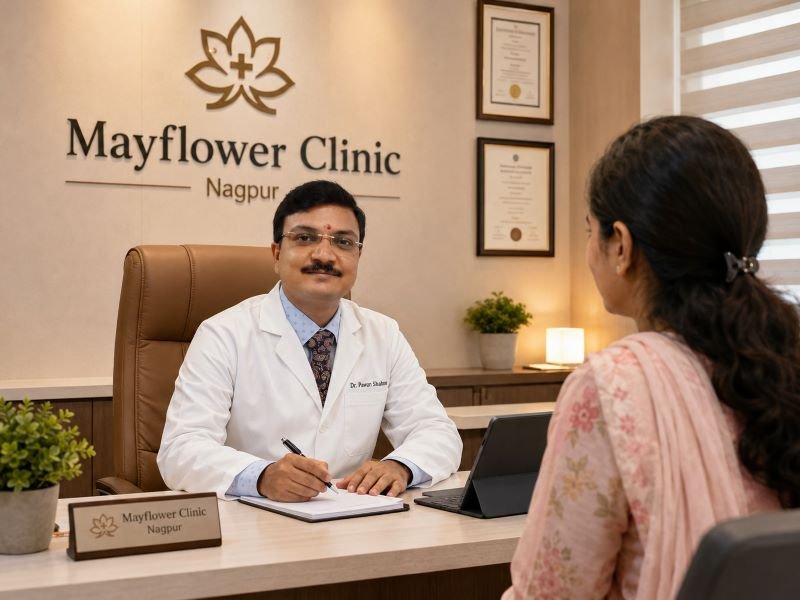
Dr. Pawan Shahane discussing burn reconstruction planning with a patient at Mayflower Clinic Nagpur
Mayflower Clinic · Dhantoli, Nagpur
21+Years of surgical practice
M.Ch.Plastic Surgery qualification
PersonalAssessment and surgical planning
StagedReconstruction and rehabilitation
Quick guidance · Detailed explanations below

Quick Answer

Local page tool
Burn reconstruction may be considered for scars that restrict movement, pull an eyelid or mouth, repeatedly break down, cause a web-space deformity, interfere with growth or create another meaningful functional problem. See problems assessed.
Understanding reconstruction

What is burn reconstruction?

Initial burn treatment focuses on saving life, controlling infection, closing wounds and protecting function. Reconstruction addresses selected problems that remain after the wound has healed or become stable. These problems may appear early, or become more obvious over time as scars mature, joints stiffen or a child grows.

The aim is not simply to make a scar lighter. A reconstructive plan asks practical questions: Does the scar restrict a joint? Does it pull an eyelid away from the eye? Does it limit mouth opening, neck extension, hand use or walking? Is the surface fragile and repeatedly ulcerating? Is there enough healthy nearby tissue for a local rearrangement, or is graft or flap coverage required?

Some concerns improve with non-operative scar care. Others need a focused operation; complex injuries may need several stages. The plan is personalised after examining the scar, surrounding tissues, circulation, sensation, joint movement, previous grafts and the patient's rehabilitation needs.

Function guides the sequence

“In burn reconstruction, the first priority is usually to release what limits movement or threatens an important structure. Appearance matters, but the safest and most useful plan begins with function, tissue quality and a realistic rehabilitation pathway.”
Dr. Pawan Shahane, M.Ch. Plastic Surgery · Founder, Mayflower Clinic, Nagpur
Problems assessed

When may burn reconstruction be considered?

A consultation focuses on the specific limitation rather than the appearance of the scar alone.

Joint contracture

Tight scar crossing the neck, shoulder, elbow, wrist, fingers, hip, knee or ankle may reduce movement and daily function.
Hand deformity

Web-space tightening, finger contracture, thumb restriction, graft tightening or loss of useful hand span may need specialised planning.

👁

Facial distortion

Scars may pull the eyelid, lip, nose, ear or neck. Protection of the eye, mouth function and facial expression may take priority.

🛡

Unstable scar

Some scars repeatedly crack, ulcerate or break down, especially over pressure points, creases or poorly padded areas.

Pain, itching or sensitivity

Persistent symptoms require assessment because treatment may involve scar care, nerve evaluation, medication, rehabilitation or selected surgery.

🧒

Growth-related tightening

In children, a scar may become relatively tight as the body grows. Repeat assessment and staged correction may be required.
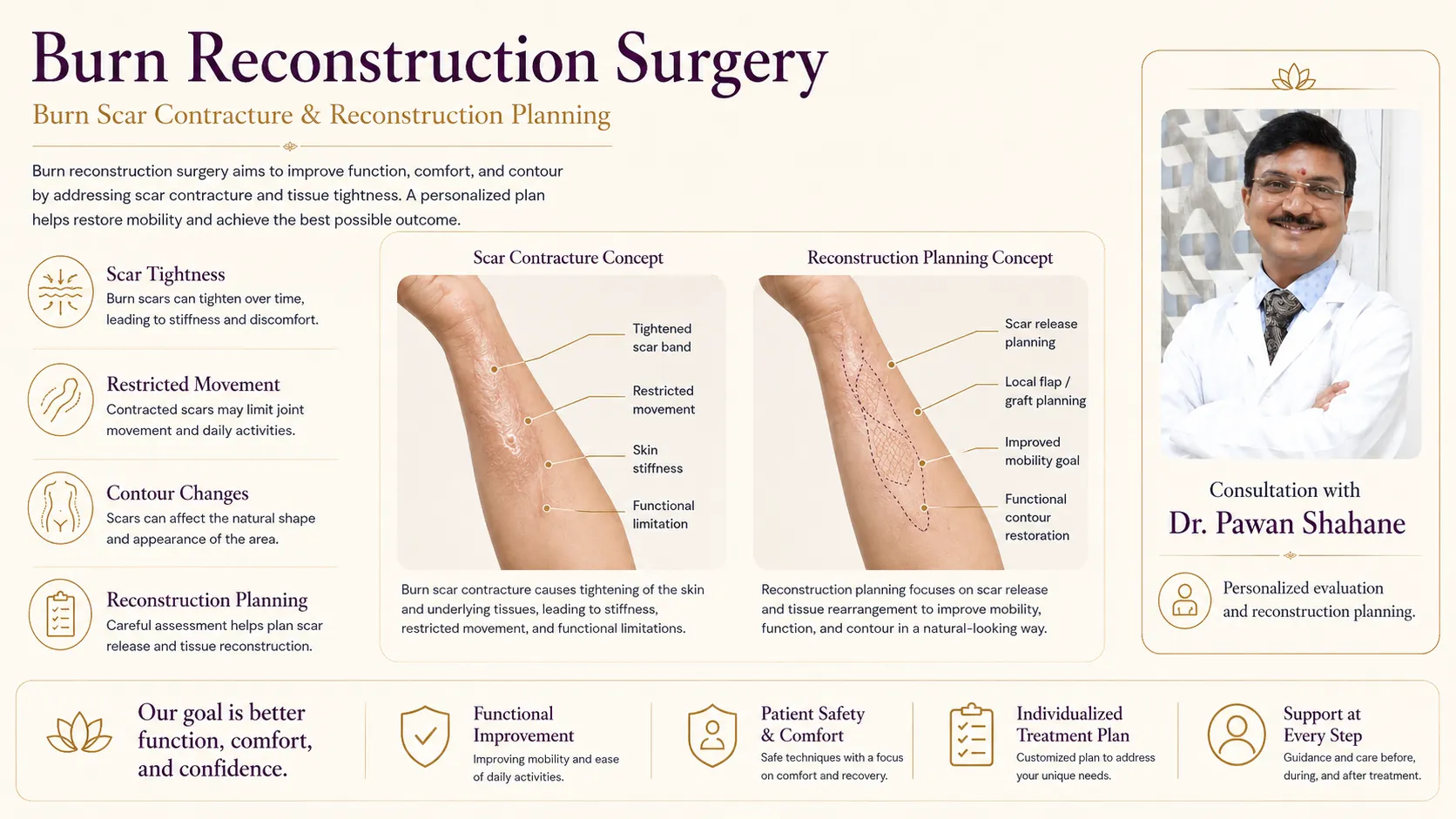
Burn scar contracture reconstruction concept showing assessment, release and resurfacing options
Educational overview: a contracture is assessed according to location, depth, available healthy tissue, functional restriction and risk of recurrence. The actual operation may differ.
Consultation and evaluation

How is a post-burn scar assessed?

1

Burn and treatment history

Cause and date of injury, depth, infection, grafting, previous operations, healing time and present symptoms are reviewed.

2

Scar behaviour

Thickness, colour, pliability, tenderness, itching, adherence, instability and maturity of the scar are examined.

3

Movement and function

Joint range, hand use, eyelid closure, mouth opening, neck position, gait or other site-specific functions are documented.

4

Tissue and circulation

The surgeon assesses adjacent healthy skin, previous grafts, blood supply, sensation, exposed structures and donor-site options.

5

Rehabilitation readiness

Access to physiotherapy, hand therapy, splinting, dressings, family support and the ability to protect the reconstruction are considered.

6

Priority and staging

Problems threatening the eye, airway, feeding, hand function, walking or a major joint are often prioritised before appearance-only concerns.

Treatment options

Which techniques may be used?

The simplest suitable method is preferred, but the scar must be released adequately and the resulting defect covered with tissue that can tolerate movement and healing.

OptionWhat it doesWhen it may be consideredImportant limitation
Non-operative scar careUses moisturising, massage, silicone, pressure, splinting, stretching and therapy.Selected raised, itchy, sensitive or tightening scars without a fixed severe deformity.Requires consistency and does not replace surgery for every established contracture.
Scar release with Z-plastyRearranges local skin to lengthen a tight scar and change its direction.Linear or localised contractures with usable surrounding tissue.Not suitable when the scarred area is too broad, poor quality or lacking healthy adjacent skin.
Skin graftingCovers the defect after scar release with skin taken from another area.Broad defects where local closure is not possible and the wound bed is suitable.Grafts can contract, differ in colour or texture and require donor-site healing.
Local or regional flapMoves nearby tissue with its blood supply to provide thicker, more durable coverage.Exposed structures, joint areas, recurrent contracture or defects needing robust tissue.Creates additional scars and depends on available tissue and vascular anatomy.
Free-flap reconstructionTransfers tissue from a distant site using microsurgical blood-vessel connection.Selected complex defects where simpler options cannot provide adequate coverage.Longer surgery, greater complexity and specialised postoperative monitoring.
Tissue expansionGradually stretches nearby healthy skin to create additional tissue for reconstruction.Selected stable areas where adjacent skin offers a useful colour and texture match.Requires staged visits, time and protection of the expander; complications can interrupt the plan.
Scar revision or selected laser treatmentMay improve a scar's contour, texture, pliability or symptoms in selected cases.After careful evaluation of scar type, skin type, maturity and functional needs.Cannot erase the scar and may require several sessions or combination treatment.
Staged care pathway

Your burn reconstruction journey

1
Consultation

Define the functional problem

Bring previous discharge summaries, operative notes, photographs, therapy records and a list of current symptoms. The limiting scar and realistic goal are identified.

2
Planning

Choose the reconstructive ladder

The plan may range from continued scar care to local rearrangement, graft, flap, tissue expansion or a staged combination. Donor sites and rehabilitation are discussed.

3
Before surgery

Prepare skin, health and support

Medical fitness, medicines, nutrition, smoking or nicotine use, wound condition and home support are reviewed. Splints or therapy may be planned in advance.

4
Procedure day

Release and resurface safely

The restrictive tissue is released as required and the defect is reconstructed using the selected method. Procedure duration and stay depend on complexity.

5
Early recovery

Protect the reconstruction

Dressings, elevation, positioning, pain control and protection of grafts or flaps are prioritised. The team explains warning signs and activity restrictions.

6
Rehabilitation

Maintain the surgical gain

Therapy begins at a timing appropriate to the reconstruction. Splinting, range-of-motion work, strengthening and scar care may continue for weeks or months.

7
Long-term review

Monitor scar maturation and recurrence

Further treatment may be considered only after healing and reassessment. Complex burns, facial scars and growing children may need planned staged follow-up.
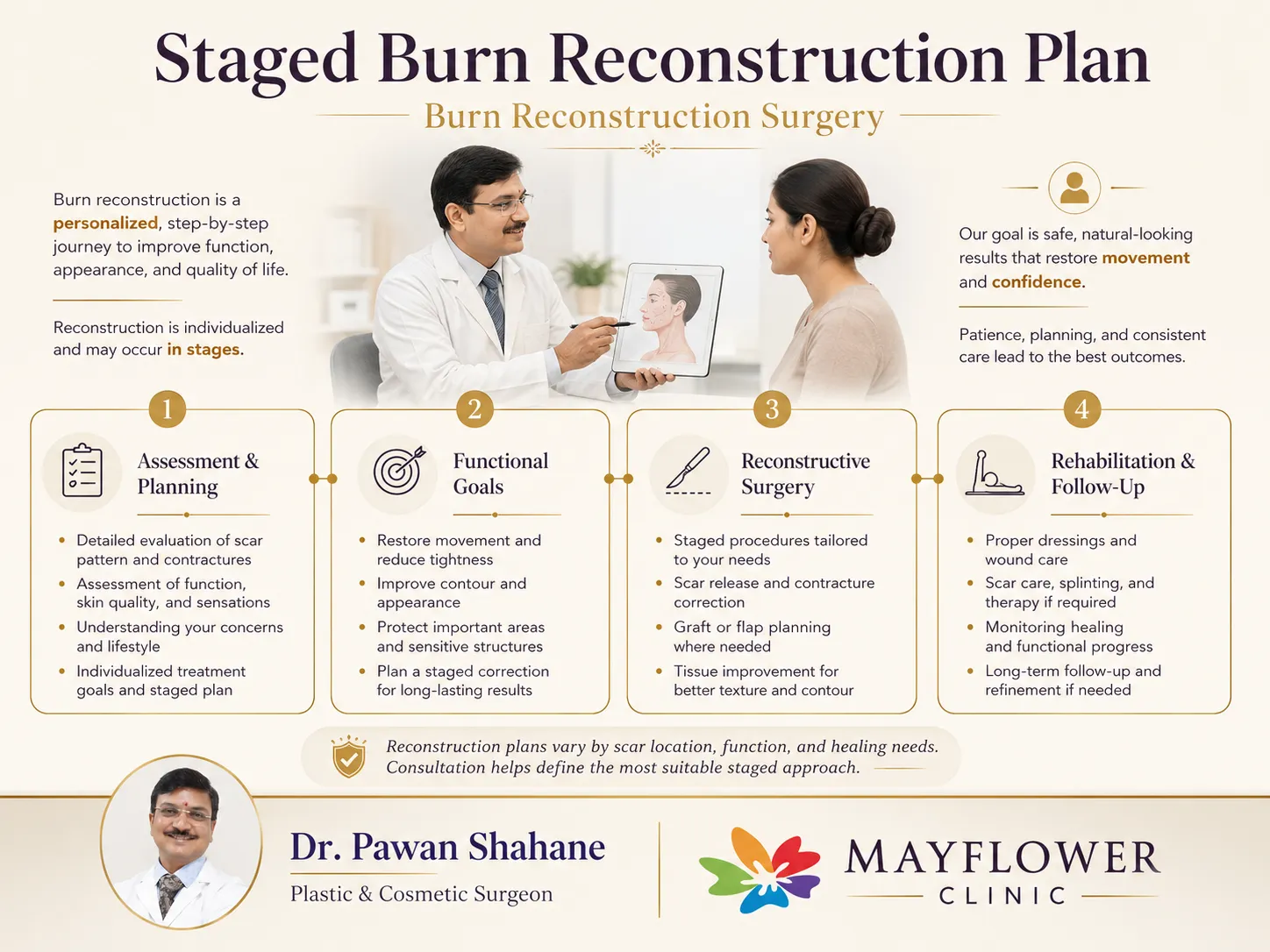
Staged burn reconstruction plan from assessment and surgery to rehabilitation and follow-up
A staged pathway helps coordinate surgery, protection, rehabilitation and long-term scar review.

Timing is individual

Some scars are observed while they mature; others need earlier action because they threaten the eye, mouth, neck position, hand use or movement at a major joint. Timing is decided clinically rather than by a fixed number of months.

Recovery and rehabilitation

What recovery may involve

🩹

Wound and dressing care

Keep dressings clean and dry as instructed. Grafts, flaps and donor sites have different protection and review schedules.

🛏

Positioning and elevation

Elevation and prescribed positioning may help swelling and protect the corrected length or contour.

🦾

Splints and supports

A custom splint may hold the reconstructed area in a therapeutic position. Use must follow the therapist's schedule.

Guided movement

Movement may begin early or be delayed depending on graft take, flap stability, tendon exposure, joint work and surgeon instructions.

Scar and sun care

Once healed, moisturising, massage, silicone or pressure therapy may be recommended. New scars also need sun protection.

🚩

When to contact the team

Report fever, worsening redness, foul discharge, increasing pain, bleeding, sudden swelling, colour change, loss of movement or dressing problems promptly.

Realistic expectations

Risks, limitations and possible need for further stages

Burn reconstruction can provide meaningful improvement, but scarred tissue has altered biology and every operation creates new scars. The expected benefit must be balanced against wound-healing risk, donor-site effects and the possibility of recurrence.

  • Bleeding, infection, delayed healing or wound separation
  • Partial or complete graft loss
  • Flap congestion, reduced blood supply or flap loss
  • Recurrent contracture or limited range-of-motion gain
  • Altered sensation, pain, numbness or hypersensitivity
  • Colour, thickness or texture difference at the reconstructed area
  • Donor-site scar, discomfort, contour change or healing problem
  • Need for splinting, prolonged therapy or another procedure
  • Anaesthesia-related and medical risks based on individual health

What surgery cannot promise

  • Complete removal of every visible scar
  • Perfectly normal colour, texture or sensation
  • Full movement in every severely damaged joint
  • One-stage correction of every complex burn deformity
  • No recurrence during growth or scar remodelling

The consultation should clarify the most useful achievable goal, what trade-offs are involved and how rehabilitation affects the outcome.

Reconstructive planning in Nagpur

Why specialist plastic-surgery assessment matters

Burn scars differ greatly in depth, shape, tissue quality and functional impact. Releasing a scar creates a defect that must be resurfaced appropriately; choosing between a graft, local flap, regional flap, tissue expansion or microsurgical option requires reconstructive judgement.

At Mayflower Clinic, Dr. Pawan Shahane personally evaluates the scar, sets priorities and explains whether the problem is suited to conservative care, a focused operation or staged reconstruction. Where therapy, hospital admission, anaesthesia or multidisciplinary support is required, this is incorporated into the plan.
Dr. Pawan Shahane with Indian Association of Aesthetic Plastic Surgeons membership information
Patient experiences

Feedback about reconstructive and plastic-surgery care

These testimonials relate to other reconstructive or plastic-surgery concerns and are not claims about burn-reconstruction outcomes.

★★★★★
“I had accident and had trauma to face… Scar was pulling my eye… He explained me everything. I go for surgery and now, my eye is free.”
Rajendra UkeyPatient testimonial · facial scar reconstruction
★★★★★
“I had this lypoma in my right forearm… the doc is always there to help… Thank you so much doctor. Really grateful.”
Dhanashree SadawartiPatient testimonial · forearm surgery
★★★★★
“Good experience. Highly skilled surgeon. Post op care and consultation was also done nicely.”
Mahika GoelPatient testimonial · surgical care
Clear answers for patients and families

Common questions about burn reconstruction

What is burn reconstruction surgery?
Burn reconstruction surgery is planned treatment for selected scars, contractures and deformities that remain after a burn has healed or stabilised. Its goals may include improving movement, comfort, protection and appearance.
Does every burn scar require surgery?
No. Many scars are managed with moisturising, massage, silicone, pressure therapy, splinting, exercises or observation. Surgery is considered when the scar causes a meaningful functional, protective or reconstructive problem.
What is a post-burn contracture?
A contracture occurs when scar tissue tightens and restricts movement or pulls nearby structures out of position. It is especially important around joints, the neck, eyelids, mouth and hands.
When should burn reconstruction be considered?
Assessment is appropriate when a healed burn scar restricts movement, repeatedly breaks down, causes pain or itching, distorts an important structure or creates a significant functional difficulty. Timing depends on wound stability, scar behaviour and urgency.
Which operations may be used for burn scars?
Options may include scar release, Z-plasty or other local tissue rearrangement, skin grafting, local or regional flaps, selected free-flap reconstruction, tissue expansion and scar revision. The technique is chosen after examination.
Can burn reconstruction improve movement?
Releasing a restrictive scar and resurfacing the area may improve range of movement, but the result depends on the joint, depth of injury, surrounding tissues, rehabilitation and risk of recurrence.
Can burn reconstruction remove a scar completely?
No procedure can erase a burn scar completely. Reconstruction aims to replace or rearrange restrictive tissue and make the area more functional, stable or less conspicuous.
Is physiotherapy needed after burn reconstruction?
Rehabilitation is often central to maintaining the gain achieved by surgery. Depending on the area, this may include splinting, stretching, positioning, hand therapy, strengthening and scar care.
How long does recovery take after burn reconstruction?
Recovery varies widely because a small Z-plasty is different from graft or flap reconstruction. Wound healing may take weeks, while scar maturation, movement gains and staged rehabilitation can continue for months.
Can burn contractures return after surgery?
Recurrence can occur, particularly in growing children, severe scars, areas under tension or when rehabilitation is difficult. Long-term follow-up and adherence to therapy can be important.
Is burn reconstruction performed in one stage?
Some focused problems can be treated in one operation, while complex burns may require staged procedures. Priority is usually given to function, protection of vital structures and the most limiting contractures.
How is the cost of burn reconstruction decided?
Cost depends on the area involved, number of stages, need for graft or flap reconstruction, anaesthesia, hospital care, dressings and rehabilitation. A transparent estimate is provided after examination and planning.
Mayflower Clinic · Dhantoli

Book a burn-scar and contracture assessment

A consultation can clarify whether the concern is best managed with scar care, rehabilitation, a focused release or staged reconstruction—and what improvement is realistically achievable.

Medical Disclaimer: All surgical procedures carry inherent risks, and individual outcomes vary based on anatomy, burn depth, scar behaviour, tissue quality and healing biology. Surgical results are not guaranteed. Formal in-person consultation with Dr. Pawan Shahane is required before any surgical decision. This page is for general educational purposes only and does not constitute medical advice or a treatment recommendation. For a recent or serious burn, seek urgent emergency or burn-service assessment.