
★★★★★
Aarti KateVerified Mayflower Clinic Google reviewer. Procedure and outcome are not inferred on this page.

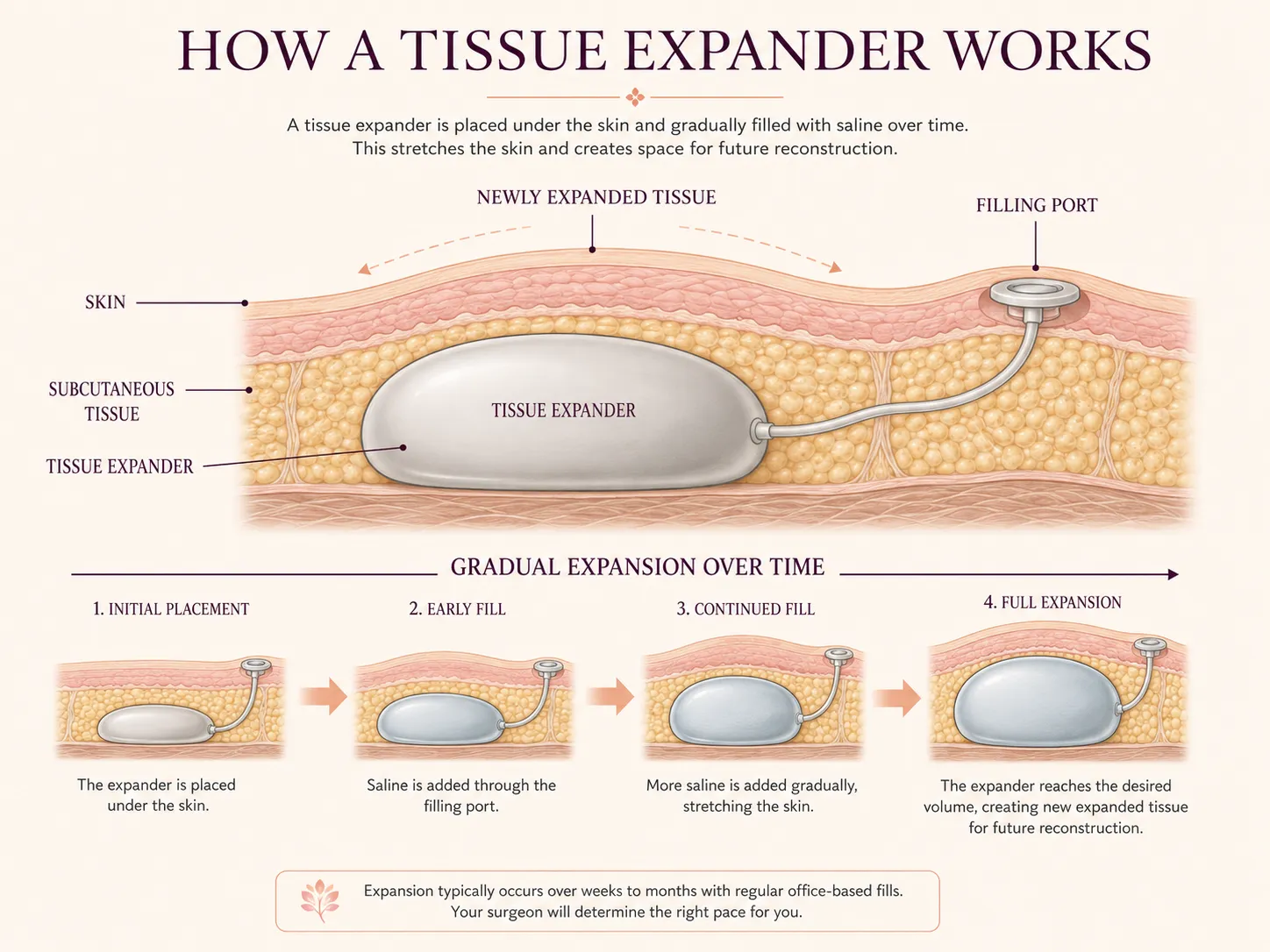
Tissue expansion is not a one-step cosmetic procedure. It is a planned reconstructive process in which a temporary expander is placed beneath suitable tissue and enlarged gradually, creating additional local skin and soft tissue that may later be used for reconstruction.


A tissue expander is a temporary reconstructive device placed beneath suitable skin and soft tissue near the area that needs reconstruction. After the placement site has healed sufficiently, the expander is enlarged gradually during planned follow-up visits.
The controlled increase in volume places stretch on the overlying tissue. Over time, this provides additional local tissue that can be used during a later reconstructive operation. Because the expanded tissue comes from next to the defect, it may offer useful similarity in colour, texture and—in selected scalp reconstruction—hair-bearing quality.
Important distinction: a tissue expander is not simply another name for a permanent implant. Its main purpose is to create or prepare tissue for a later reconstructive stage.
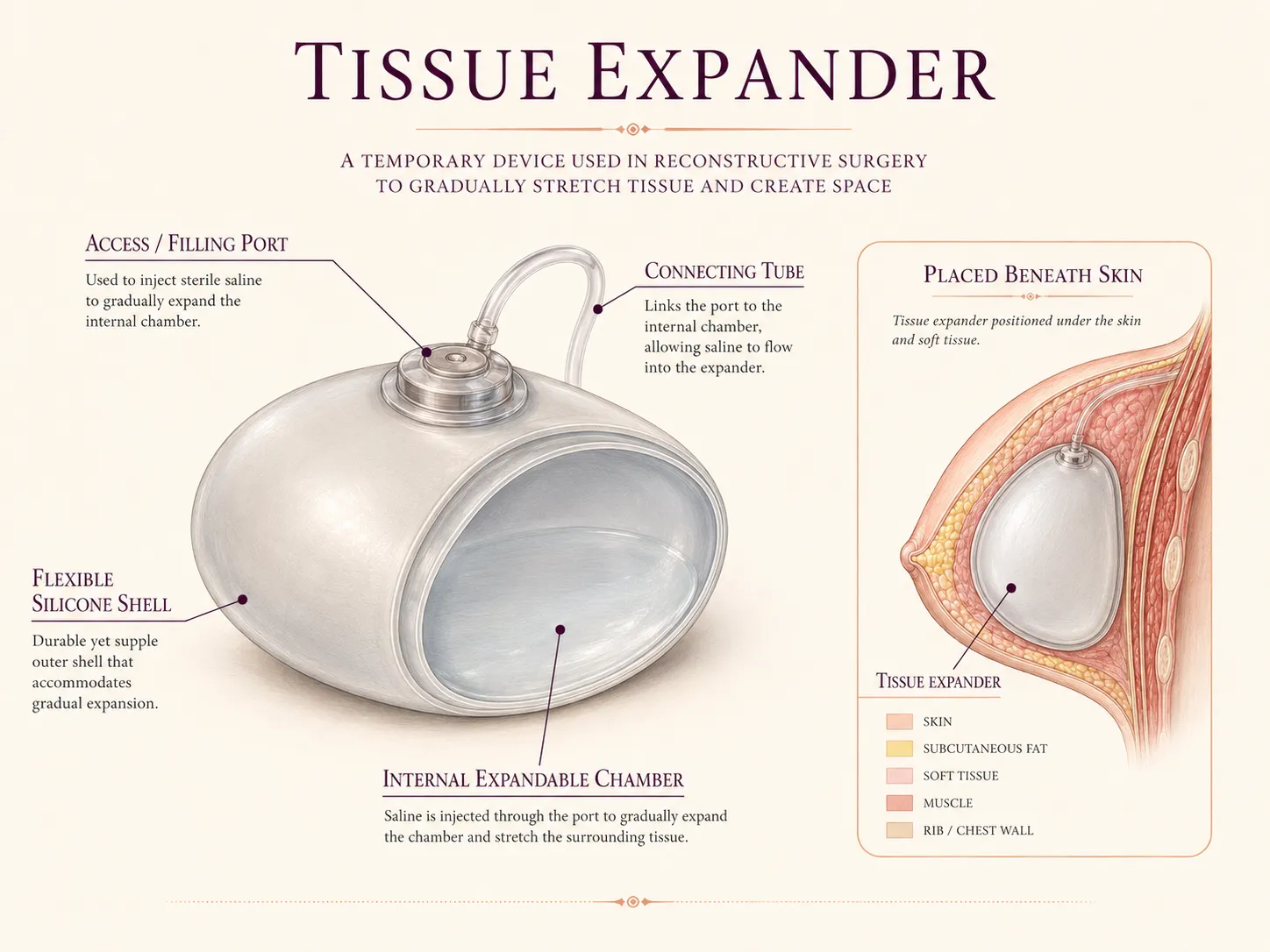
Different expanders are designed for different reconstructive sites. In general, the system includes a flexible expandable chamber and a method of accessing that chamber for controlled filling. Some designs use an integrated or remote filling port connected by tubing.
The part that increases in volume gradually to stretch the overlying tissue.
Allows controlled expansion during follow-up according to the device design and surgical plan.
Selected to match the reconstructive site, tissue available and planned direction of expansion.
The expander is generally removed during a later reconstructive stage once adequate tissue is available.
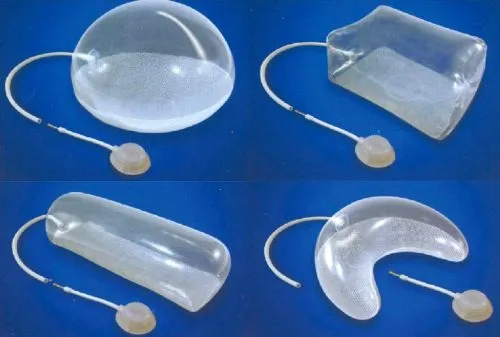
The photograph on this page shows real tissue expander devices in different shapes and sizes. Device selection is not based on choosing a “bigger” or “smaller” expander from a catalogue. It is a reconstructive planning decision.
Selection depends on the site to be reconstructed, the size and shape of the defect, the quality and mobility of surrounding tissue, the direction in which new tissue is needed, the location of scars, and the planned second-stage reconstruction.
Tissue expansion is a reconstructive option, not a diagnosis. Whether it is appropriate depends on the defect and the quality of the tissue around it.
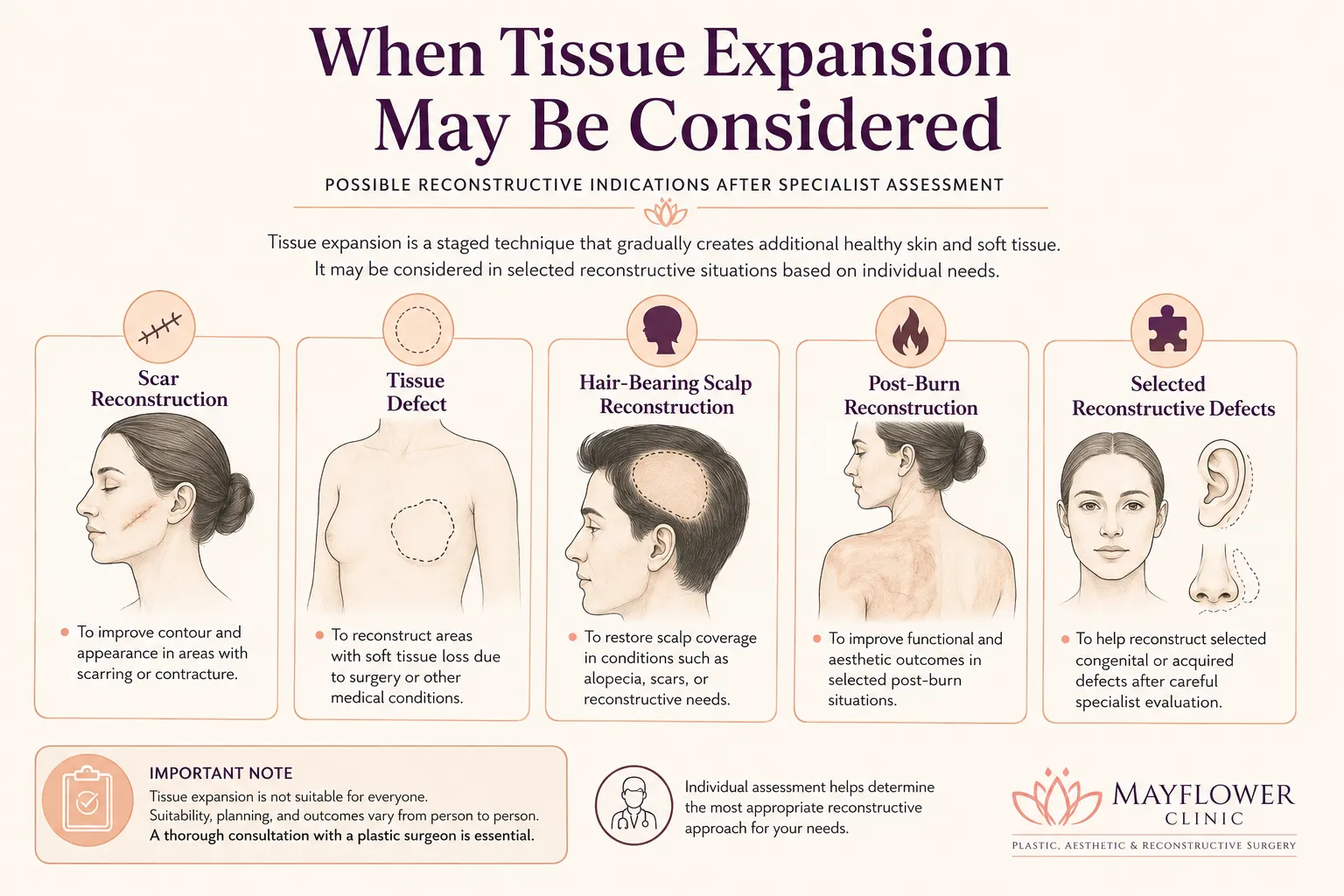
Selected scars or scarred areas where nearby healthy tissue can be expanded to assist reconstruction.
Selected areas of tissue loss after surgery, trauma or other acquired defects.
Especially useful when hair-bearing scalp tissue is important to the reconstructive goal.
Selected burn-scar problems when surrounding tissue quality and blood supply permit expansion.
Some congenital conditions may require additional local tissue as part of staged reconstruction.
Including selected breast, face, neck, limb or other reconstructive pathways when clinically appropriate.
The key requirement is not simply “needing extra skin.” Tissue expansion depends on whether there is enough healthy, reliable surrounding tissue to expand safely and whether the patient can complete a staged process with repeated follow-up.
A reconstructive defect with usable adjacent tissue, a clear staged plan, reasonable healing capacity and ability to attend repeated reviews.
Active infection, severely damaged or poorly vascularized tissue, very rigid scarred tissue, inability to protect the area or inability to complete follow-up may make another reconstructive option more appropriate.
Prior treatment can change tissue quality and blood supply. It does not automatically rule tissue expansion in or out; it changes the planning discussion.
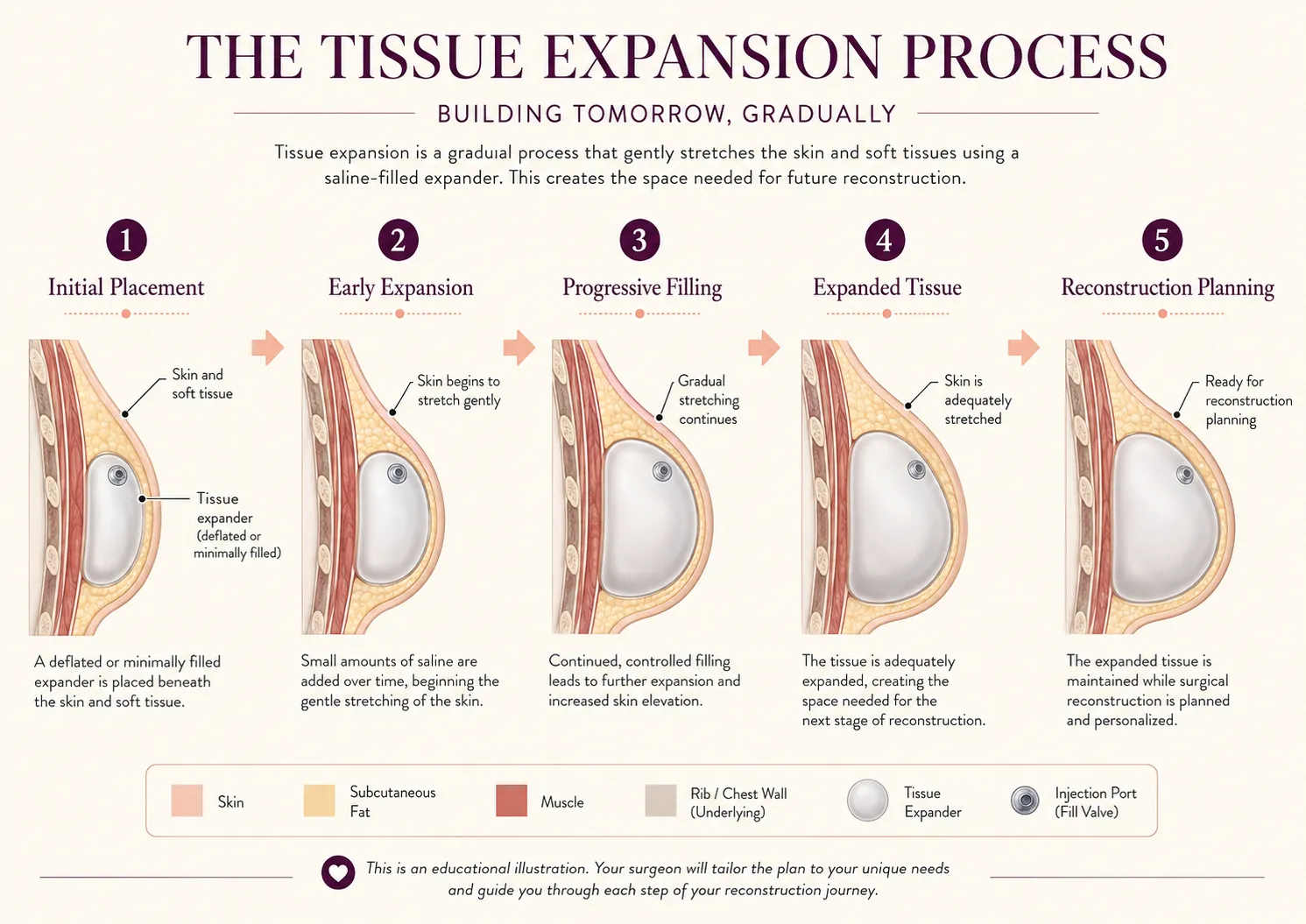
The surrounding tissue needs time to adapt. Expansion that is too rapid or inappropriate for the local tissue can increase pressure and may compromise the skin or wound.
At each visit, the surgeon assesses the wound, skin colour and quality, tension, discomfort, expander position and the amount of additional tissue still required. The expansion plan can therefore change during treatment.
The number, interval and amount of expansion are individualized. A responsible plan follows tissue response rather than a fixed visit count promised in advance.
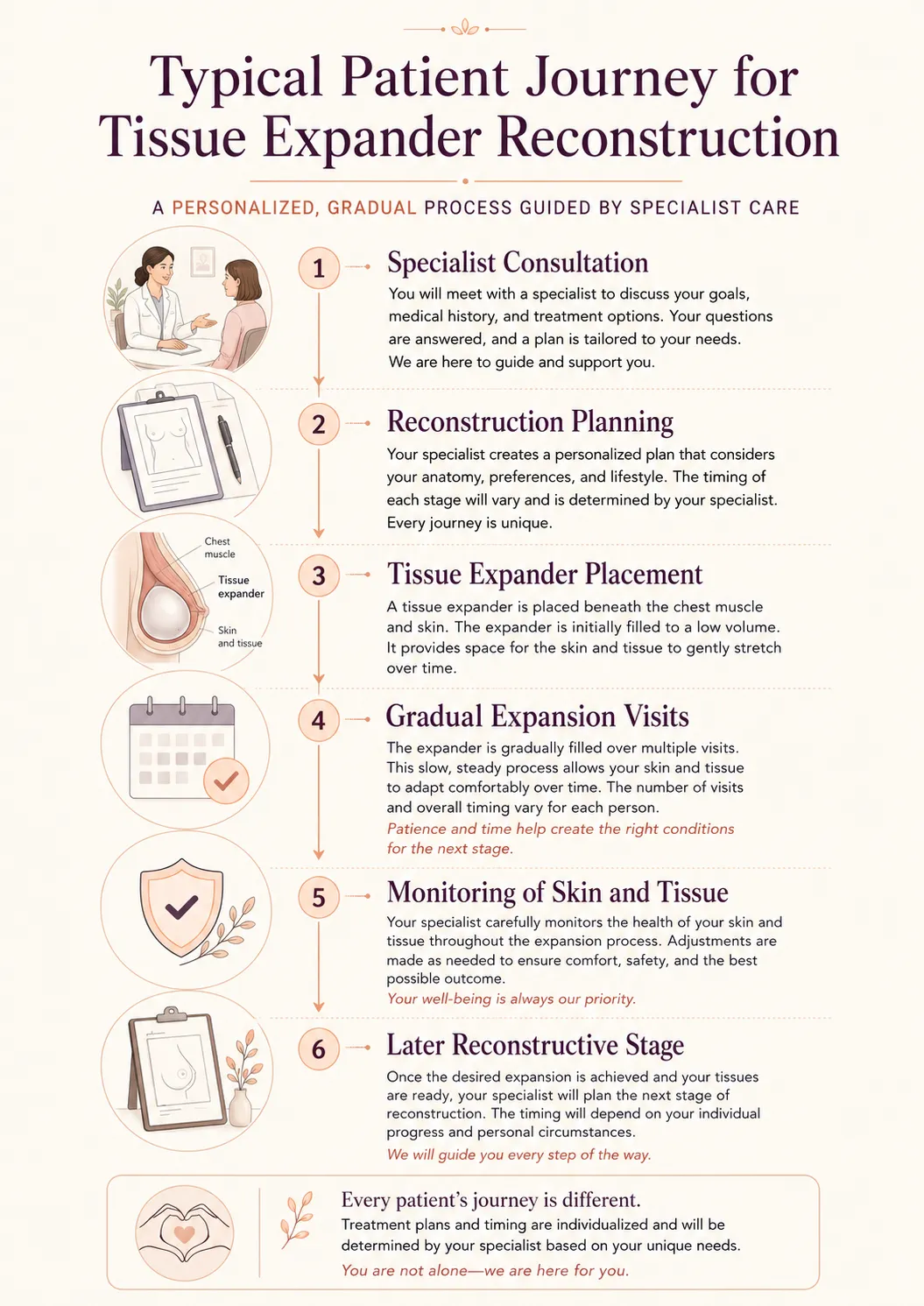
The exact sequence varies, but most plans include assessment, placement, gradual expansion, monitoring and a later reconstructive stage.
Define the reconstructive problem, examine nearby tissue, review previous operations or treatment and discuss realistic alternatives.
Select the site, direction, shape and size of expansion and plan where scars and the access port may be positioned.
The temporary expander is surgically placed beneath suitable tissue. Wound care and protection of the area begin immediately.
After sufficient healing, controlled expansion begins. The schedule is based on tissue response, not a fixed online protocol.
The surgeon monitors colour, tension, wound integrity, device position, discomfort and whether enough tissue is being created safely.
Once adequate tissue is available, the expander is removed and the expanded tissue is used according to the planned reconstruction.
Aftercare has two goals: protect the surgical wound and protect the skin being expanded. Instructions vary by body site and stage, so the plan given by the operating surgeon takes priority over generic internet advice.
Keep the area clean and dry as instructed and do not disturb dressings or sutures prematurely.
Expansion requires repeated review. Missing visits can delay recognition of skin or device problems.
Do not press, massage, puncture or manipulate the expander or access-port area unless specifically instructed.
Take prescribed medicines as directed and do not self-start antibiotics or pain medicines without checking when uncertain.
Follow the specific bathing, washing and activity instructions for the wound and anatomical site.
Do not wait for the next scheduled fill if redness, swelling, discharge, wound opening or skin changes develop.
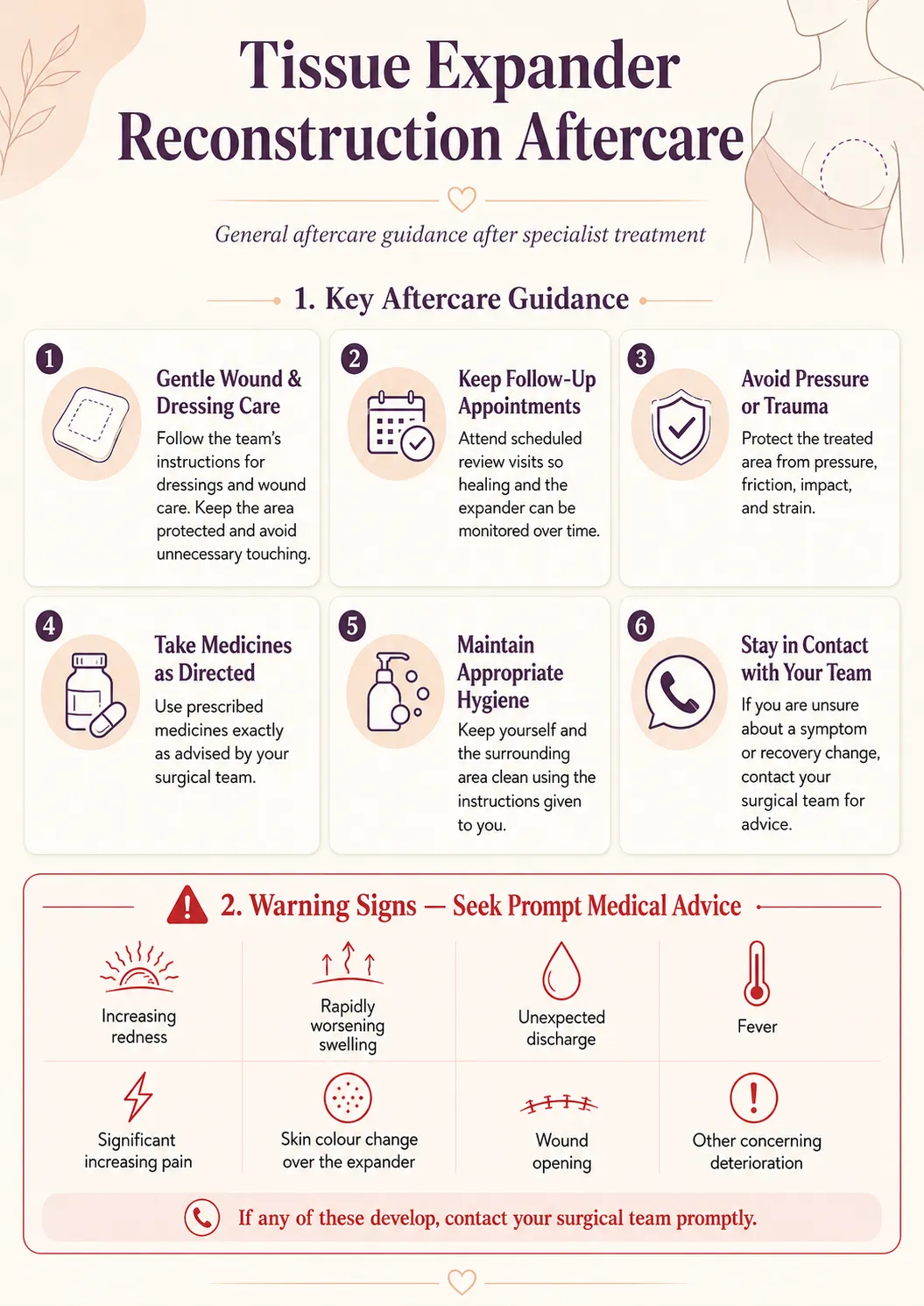
Tissue expansion is useful because it can create local tissue, but it is still surgery involving a temporary implanted device and repeated expansion. Complications can interrupt or change the reconstruction plan.
Emergency note: WhatsApp and website forms are not emergency services. Severe or rapidly worsening symptoms require urgent medical assessment.
The best alternative depends on the defect. A plastic surgeon may compare tissue expansion with local or regional flaps, skin grafts, staged scar revision, fat grafting, free-tissue transfer, implants or prosthetic reconstruction, or simply no surgery when the expected benefit does not justify the burden or risk.
Tissue expansion can be attractive because it uses nearby tissue, but it is not automatically the best reconstructive method for every site.
Explore Reconstructive Plastic SurgeryThe clinic review inventory verifies these Google reviewer names. Because the source available for this page does not identify them as tissue-expander patients, no tissue-expander procedure or result is attributed to them.
Verified Mayflower Clinic Google reviewer. Procedure and outcome are not inferred on this page.
Verified Mayflower Clinic Google reviewer. Procedure and outcome are not inferred on this page.
Verified Mayflower Clinic Google reviewer. Procedure and outcome are not inferred on this page.
These answers are educational and cannot determine your individual suitability.
References support general education only. Individual reconstruction, device selection, timing and aftercare require an in-person plastic-surgery assessment.
Bring prior operative notes, photographs or reports when available. Dr. Pawan Shahane can assess the defect, local tissue, previous scars and reconstructive alternatives before discussing whether staged tissue expansion is appropriate.

Case of the Month: Grade 3 Gynecomastia…

The Science of Facial Aging: Why Wrinkles,…