0712 6692706 / 0712 3551170 / +91 8087471244   |   contact@mayflowerclinic.in
M.Ch. Plastic Surgery · Peripheral Nerve Reconstruction

Nerve Surgery in Nagpur — Repair, Grafting, Nerve Transfer & Brachial Plexus Reconstruction

Peripheral nerve injuries can affect movement, sensation, protective feeling and pain. The correct plan depends on which nerve is injured, where it is injured, whether the nerve is compressed, stretched or divided, and how much time has passed.

This page focuses on nerves of the arms, hands, legs and brachial plexus. It does not describe surgery of the brain or spine.

Dr. Pawan Shahane, M.Ch. Plastic Surgeon in Nagpur
Reviewed by Dr. Pawan Shahane, M.Ch. Plastic Surgery 21+ years surgical practice · Ex-Asst. Prof. GMC Nagpur · IAAPS Member · Reconstructive and hand surgery care
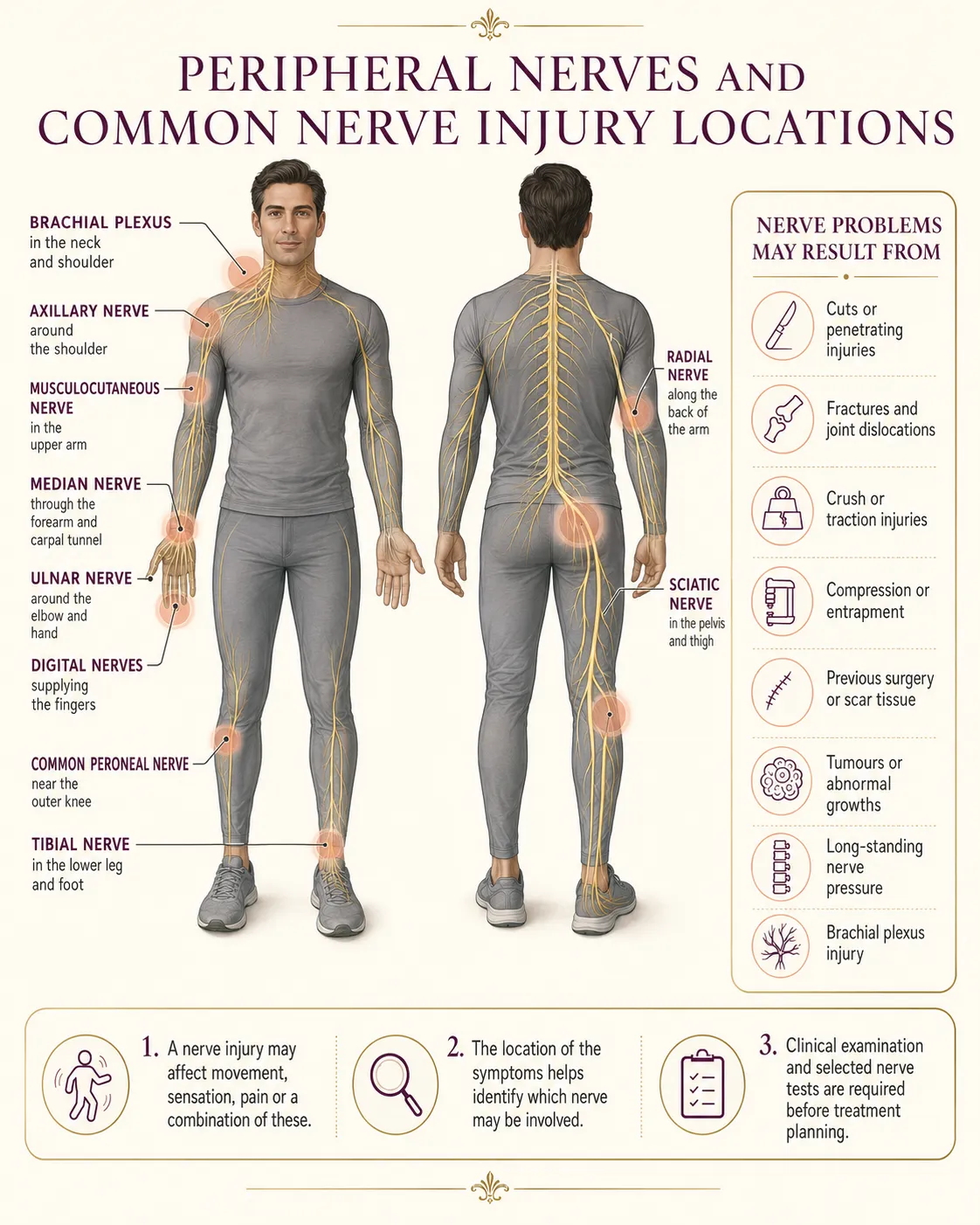
Peripheral nerve injury anatomy map showing common nerve pathways and injury locations in the upper and lower limbs
Peripheral nerve anatomyCommon nerve pathways and injury locations from the brachial plexus to the hand and lower limb
21+ YearsSurgical practice
M.Ch.Plastic Surgery qualification
Function FirstMovement, sensation and protection
Personal ReviewAssessment by Dr. Pawan Shahane
Clear scope

Peripheral nerve surgery is different from brain or spinal surgery

A peripheral nerve carries motor, sensory or mixed signals between the spinal cord and the limbs. Injury may follow a cut, crush, traction injury, fracture, dislocation, injection injury, previous surgery, scarring or prolonged compression.

Plastic and reconstructive nerve surgery commonly addresses accessible peripheral nerves, nerve gaps, painful neuromas, selected compression syndromes and brachial plexus injuries. Sciatica, slipped-disc surgery and spinal canal surgery belong to a different specialty pathway and are not the focus of this page.

Quick guidance · Detailed explanations below

Quick Answer

On-page guide · no diagnosis
Select a question above. A short answer will appear here and link to the relevant section.
Understanding the problem

What may suggest a peripheral nerve injury?

A nerve injury does not always look dramatic from the outside. A small wound can still involve a deeper nerve, while a traction or crush injury may leave the skin intact. Symptoms depend on whether motor, sensory or autonomic fibres are affected.

  • Numbness, reduced feeling or altered sensation in a specific nerve distribution
  • Weakness, loss of finger or wrist movement, foot drop or difficulty lifting the arm
  • Burning, electric-shock, shooting or touch-sensitive pain
  • Loss of protective sensation, leading to unnoticed burns or repeated injury
  • Muscle wasting, joint stiffness or abnormal posture developing over time
  • A painful lump or neuroma near an old cut, amputation stump or surgical scar

Not every nerve injury needs an operation. Some neurapraxic or compression injuries can improve with observation, protection and rehabilitation. Others require exploration or reconstruction because the nerve is divided, scarred, trapped or too far from its target for useful spontaneous recovery.

Clinical assessment

How is a peripheral nerve injury evaluated?

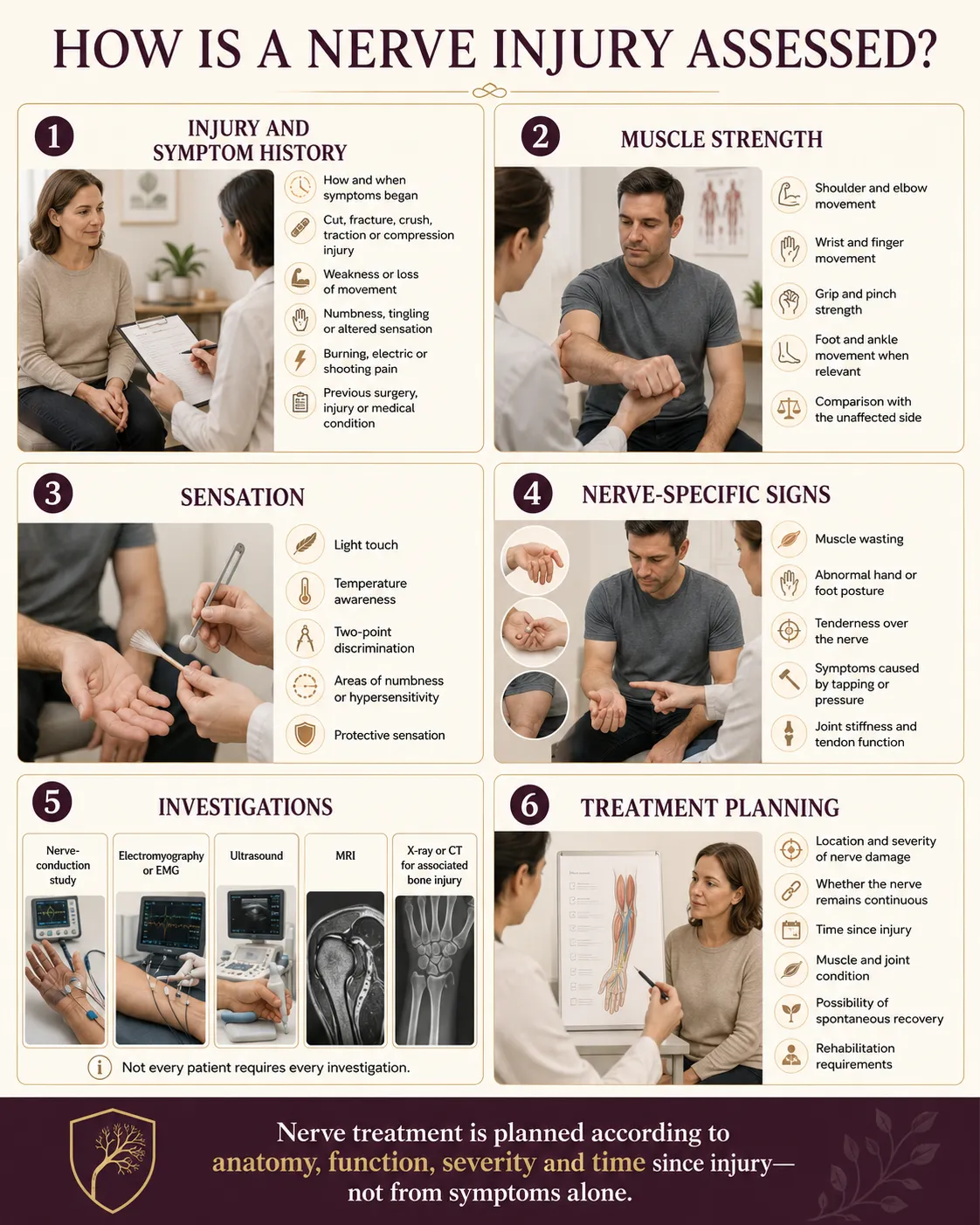
Assessment maps the injured nerve, estimates the level and severity of damage, checks whether the nerve remains continuous, and identifies associated tendon, bone, joint or blood-vessel injuries.

Clinical assessment pathway for peripheral nerve injury including history, muscle testing, sensation, circulation, electrodiagnostic studies and imaging
Nerve injury clinical assessment: examination findings are interpreted together with the injury mechanism, timing and selected tests. No single online symptom or scan can define the complete treatment plan.
1

Injury and symptom history

How and when symptoms began; cut, crush, traction, fracture, dislocation, compression, injection or previous surgery; and whether weakness, numbness or pain is changing.

2

Muscle-strength mapping

Selected shoulder, elbow, wrist, finger, ankle or foot movements are tested to localize the nerve level and record preserved donor function.

3

Sensory examination

Light touch, protective sensation, altered sensitivity and two-point discrimination may be mapped across the hand or foot.

4

Wound and circulation

Scars, skin condition, swelling, tissue viability, fractures, tendon movement, joint stability and circulation are reviewed because combined injuries change priorities.

5

Electrodiagnostic studies

Nerve-conduction studies and electromyography may help assess denervation, continuity and early recovery when performed and interpreted at an appropriate stage.

6

Targeted imaging

Ultrasound, MRI, X-ray, CT or vascular imaging may be selected according to the suspected lesion and associated trauma.

Important: a normal early test does not automatically exclude a significant nerve injury. Serial clinical examination and correctly timed electrodiagnostic testing may be needed.
Treatment options

Observation, decompression, direct repair, grafting and nerve transfer serve different injuries

Not every nerve injury needs surgery. The treatment is selected only after determining whether the nerve is bruised, compressed, scarred, divided, missing a segment or too far from its target for useful recovery through the original pathway.
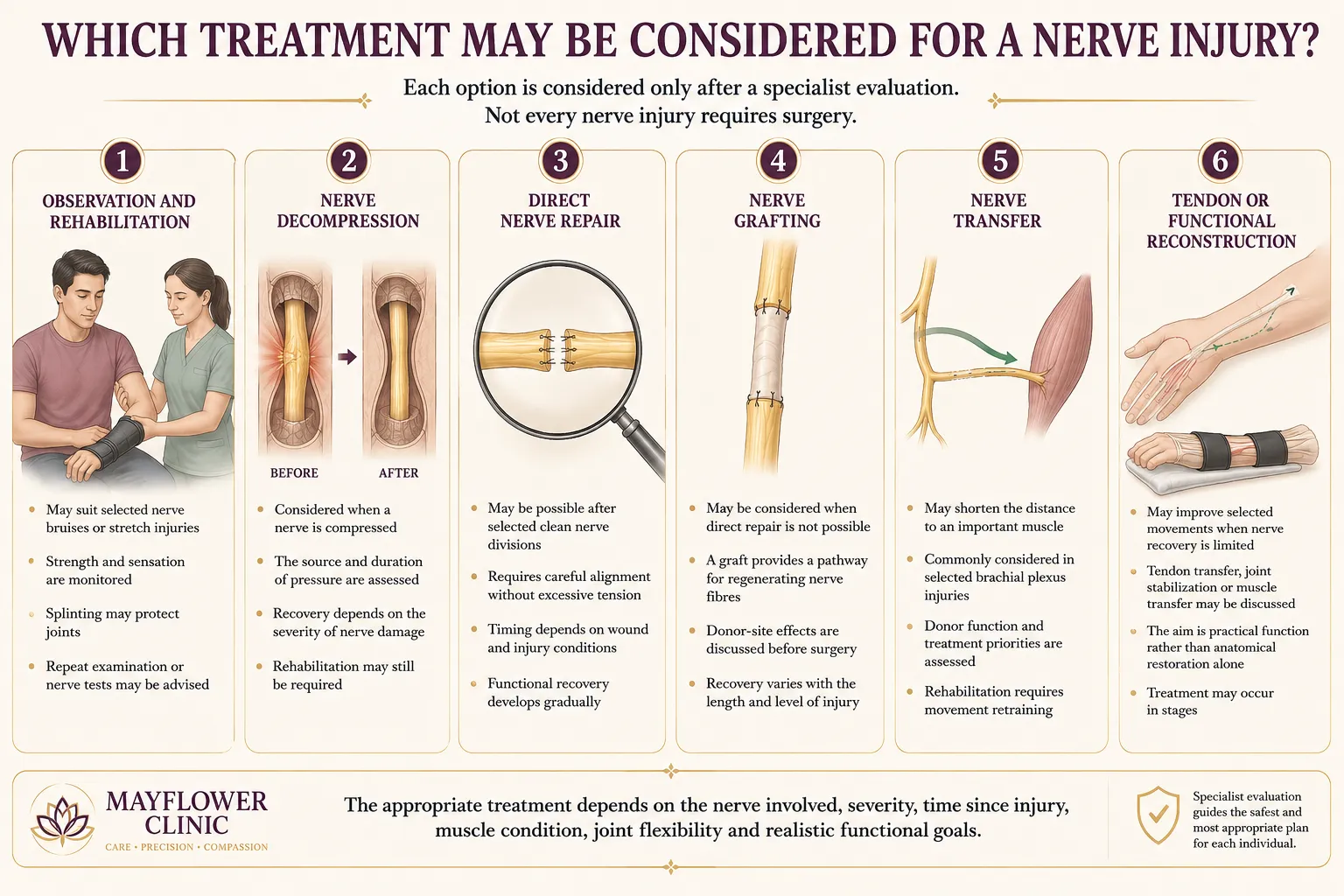
Comparison of observation and rehabilitation, nerve decompression, direct nerve repair, nerve grafting, nerve transfer and secondary reconstruction
Peripheral nerve surgery options: each method solves a different anatomical problem. Several methods may be combined in complex injuries.
1

Observation, splinting and rehabilitation

Selected stretch, bruise or compression injuries may be monitored when clinical findings suggest a reasonable possibility of spontaneous recovery. Joint protection and therapy prevent avoidable secondary problems.

Serial examinationProtect weak jointsRepeat tests when indicated
2

Neurolysis or nerve decompression

If a continuous nerve is compressed or tethered by scar, surgery may release pressure and free the nerve. This is different from dividing and reconnecting the nerve.

EntrapmentScar tetheringContinuity preserved
3

Direct microsurgical nerve repair

When viable nerve ends can meet without harmful tension, they may be aligned under magnification using fine sutures or another suitable coaptation method.

Selected divided nervesNo significant gapTension-free alignment
4

Nerve grafting

When a damaged segment must be removed and the ends cannot meet without tension, a graft may bridge the defect. Donor-nerve choice and expected donor-site sensory changes are discussed before surgery.

Nerve gapBiological bridgeDonor-site counselling
5

Nerve transfer

A selected functioning donor nerve or branch is connected to a non-functioning recipient nerve. A connection closer to the target can reduce the regeneration distance, but postoperative motor retraining is essential.

Severe or proximal injuryCloser to targetMotor relearning
6

Secondary functional reconstruction

For delayed or incomplete recovery, tendon transfer, joint balancing, scar release, neuroma treatment or functional muscle transfer may be considered according to remaining function and goals.
Delayed presentationResidual weaknessFunction-first planning
Selection principle: the aim is not to use the most complex technique. It is to choose the least disruptive reconstruction that offers a realistic route to useful motor function, protective sensation or pain reduction.
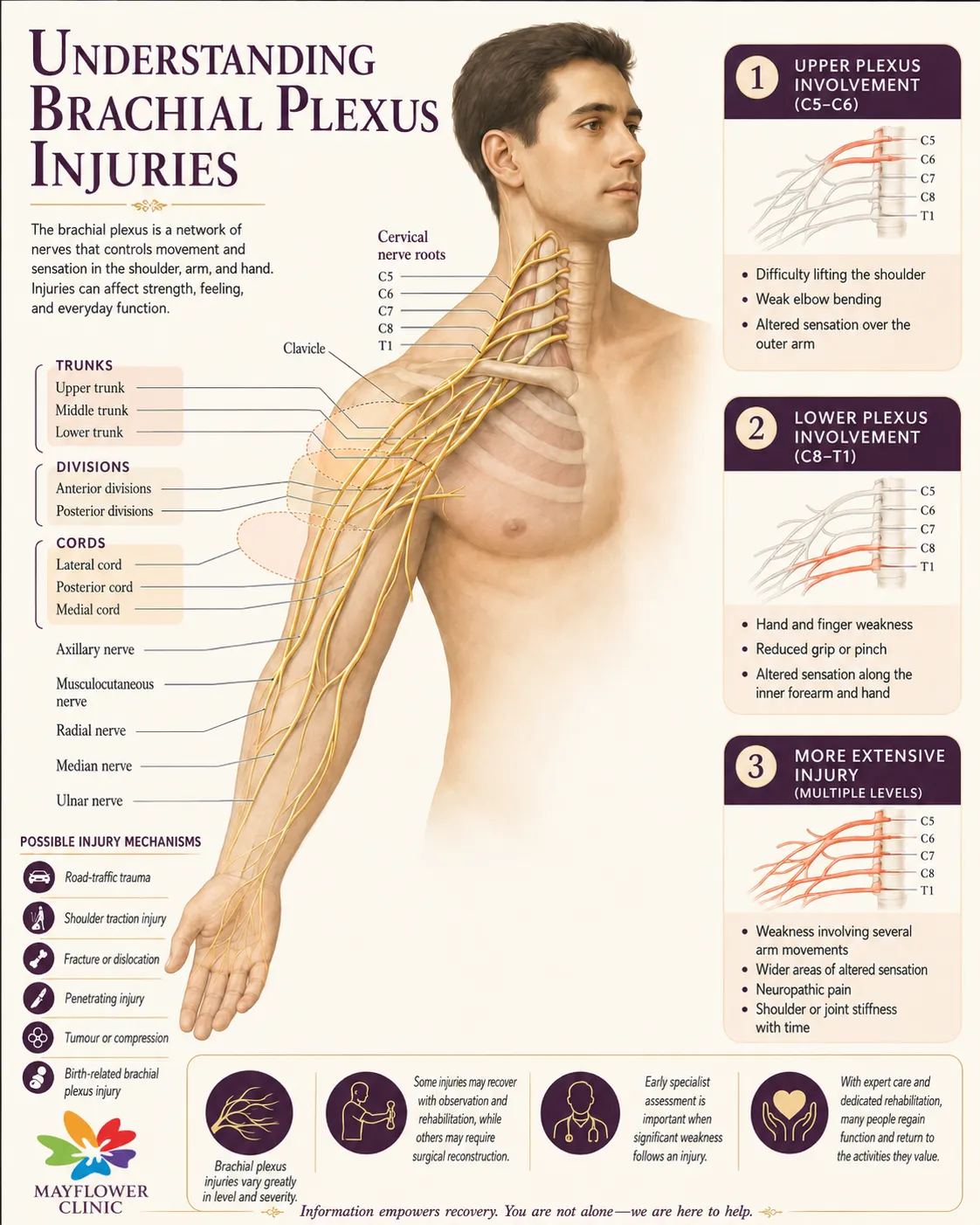
Brachial plexus injury anatomy showing C5 to T1 nerve roots, upper and lower plexus patterns and possible effects on shoulder, elbow and hand function
Brachial plexus anatomy and injury patterns: symptoms depend on which roots, trunks, cords or terminal nerves are involved. The diagram is educational and cannot identify an individual injury pattern.
Brachial plexus injury repair

A brachial plexus injury may need a combination of reconstructive methods

The brachial plexus is the network of nerves from the neck that powers and supplies sensation to the shoulder, arm and hand. Injuries range from stretch injuries that may recover to rupture or root-avulsion patterns that cannot reconnect spontaneously.

The plan may include exploration, neurolysis, nerve grafting, nerve transfers, tendon transfers or functional muscle transfer. Priorities are individualized according to preserved muscles, pain, hand potential, time since injury and the patient’s work and daily needs.

ShoulderStability and control
ElbowUseful flexion
HandPosition, grasp or protection
Read the dedicated Brachial Plexus Surgery guide →
Treatment pathway

From injury assessment to long-term nerve rehabilitation

Nerve surgery is one part of a longer pathway. Decisions are revised as examination, testing and functional recovery evolve.
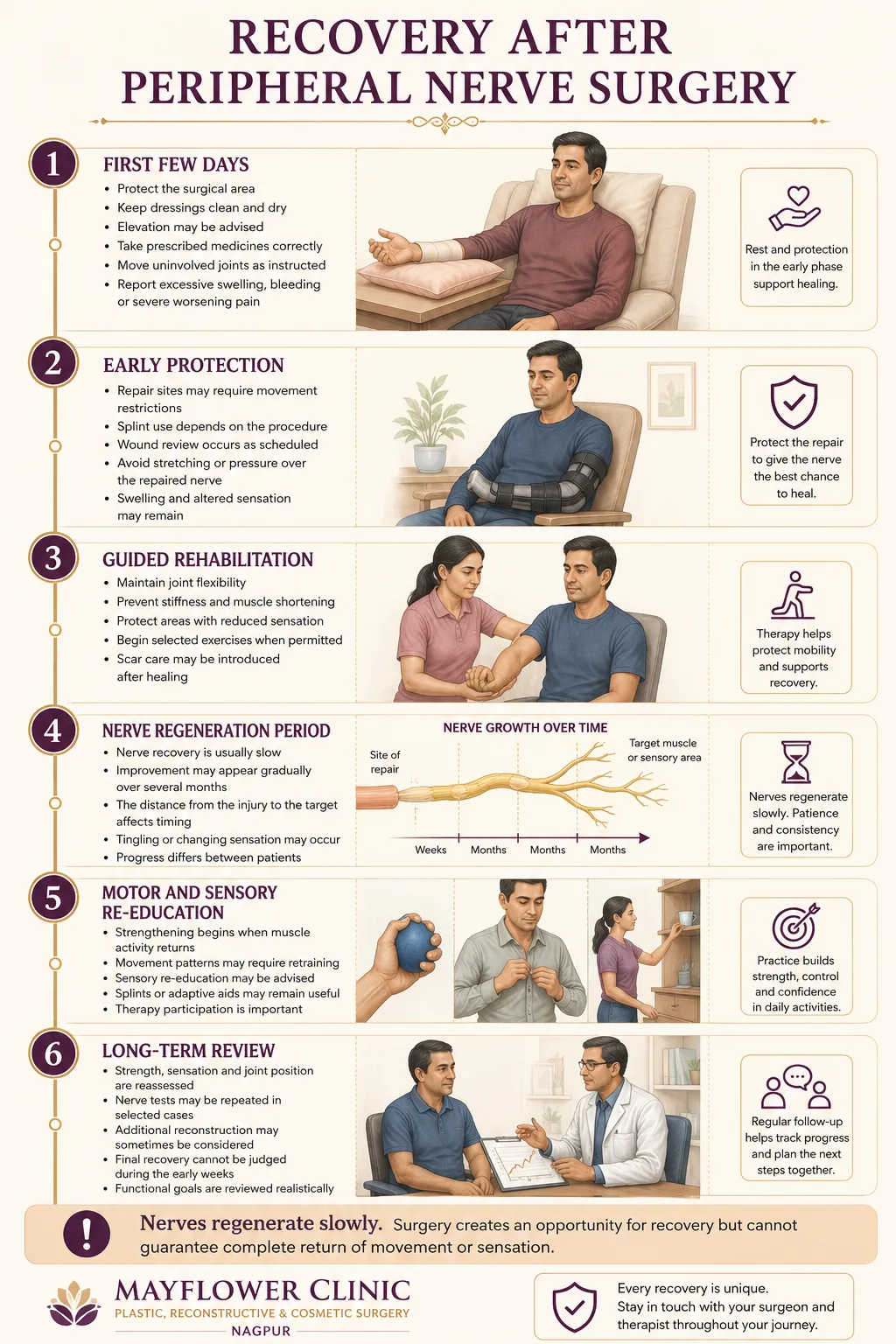
Recovery and rehabilitation timeline after peripheral nerve surgery showing early protection, guided therapy, nerve regeneration, motor retraining and long-term review
Recovery after peripheral nerve surgery: wound healing, nerve regeneration and return of useful function occur on different timelines. The exact restrictions and therapy plan depend on the reconstruction performed.
1
Initial assessment

Protect the limb and identify urgent associated injuries

Control wounds, stabilize fractures or joints, assess circulation and document movement and sensation.

2
Localization

Map which nerve and which level are affected

Clinical examination is combined with selected imaging and electrodiagnostic testing at an appropriate time.

3
Decision

Observe, decompress, explore or reconstruct

The plan depends on continuity, gap, scar, recovery signs, distance to the target and time since injury.

4
Surgery

Perform the selected repair, graft or transfer

Microsurgical reconstruction is planned to protect functioning structures and create a viable route to the target.

5
Early recovery

Protect the reconstruction without allowing avoidable stiffness

Dressings, splints and movement restrictions are individualized. Uninvolved joints may need guided motion.

6
Reinnervation phase

Look for gradual motor or sensory change

Serial examination may detect early muscle activity or advancing sensation. Recovery is not judged in the first few days.

7
Motor retraining

Teach the brain how to use a nerve transfer

A transferred nerve initially activates through its original movement pattern. Therapy helps build the new movement association.

8
Long-term review

Assess useful function and consider secondary reconstruction

If recovery is incomplete, options may include tendon transfer, scar release, joint balancing, pain treatment or functional muscle transfer.

Recovery and therapy

Rehabilitation protects the reconstruction and converts recovery into useful function

Therapy is tailored to the repaired nerve, joints involved, associated tendon or bone injury, and the stage of nerve regeneration.

Joint movement

Maintain safe passive or active movement to reduce stiffness while following repair-specific restrictions.

Splinting and protection

Position weak joints, protect insensate skin and reduce deforming forces while muscles are recovering.

Sensory re-education

Retrain recognition of touch and texture and learn protection strategies where sensation is absent or altered.

Motor retraining

Use visual feedback, targeted exercises and task practice to activate recovering or transferred nerves.

Scar and swelling care

Manage swelling, improve scar mobility and monitor sensitivity without applying unapproved pressure over a repair.

Functional goals

Plan return to self-care, writing, work, driving or protective footwear according to actual recovery and safety.

Contact the treating team urgently after surgery for:

  • Increasing severe pain not controlled as advised
  • A cold, pale, blue or markedly swollen hand or foot
  • Dressings that feel increasingly tight
  • New loss of movement or sensation compared with the immediate postoperative baseline
  • Fever, spreading redness, pus or wound breakdown
  • Breathing difficulty, chest pain or another emergency symptom
Realistic expectations

What determines recovery after nerve surgery?

The aim is useful function, safer sensation or reduced pain—not a promise of normal anatomy or complete recovery.

1

Injury level

Higher injuries require nerve fibres to travel farther before reaching the target.

2

Injury severity

Compression, stretch, rupture and avulsion injuries have different recovery potential.

3

Time since injury

Prolonged denervation changes muscles and can alter which reconstructive options remain useful.

4

Associated damage

Fractures, tendon injury, vascular injury, scarring and joint stiffness influence the final result.

5

Patient factors

Age, smoking, diabetes, nutrition and overall health can influence healing and rehabilitation.

6

Target distance

The distance between reconstruction and muscle or sensory target affects the time available for reinnervation.

7

Therapy participation

Splinting, exercises, sensory protection and motor retraining help translate nerve recovery into function.

8

Biological variability

Even technically sound repair can produce different outcomes in different patients.

Transparent planning

What affects nerve surgery cost in Nagpur?

A responsible estimate requires examination and review of the injury. Publicly quoting one package can be misleading because a decompression, direct repair, graft and brachial plexus reconstruction have very different requirements.

  • Nerve involved and level of injury
  • Exploration, repair, graft or transfer complexity
  • Need for donor nerve graft and additional incisions
  • Associated tendon, bone, vessel or soft-tissue procedures
  • Anaesthesia, operating facility and expected stay
  • Splints, therapy, electrodiagnostic tests and follow-up

What you should receive at consultation

  • A clear explanation of the suspected nerve and injury level
  • Whether further testing or a period of observation is required
  • The goal of each proposed procedure and what it cannot guarantee
  • Donor-nerve trade-offs where grafting or transfer is planned
  • Expected rehabilitation pathway and review schedule
  • A written estimate based on the planned treatment
Patient feedback

Experiences shared by Mayflower Clinic patients

These are individual experiences published in the clinic’s existing testimonial records. They are not specific predictions for nerve-surgery outcomes.

★★★★★
“I had accident and had trauma to face… He explained me everything. I go for surgery and now, my eye is free. I am very much happy.”
Rajendra UkeyPublished patient feedback · individual result
★★★★★
“The surgery was really good and the doc is always there to help… Thank you so much doctor. Really grateful.”
Dhanashree SadawartiPublished patient feedback · individual result
★★★★★
“Good experience. Highly skilled surgeon. Post op care and consultation was also done nicely.”
Mahika GoelPublished patient feedback · individual result
Common questions about nerve surgery

Questions patients often ask

These answers provide general education. The correct operation and timing can only be decided after examination.

What type of nerve surgery is covered on this page?
This page covers peripheral nerve surgery involving nerves of the arms, hands, legs and brachial plexus. It does not describe brain surgery, spinal decompression or treatment of sciatica.
When can a cut nerve be repaired directly?
Direct repair may be considered when healthy nerve ends can be brought together without harmful tension. The surgeon must also assess wound contamination, tissue loss, blood supply and associated injuries.
What is a nerve graft?
A nerve graft bridges a gap when direct tension-free repair is not possible. A suitable donor sensory nerve is commonly used as a biological pathway for regenerating fibres. Donor-site numbness or other trade-offs are discussed before surgery.
What is a nerve transfer?
A nerve transfer redirects a selected functioning donor nerve or branch to a non-functioning recipient nerve. It can place the nerve connection closer to a target muscle, but requires careful donor selection and postoperative motor retraining.
How is a brachial plexus injury repaired?
Depending on the level and severity of injury, reconstruction may involve neurolysis, nerve grafting, nerve transfers, tendon transfers or functional muscle transfer. Treatment priorities may include shoulder stability, elbow flexion, hand positioning or protective sensation.
Why does timing matter after a nerve injury?
Muscles and sensory targets change during prolonged denervation. Early specialist assessment helps determine whether observation, serial testing or surgery is appropriate. An emergency operation is not required for every closed nerve injury, but unnecessary delay can remove options.
Which tests may be needed before nerve surgery?
Evaluation may include detailed motor and sensory mapping, nerve-conduction studies and electromyography, ultrasound, MRI or other imaging. The type and timing of testing depend on the suspected nerve and mechanism of injury.
Will movement or sensation return immediately after surgery?
No. Nerve regeneration and motor retraining are gradual. The wound may heal before any meaningful muscle or sensory change is visible. Progress is assessed through serial examinations over months.
Is physiotherapy needed after nerve repair or transfer?
Rehabilitation is usually important. It may include joint protection, splinting, maintaining movement, preventing contracture, sensory re-education, muscle stimulation in selected cases and retraining after nerve transfer.
Can an old nerve injury still be treated?
Some delayed injuries still have reconstructive options, but the strategy may differ. Nerve transfer, tendon transfer, scar release or functional muscle transfer may be considered when primary nerve repair is no longer likely to reach the target in time.
What are the limitations of nerve surgery?
Recovery depends on injury level and severity, time since injury, target distance, scarring, age, associated injuries and rehabilitation. Normal strength, normal sensation and complete pain relief cannot be guaranteed.
What affects the cost of nerve surgery in Nagpur?
Cost depends on the nerve involved, complexity of exploration or reconstruction, graft requirements, anaesthesia and facility needs, associated injuries, rehabilitation and follow-up. A written estimate follows examination and a defined treatment plan.
Peripheral nerve consultation · Nagpur

Arrange an assessment for weakness, numbness or suspected nerve injury

Bring previous operation notes, discharge summaries, imaging, electrodiagnostic reports and a clear timeline of how the injury occurred. Urgent trauma or circulation concerns should be taken to an emergency facility.

Medical Disclaimer: All surgical procedures carry inherent risks, and individual outcomes vary based on the nerve injured, level and severity of damage, time since injury, associated trauma and healing biology. Surgical results are not guaranteed. Formal in-person consultation with Dr. Pawan Shahane is required before any surgical decision. This page is for general educational purposes only and does not constitute medical advice or a treatment recommendation. New loss of movement, severe trauma, a cold or pale limb, uncontrolled bleeding, breathing difficulty or another emergency requires urgent medical care.