
Cuts and Open Wounds
Depth, contamination, foreign material and possible tendon, nerve, vessel or joint involvement must be assessed.

A hand injury may involve more than the visible wound. Bones, joints, tendons, nerves, blood vessels, nails and skin may need separate assessment so that treatment protects both healing and function.


Severe hand injury? Go to the nearest emergency department for uncontrolled bleeding, pale/blue/cold fingers, sudden numbness, major deformity, exposed tissue or bone, severe crush injury, amputation, or rapidly worsening swelling. A website or routine clinic message is not an emergency service.
View warning signsThe hand combines delicate anatomy with demanding function. A cut may cross a flexor or extensor tendon. A crush injury may affect bone, nail bed, circulation and soft tissue together. A fracture can look minor yet cause finger rotation, joint stiffness or grip difficulty if alignment is not assessed correctly.
At consultation, the purpose is not only to identify the injured part. It is to understand what the hand can and cannot do, which structures remain intact, whether circulation is safe, and what treatment offers a realistic balance between protection and early rehabilitation.
Where surgery is appropriate, it is personally planned and performed by Dr. Pawan Shahane. Hospital-based imaging, anaesthesia, fixation, microsurgical support or multidisciplinary care may be arranged according to the injury.
Several tissues can be injured at the same time. Accurate assessment helps identify which problem needs protection, repair or rehabilitation.
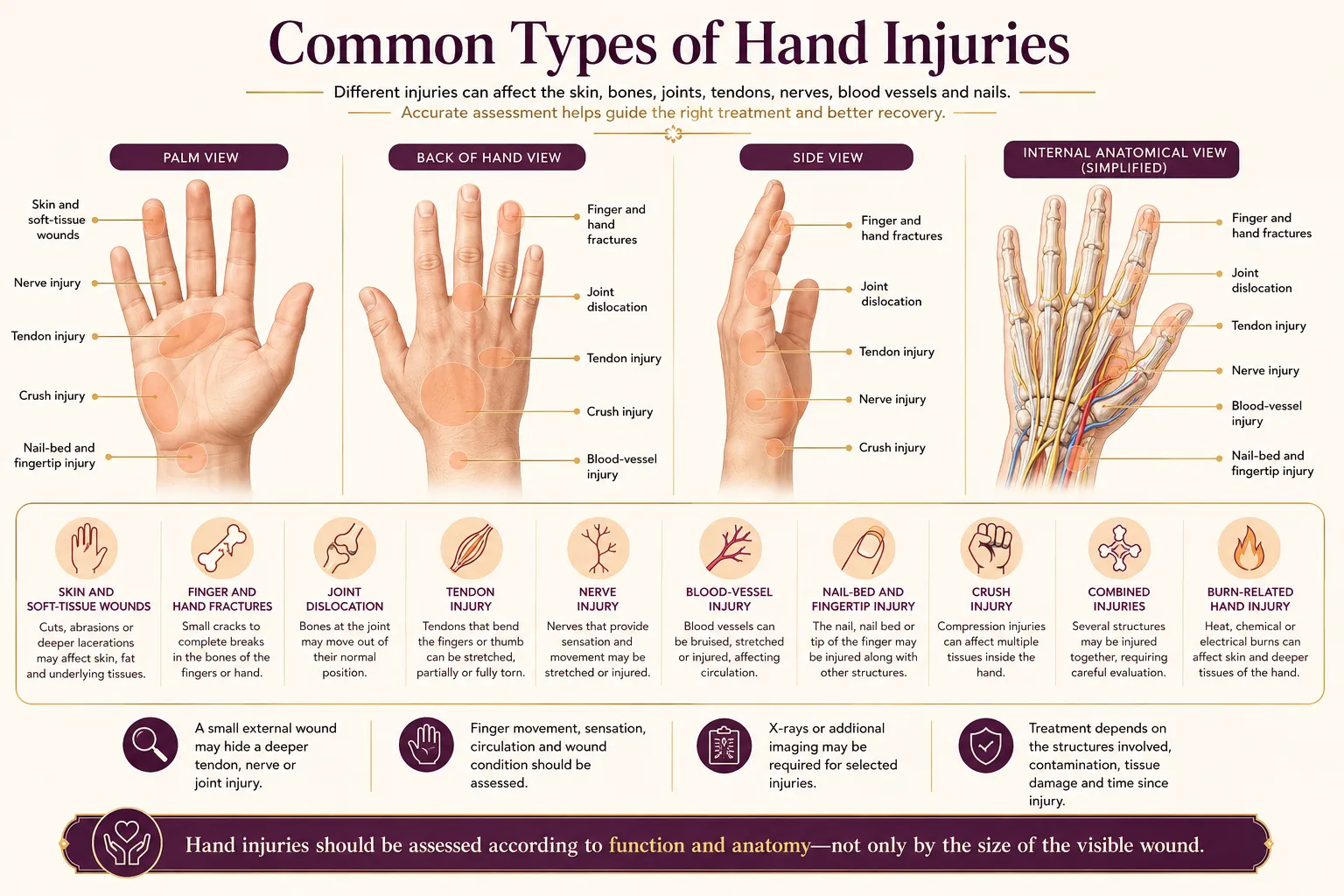
Depth, contamination, foreign material and possible tendon, nerve, vessel or joint involvement must be assessed.
Alignment, rotation, shortening, joint involvement and stability influence splinting or fixation decisions.
A displaced joint may need realignment, stability testing, protection and selected surgical repair.
Loss of active bending or straightening may indicate partial or complete tendon damage.
Numbness, altered sensation, weakness or loss of specific movements may follow nerve trauma.
Colour, warmth, capillary refill and blood flow matter because circulation can be time-sensitive.
Care may involve the nail plate, nail bed, fingertip bone, sensation and soft-tissue coverage.
Multiple structures may be damaged despite a limited external wound, requiring staged evaluation.
Depth, joint position, swelling, wounds and later scar contracture risk can affect hand function.
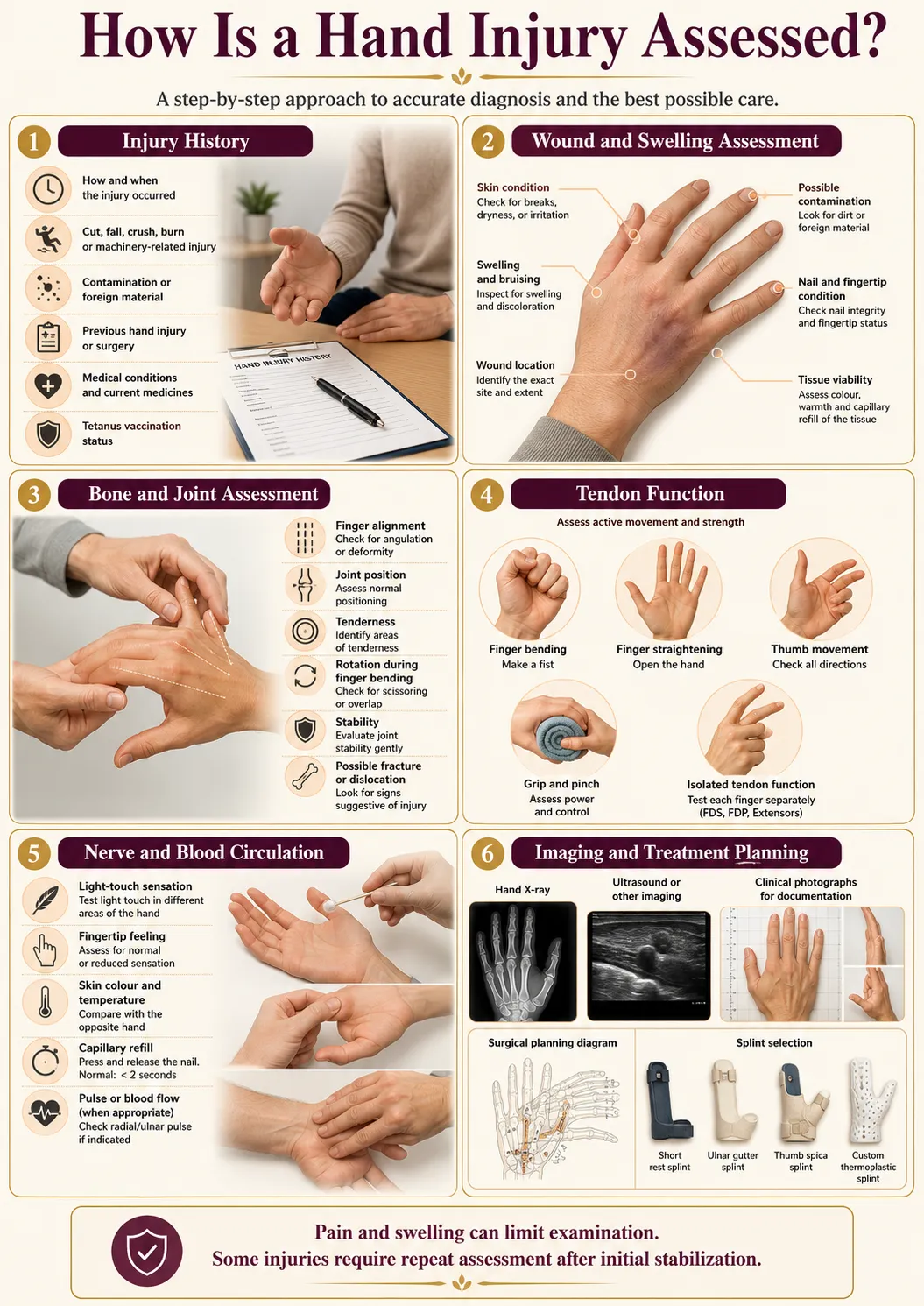
A useful examination follows anatomy and function rather than focusing only on pain. Swelling, guarding and dressings can temporarily hide an injury, so reassessment may be needed after protection or pain control.
“The goal is not simply to close a wound or fix an X-ray. We plan for useful finger movement, sensation, stability, soft-tissue cover and rehabilitation from the beginning.”— Dr. Pawan Shahane, M.Ch. Plastic Surgery · Mayflower Clinic, Nagpur
Treatment depends on the injured structures, contamination, tissue condition, alignment, circulation, time since injury and the patient’s functional needs.
Selected superficial or stable injuries may need careful cleaning, a protective dressing, symptom control and scheduled review.
A splint may protect a fracture, joint, tendon or soft-tissue injury while allowing the recommended joints to move.
Closed reduction or surgical fixation may be considered when alignment, rotation, joint congruity or stability is unacceptable.
Partially or completely injured flexor or extensor tendons may need repair and a structured protected-movement programme.
Selected divided nerves or vessels may need direct repair, grafting or other reconstruction after the injury pattern is defined.
Skin grafts, local flaps or more complex coverage may be considered when bone, tendon, joint or implant needs durable protection.
Treatment may address the nail bed, fingertip bone, sensation, wound closure and preservation of useful length.
Old injuries may require scar release, tendon reconstruction, corrective bone treatment, nerve procedures or staged rehabilitation.
Therapy may guide swelling control, splint adjustment, controlled movement, scar care, strengthening and return to work.
Recovery is different for a stable fracture, a contaminated wound, a tendon repair and a nerve injury. Early priorities are protection, swelling control, wound safety and circulation. Later priorities include movement, scar management, coordination, strength and return to specific tasks.
Remove rings before swelling increases, cover the wound, support the hand and seek appropriate medical care.
Examination and imaging guide whether observation, splinting, reduction, repair or reconstruction is appropriate.
Keep dressings clean, use the splint as advised, elevate when appropriate and report circulation or wound concerns.
Approved movement, swelling control, scar care, coordination and gradual strength work are introduced according to the repair.
Work, lifting, driving, machinery use and sport are resumed in stages based on healing and functional testing.
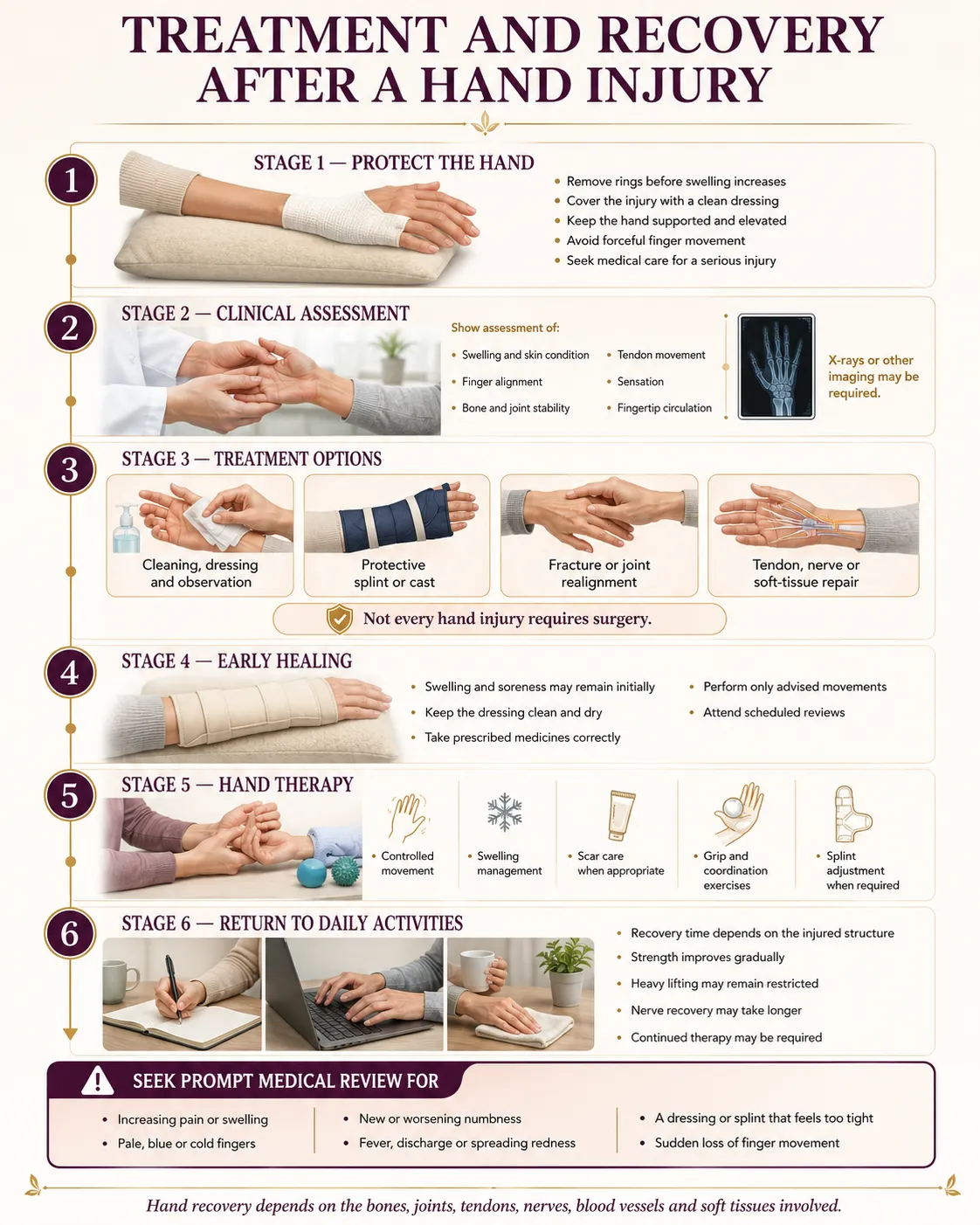
Do not wait for a routine appointment when circulation, bleeding, severe contamination or rapidly changing function may be at risk.
Hand trauma can require decisions about skin cover, bone stability, tendon gliding, nerve recovery, circulation and rehabilitation at the same time. Dr. Pawan Shahane evaluates these priorities together and explains what can reasonably be protected, repaired or reconstructed.
Because the severity and setting vary, acute injuries may first require emergency care, imaging, hospital admission or support from other specialists. The treatment plan is based on the actual injury rather than a fixed package.
There is no responsible single price for every hand injury. A written estimate is prepared after the injury, required facility and rehabilitation plan are defined.
Single-structure versus combined bone, tendon, nerve, vessel and soft-tissue trauma.
Operating facility, admission, anaesthesia, monitoring and timing requirements.
X-ray and selected ultrasound, CT, MRI, vascular or laboratory assessment.
Pins, screws, plates, sutures, splints, dressings and reconstruction materials when required.
One procedure versus staged wound, nerve, tendon, bone or soft-tissue reconstruction.
Hand therapy, splint modification, dressing care, follow-up and return-to-work planning.
Choose a common question or type your own. Answers are prewritten for this page and do not diagnose an injury.
🔒 Private local search — no data sent to external servers.
These answers are educational. An individual injury requires examination.
Content is written for patient education and reviewed by Dr. Pawan Shahane. Clinical decisions require examination and may differ from general guidance.
Original publication: 7 April 2021 · Medically reviewed and rebuilt: 26 July 2026
For a non-emergency injury, bring available X-rays, reports, discharge notes, photographs and details of previous treatment. Severe or rapidly changing injuries should go directly to emergency care.

Case of the Month: Grade 3 Gynecomastia…

The Science of Facial Aging: Why Wrinkles,…