0712 6692706 / 0712 3551170 / +91 8087471244   |   contact@mayflowerclinic.in
M.Ch. Plastic Surgery · Reconstructive Care · Nagpur

Tendon Injury Treatment in Nagpur — Repairing the Link Between Muscle and Movement

A cut, crush injury, sudden rupture or old scarred tendon can interrupt bending, straightening, grip, walking or another essential movement. Treatment begins by identifying which tendon is injured, whether it is partial or complete, what other structures are involved, and whether protection, direct repair or reconstruction offers the most realistic functional pathway.

Important: not every tendon injury needs surgery. Deep cuts, sudden loss of active movement, contaminated wounds and injuries with numbness or poor circulation need prompt clinical assessment.
Dr. Pawan Shahane
Reviewed by Dr. Pawan Shahane, M.Ch. Plastic Surgery 21+ years surgical practice · Ex-Asst. Prof. GMC Nagpur · IAAPS Member · Reconstructive and hand surgery care
Dr. Pawan Shahane discussing tendon injury assessment and reconstructive treatment at Mayflower Clinic Nagpur
Mayflower Clinic · Surdham Complex, Dhantoli, Nagpur
21+ YearsSurgical practice
M.Ch.Plastic Surgery qualification
Function FirstMovement-based planning
Doctor-LedAssessment and follow-up
Clear scope

This Page Focuses on Traumatic Tendon Injury and Reconstructive Tendon Care

Tendons transmit the pull of a muscle to a bone. A tendon may be cut, partially torn, pulled away from bone, ruptured after sudden force, trapped in scar tissue or become ineffective because its muscle or nerve no longer works.

Plastic and reconstructive tendon care commonly involves hand and wrist flexor or extensor injuries, combined wounds involving nerves or vessels, tendon loss, adhesions, delayed injury, grafting and tendon transfer.

  • Fresh cuts and penetrating injuries
  • Crush or machinery-related injuries
  • Closed tendon rupture or avulsion
  • Delayed, scarred or neglected tendon injury
  • Loss of movement after nerve injury or previous surgery
Quick guidance · Detailed explanations below

Quick Answer

On-page guide · no diagnosis
Start here: a tendon injury is assessed by the movement that has been lost, the condition of the tendon and surrounding tissues, and the time since injury. Select a question above for a focused answer.
!

Seek Prompt Assessment After These Warning Signs

A deep or contaminated cut; inability to actively bend or straighten a finger, wrist, foot or joint; a sudden snap or pop with loss of function; exposed tissue; severe deformity; rapidly increasing swelling; uncontrolled bleeding; new numbness; or a limb or digit that is pale, blue or cold. Do not repeatedly test a suspected repair or try to pull a wound open to inspect it.

Anatomy and injury patterns

Which Tendons Can Be Injured?

Tendon injuries are described by location, the movement affected, whether the injury is open or closed, and whether tendon continuity is partial, complete or lost over a segment.

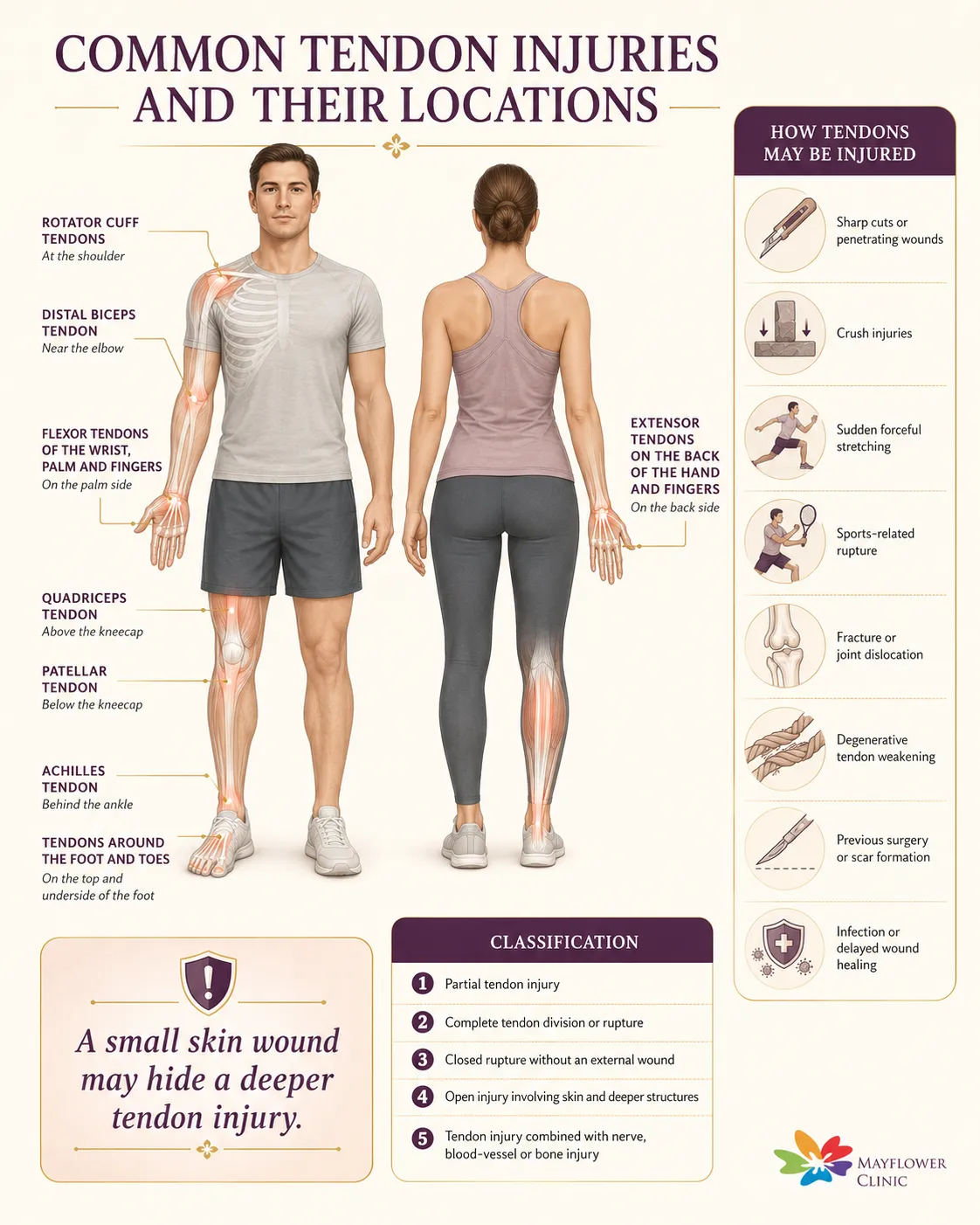
Common Tendon Injuries and Their Locations
Anatomy map showing common tendon injury locations including shoulder biceps hand finger knee Achilles ankle and foot tendons
Large patient-education anatomy map showing common tendon locations and mechanisms of injury. The illustration is educational and does not diagnose the injured tendon.

Flexor Tendon Injury

May reduce active bending of a finger, thumb or wrist. A small palm-side cut can injure a tendon, nerve or vessel together.

🖐️

Extensor Tendon Injury

May cause drooping or inability to fully straighten a finger, thumb or wrist. Tendons on the back of the hand lie close to the skin.

↘️

Avulsion or Pull-Off Injury

A tendon may pull away from bone during sudden force and may bring a small bone fragment with it.

〰️

Partial Tendon Tear

Movement may remain but can be painful, weak, catching or unreliable. The injury still requires careful assessment.

Complete Division or Rupture

Continuity is lost, often producing a clear movement deficit. Timing, tissue quality and tendon retraction influence treatment.

🧷

Adhesion and Restricted Gliding

Scar tissue may bind a repaired or injured tendon to surrounding tissue, limiting movement despite intact continuity.

🔁

Chronic or Neglected Injury

Old injuries may develop a gap, shortening, joint stiffness, muscle imbalance or poor tissue quality requiring reconstruction.

🧩

Combined Injury

Tendons may be injured with skin, bone, joint, nerve, vessel or muscle damage. The overall treatment sequence must protect all repaired structures.

Symptoms and functional clues

What May Suggest a Tendon Injury?

Pain alone cannot show whether a tendon is intact. The more useful clue is often a specific movement that has become weak, incomplete or impossible.

↕️

Loss of Active Movement

The joint may be movable by someone else but cannot be moved normally by the injured muscle-tendon unit.

📉

Weak or Incomplete Movement

A partial tear, pain, tendon imbalance or associated nerve injury may reduce strength without causing complete loss.

🔊

Sudden Snap or Pop

A forceful injury may be followed by bruising, a change in contour and immediate functional loss.

🩹

Cut Across a Tendon Path

Any deep cut over the hand, wrist, ankle or another tendon pathway should be checked for deeper structural injury.

🔒

Catching or Restricted Gliding

Scar adhesion, partial injury or tendon-sheath damage may cause movement to catch or stop before the expected range.

🧊

Numbness or Poor Circulation

These signs suggest associated nerve or vessel injury and may make assessment more urgent.

A useful practical point: a finger can sometimes still move because another tendon or joint compensates. Isolated tendon testing by a clinician is therefore more reliable than casually checking whether “some movement” remains.
Clinical assessment

How Is a Tendon Injury Assessed?

Assessment follows the injured movement and the anatomy around it. Open wounds and severe swelling may need protection first, followed by repeat examination.

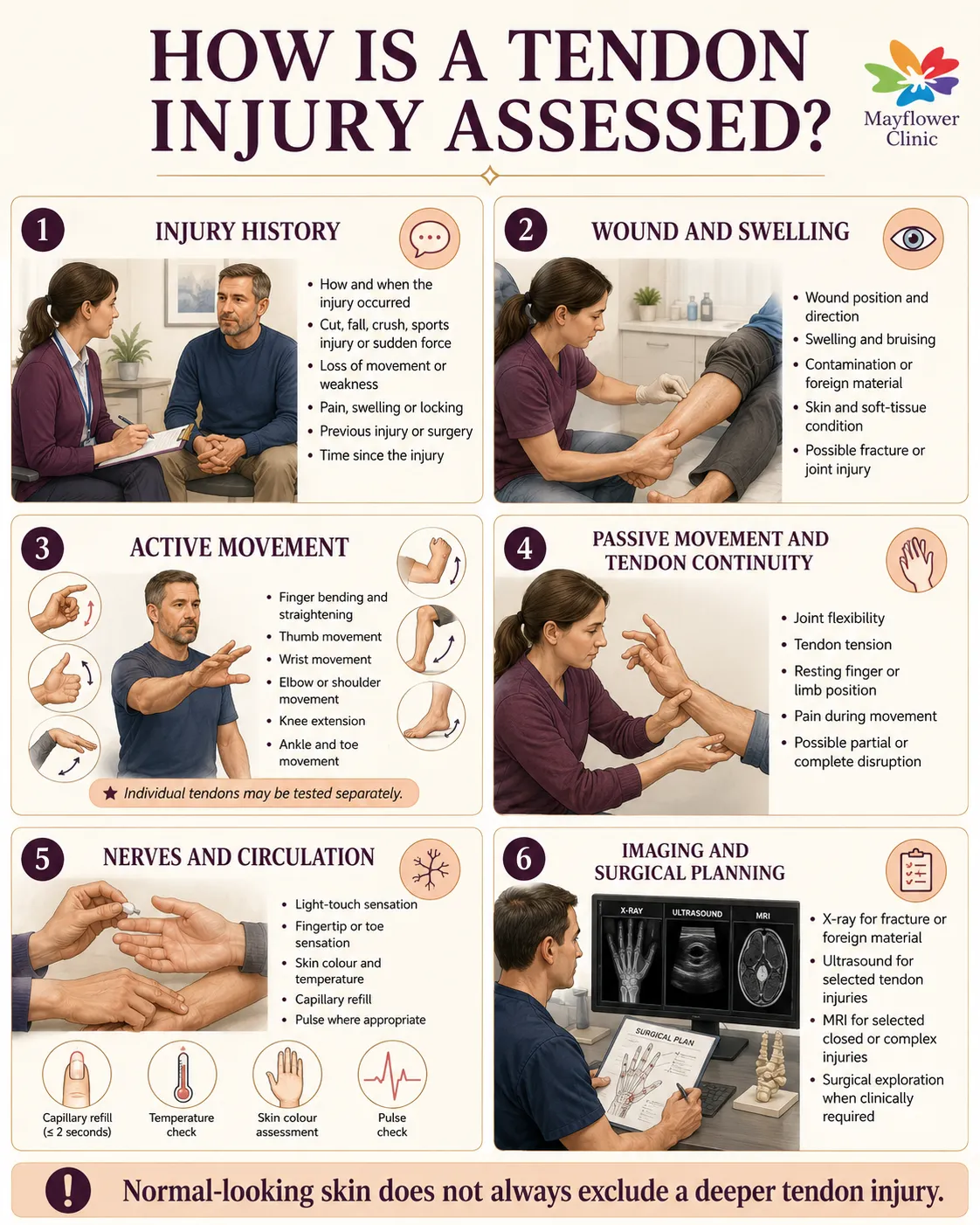
How Is a Tendon Injury Assessed?
Clinical assessment infographic for tendon injury showing history wound swelling active movement isolated testing nerves circulation and imaging
Assessment may combine movement testing with wound, bone, joint, nerve and circulation checks because tendon injuries often occur with other structural damage.

Injury history and timing

How the injury occurred, the force involved, whether there was a cut, crush, fall, machinery injury or sudden stretch, and what movement was lost immediately afterwards.

Wound, swelling and tissue condition

Wound location, contamination, bruising, tendon exposure, skin viability and whether urgent cleaning or coverage is required.

Active and isolated tendon movement

Each relevant tendon may be tested separately while comparing the injured and unaffected sides. Pain, guarding and partial injury can complicate interpretation.

Bone, joint and muscle examination

Fracture, dislocation, joint stiffness, muscle damage or tendon avulsion from bone may change the repair strategy.

Nerve and circulation checks

Sensation, motor function, skin colour, warmth and capillary refill are reviewed because nerves and vessels may be injured in the same wound.

Imaging or exploration when indicated

X-rays may assess fracture, joint injury or foreign material. Ultrasound or MRI may clarify selected closed or delayed injuries. Some open injuries are defined during formal surgical exploration.

Individualized treatment

Which Treatment May Be Considered for a Tendon Injury?

Treatment is selected after specialist examination. The aim is not simply to reconnect tissue, but to create a tendon pathway that can heal, glide and ultimately support useful movement.

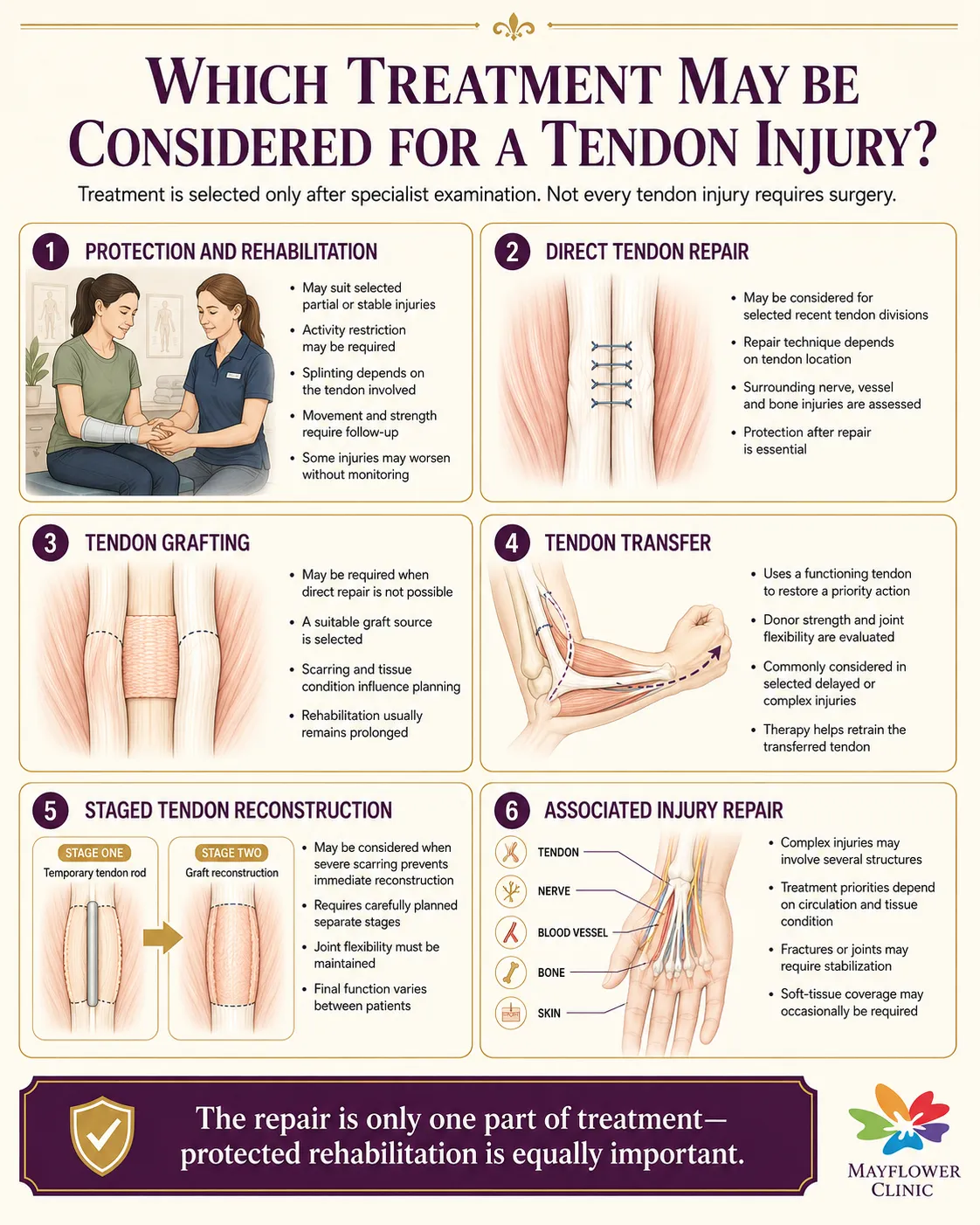
Tendon Injury Treatment Options Comparison
Comparison infographic showing protection rehabilitation direct tendon repair tendon grafting tendon transfer tenolysis and staged reconstruction
Not every tendon injury requires surgery. Options range from protection and supervised rehabilitation to direct repair, grafting, transfer or staged reconstruction.
Selected stable injuries

Protection and Rehabilitation

Activity restriction, a splint or brace, swelling control and guided movement may suit selected partial or closed injuries.

Open wound care

Cleaning and Associated Injury Treatment

Contamination, skin loss, fracture, joint injury, nerve damage and circulation may need treatment before or alongside tendon repair.

Recent suitable injury

Direct Tendon Repair

Healthy tendon ends may be aligned and joined, or a tendon may be reattached to bone, when this can be achieved without harmful tension.

Tendon gap

Tendon Grafting

A graft may bridge missing or unusable tendon when direct repair is not possible. It can be a single-stage or part of staged reconstruction.

Lost muscle or nerve function

Tendon Transfer

A functioning donor tendon is redirected to restore a priority movement while preserving an acceptable balance of remaining function.

Scarred or complex injury

Tenolysis or Staged Reconstruction

Adhesion release, pulley reconstruction, joint release, temporary tendon-rod placement or later grafting may be considered in selected cases.

Repair and reconstruction

How Can an Injured Tendon Be Repaired or Reconstructed?

The technique depends on tendon continuity, tissue quality, the size of any gap, joint mobility, muscle power, nerve function, skin coverage and the movement that matters most to the patient.

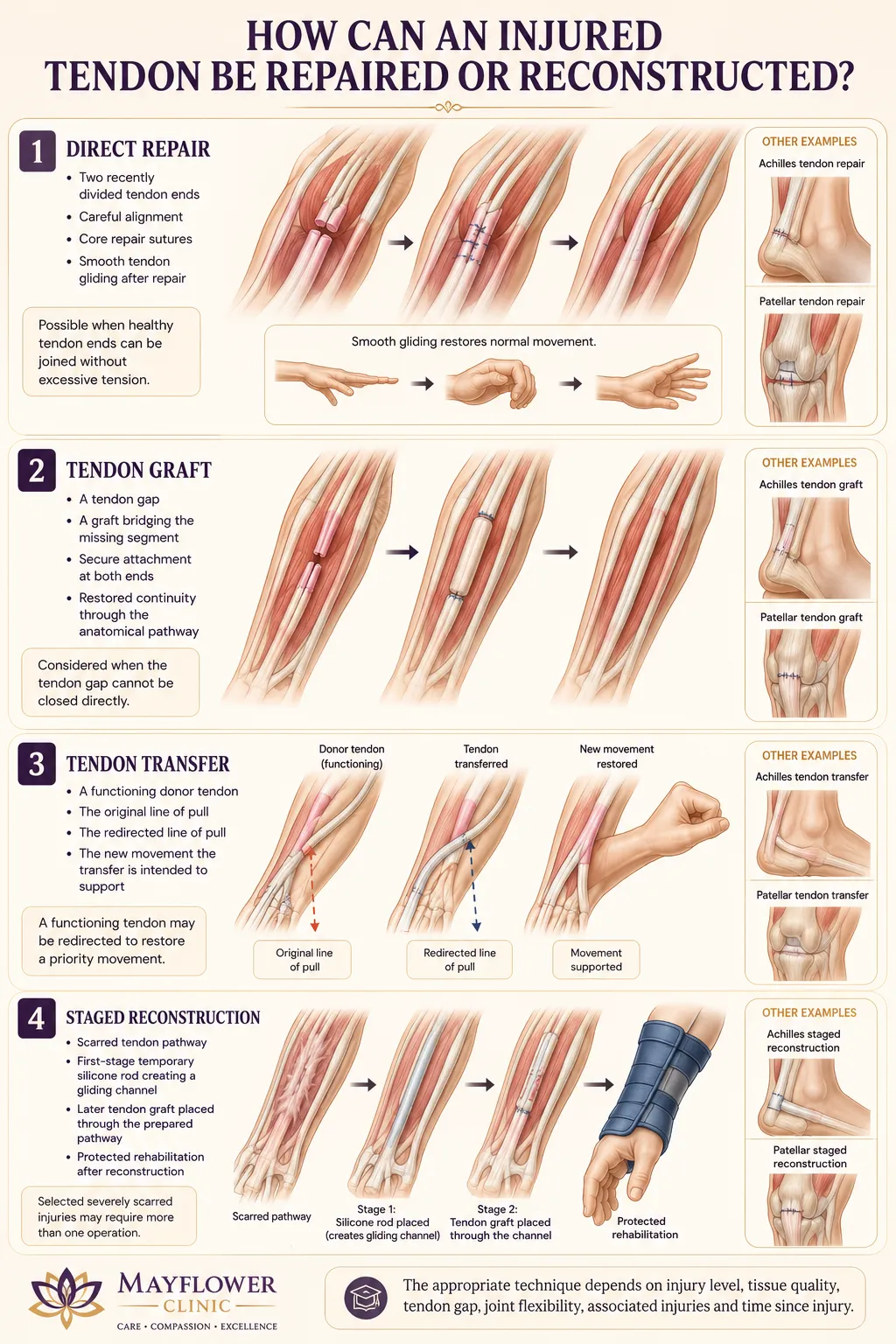
Tendon Repair and Reconstruction Techniques
Medical illustration comparing direct tendon repair tendon graft tendon transfer and staged tendon reconstruction
Direct repair, tendon grafting, tendon transfer and staged reconstruction solve different anatomical problems. No one technique is suitable for every injury.
1

Direct repair

Used when suitable tendon ends can be restored to continuity. The repair must be strong enough for the selected rehabilitation protocol while avoiding unnecessary bulk or tension.

2

Repair back to bone

When a tendon has avulsed from its attachment, fixation may restore the tendon-to-bone connection. Bone quality and the size of any associated fragment matter.

3

Tendon graft

A graft bridges a gap and must pass through an anatomical pathway that can permit gliding. Joint stiffness and scarred tissue may need correction first.

4

Tendon transfer

The donor tendon must have adequate power, excursion and a useful line of pull. Rehabilitation includes learning a new way to activate the transferred movement.

5

Tenolysis

Scar binding is released around an intact tendon when passive movement is better than active movement and therapy alone has not restored gliding.

6

Staged reconstruction

Severe scarring, pulley loss or an unsuitable tendon bed may require preparation in one stage and definitive grafting later.

Associated injuries change the plan. A tendon repair may need to be coordinated with fracture fixation, nerve repair, vessel repair, skin or soft-tissue coverage and a rehabilitation programme that protects every reconstructed structure.
Dr. Shahane's clinical perspective

A Tendon Must Not Only Heal—It Must Glide and Produce a Useful Movement

“Tendon reconstruction is a balance between secure healing and controlled movement. The repair, splint and therapy programme must be planned together, because too much stress can disrupt the repair while too little movement can lead to stiffness and adhesion.”
Dr. Pawan Shahane, M.Ch. Plastic Surgery · Founder, Mayflower Clinic, Nagpur
⏱️

Timing

Fresh clean injuries may allow direct repair, while delayed injuries often require a different reconstructive approach.

🧵

Tissue Quality

Contamination, crushing, scarring, tendon loss and poor skin coverage can limit immediate repair.

🦴

Joint Mobility

A reconstructed tendon cannot create useful motion through a severely stiff or unstable joint without addressing the joint problem.

Nerve and Muscle Function

The muscle must be able to generate force and its nerve supply must be considered when choosing repair, graft or transfer.

🧑‍🔧

Functional Priority

Hand dominance, occupation, walking needs, sports, caregiving and daily tasks help define the most valuable movement to restore.

🤝

Rehabilitation Access

The safest technique and protocol must be realistic for follow-up, splint use and supervised therapy.

Protection and rehabilitation

Recovery After Tendon Repair or Reconstruction

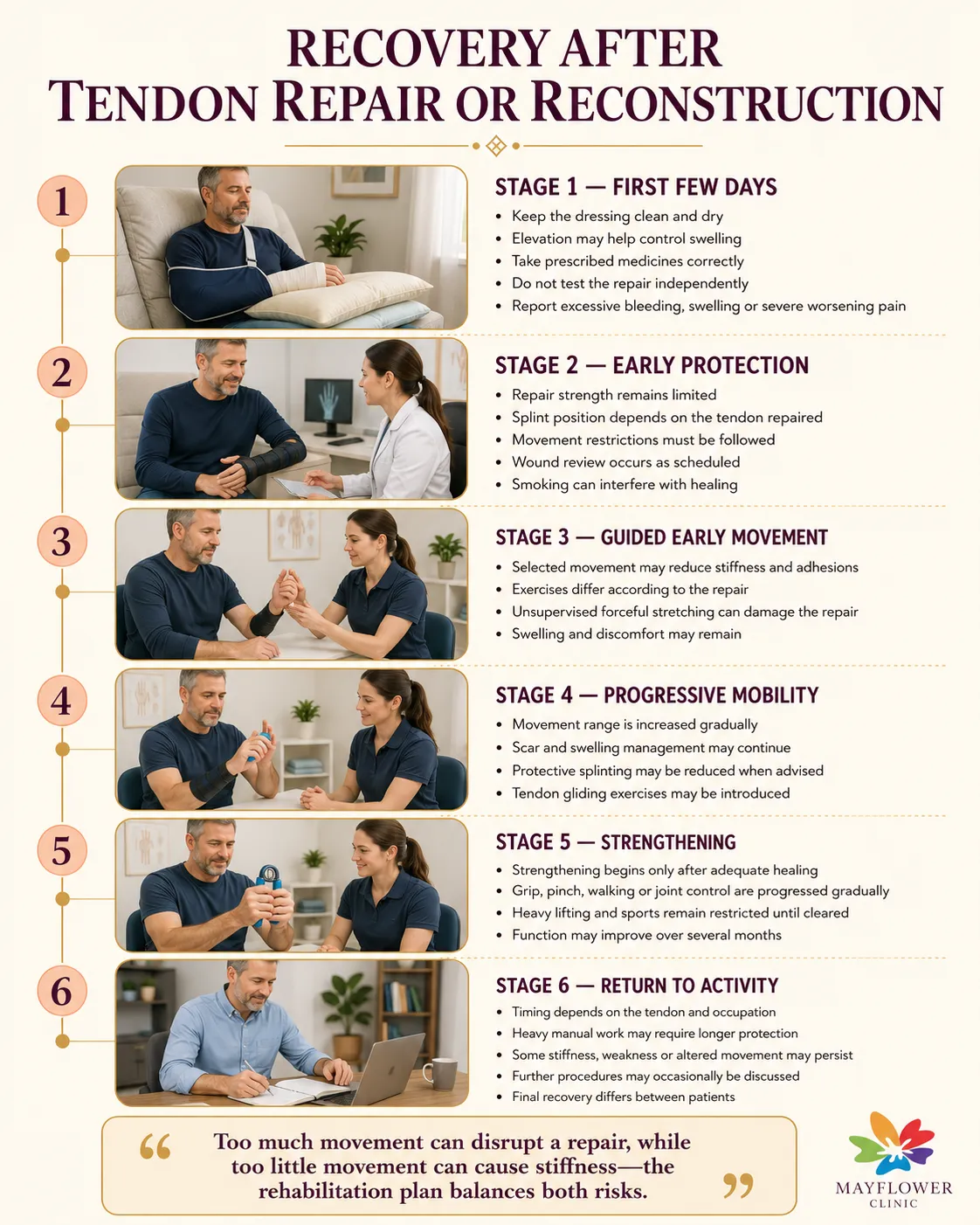
Recovery is active but carefully controlled. The schedule below is a general pathway; the exact splint position, exercise sequence and timing vary according to the tendon and repair.

Tendon Repair Recovery and Rehabilitation
Recovery timeline after tendon repair or reconstruction showing protection splinting guided movement strengthening and return to function
Recovery typically progresses from protection and wound care to guided movement, progressive use and later strengthening. Individual protocols differ.

First few days

Protect the dressing, elevate when advised, take prescribed medicines correctly and report excessive bleeding, severe worsening pain or rapidly increasing swelling.

Early protection

A custom splint, brace or cast may protect the repair. Do not alter its position or test tendon strength independently.

Guided early movement

Selected repairs benefit from a controlled movement protocol to reduce stiffness and adhesions. Exercises differ by tendon zone and repair strength.

Progressive movement

Active movement is increased gradually while monitoring lag, stiffness, swelling, wound healing and tendon glide.

Strengthening

Resistance is introduced only after adequate healing. Premature gripping, lifting, running or forceful stretching can overload the repair.

Return to work or sport

Return is based on the repaired tendon, job demands, hand dominance, walking requirements, strength and movement—not on wound appearance alone.

Do not copy another patient's exercises. A programme designed for a flexor tendon repair may be unsafe for an extensor repair, tendon transfer, graft or lower-limb reconstruction.
Risks and realistic expectations

What Can Limit Recovery?

Tendon healing is biological and movement recovery depends on more than the operation. Severe injury, tissue loss, infection, joint stiffness, nerve damage and delayed rehabilitation can all affect the result.

Stiffness

Joints and surrounding tissues may stiffen during protection, especially after crush injury or prolonged immobilization.

Adhesions

Scar tissue can restrict tendon gliding and reduce active movement even when the tendon has healed.

Repair gapping or rupture

Excessive force, a fall, unsupervised exercise or biological healing problems can disrupt the repair.

Incomplete strength or movement

Some patients retain weakness, lag or reduced range despite repair and rehabilitation.

Scar and sensitivity

Scars may remain visible, tender, tight or sensitive and can take months to mature.

Further surgery

Revision repair, tenolysis, grafting, transfer, joint release or another reconstructive procedure may be needed in selected cases.

Contact the treating team promptly after surgery if you notice

Increasing redness or discharge, fever, uncontrolled pain, excessive bleeding, a splint that feels dangerously tight, new numbness or colour change, a sudden “ping,” or new loss of movement that had previously been present.

Consultation and cost factors

What Determines the Treatment Plan and Cost?

A reliable estimate requires examination because the same symptom—such as inability to bend a finger—can result from a fresh cut, tendon retraction, associated nerve damage, joint stiffness, an old scarred injury or a rupture away from the hand.

  • Tendon and body region involved
  • Partial, complete, avulsed or missing tendon
  • Fresh versus delayed injury
  • Open wound, contamination or infection
  • Direct repair, graft, transfer or staged reconstruction
  • Associated nerve, vessel, bone or joint injury
  • Anaesthesia and hospital or facility needs
  • Splints, dressings, therapy and follow-up

No fixed public package can accurately represent every tendon injury. A written estimate can be discussed after the anatomy and treatment sequence are defined.

Clear answers · detailed guidance above

Common Questions About Tendon Injury Treatment

What is a tendon injury?
A tendon injury affects the strong tissue that transmits muscle force to bone. It may involve irritation, a partial tear, complete division, rupture from bone, scar adhesion or loss of an effective line of pull.
Does every tendon injury require surgery?
No. Selected partial, stable or closed injuries may be treated with protection, splinting or bracing and supervised rehabilitation. Surgery is considered when tendon continuity or useful movement cannot be restored safely without repair or reconstruction.
When should a tendon injury be assessed urgently?
Urgent assessment is important after a deep cut, sudden loss of active movement, a visible or contaminated wound, severe deformity, a cold or pale limb, uncontrolled bleeding, new numbness, or rapidly worsening swelling or pain.
Can a small cut completely divide a tendon?
Yes. A small skin wound can conceal a complete or partial tendon division, especially in the fingers, hand or wrist. Movement, sensation and circulation should be examined rather than judging severity from wound size alone.
How is a tendon injury diagnosed?
Diagnosis begins with the injury history and a structured examination of wounds, swelling, active and isolated movements, joint stability, nerves and circulation. X-ray, ultrasound, MRI or surgical exploration may be selected when clinically indicated.
What is direct tendon repair?
Direct repair joins suitable tendon ends or reattaches a tendon to bone when this can be achieved with appropriate alignment and without excessive tension. The repair then needs protection and a planned rehabilitation programme.
When is tendon grafting considered?
A tendon graft may bridge a gap when healthy ends cannot be joined directly, or when an old injury has caused tendon loss or scarring. The graft and rehabilitation plan depend on the tendon, joints, tissues and functional goal.
What is a tendon transfer?
A tendon transfer redirects a functioning donor tendon to support a priority movement that has been lost. It may be considered when the original muscle-tendon unit or its nerve supply cannot provide useful function.
What is tendon reconstruction?
Tendon reconstruction is a broader plan that may include grafting, transfer, staged procedures, pulley or soft-tissue reconstruction, scar release or correction of joint stiffness. It is individualized to the remaining anatomy and functional priorities.
Why is splinting important after tendon repair?
A new repair is vulnerable to stretching, gapping or rupture. A procedure-specific splint or brace protects the repair while allowing only the movements that have been approved by the surgeon and therapist.
Why is hand therapy or physiotherapy important after tendon surgery?
Rehabilitation helps balance protection against stiffness and adhesions. It may include controlled movement, swelling and scar care, joint mobility, later strengthening and retraining of movement after a transfer.
How long does recovery take after tendon repair or reconstruction?
Recovery commonly unfolds over several weeks to months and varies with the tendon, injury zone, repair strength, associated injuries, tissue quality, rehabilitation and work demands. Full strength and fine movement may take longer than wound healing.
Can an old or neglected tendon injury still be treated?
Some delayed injuries can still be improved, but direct repair may no longer be possible. Evaluation may consider tendon grafting, tendon transfer, tenolysis, staged reconstruction, joint release or a more limited functional goal.
What are the risks and limitations of tendon surgery?
Possible problems include infection, stiffness, scar sensitivity, adhesions, weakness, incomplete movement, repair gapping or rupture, donor-site symptoms and the need for further surgery. Normal movement cannot be guaranteed.
What affects the cost of tendon injury treatment in Nagpur?
Cost depends on the tendon and body region, time since injury, wound condition, imaging, anaesthesia, direct repair versus graft or transfer, associated nerve or bone injury, facility needs, splints and rehabilitation. A written estimate follows examination.


Medical References and Review Notes

This page is written for patient education and has been medically reviewed by Dr. Pawan Shahane. Clinical decisions require examination and may differ from general guidance.

  1. British Society for Surgery of the Hand — Hand injuries and tendon injuries.
  2. British Society for Surgery of the Hand — Flexor tendon injury.
  3. British Society for Surgery of the Hand — Extensor tendon injury.
  4. British Society for Surgery of the Hand — Thumb extensor tendon rupture, grafting and tendon transfer.
  5. NHS — Hand tendon repair and recovery.
  6. St George's University Hospitals NHS Foundation Trust — Tendon injuries, splinting and rehabilitation.
Originally published: 7 April 2021 · Medically reviewed and rebuilt: 27 July 2026 · Reviewer: Dr. Pawan Shahane, M.Ch. Plastic Surgery

Book a Tendon Injury or Reconstruction Consultation in Nagpur

Bring your injury records and describe the exact movement that has been lost. The consultation will assess tendon continuity, joints, nerves, circulation, tissue condition and the most realistic treatment pathway.

Medical Disclaimer: All surgical procedures carry inherent risks, and individual outcomes vary based on anatomy, injury severity, tissue condition and healing biology. Surgical results are not guaranteed. Formal in-person consultation with Dr. Pawan Shahane is required before any surgical decision. This page is for general educational purposes only and does not constitute medical advice or a treatment recommendation. In an emergency or where circulation is threatened, seek immediate hospital care rather than waiting for an online response.