
Can exercise remove a localized thigh bulge?
Exercise supports fitness and overall fat loss, but it cannot choose where fat is lost. A stable, pinchable disproportion may remain even after weight has settled.
Understand the diagnosis →
Inner-thigh fullness, outer-thigh “saddlebags,” loose skin and cellulite can look similar in clothing but need different treatment. This page helps you understand what can be improved, what cannot, and when liposuction, a non-surgical option or a thigh lift may be considered.


Quick guidance first, with detailed explanations, recovery information and risks below.
Exercise supports fitness and overall fat loss, but it cannot choose where fat is lost. A stable, pinchable disproportion may remain even after weight has settled.
Understand the diagnosis →No. Inner-thigh skin is often thinner and more prone to laxity; outer-thigh contour must be balanced with hips and buttocks. Over-removal can create hollows or imbalance.
Compare thigh zones →Not reliably. Cellulite is not simply excess fat. It may remain unchanged and can become more noticeable if skin support is poor.
Fat vs skin vs cellulite →Fat removal alone cannot remove substantial skin folds. Depending on laxity, a thigh lift or acceptance of residual looseness may be the more honest discussion.
Review treatment pathways →It may suit a smaller, pinchable bulge and a patient comfortable with gradual, modest change. It is not equivalent to surgical liposuction and devices have their own limitations.
See the comparison →Cost depends on zones, treatment type, anaesthesia, facility needs, tests, garments and follow-up—not simply “both thighs.” A written estimate follows examination.
See cost factors →Choose a common question or type a few words to jump to the most useful section.
“The inner thigh, outer thigh, hip and knee must read as one continuous contour. Removing the maximum amount of fat is not the goal; preserving smooth transitions and respecting the skin is.”— Dr. Pawan Shahane, M.Ch. Plastic Surgery · Founder, Mayflower Clinic, Nagpur
Thigh fullness may come from localized subcutaneous fat, generalized weight gain, muscle shape, swelling, loose skin after weight loss, cellulite or a combination. A procedure can only improve the component it is designed to treat.
Liposuction removes selected subcutaneous fat and reshapes transitions. It does not strengthen muscle, treat obesity, eliminate cellulite or guarantee skin tightening. Non-surgical fat reduction may gradually reduce a smaller localized bulge, but the change is usually more modest. Thigh-lift surgery addresses excess skin and may be discussed when laxity is the dominant problem.
Planning must also protect the natural contour around the groin, knee and buttock crease. Aggressive removal from thin-skinned areas can increase the risk of waviness, hollows and visible asymmetry.
Assessed for rubbing, skin thinness, laxity and the transition from groin to knee.
Assessed with hip and buttock proportions; “saddlebag” reduction must avoid a scooped contour.
Treated selectively because over-reduction can reveal muscle edges or create irregularity.
A small deposit may affect the visual line of the leg, but conservative planning is important.
Correct classification prevents a patient from choosing a treatment that cannot meet the actual concern.
A soft, pinchable layer that changes thigh volume or proportion. Liposuction or a suitable non-surgical fat-reduction option may be discussed.
Loose, crepey or folding skin—often after weight loss or with ageing. Fat removal alone may leave laxity; thigh-lift scars and recovery may need discussion.
Dimpling caused by the skin–fat interface and fibrous bands. Liposuction is not a standard cellulite cure and may not improve the dimples.
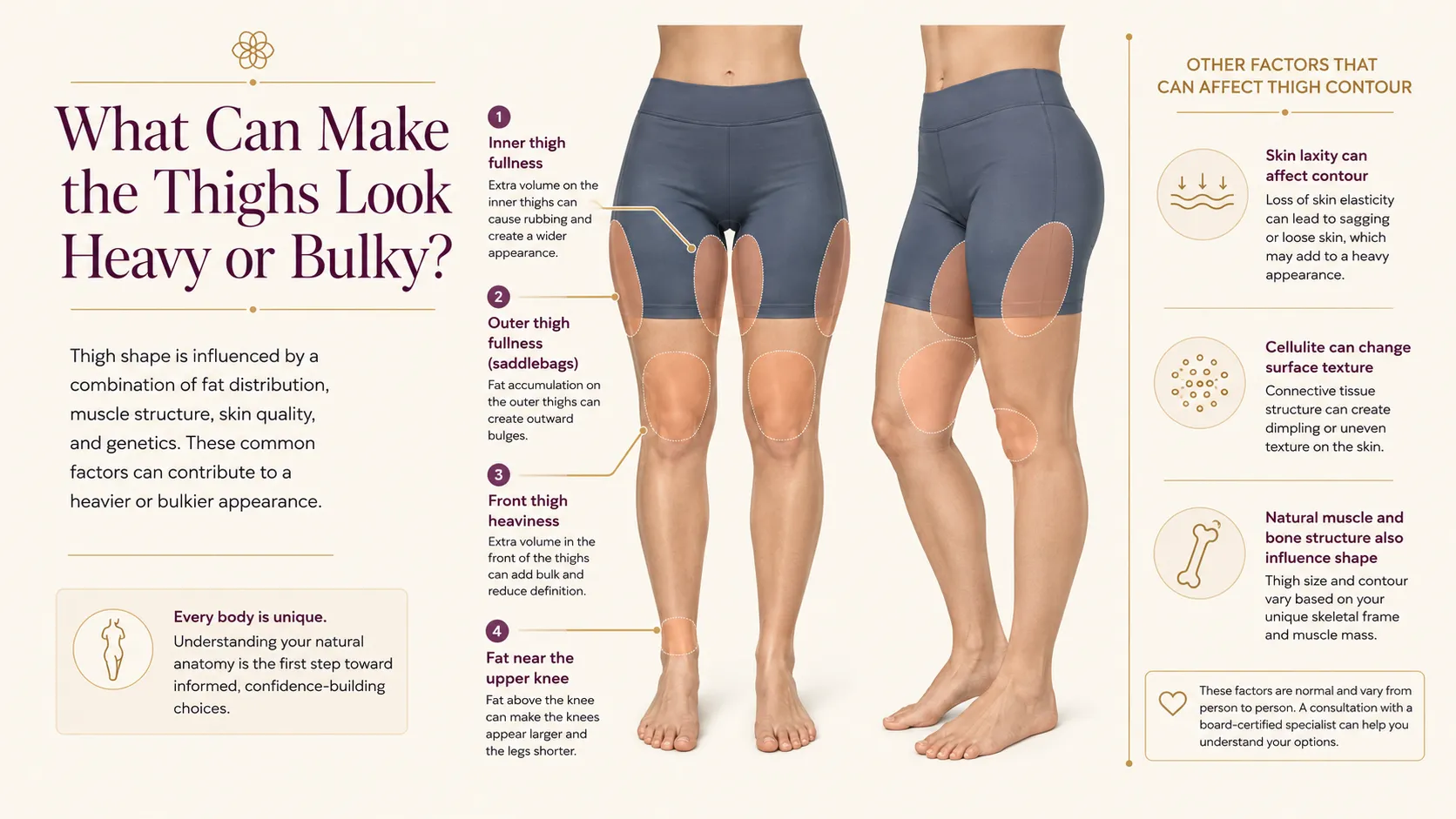
Inner-thigh fullness, outer-thigh saddlebags, front-thigh heaviness and upper-knee fat are assessed separately, together with skin quality and cellulite.
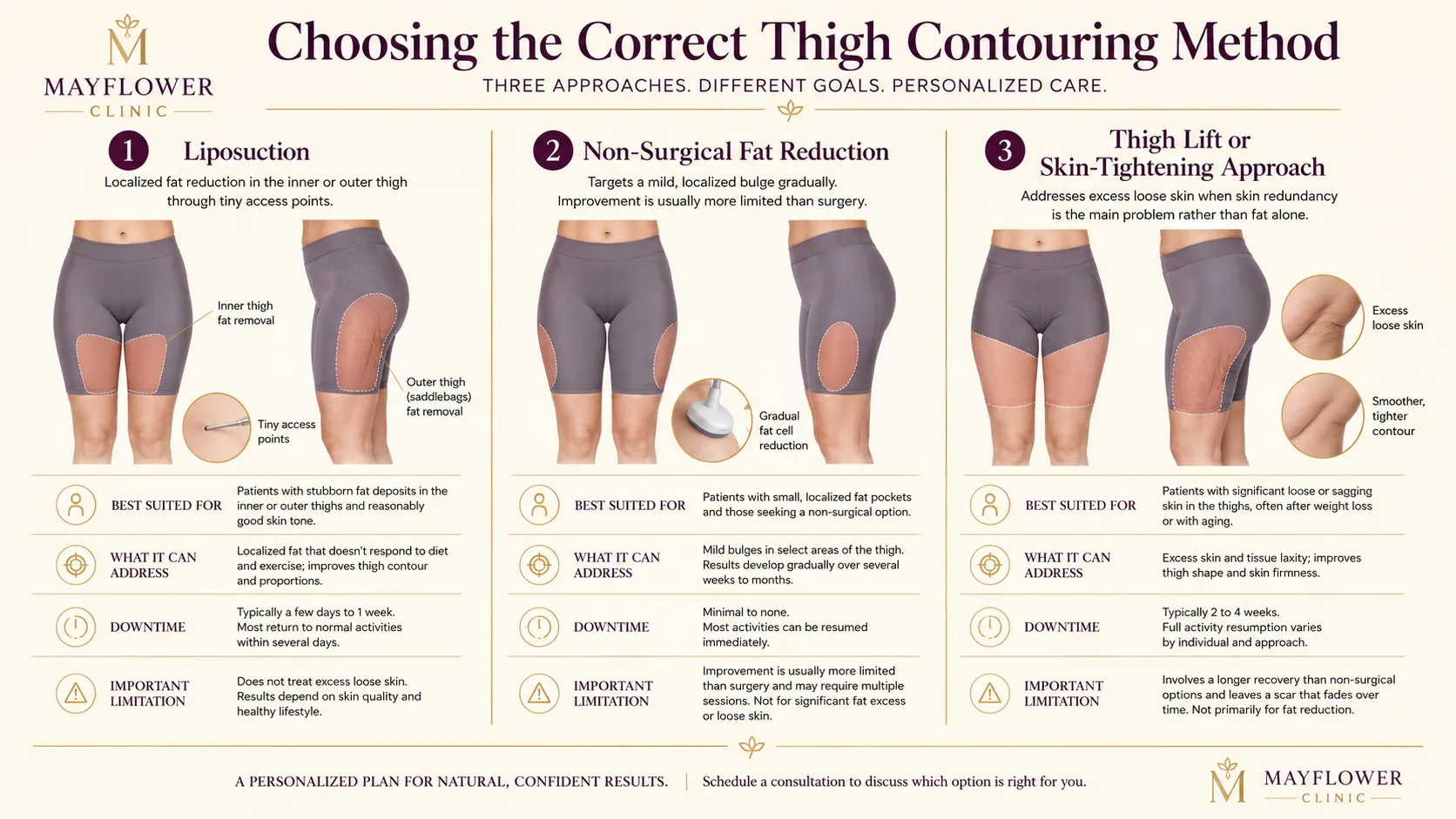
Liposuction, non-surgical fat reduction and thigh-lift surgery address different concerns, with different scars, recovery and limitations.
This is general education. The final plan depends on examination, medical history, skin quality and treatment availability.
| Primary concern | Pathway that may be discussed | What it may improve | Important limitation |
|---|---|---|---|
| Localized inner or outer thigh fat with good skin elasticity | Carefully planned liposuction | More direct reduction and contour shaping | Cannot guarantee cellulite improvement or tight skin; contour irregularity is possible |
| Smaller, pinchable bulge with preference to avoid surgery | Suitable non-surgical body-contouring technology, if clinically appropriate and available | Gradual, modest reduction without incisions | Not equivalent to liposuction; several sessions may be needed; device-specific adverse effects exist |
| Substantial loose skin, folds or post-weight-loss laxity | Thigh-lift assessment, sometimes with selective liposuction | Removal and redraping of excess skin | Longer scars, wound-healing risks and a more involved recovery |
| Cellulite or skin dimpling without a major fat bulge | Separate cellulite-focused assessment | Potential improvement using a treatment selected for the skin–fibrous band problem | Thigh liposuction alone is not a reliable cellulite treatment |
| Generalized thigh enlargement related to overall weight | Nutrition, physical activity and medical weight-management pathway first | Overall health and proportional fat reduction | Cosmetic contouring should not be presented as obesity treatment |
No technique is automatically “best.” The safest useful option is the one matched to the tissue problem and acceptable trade-offs.
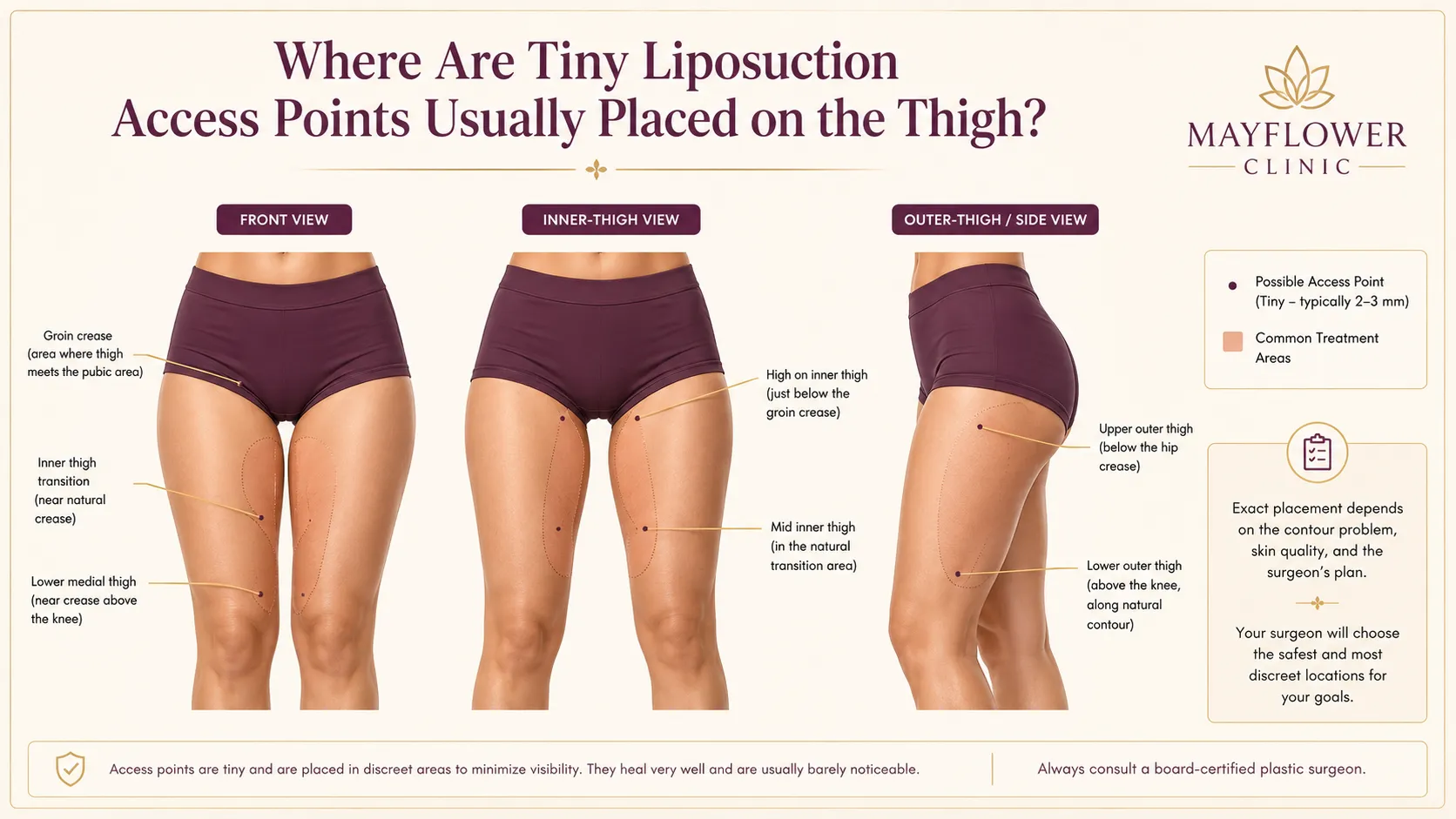
Small access incisions allow a cannula to remove selected subcutaneous fat. The plan may include inner thighs, outer thighs, upper knees or another connected zone, but conservative blending is central.
Key limit: removes fat, not major loose skin or cellulite.An energy-assisted technique may be considered in selected cases. The device is a tool, not a guarantee of smoother skin or a better result; surgeon judgment and tissue handling remain decisive.
Key limit: additional technology does not remove the usual surgical risks.Cooling or other device-based technologies may be considered for a smaller localized deposit when a patient accepts gradual, more modest change. Suitability depends on the device, applicator fit and health profile.
Key limit: not a substitute for liposuction or weight-loss treatment; rare device-specific complications can occur.When skin excess is the main problem, removal and redraping of skin may be discussed. Scar length depends on the pattern and severity of laxity, and wound care is more demanding than after liposuction.
Key limit: longer scars and a different complication profile.The consultation is not simply a measurement of thigh circumference. It evaluates the shape of the entire lower body and the quality of the tissues that must heal and redrape.
Fat, skin, cellulite, swelling and muscle contribution are separated before any procedure is chosen.
Inner and outer thighs are marked in relation to the hips, buttocks and knees, with attention to natural asymmetry.
Tests, medicines, nicotine cessation, fasting, transport, compression garments and thrombosis prevention are individualized.
For liposuction, small access points and controlled fat removal are used to preserve smooth contour transitions. Other pathways follow their own protocol.
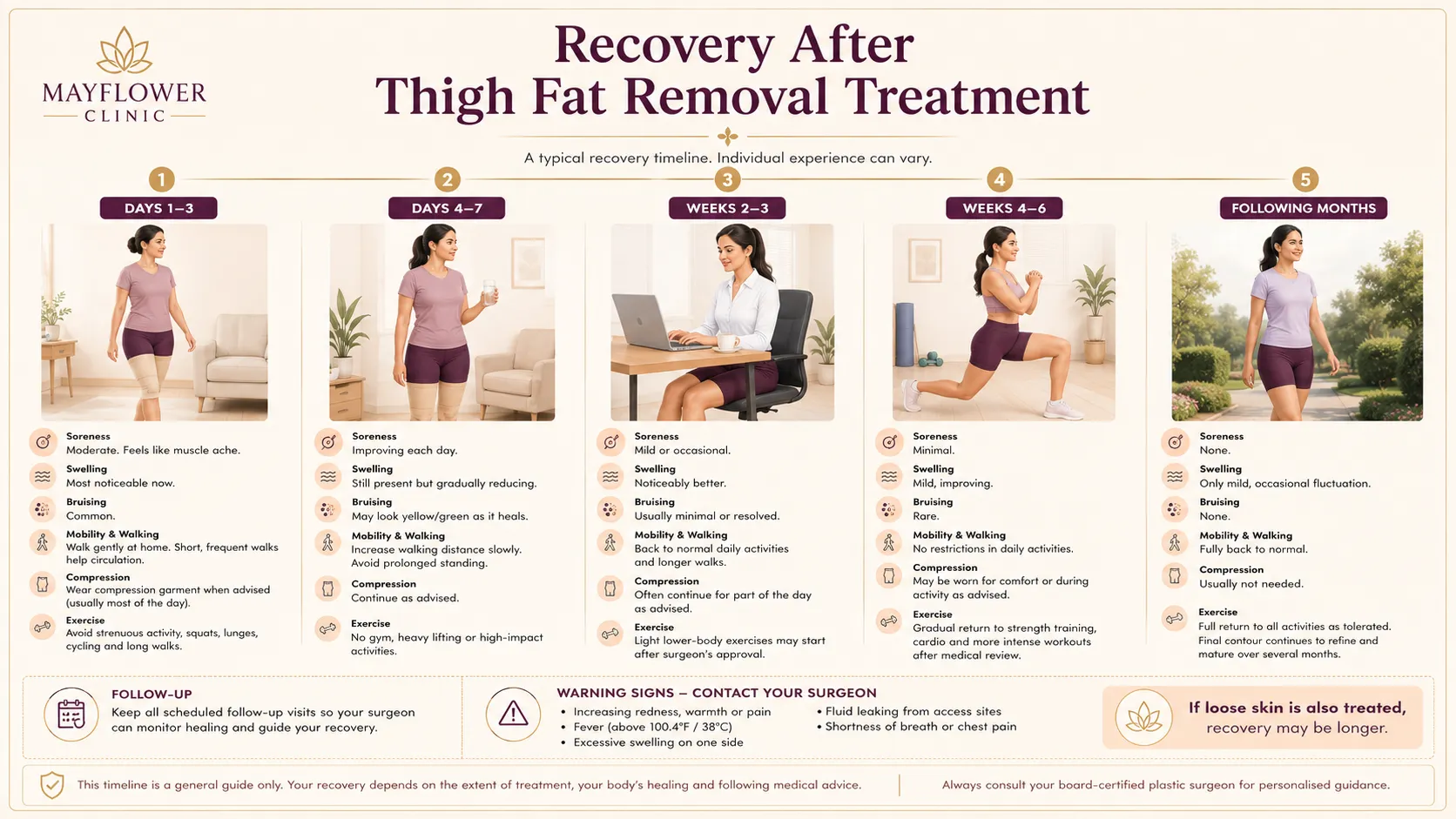
Early gentle movement is usually encouraged. Swelling, bruising, tenderness and temporary unevenness are expected after surgery.
Work, driving and exercise resume according to comfort, wound healing, swelling and surgeon clearance—not a universal internet timetable.
Residual swelling and tissue firmness can take weeks to months to improve. Final assessment is delayed until the contour has stabilized.
Access points are planned according to the zones being treated and the direction needed for controlled contour blending. Their exact number and position are individualized.
These are general bands, not promises. Thigh-lift recovery is usually more involved than liposuction recovery.
Sudden breathlessness, chest pain, fainting, one-sided calf swelling or pain, rapidly worsening thigh swelling, uncontrolled bleeding, high fever, spreading redness, severe pain out of proportion, or a cold/pale/numb leg.
The aim is a smoother, more proportionate transition—not a perfectly straight leg, a guaranteed thigh gap or identical right and left thighs. Existing skeletal shape, muscle bulk, skin quality and cellulite remain influential.
Removed fat cells are reduced in the treated zone, but remaining cells can enlarge with weight gain. Ageing, pregnancy, hormones and weight change can alter the contour over time.
A single online price can be misleading because “thigh fat removal” may mean one small outer-thigh zone, circumferential thigh liposuction, non-surgical sessions or skin-removal surgery.
A written personalized estimate is provided after consultation, with inclusions and exclusions explained.

Thighs are vulnerable to visible irregularity because the skin can be thin and the contour is seen from multiple angles while standing and walking. Treatment therefore depends on restraint, balanced marking and continuity of postoperative care—not just the name of a device.
Dr. Pawan Shahane personally evaluates the concern, discusses the appropriate procedure and limitations, performs surgical treatment when chosen, and leads postoperative review at Mayflower Clinic.
These are general published clinic testimonials, not thigh-specific outcome claims. Individual results and experiences vary.
“Good experience. Highly skilled surgeon. Post op care and consultation was also done nicely.”Mahika GoelPublished patient testimonial
“Honest and explains everything well. His staff are also good.”Sandip BhudePublished patient testimonial · excerpt
“Amazing experience with Dr Pawan Shahane… He is good in knowledge… and he is very kind in nature.”Jithin RajPublished patient testimonial · excerpt
Testimonials are personal experiences, not guarantees of medical or cosmetic outcome.
No. Thigh contouring is intended for localized fat or skin concerns. It does not treat obesity or replace nutrition, exercise or medical weight management.
Sometimes, but the decision depends on overall leg proportions, skin quality, safe treatment extent, anaesthesia planning and the risk of over-correction. Each zone is marked and assessed separately.
Liposuction generally offers more direct contour change for a suitable localized fat deposit, while non-surgical treatment may suit a smaller pinchable bulge and usually produces a more gradual, modest change. Examination is needed to choose safely.
No. Cellulite is related to skin, fibrous bands and the fat–skin interface. Liposuction is not a cellulite treatment and cellulite may remain, become more noticeable or require a separate plan.
Liposuction removes fat; it does not reliably remove substantial loose skin. Skin with good elasticity may contract to some degree, but visible laxity may need a thigh-lift discussion.
A thigh lift may be considered when excess skin, folds, rubbing or post-weight-loss laxity is the main concern. It involves longer scars and a different recovery and risk profile from liposuction.
Anaesthesia varies with the zones treated, expected procedure extent, patient health and surgeon–anaesthesia planning. Local anaesthesia with sedation or general anaesthesia may be considered for surgical treatment.
The time varies with inner versus outer thigh treatment, number of zones, symmetry work, whether another area is combined and anaesthesia requirements. A personalized estimate is provided after marking and examination.
Walking usually begins early, while bruising, tenderness and swelling are expected. Many patients return to light desk work within several days to about two weeks, but exercise and final contour take longer and vary by treatment extent.
A compression garment is commonly advised after surgical liposuction, but duration and fit are individualized. It should not be so tight that it causes pain, numbness or circulation concerns.
Liposuction uses small access incisions placed strategically where feasible. They usually fade but cannot be promised to become invisible. A thigh lift creates substantially longer scars.
Removed fat cells do not regenerate in the same way, but remaining fat cells can enlarge with weight gain and the thighs continue to age. Stable weight and realistic expectations support longer-lasting contour improvement.
Risks can include bruising, swelling, infection, fluid collection, numbness, asymmetry, contour irregularity, loose skin, pigmentation change, poor healing, blood clots, anaesthesia complications and need for revision. Risk differs by procedure and patient health.
Cost depends on the zones treated, treatment type, procedure extent, anaesthesia, facility requirements, compression garments, tests, medicines, follow-up and whether skin-removal surgery is required. A written personalized estimate follows consultation.
Gentle walking is usually encouraged early after surgery, while strenuous exercise, running and lower-body training resume gradually after surgeon clearance. The schedule depends on swelling, wound healing and the treatment performed.
Yes, but travel timing must account for consultation, pre-operative tests, procedure day, early follow-up, mobility and blood-clot prevention. Long-distance return travel should be planned with the surgical team rather than booked around a fixed online timeline.
These sources do not replace an examination or individualized advice.
Page updated: 24 July 2026. Clinical review should be reconfirmed before publication and whenever treatment availability or guidance changes.
Bring your main concern—inner thigh, outer thigh, loose skin, rubbing or cellulite—and receive an anatomy-led discussion of suitable options, limitations, recovery and cost factors.

Case of the Month: Grade 3 Gynecomastia…

The Science of Facial Aging: Why Wrinkles,…