
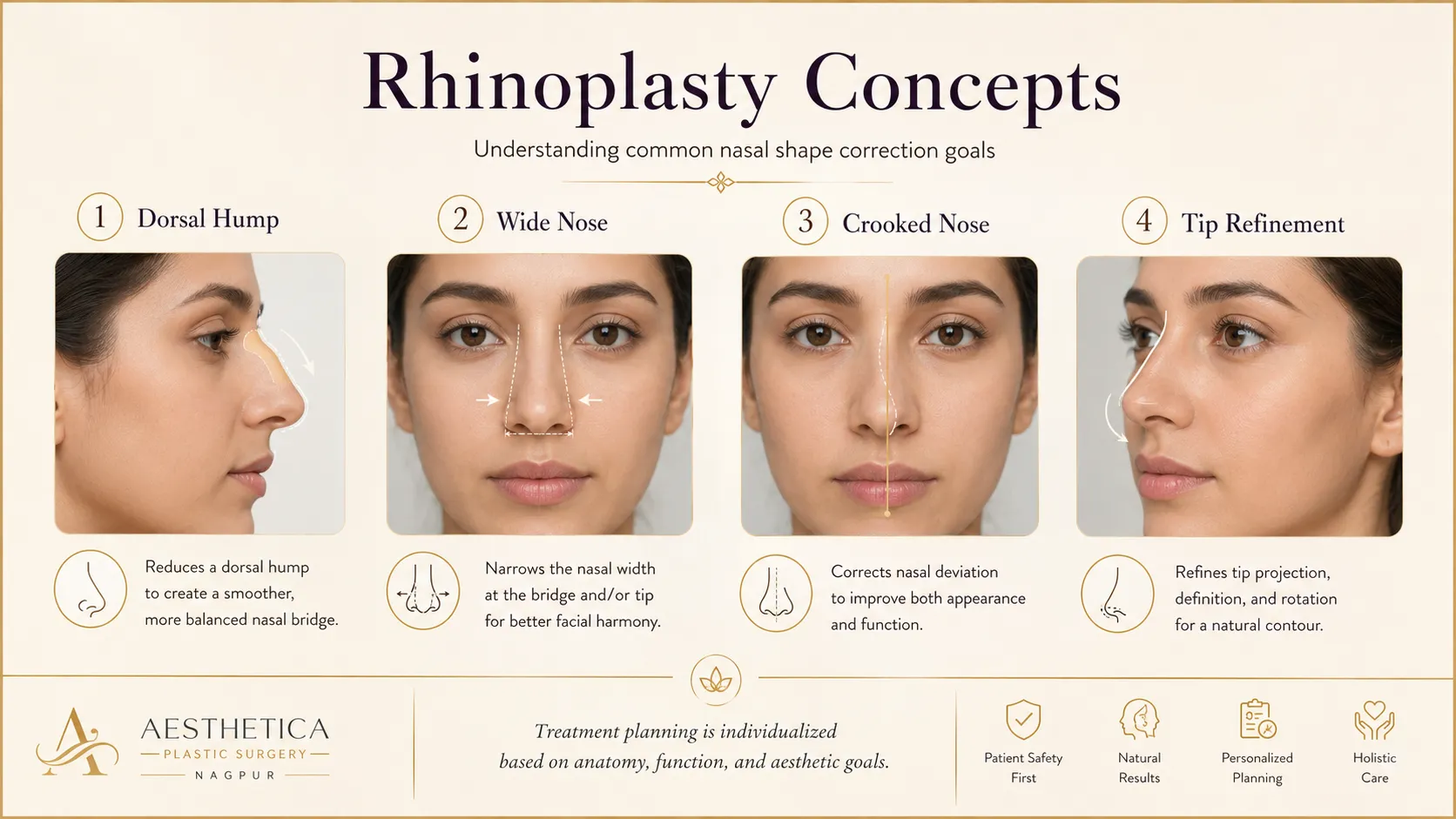
External framework
Assessment includes nasal length, width, dorsal lines, radix, middle vault, tip projection and rotation, nostril shape, alar base, symmetry and relationship to the chin and face.

“Nasal surgery” is not one procedure. It may mean cosmetic rhinoplasty, septoplasty for obstruction, combined septorhinoplasty, correction after injury, revision surgery or reconstruction. This page helps you enter the right pathway before discussing an operation.

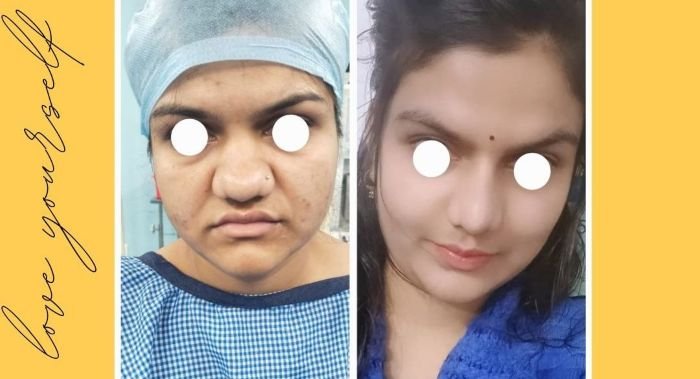
Describe your main concern in ordinary words. This on-page guide will point you to the most relevant section and procedure pathway.
This guide cannot examine you, diagnose the cause, recommend surgery, calculate candidacy or replace an in-person consultation.
“A patient asking for nose surgery may be describing a shape concern, an airway problem, an old injury, tissue loss or several issues together. The operation should follow the diagnosis—not the search term.”— Dr. Pawan Shahane, M.Ch. Plastic Surgery
People use “nasal surgery,” “nose surgery” and “rhinoplasty” interchangeably, but they do not always mean the same thing. Rhinoplasty primarily changes or restores the nasal framework. Septoplasty straightens the internal septum. Septorhinoplasty combines functional and external correction. Trauma and reconstruction may require an entirely different sequence.
The first consultation should therefore identify the dominant problem and the structures involved. A nose that looks crooked can have a straight septum; a nose that looks straight can still have significant obstruction. A patient with an old fracture may need bone, septal and valve correction, while tissue loss may require staged reconstruction rather than routine rhinoplasty.
These categories can overlap. The final plan depends on examination rather than a self-selected procedure name.
For concerns such as a hump, wide bridge, bulbous tip, drooping tip, asymmetry or disproportion—while preserving stable support and airway.
Explore cosmetic nose surgery Airway-ledFor selected obstruction related to a deviated septum, valve weakness or other internal structural factors. Turbinates and inflammatory causes must also be considered.
Explore breathing-focused surgery CombinedWhen external shape and internal breathing concerns need coordinated correction in one plan rather than two unrelated operations.
See combined planning After injuryFor recent or old fractures, displaced nasal bones, septal injury, valve collapse, scars or asymmetry after trauma. Timing changes the treatment.
Explore crooked-nose correction RestorationFor tissue loss, scar contracture, congenital difference, tumour-related defects or complex trauma involving skin, lining and structural support.
Read reconstruction guidance Previous surgeryFor persistent obstruction, asymmetry, collapse, scar-related distortion or unsatisfactory shape after a previous nasal operation.
Explore revision rhinoplasty| What the patient notices | What needs assessment | Possible destination | Important caution |
|---|---|---|---|
| Hump, wide nose, tip concern or disproportion | Whole-face proportion, skin, bones, cartilage, tip support and airway | Cosmetic rhinoplasty | Reduction alone can weaken support in the wrong anatomy. |
| One-sided or persistent blocked breathing | Septum, turbinates, valves, allergy/inflammation and external framework | Functional surgery or septorhinoplasty | A septal deviation is not the only cause of obstruction. |
| Crooked nose with breathing difficulty | Nasal bones, dorsal/caudal septum, middle vault, valves and facial asymmetry | Structural straightening | Perfect geometric straightness is not always achievable. |
| Recent fracture or sudden deformity | Timing, displacement, bleeding, septal haematoma and associated injury | Urgent assessment / fracture pathway | Do not wait for an elective cosmetic appointment if there is acute injury or severe obstruction. |
| Old trauma, collapse or scarred nose | Framework stability, septum, valves, scar tissue and graft availability | Post-traumatic or reconstructive surgery | More than one stage may be needed. |
| Problem after previous rhinoplasty | Healing interval, scar, missing support, airway and available graft material | Revision rhinoplasty | Revision is often more complex than primary surgery. |
That is why cosmetic photographs alone are not a complete nasal assessment.
Assessment includes nasal length, width, dorsal lines, radix, middle vault, tip projection and rotation, nostril shape, alar base, symmetry and relationship to the chin and face.
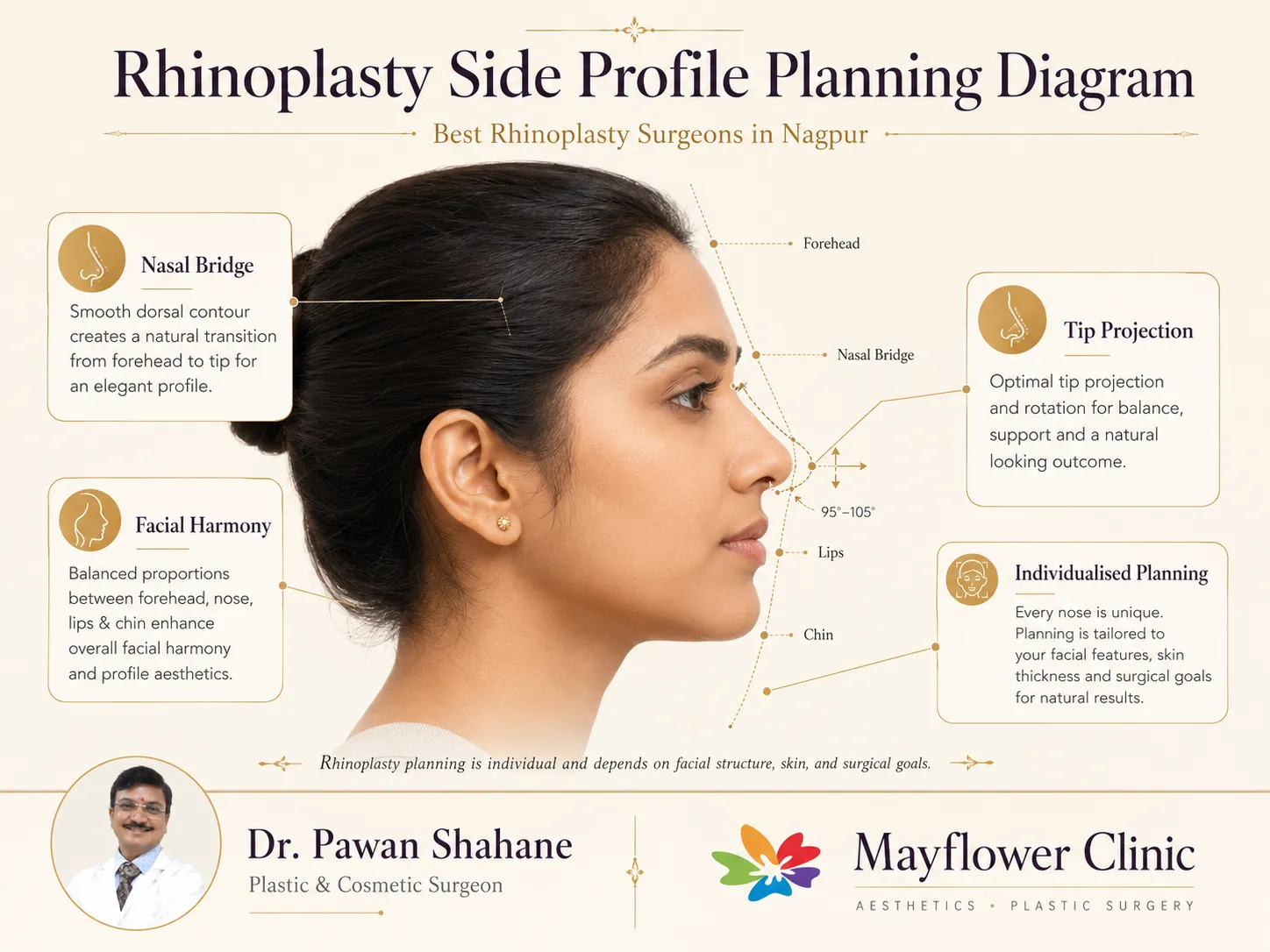
Evaluation considers the septum, turbinates, internal and external valves, lining, previous scars and whether the external framework contributes to airflow narrowing.
“Deviated septum” is common, but obstruction can be multi-level.
The septum may bend in its front, middle or back segments. Caudal deviation can also affect nostril symmetry and tip position.
Turbinates can enlarge with allergy or inflammation. Their role should be considered before assuming septoplasty alone will solve obstruction.
The narrowest airway area may be weak, pinched or collapse during inspiration. Support may be needed rather than simple tissue removal.
A crooked or narrow middle vault, old fracture or over-reduced nose can contribute to obstruction and may require structural correction.
Surgery does not treat every cause of congestion. Medical treatment or an ENT opinion may be appropriate when symptoms suggest inflammatory disease.
CT imaging or nasal endoscopy is not routine for every cosmetic case, but may be advised for selected sinus, trauma, obstruction or complex revision concerns.
Routine rhinoplasty reshapes an existing framework. Reconstructive nasal surgery may need to restore missing or scarred components after trauma, burns, previous surgery, congenital difference or removal of a lesion. The nose has three functional layers: external cover, internal lining and structural support. A complex defect may involve all three.
Small contour problems may be corrected in one operation. Larger defects may need local tissue rearrangement, flaps, cartilage grafts or staged reconstruction. The goal is a safe, stable and proportionate restoration with realistic limits—not an instant cosmetic transformation.
Timing matters. Early fracture management is different from correction of a deformity that has healed.
Healed bone, septum, valves and scars are assessed together before structural straightening.
Coverage, lining and support may need separate reconstructive solutions.
Planning considers growth, function, previous procedures and the patient’s priorities.
Appearance, breathing, trauma, previous surgery or tissue loss—plus what matters most if several concerns coexist.
Previous injuries, operations, allergy, sinus symptoms, obstruction pattern, medications, smoking and general health are discussed.
Facial proportions, nasal framework, septum, turbinates, valves, skin, scars and airway behaviour are evaluated.
The plan may be cosmetic rhinoplasty, septoplasty, septorhinoplasty, trauma correction, revision or reconstruction—or non-surgical/medical management when surgery is not appropriate.
Open versus closed access, cartilage support, osteotomies, staged reconstruction, anaesthesia, scars, risks and realistic outcomes are explained.
Surgery is personally performed by Dr. Pawan Shahane according to the agreed plan and intra-operative anatomy.
Splint or wound care, swelling, breathing, scars and gradual tissue settling are reviewed over the appropriate timeline.
Bleeding, infection, anaesthesia-related events, delayed healing, scarring and need for additional treatment are possible.
Persistent obstruction, asymmetry, contour irregularity, numbness, septal problems, valve weakness or unsatisfactory appearance can occur.
Skin thickness, scar biology, prior trauma, previous surgery and graft behaviour influence how quickly and predictably tissues settle.
Faces are naturally asymmetric. A severely crooked or traumatised nose may improve substantially without becoming mathematically straight.
Structural surgery cannot remove allergy or every inflammatory cause. Some patients need continued medical treatment.
Further surgery is not common for every patient, but can be required when healing, function or contour remains problematic.
A limited septoplasty, structural rhinoplasty, old-fracture correction and multi-stage reconstruction do not share one identical recovery. For many primary nasal operations, a splint may be used for roughly one week, early social recovery often takes one to two weeks, and swelling continues to reduce over several months.
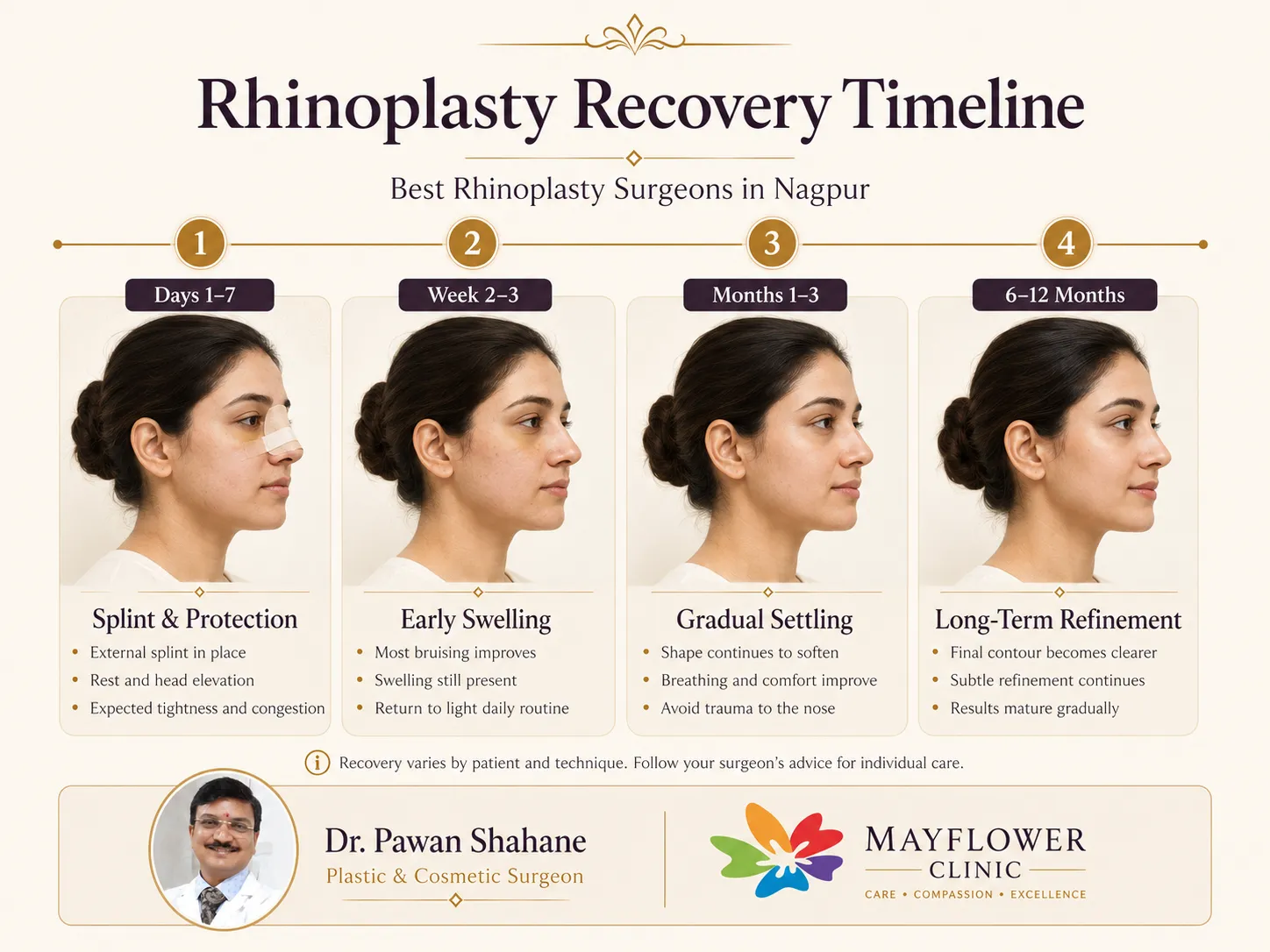
Educational timeline. Your instructions may differ for septoplasty, trauma surgery, revision or reconstruction.
Individual experiences do not predict another patient’s outcome.
“Rhinoplasty, nose surgery done for my sister. We are very happy with results… He explains everything and how to take care. He support at every stage and do the surgery as planned.”
“I am very happy with my nose surgery, rhinoplasty. It’s been 3 weeks… I wanted a sharp tip, and I was having a broad nose.”
“From the initial consultation to the post-operative care, Dr. Shahane demonstrated exceptional skill, professionalism, and a genuine care for my well-being.”
Nasal surgery is an umbrella term. It may include cosmetic rhinoplasty, septoplasty, combined septorhinoplasty, post-traumatic correction, revision surgery or reconstruction. The correct category depends on anatomy, symptoms, previous surgery and goals.
Rhinoplasty changes or restores the external nasal framework. Septoplasty straightens the internal septum to address selected forms of obstruction. When both shape and breathing need treatment, a combined septorhinoplasty may be considered.
Yes, selected patients can have both planned together. This is especially relevant when the septum, middle vault, valves and external crookedness are related. Treating one without considering the other may be incomplete.
It depends on timing and damage. A recent fracture may need early assessment, while an old deformity may require osteotomies, septal correction, valve support or reconstruction. Tissue loss and scars change the plan further.
Reconstructive surgery restores missing, scarred or unstable skin, lining and structural support after trauma, burns, previous surgery, congenital difference or removal of a lesion. Larger defects may require staged treatment.
No. Obstruction can involve the septum, turbinates, internal or external nasal valves, inflammation, allergy or the external framework. The cause should be assessed before surgery is selected.
Neither is universally better. Closed surgery uses internal incisions, while open surgery adds a small columellar incision for exposure. Complexity, revision status, grafting needs and the required visibility guide the choice.
Not every cosmetic patient needs these tests. They may be considered for selected sinus symptoms, significant obstruction, trauma, unusual findings or complex revision surgery, sometimes with an ENT assessment.
Many primary operations require around one to two weeks for early social recovery, but swelling and internal healing continue longer. Septoplasty, complex trauma surgery and reconstruction may follow different timelines.
Early changes are visible after splint removal, but the result should not be judged then. Swelling settles gradually, and tip refinement can take many months—especially with thick skin, revision surgery or reconstruction.
Cost varies because “nasal surgery” can describe very different operations. It depends on whether treatment is cosmetic, functional, combined, revision, traumatic or reconstructive, as well as anaesthesia, facility and graft requirements.
Start by identifying your dominant concern: appearance, breathing, injury, previous surgery or tissue loss. A consultation should then examine both the external nose and internal airway before recommending a pathway.
Bring your main concern, previous reports or operation notes, and photographs from before an injury or earlier surgery when available. The goal of the first visit is to identify the correct pathway—not to force every concern into rhinoplasty.

Case of the Month: Grade 3 Gynecomastia…
What Is Acne Scar Correction? A Complete…