0712 6692706 / 0712 3551170 / +91 8087471244   |   contact@mayflowerclinic.in

M.Ch. Plastic Surgery · Whole-Face Planning

Rhinoplasty and Facial Surgery in Nagpur — A Better Nose Plan Starts With the Whole Face.

The nose is central, but it is not viewed in isolation. Chin projection, the upper lip and smile, cheeks, eyelids, ears, jaw position and natural facial asymmetry can change how nasal size and shape are perceived. This page explains the Mayflower Max-Lift™ structural rhinoplasty concept, when rhinoplasty alone may be enough, when a selected facial procedure may reasonably be combined, and when staging is the safer or more logical plan.

Dr. Pawan Shahane
Reviewed by Dr. Pawan Shahane, M.Ch. Plastic Surgery21+ years surgical practice · Ex-Asst. Prof. GMC Nagpur · IAAPS Member · 9 yrs ThreeBestRated Nagpur
Dr. Pawan Shahane discussing rhinoplasty and whole-face surgical planning with a patient at Mayflower Clinic Nagpur
Whole-face assessment before combinationFrontal, profile, three-quarter and dynamic views help separate a true nasal concern from the way nearby facial structures influence perception.
21+Years surgical practice
M.Ch.Plastic Surgery
9 YearsThreeBestRated Nagpur
0 DelegationSurgery led personally
Page Guide

Quick Answer

Ask a simple question about rhinoplasty alone, combination procedures, facial balance, staging, safety, cost factors or recovery. The guide searches the medically reviewed answers already published on this page.

Private · On-page · No login

General education only. This guide cannot examine your face, diagnose a condition, calculate candidacy, recommend surgery, provide a patient-specific price or replace an in-person consultation.

Combination surgery should solve a connected planning problem—not create a longer procedure without a clear reason.

“The nose must be designed for the face that already exists. A second facial procedure is considered only when it addresses a real, independent concern or materially changes the proportion we are trying to achieve.”
— Dr. Pawan Shahane, M.Ch. Plastic Surgery
What this page means

Rhinoplasty with facial surgery is an individual plan—not a cosmetic package

Rhinoplasty can improve nasal shape, support and, when indicated, breathing. In many patients, that is the only operation required. A wider facial assessment is still valuable because the same nose can appear more or less prominent depending on chin projection, lip position, cheek contour, jaw position, eyelid shape, ear prominence and the natural asymmetry of the face.

Combined facial surgery means that a separately justified facial procedure is planned alongside rhinoplasty. The procedures may share one anaesthetic and one broad recovery period, but they remain distinct operations with their own indications, limitations and risks. The decision is therefore based on anatomy, priorities, health, total surgical time, recovery compatibility and whether the result of one procedure should be seen before planning the next.

Questions answered during consultation

  • Is the nose truly disproportionate, or does chin or jaw position change how it is perceived?
  • Is another facial concern important to the patient even if it does not affect rhinoplasty planning?
  • Can both procedures be performed safely within a reasonable anaesthetic and operative plan?
  • Would swelling or tissue change from one procedure make the other harder to judge?
  • Would jaw surgery, dental correction or another treatment alter the nose or profile later?
  • Does the patient prefer one longer recovery or two shorter, more focused recoveries?
Key principle: a full-face assessment does not mean recommending full-face surgery. Its purpose is to prevent tunnel vision, preserve individual identity and avoid treating a perceived “large nose” when the relationship between several features is the real issue.
Quick Answer Library

Concise answers about whole-face rhinoplasty planning

These answers are published directly in the page HTML for patients, screen readers, search engines and browsing agents. The Page Guide above only helps locate the most relevant answer.

One source of truth: each interactive answer is read from the visible cards below, so the guide does not keep a separate hidden medical answer bank.

What is Mayflower Max-Lift™ Rhinoplasty?

It is Mayflower Clinic’s name for an individualised, structural rhinoplasty planning approach. It looks beyond isolated bridge reduction to nasal-base and tip support, dynamic movement during smiling, the upper-lip and chin relationship, airway needs and whole-face proportion. It is not one fixed operation, and not every patient needs grafting, muscle release, augmentation or another facial procedure.

Read the Max-Lift explanation ↓

Is rhinoplasty alone enough?

Often, yes. When nasal shape, support or breathing is the main concern and nearby facial features are acceptable to the patient, adding another operation may offer no meaningful benefit. Whole-face analysis is used to confirm the plan and avoid unnecessary treatment.

See how the decision is made ↓

Which facial procedures can be combined?

Selected plans may include chin augmentation or genioplasty, eyelid surgery, ear correction, facial fat grafting, scar revision or another facial procedure. Each must have its own indication; the page title is not a reason to perform several operations.

Review possible combinations ↓

Do I need chin surgery with rhinoplasty?

A retruded chin can make the nose appear more prominent in profile, but not every profile needs chin surgery. The consultation separates a true nasal excess from a nose–chin proportion issue and discusses implant, genioplasty, non-surgical or no-treatment options where relevant.

Read about nose–chin perception ↓

Combined surgery or staged surgery?

Combined surgery may suit compatible procedures in a healthy patient and can consolidate recovery. Staging may be better when the total operation would be extensive, jaw surgery is planned, one result should guide the next decision, or the patient prefers shorter individual recoveries.

Compare combined and staged plans ↓

Does facial asymmetry affect rhinoplasty planning?

Yes. Differences in the eyes, cheeks, dental midline, jaw and chin can make a straight nasal axis look off-centre. Planning records these differences so the nose is assessed in the real face rather than against an artificial perfectly symmetrical template.

Understand facial asymmetry ↓

Can eyelid or ear surgery be combined?

In selected patients, yes. Blepharoplasty and otoplasty address separate concerns and may have compatible recovery plans. Suitability depends on the patient’s health, total operative time, dressings, eye or ear-specific risks and whether one combined recovery is genuinely useful.

See independent facial procedures ↓

How long is combined facial-surgery recovery?

Recovery follows the slowest-healing procedure. Nasal splinting is often about a week, but swelling in the nose and another facial area may remain visible for longer. Many patients plan roughly one to three weeks away from public-facing work, depending on the combination.

See the recovery timeline ↓

Is combined surgery cheaper?

Some facility and anaesthesia costs may overlap, but longer operating time and added materials or aftercare can increase the total. Safety and clinical logic should determine the plan; a combination should not be chosen mainly because it appears to offer a package saving.

Read the cost factors ↓

How is safety decided?

Safety assessment considers medical history, smoking, medicines, examination, anaesthesia review, total operative time, blood-loss expectations, wound locations, postoperative monitoring and the patient’s ability to manage a more complex recovery. Staging remains a valid safety choice.

Review safety planning ↓
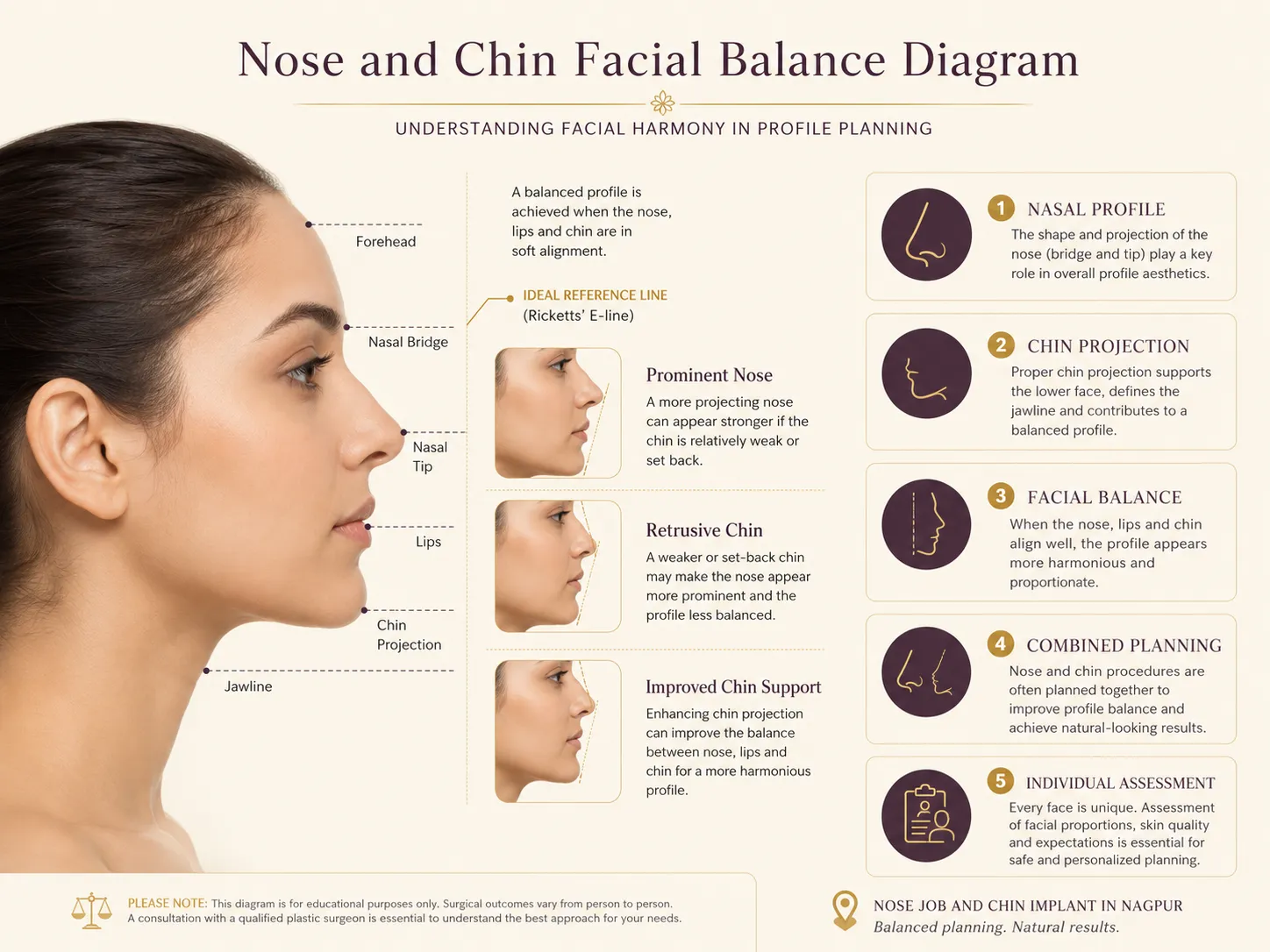
Educational side-profile diagram showing the relationship between nasal projection, lips and chin projection
Educational planning visual: the nose is interpreted relative to the lips, chin, jawline and forehead rather than by one isolated measurement.
Whole-face analysis

The nose changes the face—and the face changes how the nose is seen

Facial analysis uses several views because a single profile photograph can be misleading. Frontal assessment considers the facial midline, eye and cheek asymmetry, nose width, jaw position and chin alignment. Profile assessment considers the forehead–nose transition, nasal projection, lip position, chin projection and neck–jaw relationship. Three-quarter and smiling views show how structures interact in motion.

Measurements and angles can improve consistency, but they are guides rather than universal beauty rules. Ethnic characteristics, sex-related features, age, personal identity and the patient’s own priorities matter. A “golden ratio” is not used as a rigid template.

Frontal viewMidline, facial width, eyes, cheeks, nasal axis, jaw and chin.
Profile viewForehead, radix, bridge, tip, lips, chin and neck.
Basal viewNostrils, alar base, columella, tip symmetry and support.
Dynamic viewSmile, lip movement, tip movement and muscle-related asymmetry.
When jaw position matters: a significant bite or skeletal-jaw concern may need orthodontic or maxillofacial evaluation. Jaw surgery can change the nose and profile, so rhinoplasty timing may need coordination rather than immediate combination.
Mayflower signature planning approach

What Mayflower Max-Lift™ Rhinoplasty means on this facial-surgery page

Mayflower Max-Lift™ Rhinoplasty is the clinic’s name for a structural, whole-face method of planning nose surgery. The term describes a philosophy—not a single standardised operation and not a promise of maximum elevation.

The approach begins by examining the nose at rest and during expression. A drooping or “plunging” tip may become more noticeable when smiling, while upper-lip position, the nasolabial relationship, chin projection and the maxillary base can change how the nose is perceived. These relationships are documented before deciding which nasal manoeuvres, if any, are appropriate.

Structural rhinoplasty aims to preserve or rebuild support rather than relying only on removing bone or cartilage. Depending on the anatomy, the plan may use sutures, a columellar strut, a septal-extension graft or another cartilage graft to control tip projection and rotation. Septal, ear or rib cartilage may be considered according to cartilage availability, previous surgery and the amount of reconstruction required.

When a hyperactive depressor septi nasi muscle contributes to downward tip movement during smiling, selective management may be discussed. This is not required in every patient, it is not the same as a lip lift, and it cannot guarantee a particular upper-lip or smile change.

Structural support

Tip projection and rotation

The support method is chosen after assessing skin thickness, cartilage strength, septal anatomy, tip position and the desired degree of change. More lift is not automatically better; over-rotation and stiffness are recognised limitations.

Dynamic assessment

Tip movement during smiling

Smiling photographs and examination can reveal downward tip pull or upper-lip tethering that is less obvious at rest. Muscle treatment is considered only when it is anatomically relevant.

Facial profile

Maxilla, lips and chin

The “Max” concept on Mayflower Clinic’s source page refers to maximum facial harmony and the maxillary region supporting the nasal base. It does not mean every patient needs maxillary, lip or chin surgery.

Bridge and middle vault

Refinement without unsupported reduction

Hump reduction, augmentation, osteotomies or preservation methods are selected according to the problem. Middle-vault stability and internal nasal-valve support remain part of the plan.

Breathing

Functional work when separately indicated

Septoplasty, valve support or turbinate treatment may be combined when examination identifies a functional problem. Cosmetic rhinoplasty does not automatically improve breathing, and breathing outcomes cannot be guaranteed.

Planning tools

Photography and selective 3D planning

Standardised photographs, measurements and Mayflower Clinic’s in-house 3D capability may support communication or complex planning. A simulation or printed guide is a planning aid, not a guaranteed preview of the healed result.

Important distinction: Mayflower Max-Lift™ Rhinoplasty does not mean that every nose is made smaller, higher, sharper or more rotated. The operative plan may involve reduction, augmentation, straightening, tip support, airway work, revision reconstruction—or no surgery—depending on examination and the patient’s priorities.
The central decision

When rhinoplasty alone may be enough—and when another procedure enters the discussion

The following framework is educational. It does not determine individual candidacy without examination.

Planning findingLikely discussionWhy it matters
Nasal concern is primaryRhinoplasty aloneThe nose can be addressed without adding an unrelated operation.
Retruded or over-projecting chinChin assessment; implant, genioplasty, reduction, non-surgical option or no treatmentChin projection changes perceived nasal prominence in profile.
Prominent earsOtoplasty as an independent procedureEar correction does not alter rhinoplasty technique but may share a recovery when appropriate.
Upper or lower eyelid concernBlepharoplasty assessmentThe procedure addresses a separate periorbital concern and has eye-specific risks and aftercare.
Facial volume deficiency or contour depressionFat grafting or another contour strategyVolume changes can modify light, shadow and profile; retention and symmetry are variable.
Age-related lower-face or neck changeDedicated facial-rejuvenation assessmentSkin laxity is different from nasal shape and may require a separate or staged plan.
Skeletal jaw or bite discrepancyOrthodontic / maxillofacial coordinationJaw repositioning may alter the nose, lips, chin and overall profile.
Complex revision, airway or reconstructive needPrioritise structural rhinoplasty; consider stagingLonger reconstruction and uncertain tissue behaviour may make a second procedure less sensible initially.
Possible combinations

Selected facial procedures that may be discussed with rhinoplasty

These are options for properly selected concerns—not a checklist and not a recommendation that several procedures should be performed.

Profile relationship

Chin augmentation or genioplasty

May be considered when chin projection materially affects the nose–lip–chin relationship. Implant and bone-based options have different indications and risks.

Detailed nose-and-chin guide →
Periorbital region

Blepharoplasty

Addresses selected upper- or lower-eyelid concerns. Eye health, dry-eye symptoms, lid support and procedure-specific recovery require separate assessment.

Read about blepharoplasty →
Ear position

Otoplasty

Corrects selected ear prominence or shape concerns. It does not change the nose, but may be combined when health, positioning and aftercare are compatible.

Read about otoplasty →
Volume and contour

Facial fat grafting

May restore or redistribute volume in selected areas. Variable fat retention, swelling, asymmetry and the possible need for refinement must be discussed.

Explore facial procedures →
Jawline and lower face

Chin or jawline contouring

Used only when the lower-face concern is real and independently important. A dental or skeletal problem may require another specialist rather than cosmetic contouring.

Read about chin augmentation →
Age-related change

Selected facial rejuvenation

Older patients may ask about eyelids, facial laxity or volume together with rhinoplasty. The dedicated rejuvenation page explains this distinct planning pathway.

Rhinoplasty and facial rejuvenation →
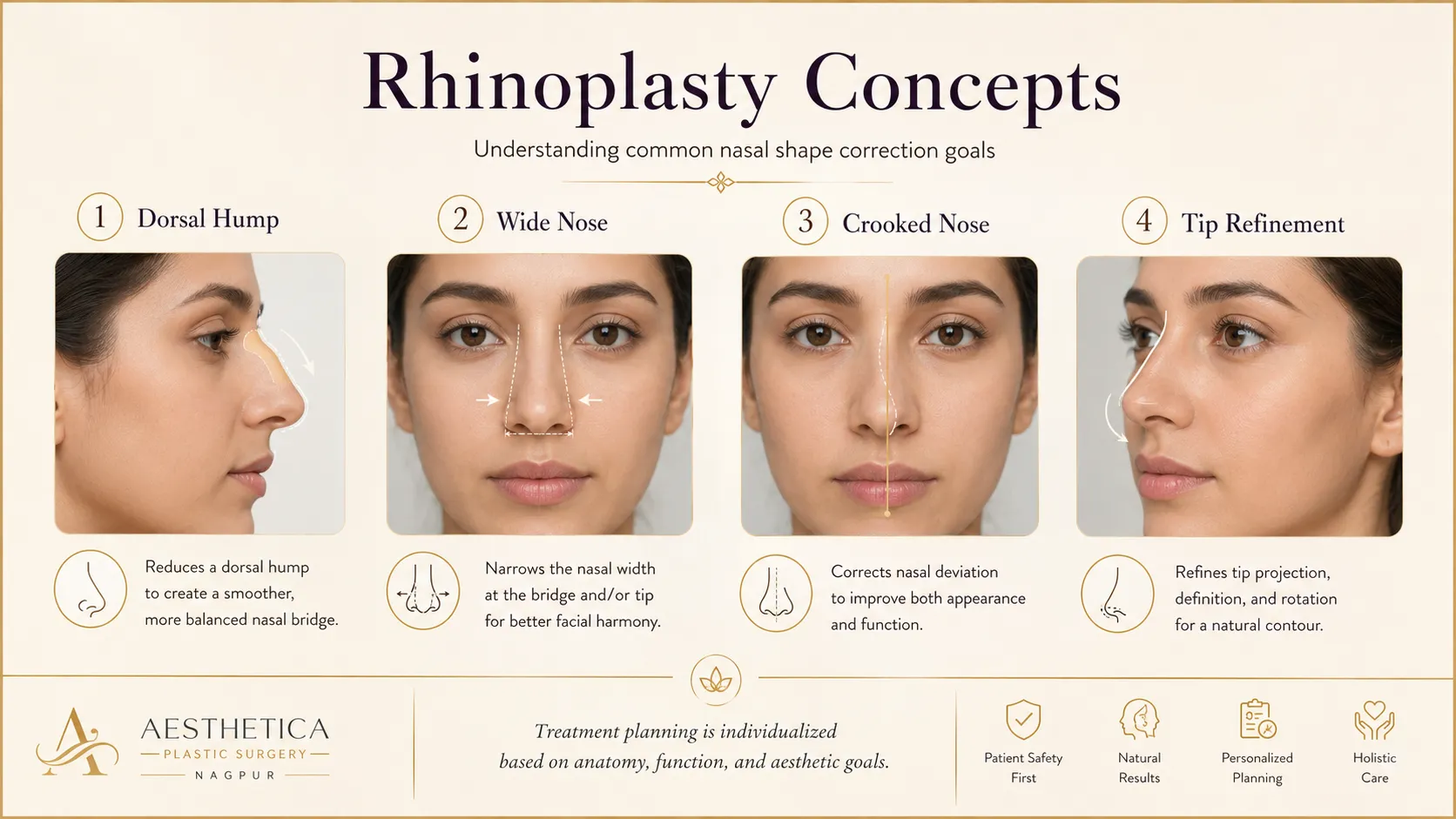
Educational diagram showing dorsal hump, wide nose, crooked nose and nasal tip refinement concepts
The nasal plan is still precise and structure-specific. Whole-face planning does not replace assessment of the bridge, bones, middle vault, tip, nostrils and airway.
The nose remains a complex operation

Facial balancing cannot compensate for weak nasal planning

Even when another facial procedure is considered, rhinoplasty must be planned on its own anatomical merits. The bridge, nasal bones, septum, middle vault, tip cartilages, nostril base, skin thickness, scars and airway each affect technique and healing.

A chin procedure cannot “hide” a poorly supported nasal tip. Facial fat grafting cannot correct a deviated septum. Eyelid or ear surgery does not reduce rhinoplasty risk. Each operation must solve the problem it is designed to treat.

  • External nasal shape and internal support are assessed separately.
  • Breathing symptoms need structural and medical evaluation.
  • Open versus closed access is chosen for the nasal work required.
  • Osteotomies, grafting and tip support are anatomy-dependent.
  • Natural-looking proportion does not mean erasing ethnic or individual features.
Timing and sequence

One operation or a staged plan?

The best sequence is the one that keeps the surgical objective clear, the total risk acceptable and the recovery manageable.

Combined surgery may be reasonable when

  • Both concerns are clearly defined and independently justified.
  • The patient is medically suitable for the total procedure.
  • Operating time and expected blood loss remain acceptable.
  • Positioning, dressings and aftercare do not conflict.
  • One result does not need to be seen before designing the other.
  • A single recovery is meaningful to the patient.

Staged surgery may be better when

  • The rhinoplasty is complex, revision, reconstructive or airway-focused.
  • Orthognathic jaw surgery or major dental correction is planned.
  • The combined anaesthetic or recovery would be excessive.
  • Swelling from one procedure would make the next result hard to judge.
  • The patient is uncertain about the second procedure.
  • Health, smoking, medication or wound-healing factors increase risk.
Staging is not a failure to “do everything at once.” It is often a deliberate way to shorten each operation, see how tissues settle and make the second decision with better information.
Patient journey

How a combined facial plan is developed

1
Before recommending procedures

Listen to the patient’s priorities

The consultation begins with what the patient notices, what causes functional difficulty and which concerns are genuinely important—not with a preselected procedure list.

  • Primary and secondary concerns
  • Previous treatment or trauma
  • Breathing and functional symptoms
  • Acceptable and unacceptable trade-offs
2
Clinical examination

Assess the nose and the whole face

Frontal, profile, three-quarter, basal and dynamic views are compared. Nasal structure and airway are assessed separately from surrounding facial proportions.

  • Facial midline and asymmetry
  • Nasal bones, bridge, tip and nostril base
  • Chin, jaw, lips, cheeks, eyes and ears
  • Skin quality, scars and healing factors
3
Problem definition

Separate connected problems from unrelated concerns

A feature can affect how the nose is perceived without requiring treatment. The surgeon distinguishes observations from procedures that are actually justified.

4
Options discussion

Compare rhinoplasty alone, combination and staging

The expected benefit, limitations, additional scars, implants or grafts, risks, anaesthesia time, cost factors and recovery are discussed for each reasonable pathway.

5
Safety review

Define the practical surgical limit

Medical history, tests, anaesthesia assessment, smoking status, medicines, total procedure length and postoperative support determine what can be performed responsibly.

6
Procedure day

Perform each operation according to its own plan

Combined does not mean blended. The rhinoplasty and any second procedure retain separate technical steps, risk controls and postoperative instructions.

7
Months of follow-up

Judge the result only after staged settling

Bruising may improve early, but the nose can continue refining for many months. Other facial areas have their own swelling and scar timelines.

Safety and limitations

Combined surgery changes the risk calculation

Risk depends on the exact procedures, patient health and duration—not simply on the number of procedure names.

Shared surgical considerations

  • Anaesthesia-related complications
  • Bleeding, infection and delayed wound healing
  • Longer operative time and more extensive swelling
  • Deep-vein thrombosis or cardiopulmonary risk in susceptible patients
  • More complex pain control, dressings and activity restrictions
  • Need for unplanned observation or additional treatment

Rhinoplasty-specific considerations

  • Persistent breathing difficulty or nasal-valve problems
  • Asymmetry, contour irregularity or residual deviation
  • Scarring, altered sensation or skin changes
  • Septal, cartilage or graft-related problems
  • Prolonged swelling, especially at the tip
  • Possible revision surgery

Second-procedure considerations

  • Implant movement, infection or firmness where implants are used
  • Eyelid malposition, dry-eye symptoms or asymmetry after blepharoplasty
  • Ear contour irregularity, recurrence or scar concerns after otoplasty
  • Variable fat survival, lumps or asymmetry after fat grafting
  • Procedure-specific nerve, sensation and scar risks

Realistic limits

  • Perfect symmetry cannot be guaranteed
  • One operation may not address every facial difference
  • Healing biology can change the planned contour
  • Computer simulations are communication aids, not promises
  • Additional surgery may sometimes be needed
  • The safest plan may be less extensive than the patient initially imagined
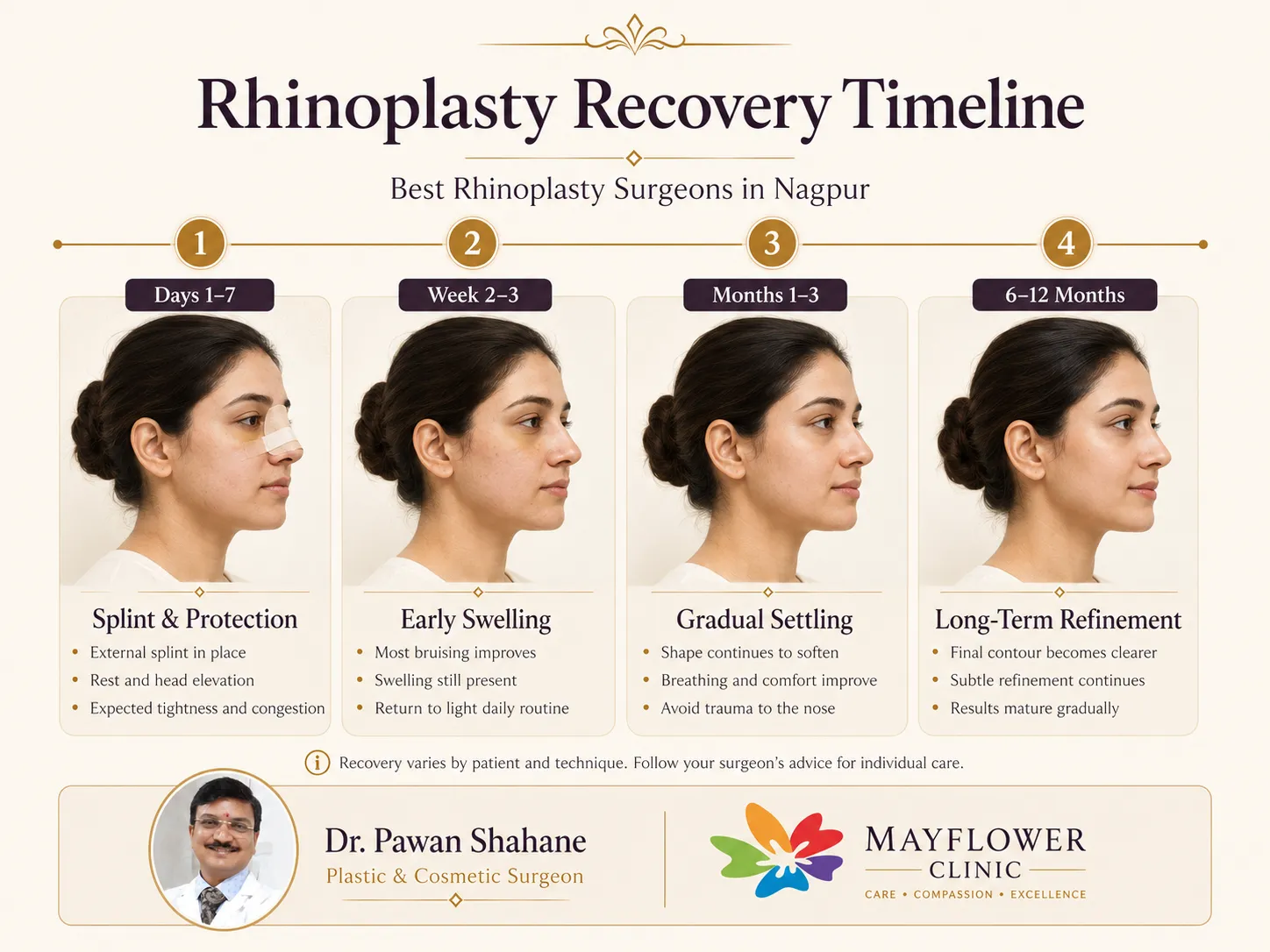
Educational rhinoplasty recovery timeline showing splint care, early swelling and gradual refinement
The nasal timeline remains important even when another facial procedure heals faster. Combined recovery follows the most restrictive component.
Recovery planning

The recovery calendar is set by the slowest procedure

A patient may feel physically comfortable before bruising and swelling have settled enough for public-facing work. Conversely, an area may look improved while internal healing still requires protection. Written instructions are tailored to every procedure included.

Days 0–3Rest, head elevation, prescribed medication, wound and swelling observation.
Days 4–10Nasal splint or dressings may be reviewed; bruising commonly remains visible.
Weeks 2–4Many resume desk work; strenuous activity and pressure remain restricted.
Months 1–3Most facial swelling decreases, but nasal tip refinement continues.
Months 6–12+Nasal contour and scars continue to mature; revision decisions are not rushed.
Report promptlyIncreasing pain, fever, heavy bleeding, vision change, breathing distress or sudden asymmetry.
Practical rule: follow the most restrictive instruction. For example, being comfortable after eyelid surgery does not mean the healing nose is ready for glasses, impact, gym activity or sun exposure.
Cost factors

Why a combined plan cannot be priced from the page title

The phrase “rhinoplasty and facial surgery” covers very different operations. A limited primary rhinoplasty with a small independent procedure is not equivalent to revision structural rhinoplasty with an implant, bone work, fat grafting or prolonged anaesthesia.

Factors that commonly affect the written estimate

  • Primary, post-traumatic or revision rhinoplasty
  • Open or closed access and structural grafting needs
  • The exact second facial procedure
  • Implant, fixation or specialised material requirements
  • Operating time, anaesthesia and facility level
  • Day-care versus overnight observation
  • Preoperative tests, garments, medicines and follow-up

See the Rhinoplasty Cost Guide

Verified patient perspectives

Real Google review excerpts about rhinoplasty care

These excerpts describe individual experiences and do not predict another patient’s result.

★★★★★
“From the initial consultation to the post-operative care, Dr. Shahane demonstrated exceptional skill, professionalism, and a genuine care for my well-being.”
N
Nishant MenghareGoogle review · Rhinoplasty patient
★★★★★
“He explains everything and how to take care. He support at every stage and do the surgery as planned.”
K
Kunal ThakurGoogle review · Family rhinoplasty experience
★★★★★
“We met with Dr. Shahane and discussed the issue. We got best result. Thanks to Dr. Shahane.”
R
Ratnesh MudgalGoogle review · Family rhinoplasty experience

Review wording is presented as the patient wrote it. Surgical outcomes vary; no testimonial is a guarantee.

Frequently asked questions

Rhinoplasty and facial surgery FAQs

What does rhinoplasty and facial surgery mean?

It describes rhinoplasty planned with one or more selected facial procedures when another feature materially affects facial balance or represents a separate concern. It is not a fixed package, and many patients need rhinoplasty alone.

How do I know whether rhinoplasty alone is enough?

Rhinoplasty alone may be appropriate when the main concern is nasal shape, support or breathing and the surrounding facial features are acceptable to the patient. Whole-face assessment helps prevent unnecessary additional procedures.

Which facial procedures may be combined with rhinoplasty?

Depending on the individual concern, rhinoplasty may be planned with chin augmentation or genioplasty, blepharoplasty, otoplasty, facial fat grafting, scar revision or selected facial rejuvenation procedures. Not every combination is suitable.

Why can chin projection change how large the nose looks?

The nose and chin are judged together in profile. A retruded chin can make the nose appear more prominent, while excessive chin projection can create the opposite imbalance. Assessment should distinguish perception from a true nasal excess.

Can rhinoplasty be combined with eyelid surgery?

It can be considered in selected healthy patients with an independent eyelid concern, compatible recovery needs and an acceptable total anaesthetic plan. The eyelid procedure should not be added solely because rhinoplasty is being performed.

Can rhinoplasty and otoplasty be performed together?

They may be combined in selected patients because they address separate facial regions. Suitability depends on health, procedure duration, positioning, dressings, aftercare and whether one combined recovery is sensible.

Should facial fat grafting be combined with rhinoplasty?

Facial fat grafting may be considered for selected contour or volume concerns, but retention is variable and swelling can make early assessment difficult. It may be combined or staged depending on the area, extent and planning goals.

Is combined facial surgery safer than having separate operations?

Neither approach is automatically safer. Combined surgery may avoid a second anaesthetic but can lengthen the procedure and make recovery more complex. Staging can shorten each operation and allow one result to guide the next decision.

Does combined rhinoplasty and facial surgery require general anaesthesia?

Many combined surgical plans use general anaesthesia, although the exact method depends on the procedures, duration, patient health and facility. Anaesthesia is decided after formal assessment rather than from the procedure name alone.

Is recovery longer after combined facial surgery?

Recovery usually follows the slowest-healing or most restrictive procedure in the plan. Swelling may involve more than one facial area, and return to work can take longer than after a limited isolated operation.

Is combined surgery cheaper than separate surgery?

Some shared facility or anaesthesia costs may overlap, but a longer and more complex operation can increase total cost. The decision should be based on safety and clinical logic rather than a package price.

Should jaw surgery be completed before rhinoplasty?

When orthognathic jaw surgery is planned, its effect on the nose and facial profile must be considered. In many cases rhinoplasty is performed after the jaw position is stable, although coordinated plans vary by diagnosis.

Can combined surgery correct all facial asymmetry?

No. Natural differences in the eyes, cheekbones, dental midline, jaw, chin, muscles and soft tissues may remain. Surgery aims for a realistic improvement in proportion, not perfect geometric symmetry.

What are the risks of rhinoplasty with another facial procedure?

Risks include anaesthesia complications, bleeding, infection, swelling, scars, asymmetry, contour irregularity, sensory change, breathing problems, implant or graft issues where relevant and possible revision surgery. Risks vary with the exact combination.

What is Mayflower Max-Lift™ Rhinoplasty?

It is Mayflower Clinic’s name for an individualised structural rhinoplasty approach that assesses tip support, nasal-base stability, the bridge and airway, movement during smiling, and the relationship of the nose to the upper lip, maxilla and chin. It is not one fixed operation and does not mean every patient needs maximum tip elevation.

Does every Max-Lift rhinoplasty require cartilage grafting or depressor septi release?

No. Cartilage grafts, septal-extension or columellar support, muscle release, implants, airway procedures and 3D planning are selected only when relevant to the individual anatomy and goals. A named approach should not replace procedure-specific consent or clinical judgement.

How much does rhinoplasty with facial surgery cost in Nagpur?

Cost depends on which procedures are required, operative time, anaesthesia, facility, implants or grafts, previous surgery and follow-up needs. A personalised written estimate follows examination and a defined surgical plan.


Medical references

Sources used for general patient education

These external references support broad concepts about facial analysis, rhinoplasty, facial implants, recovery and risk. They do not replace individual clinical assessment.

  1. American Society of Plastic Surgeons. Rhinoplasty patient information.
  2. American Society of Plastic Surgeons. Rhinoplasty risks and safety.
  3. American Society of Plastic Surgeons. Facial implants and facial balancing.
  4. American Society of Plastic Surgeons. Chin surgery and its relationship to facial proportions.
  5. Chatrath P, et al. Facial Surface Anthropometric Features and Measurements With an Emphasis on Rhinoplasty.
  6. Khan N, et al. Facial Anthropometric Measurements and Principles—Overview and Implications for Aesthetic Treatments.
  7. Raffaini M, et al. Combined rhinoplasty and genioplasty: long-term follow-up.
  8. Chen J, et al. Profileplasty: comprehensive facial profile management algorithm.
  9. Mayflower Clinic. Mayflower Max Lift Rhinoplasty source page and clinic-authored Max Lift explainer. Clinic-specific terminology has been rewritten here with conservative medical wording.
  10. Cobo R, et al. Septal Extension Graft Versus Columellar Strut.
  11. Sciegienka S, et al. Nasal Tip Support and Management of the Tip Tripod Complex.
  12. Tip Droop Prevention in Rhinoplasty: Dynamic Effect of Strut Graft on Smiling versus Muscle Release.
  13. Effects of Rhinoplasty Manoeuvres on Upper-Lip Position and Incisor Show.
Consultation in Dhantoli, Nagpur

Plan the nose for your face—not for a generic template

A consultation can clarify whether rhinoplasty alone addresses your concern, whether another facial feature deserves separate assessment, and whether any procedures are better combined or staged.

Medical Disclaimer: All surgical procedures carry inherent risks, and individual outcomes vary based on anatomy, skin type, general health and healing biology. Surgical results are not guaranteed. Formal in-person consultation with Dr. Pawan Shahane is required before any surgical decision. This page is for general educational purposes only and does not constitute medical advice or a treatment recommendation.
Mayflower ClinicSurdham Complex, Dhantoli, Nagpur — 440012, Maharashtra, India
Clinic HoursMonday–Saturday
11 AM – 6 PM
Sunday closed