Personalised treatment for facial scars after an accident, operation, burn, acne or previous wound closure—planned to make the scar less conspicuous while protecting expression, eyelid and lip function, and natural facial movement.
Individual scar assessmentSurgical and non-surgical optionsFunction-first planningRealistic scar expectations
Dr Pawan ShahaneMBBS · MS General Surgery · M.Ch. Plastic Surgery Mayflower Clinic, Dhantoli, Nagpur
Facial form and function assessed together
Reviewed by Dr Pawan Shahane, M.Ch. Plastic Surgery21+ years surgical practice · Ex-Assistant Professor, GMC Nagpur and NKPSIMS · IAAPS and IMA member
Quick patient guide
Common questions about face scar revision
General guidance only. Examination is essential before choosing treatment.
Usually, no. Scar revision replaces, repositions or remodels a noticeable scar so that it blends more naturally with nearby skin. Improvement—not complete erasure—is the realistic goal.
Understanding the treatment
What is facial scar revision?
A facial scar is the body’s repair tissue after skin injury. Its final appearance can be influenced by wound depth, direction, infection, tension, skin characteristics, sun exposure, healing tendency and the original repair.
Face scar revision is not one operation or one machine. It is an individual plan that may use scar care, injections, resurfacing, microneedling, subcision, volume restoration or surgical tissue rearrangement. The useful option depends on whether the main concern is width, elevation, depression, colour, tethering, distortion or restricted movement.
Realistic aim: a finer, flatter, better-positioned or less distracting scar. Responsible treatment cannot promise scar-free skin.
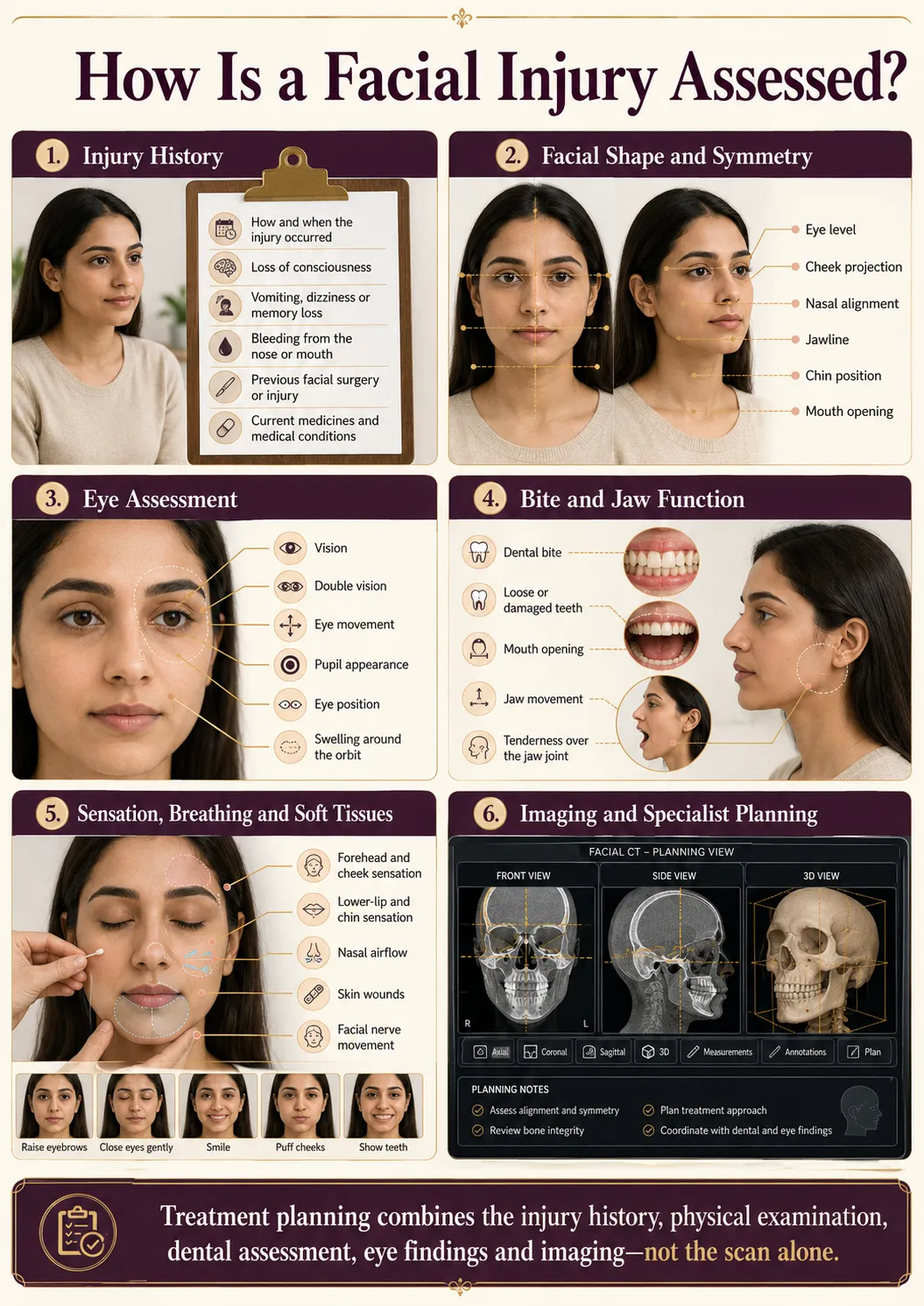
A face scar is assessed at rest and during expression, not only from a single photograph.
What the consultation examines
A face scar is more than a surface mark
The consultation identifies the scar pattern, its effect on nearby structures and the reason it remains noticeable. This prevents a surface treatment from being used when deeper release or reconstruction is actually needed.
Scar shape and direction
Width, length, edge quality, shine, colour and alignment with relaxed facial skin lines are examined.
Movement and expression
The scar is observed while smiling, speaking, closing the eyes and moving the lips or nose when relevant.
Tethering and tissue loss
Depression may result from deeper attachments, missing soft tissue or contour loss rather than surface texture alone.
Function and nearby anatomy
Eyelid closure, lip seal, mouth opening, nostril shape, sensation and facial nerve function are checked when needed.
Scar pattern matters
Which facial scars may be assessed?
Different scars require different strategies. A diagnosis based on scar behaviour and anatomy guides treatment selection.
Width and tension
Wide or stretched scars
A scar may widen after healing under tension or after wound-edge separation. Excision and careful layered closure may be considered once conditions are suitable.
Raised scar
Hypertrophic scars or keloids
Raised, firm or itchy scars require correct classification. Silicone, selected injections, pressure where practical and laser treatment may be discussed. Recurrence can occur.
Depth and tethering
Depressed or attached scars
A scar may be pulled down by deeper attachments or tissue loss. Options can include subcision, fat grafting, selected fillers, resurfacing or surgical release.
Direction
Scars crossing natural skin lines
A straight scar may catch light or lie against facial tension lines. Z-plasty, W-plasty or geometric broken-line techniques may help change or break up its direction.
Function
Scars pulling an eyelid, lip or nose
Tight scars can distort a facial structure or restrict movement. Release, tissue rearrangement, grafting or staged reconstruction may be more important than resurfacing alone.
Texture
Acne and mixed textural scars
Ice-pick, rolling and boxcar scars need different methods. Combination care may include subcision, microneedling, fractional CO₂ resurfacing, punch techniques or volume restoration.
Personalised treatment selection
Treatment options that may be considered
A treatment may be used alone or as part of a staged plan. Choice depends on scar biology, location, skin type, previous treatment and whether the problem is superficial or structural.
Option
May help with
What patients should understand
Scar care and sun protection
Healing scars, colour change and prevention of avoidable worsening
Silicone gel or sheets may be advised after the wound closes. Broad-spectrum sunscreen helps reduce persistent pigmentation.
Intralesional injections
Selected raised, firm or itchy hypertrophic scars and keloids
Several sessions may be required. Skin thinning, pigment change and recurrence are discussed before treatment.
Fractional CO₂ laser resurfacing
Selected texture, stiffness and acne, traumatic or surgical scars
At Mayflower Clinic, treatment planning may use the Femto Derma CO₂ laser. Settings and preparation must suit Indian skin; redness, swelling and pigment change are possible.
Microneedling ± PRP or exosome adjunct
Selected textural or depressed scars
Usually planned as a course. PRP or exosome-assisted protocols are adjuncts; they do not replace release of tethering, volume restoration or surgery when these are required. Adjunct evidence is evolving
Subcision and volume restoration
Rolling, tethered or depressed scars with contour loss
Bruising and swelling can occur. Fat graft survival varies, and some patients may need staged correction.
Surgical scar revision
Wide, poorly aligned, contracted, distorted or function-limiting scars
The old scar is exchanged for a new, deliberately planned scar. Layered closure, tension control and aftercare affect maturation.
Z-plasty, W-plasty or local tissue rearrangement
Scars crossing natural lines, contractures and local distortion
These techniques change scar direction, length or tension. Planning depends on nearby eyelid, lip, nose, muscle, nerve and blood-vessel anatomy.
Scar treatment often follows a sequence: assessment, treatment selection, wound care and gradual maturation.
Consultation to treatment plan
How face scar revision is planned
1
History and scar examination
The original injury or surgery, previous treatment, symptoms, healing tendency, medicines, nicotine use, diabetes and expectations are reviewed.
2
Function, expression and clinical photography
The scar is assessed at rest and during movement. Photography is performed only with appropriate consent and is used for planning and follow-up.
3
Choose a single or staged strategy
The plan explains whether surface treatment, release, volume restoration, surgery or a combination is appropriate.
4
Discuss recovery, limitations and alternatives
Anaesthesia, likely new scar position, downtime, aftercare, risks and the possibility of repeat sessions are explained before consent.
Understanding the treatment pathway
Will treatment be surgical or non-surgical?
Surface-focused treatment
May suit selected colour, texture, stiffness or mildly depressed scars.
Scar care and sunscreen
Selected injections
Microneedling
Fractional CO₂ laser
Structural correction
May be required when the scar is wide, tethered, contracted or distorts facial anatomy.
Subcision or scar release
Fat grafting or volume restoration
Scar excision and layered closure
Z-plasty, W-plasty or local flaps
Combination or staged care
Complex scars may improve most when the main structural problem is corrected first and texture or colour is refined later.
Function before surface refinement
Allow healing between stages
Review response before repeating treatment
Long-term sun and scar care
Timing and recovery
When can a facial scar be revised?
Early healing
Observe and support maturation
Fresh scars can change substantially over several months. Wound care, silicone, sun protection and monitoring may be more appropriate than immediate reoperation.
Earlier review
Do not delay functional assessment
Prompt review is sensible if a scar pulls the eyelid or lip, restricts movement, repeatedly breaks down, is infected, contains a foreign body or is rapidly becoming raised.
Mature scar
Plan elective revision individually
Elective surgery is often considered after the scar has softened and matured, but location, symptoms and reconstructive need can justify a different schedule.
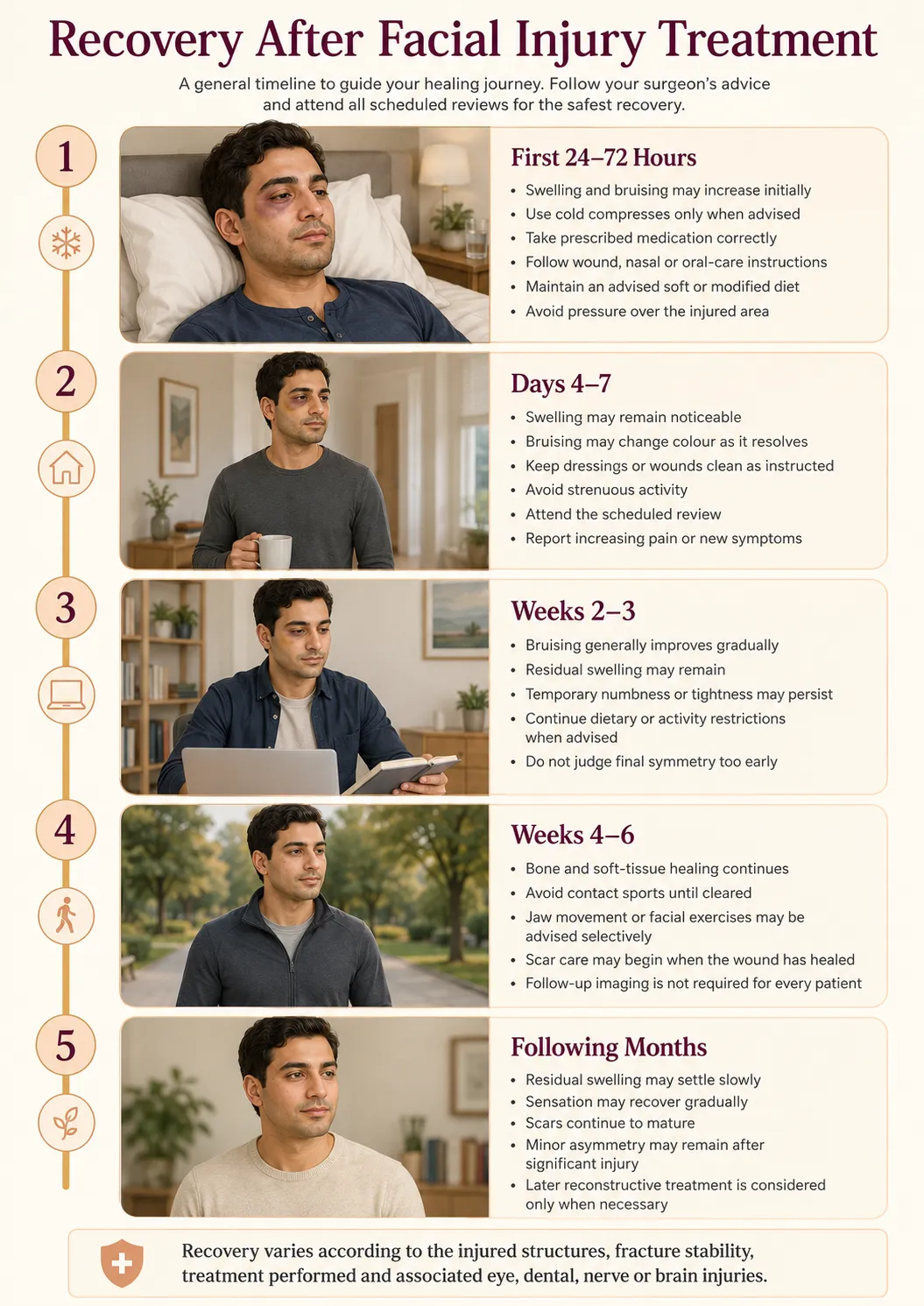
Recovery varies by method. Minor procedures may cause a few days of redness or swelling. Surgical revision may require dressings and suture review. The replacement scar may look pink or firm before gradually settling over many months.
Aftercare and scar maturation
What helps a revised scar settle well?
Follow dressing, cleansing and suture-review instructions.
Avoid nicotine because it reduces skin blood flow and impairs healing.
Protect the scar from direct sun and use sunscreen when advised.
Use silicone gel, silicone sheets or massage only after the treating surgeon approves them.
Do not pick crusts or self-treat with strong acids, bleaching agents or steroid creams.
Attend planned reviews so raised, tight or pigmented healing can be addressed early.
Contact the clinic earlier
Seek review if you notice:
Increasing redness, pain, discharge, fever or wound separation
New difficulty closing the eye, lip or mouth
A rapidly enlarging raised scar
Persistent bleeding, darkening skin edges or severe swelling
An unexpected reaction after an injection, laser or dressing
Emergency symptoms require urgent local medical care.
Safety and informed choice
Possible risks and limitations
Bleeding, infection, delayed healing or wound separation
Persistent redness, pigmentation change or texture difference
Temporary or lasting altered sensation
Asymmetry, contour irregularity or an unsatisfactory scar
Recurrence of hypertrophic scarring or keloid formation
Injury to nearby structures, depending on scar location
Need for injections, laser sessions, dressings or further revision
Diabetes, nicotine exposure, poor nutrition and medicines that affect bleeding may alter healing. Do not start or stop prescribed medicines without advice from the treating doctor.
Questions patients often ask
Face scar revision FAQs
Can an old facial scar still improve?
Yes. Mature scars can often be improved, although the suitable method depends on width, texture, colour, direction, tissue loss, tethering and whether the scar affects facial movement or function.
Can a facial scar be removed completely?
No treatment can reliably erase a scar completely. The goal is to make it finer, flatter, better positioned or less noticeable while preserving facial function.
Will surgical scar revision leave another scar?
Yes. Surgery removes or rearranges the old scar and creates a new, deliberately planned scar. The aim is for the replacement scar to heal in a more favourable position or pattern.
Is laser better than surgery for a facial scar?
Neither is universally better. Laser may improve selected colour, texture or stiffness concerns, while surgery may be needed for wide, contracted, tethered or anatomically distorting scars. Some plans combine methods.
When is the right time for face scar revision?
Many uncomplicated scars are allowed to mature before elective revision. Earlier assessment is important when a scar pulls an eyelid or lip, restricts movement, repeatedly breaks down or becomes rapidly raised.
Can a scar near the eye or mouth affect function?
Yes. Scar contracture may pull an eyelid, distort a lip, interfere with closure or restrict expression. These scars need plastic-surgical assessment because restoring function may be more important than surface appearance alone.
How many treatment sessions might I need?
A small surgical revision may be a single procedure, while injections, microneedling or laser often require a planned series. Complex scars may need staged reconstruction and later refinement.
How long does a revised scar take to settle?
Initial swelling and redness settle first, but scar colour, firmness and blending commonly continue to change over many months. Final maturation varies by scar type, treatment and individual healing.
Can acne scars be treated on this page?
Acne scars can be assessed, but mixed acne-scar patterns often need a dedicated combination plan. The clinic’s canonical acne scar information is available on the Acne Scar Correction page.
What can I do after treatment to help the scar?
Follow wound and dressing instructions, avoid nicotine, protect the scar from sun, attend reviews and use silicone or massage only when advised. Do not self-treat with strong acids or steroid creams.
Can a keloid return after treatment?
Yes. Keloids have a recognised tendency to recur. Treatment may require a combination of methods and follow-up rather than simple excision alone.
How much does face scar revision cost in Nagpur?
Cost depends on scar size and location, treatment type, anaesthesia, facility requirements and number of sessions. An individual estimate is provided after examination because photographs may not show tethering or functional distortion.
Mayflower Clinic, Dhantoli
Why consult a plastic surgeon for a facial scar?
The face combines visible skin with delicate eyelid, lip, nose, muscle, nerve and blood-vessel anatomy. Dr Pawan Shahane evaluates appearance and function together and can choose from scar surgery, tissue rearrangement, fat grafting and non-surgical scar treatments.
Consultations are private. Clinical photography is performed only with appropriate consent. Treatment is explained with realistic limitations rather than a promise of scar-free skin.
Bring previous procedure records and dated photographs if available. A face-to-face assessment helps distinguish surface texture from deeper tethering, tissue loss or contracture.
{
"@context":"https://schema.org",
"@graph":[
{
"@type":"MedicalClinic",
"@id":"https://cosmeticsurgerynagpur.com/#clinic",
"name":"Mayflower Clinic",
"url":"https://cosmeticsurgerynagpur.com/",
"telephone":"+917126692706",
"email":"contact@mayflowerclinic.in",
"priceRange":"₹₹",
"address":{"@type":"PostalAddress","streetAddress":"Surdham Complex, Dhantoli","addressLocality":"Nagpur","addressRegion":"Maharashtra","postalCode":"440012","addressCountry":"IN"},
"geo":{"@type":"GeoCoordinates","latitude":21.1417,"longitude":79.0827},
"openingHoursSpecification":[{"@type":"OpeningHoursSpecification","dayOfWeek":["Monday","Tuesday","Wednesday","Thursday","Friday","Saturday"],"opens":"11:00","closes":"18:00"}],
"sameAs":["https://www.facebook.com/mayflowerclinicindia/","https://www.instagram.com/drpawanshahane/?hl=en","https://www.youtube.com/@mayflowerclinic9431","https://share.google/mxgMNQ106wHR4IWM6"]
},
{
"@type":"Physician",
"@id":"https://cosmeticsurgerynagpur.com/dr-pawan-shahane/#doctor",
"name":"Dr Pawan Shahane",
"url":"https://cosmeticsurgerynagpur.com/dr-pawan-shahane/",
"image":"https://cosmeticsurgerynagpur.com/wp-content/uploads/2026/06/6244433929700491809.jpg",
"medicalSpecialty":"PlasticSurgery",
"honorificSuffix":"M.Ch. Plastic Surgery",
"alumniOf":[{"@type":"CollegeOrUniversity","name":"Government Medical College Nagpur"},{"@type":"CollegeOrUniversity","name":"SSG Hospital Baroda"}],
"memberOf":[{"@type":"Organization","name":"Indian Medical Association"},{"@type":"Organization","name":"Indian Association of Aesthetic Plastic Surgeons"}],
"worksFor":{"@id":"https://cosmeticsurgerynagpur.com/#clinic"}
},
{
"@type":"MedicalProcedure",
"@id":"https://cosmeticsurgerynagpur.com/face-scar-revision/#procedure",
"name":"Face Scar Revision",
"alternateName":["Facial Scar Revision","Facial Scar Treatment"],
"procedureType":"Surgical and non-surgical scar treatment",
"bodyLocation":"Face",
"howPerformed":"Treatment is individualised and may include scar care, injections, fractional CO2 laser resurfacing, microneedling, subcision, volume restoration, scar excision, Z-plasty, W-plasty or local tissue rearrangement.",
"followup":"Scar care, sun protection and scheduled review may be advised according to the treatment used.",
"provider":{"@id":"https://cosmeticsurgerynagpur.com/dr-pawan-shahane/#doctor"}
},
{
"@type":"MedicalWebPage",
"@id":"https://cosmeticsurgerynagpur.com/face-scar-revision/#webpage",
"url":"https://cosmeticsurgerynagpur.com/face-scar-revision/",
"name":"Face Scar Revision Treatment in Nagpur",
"headline":"Face Scar Revision Treatment in Nagpur",
"description":"Face scar revision in Nagpur for accident, surgery, acne, raised, depressed or tight scars. Personalised surgical and non-surgical care by Dr Pawan Shahane.",
"dateModified":"2026-08-06",
"inLanguage":"en-IN",
"isPartOf":{"@id":"https://cosmeticsurgerynagpur.com/#website"},
"about":{"@id":"https://cosmeticsurgerynagpur.com/face-scar-revision/#procedure"},
"reviewedBy":{"@id":"https://cosmeticsurgerynagpur.com/dr-pawan-shahane/#doctor"},
"mainEntity":{"@id":"https://cosmeticsurgerynagpur.com/face-scar-revision/#procedure"},
"breadcrumb":{"@id":"https://cosmeticsurgerynagpur.com/face-scar-revision/#breadcrumb"}
},
{
"@type":"WebSite",
"@id":"https://cosmeticsurgerynagpur.com/#website",
"url":"https://cosmeticsurgerynagpur.com/",
"name":"Mayflower Clinic Cosmetic Surgery Nagpur",
"publisher":{"@id":"https://cosmeticsurgerynagpur.com/#clinic"}
},
{
"@type":"BreadcrumbList",
"@id":"https://cosmeticsurgerynagpur.com/face-scar-revision/#breadcrumb",
"itemListElement":[
{"@type":"ListItem","position":1,"name":"Home","item":"https://cosmeticsurgerynagpur.com/"},
{"@type":"ListItem","position":2,"name":"Scar Management","item":"https://cosmeticsurgerynagpur.com/scar-management/"},
{"@type":"ListItem","position":3,"name":"Face Scar Revision","item":"https://cosmeticsurgerynagpur.com/face-scar-revision/"}
]
},
{
"@type":"FAQPage",
"@id":"https://cosmeticsurgerynagpur.com/face-scar-revision/#faq",
"mainEntity":[
{"@type":"Question","name":"Can an old facial scar still improve?","acceptedAnswer":{"@type":"Answer","text":"Yes. Mature scars can often be improved, although the suitable method depends on width, texture, colour, direction, tissue loss, tethering and whether the scar affects facial movement or function."}},
{"@type":"Question","name":"Can a facial scar be removed completely?","acceptedAnswer":{"@type":"Answer","text":"No treatment can reliably erase a scar completely. The goal is to make it finer, flatter, better positioned or less noticeable while preserving facial function."}},
{"@type":"Question","name":"Will surgical scar revision leave another scar?","acceptedAnswer":{"@type":"Answer","text":"Yes. Surgery removes or rearranges the old scar and creates a new, deliberately planned scar. The aim is for the replacement scar to heal in a more favourable position or pattern."}},
{"@type":"Question","name":"Is laser better than surgery for a facial scar?","acceptedAnswer":{"@type":"Answer","text":"Neither is universally better. Laser may improve selected colour, texture or stiffness concerns, while surgery may be needed for wide, contracted, tethered or anatomically distorting scars. Some plans combine methods."}},
{"@type":"Question","name":"When is the right time for face scar revision?","acceptedAnswer":{"@type":"Answer","text":"Many uncomplicated scars are allowed to mature before elective revision. Earlier assessment is important when a scar pulls an eyelid or lip, restricts movement, repeatedly breaks down or becomes rapidly raised."}},
{"@type":"Question","name":"Can a scar near the eye or mouth affect function?","acceptedAnswer":{"@type":"Answer","text":"Yes. Scar contracture may pull an eyelid, distort a lip, interfere with closure or restrict expression. These scars need plastic-surgical assessment because restoring function may be more important than surface appearance alone."}},
{"@type":"Question","name":"How many treatment sessions might I need?","acceptedAnswer":{"@type":"Answer","text":"A small surgical revision may be a single procedure, while injections, microneedling or laser often require a planned series. Complex scars may need staged reconstruction and later refinement."}},
{"@type":"Question","name":"How long does a revised scar take to settle?","acceptedAnswer":{"@type":"Answer","text":"Initial swelling and redness settle first, but scar colour, firmness and blending commonly continue to change over many months. Final maturation varies by scar type, treatment and individual healing."}},
{"@type":"Question","name":"Can acne scars be treated on this page?","acceptedAnswer":{"@type":"Answer","text":"Acne scars can be assessed, but mixed acne-scar patterns often need a dedicated combination plan. The clinic's canonical acne scar information is available on the Acne Scar Correction page."}},
{"@type":"Question","name":"What can I do after treatment to help the scar?","acceptedAnswer":{"@type":"Answer","text":"Follow wound and dressing instructions, avoid nicotine, protect the scar from sun, attend reviews and use silicone or massage only when advised. Do not self-treat with strong acids or steroid creams."}},
{"@type":"Question","name":"Can a keloid return after treatment?","acceptedAnswer":{"@type":"Answer","text":"Yes. Keloids have a recognised tendency to recur. Treatment may require a combination of methods and follow-up rather than simple excision alone."}},
{"@type":"Question","name":"How much does face scar revision cost in Nagpur?","acceptedAnswer":{"@type":"Answer","text":"Cost depends on scar size and location, treatment type, anaesthesia, facility requirements and number of sessions. An individual estimate is provided after examination because photographs may not show tethering or functional distortion."}}
]
}
]
}
(function(){
var root=document.getElementById('mf-face-scar');
if(!root)return;
var answerBox=root.querySelector('#mf-guide-answer');
var answers={
remove:'Usually, no. Scar revision replaces, repositions or remodels a noticeable scar so that it blends more naturally with nearby skin. Improvement—not complete erasure—is the realistic goal.',
timing:'Timing is individual. Many uncomplicated scars are allowed to mature before elective revision. Earlier review is important when a scar pulls an eyelid or lip, restricts movement, breaks down or grows rapidly.',
method:'Not always. Silicone care, injections, microneedling, fractional CO₂ laser, subcision or volume restoration may suit selected scars. Wide, tight or distorting scars may require surgery.',
result:'Scar change is gradual. Swelling and redness settle first, while colour, firmness and final blending can continue to improve for many months. Some treatments require a planned series.'
};
root.querySelectorAll('.mf-chip').forEach(function(button){
button.addEventListener('click',function(){
root.querySelectorAll('.mf-chip').forEach(function(item){item.setAttribute('aria-selected','false')});
button.setAttribute('aria-selected','true');
answerBox.innerHTML=answers[button.getAttribute('data-answer')]||answers.remove;
});
});
})();
Manage Consent
To provide the best experiences, we use technologies like cookies to store and/or access device information. Consenting to these technologies will allow us to process data such as browsing behavior or unique IDs on this site. Not consenting or withdrawing consent, may adversely affect certain features and functions.
Functional
Always active
The technical storage or access is strictly necessary for the legitimate purpose of enabling the use of a specific service explicitly requested by the subscriber or user, or for the sole purpose of carrying out the transmission of a communication over an electronic communications network.
Preferences
The technical storage or access is necessary for the legitimate purpose of storing preferences that are not requested by the subscriber or user.
Statistics
The technical storage or access that is used exclusively for statistical purposes.The technical storage or access that is used exclusively for anonymous statistical purposes. Without a subpoena, voluntary compliance on the part of your Internet Service Provider, or additional records from a third party, information stored or retrieved for this purpose alone cannot usually be used to identify you.
Marketing
The technical storage or access is required to create user profiles to send advertising, or to track the user on a website or across several websites for similar marketing purposes.