0712 6692706 / 0712 3551170 / +91 8087471244   |   contact@mayflowerclinic.in

Plastic & Reconstructive Surgery · Nagpur

Maxillofacial Surgery in Nagpur

Assessment and reconstructive planning for injuries and conditions affecting the facial bones, eye sockets, jaws, bite, facial sensation and surrounding soft tissues. The priority is to understand both function and facial support before deciding whether observation, surgery or multidisciplinary care is appropriate.

Dr. Pawan Shahane, M.Ch. Plastic Surgery
Reviewed by Dr. Pawan Shahane, M.Ch. Plastic Surgery 21+ years surgical practice · Ex-Asst. Prof. GMC Nagpur · IAAPS Member · 9 years ThreeBestRated Nagpur
Dr. Pawan Shahane consulting a patient about facial and maxillofacial treatment planning at Mayflower Clinic Nagpur
Mayflower ClinicSurdham Complex, Dhantoli, Nagpur
Severe facial trauma can be an emergency.

Difficulty breathing, altered consciousness, heavy bleeding, sudden visual symptoms, repeated vomiting or suspected head and neck injury require urgent hospital evaluation—not a routine clinic appointment.

See warning signs
M.Ch.Plastic Surgery qualification
21+ YearsSurgical practice
Function FirstVision, bite, airway and movement
Team CareSpecialist coordination when required
Page Guide

Quick Answer

Choose the question closest to what you need. Detailed explanations are linked below.

Private local search — no data sent to external servers
Start with the diagnosis. Maxillofacial treatment is selected only after examining facial symmetry, vision, bite, jaw movement, sensation, airway and soft tissues.
Questions Patients Often Ask

Clear answers before considering treatment

Maxillofacial problems are not defined by appearance alone. The same visible swelling or asymmetry may represent a soft-tissue injury, a stable fracture, a displaced fracture, a dental bite problem or a condition requiring another specialist.

Does every fracture need surgery?

No. Stable, non-displaced injuries may be observed. Surgery is considered when alignment, stability, vision, bite, breathing, mouth opening or facial support is affected.

Can swelling hide a fracture?

Yes. Swelling can temporarily conceal asymmetry and bone displacement. Examination and selected imaging determine the actual injury pattern.

What is checked besides the bone?

Vision, eye movement, dental bite, teeth, jaw movement, facial sensation, breathing, wounds, nerves and soft-tissue condition may all need assessment.

Will plates always be required?

No. Plates or screws are used only when fixation is needed to hold a reduced fracture or reconstructed bone in the planned position.

Can numbness improve?

Some altered sensation improves as swelling settles or nerves recover. The prognosis depends on whether a nerve is compressed, stretched, bruised or disrupted.

Is one specialist always enough?

No. Eye, dental, jaw, airway, neurological or complex injury findings may require coordinated care with other specialists.

Understanding the Scope

What does maxillofacial surgery involve?

Maxillofacial surgery concerns the connected structures of the face: the forehead and frontal bone, eye sockets, nose, cheekbones, upper jaw, lower jaw, chin, dental bite, facial nerves and surrounding soft tissues. These structures influence appearance, but they also support vision, breathing, chewing, speaking, mouth opening and facial sensation.

At Mayflower Clinic, Dr. Pawan Shahane evaluates plastic and reconstructive aspects of facial trauma, wounds, scars, tissue loss and facial structural problems. When a condition requires oral and maxillofacial surgery, orthodontics, dentistry, ophthalmology, ENT, neurosurgery or another specialty, the treatment plan should be coordinated rather than treating one structure in isolation.

This page is broader than the dedicated Face Injury Treatment page. It explains how facial skeleton, bite, eye function, soft tissue and reconstructive needs are considered together.

Facial bone and orbital fractures
Jaw alignment and post-traumatic bite changes
Facial wounds and scar planning
Cheek, midface and chin support
Facial sensation and nerve symptoms
Soft-tissue loss or contour defects
Congenital or developmental facial differences
Reconstruction after disease or previous surgery
Important limitation: Routine dental extraction and general dental care are not substitutes for plastic or reconstructive assessment, and plastic surgery assessment is not a substitute for dental or oral and maxillofacial evaluation when the teeth, bite or jaw require it.
Conditions and Concerns

What may require maxillofacial assessment?

The correct treatment depends on the diagnosis. A condition may need observation, a procedure by Dr. Pawan Shahane, or coordinated care with another specialty.

01

Facial fractures

Injuries of the nose, orbital rim or floor, cheekbone, upper jaw, lower jaw, chin or several connected facial bones.

02

Orbital and cheek injuries

Assessment may include vision, eye movement, double vision, eye position, cheek projection and sensation below the eye.

03

Jaw and bite changes

A bite that feels suddenly different, difficulty opening the mouth or post-traumatic jaw asymmetry may require dental and skeletal assessment.

04

Facial wounds and scars

Repair considers tissue viability, contamination, nerve or duct injury, scar direction, function and later scar maturation.

05

Soft-tissue or bone loss

Trauma, infection, disease or previous operations may leave defects requiring staged reconstruction or contour restoration.

06

Congenital facial differences

Selected developmental conditions may need long-term planning involving function, growth, speech, dental development and facial symmetry.
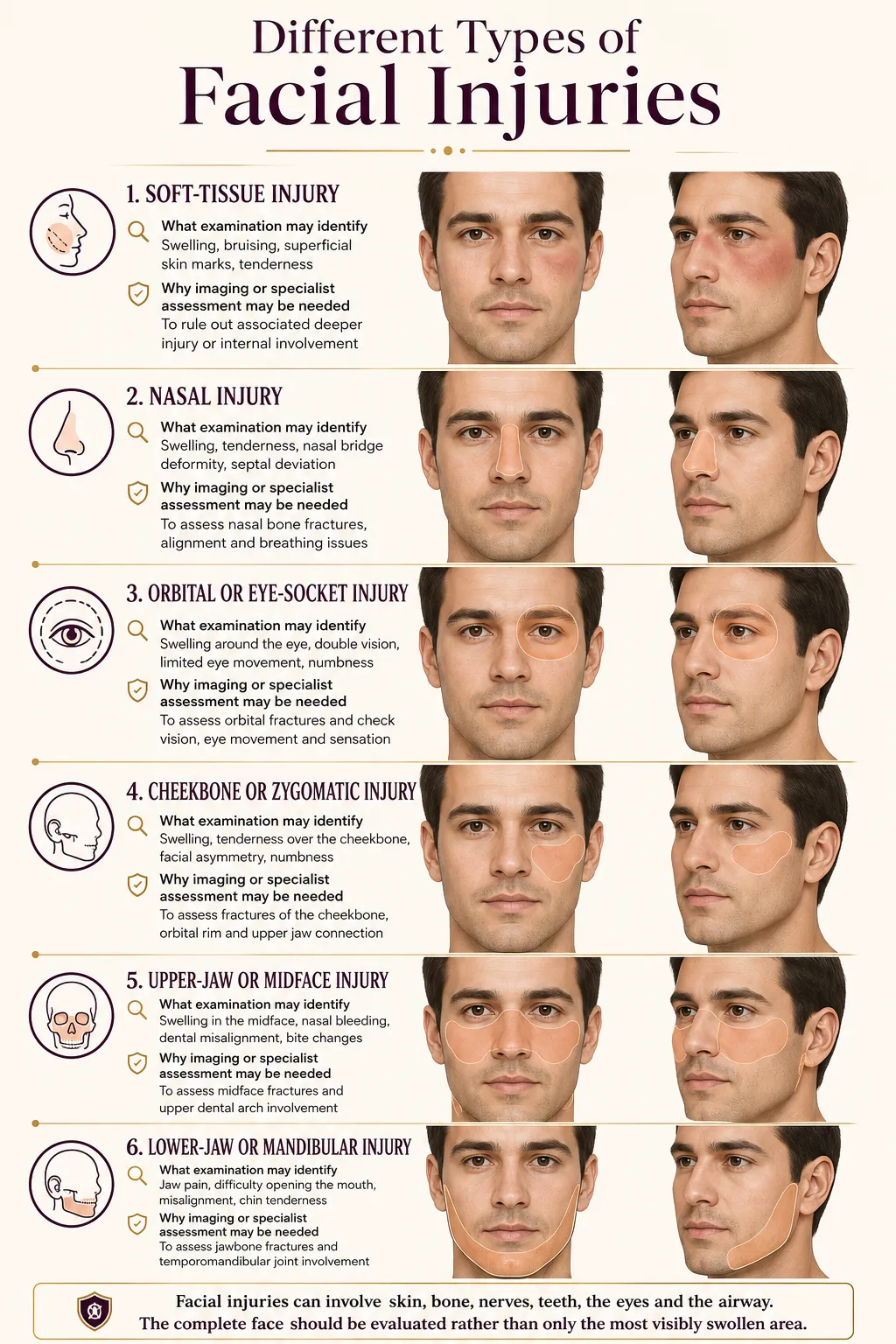
Different types and zones of facial injuries involving soft tissue, nose, orbit, cheekbone, upper jaw and lower jaw
Existing patient-education image reused to show how facial injuries may involve different connected zones.
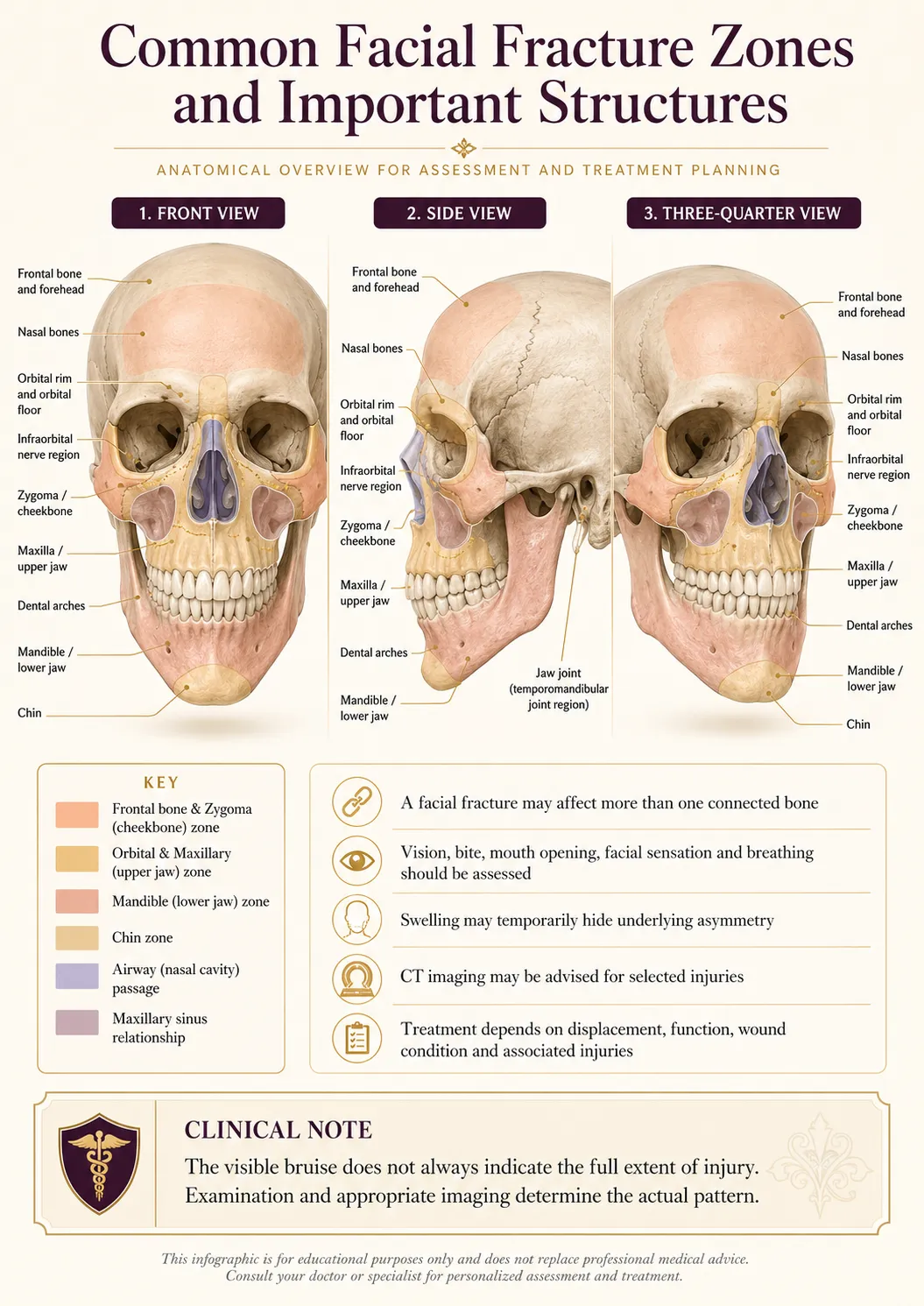
Facial fracture zones anatomy map showing nasal bones, orbit, cheekbone, upper jaw, lower jaw, chin and important facial structures
Facial bones are connected. A force affecting one area may influence nearby support, sensation, bite or eye function.
Connected Anatomy

Why the whole face must be assessed

A bruise or tender point does not always reveal the complete injury. The cheekbone helps support the eye socket and connects with the upper jaw. The upper and lower jaws determine the dental bite. Sensory nerves travel through small openings in the facial bones. The nasal and midface skeleton can influence breathing and central facial support.

  • Vision and eye movement: orbital injuries may affect more than the visible eyelid swelling.
  • Bite and chewing: jaw or midface displacement may change how the teeth meet.
  • Mouth opening: cheekbone, jaw or joint injuries can restrict movement.
  • Facial sensation: numbness may indicate swelling or injury near a sensory nerve.
  • Breathing: nasal, midface or swelling-related obstruction may need prompt assessment.

Examination and appropriate imaging determine the actual pattern; the illustration is educational and cannot diagnose an individual injury.
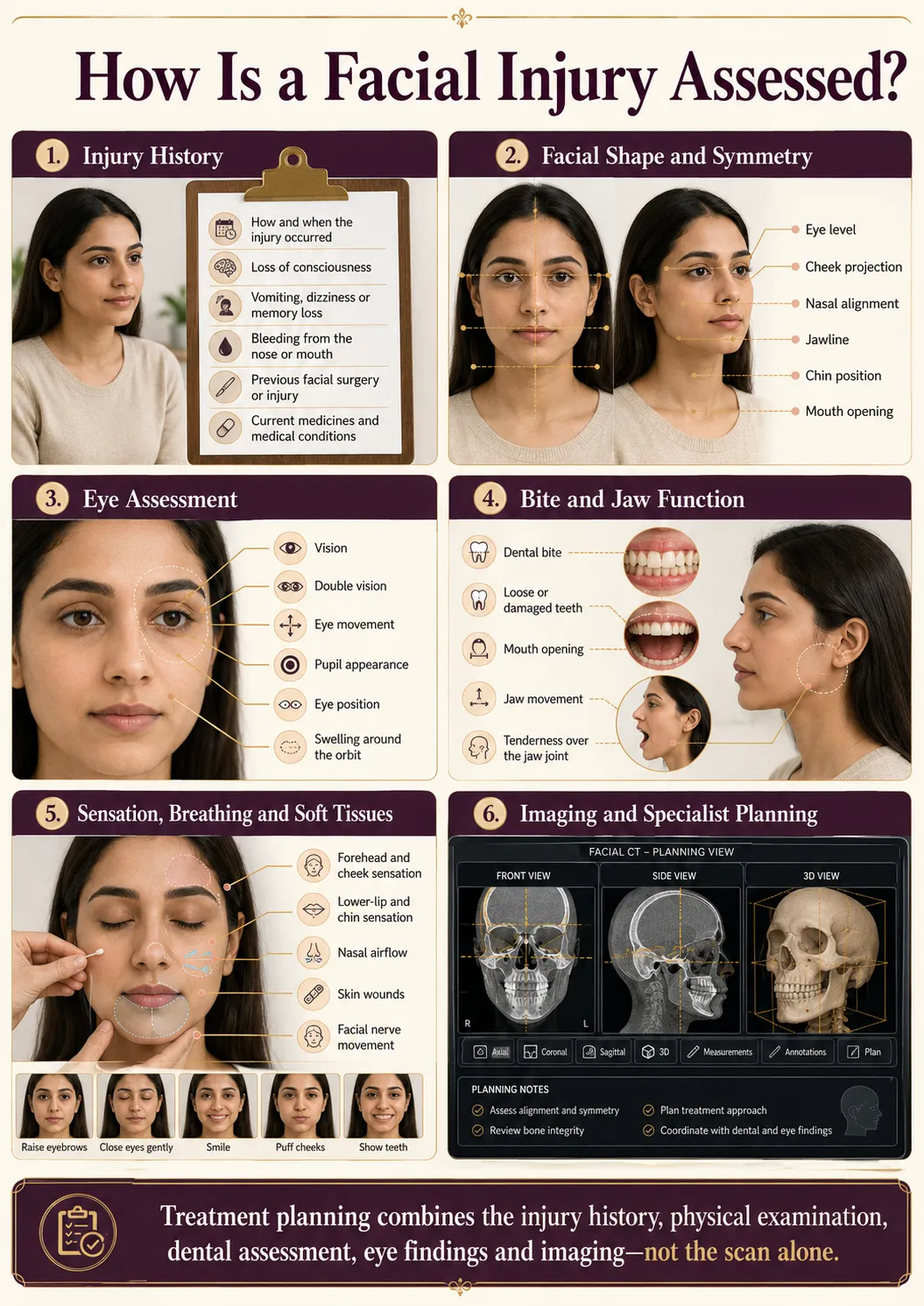
Clinical assessment of facial injury including history, symmetry, vision, bite, jaw function, sensation, breathing and imaging
A structured examination helps decide whether observation, imaging, urgent referral or surgery is appropriate.
Consultation and Evaluation

How is a maxillofacial condition assessed?

The consultation begins with how the condition occurred, when symptoms began and whether they are improving or worsening. Previous facial injury, surgery, dental treatment, medical illness, medicines and smoking history may influence planning.

Face and symmetry

Eye level, cheek projection, nasal alignment, jawline, chin position, swelling and right-to-left differences.

Eyes and orbit

Vision, new double vision, eye movement, pupil appearance, eye position and sensation around the cheek.

Bite and jaw

Dental bite, loose or damaged teeth, mouth opening, jaw movement and tenderness over the jaw joints.

Nerves and soft tissue

Facial sensation, facial movement, wounds, scars, tissue viability, breathing and possible salivary-duct injury.

Imaging is selective. CT scans are commonly considered for suspected facial-bone injuries, but dental imaging, clinical photography or other tests may be more relevant for selected conditions.

Treatment Pathways

Which treatment may be considered?

Not every condition requires an operation. Treatment is chosen according to stability, displacement, functional effect, wound condition, associated injuries, overall health and realistic benefit.
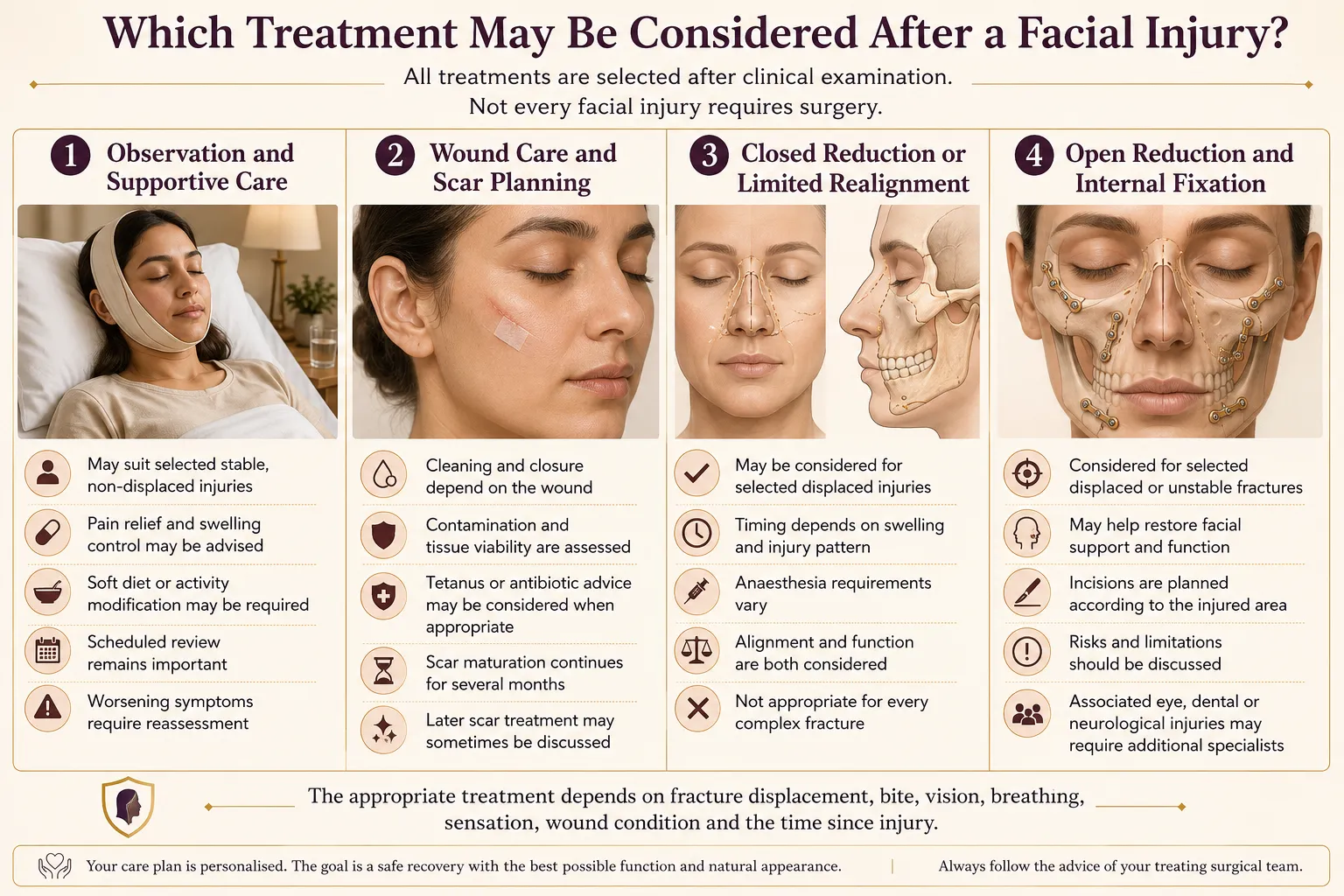
Comparison of observation, wound care, realignment and reconstructive treatment options after facial injury
Existing comparison image reused to explain that treatment ranges from supportive care to reconstruction.
1

Observation and supportive care

Selected stable injuries may be managed with pain control, swelling advice, diet or activity modification and scheduled review.

2

Wound repair and scar planning

Cleaning, closure and reconstruction depend on contamination, tissue viability and whether nerves, ducts or deeper structures are involved.

3

Fracture reduction and fixation

Displaced or unstable fractures may require realignment and internal fixation to restore facial support and function.

4

Reconstruction and rehabilitation

Bone or soft-tissue loss may require grafts, local tissue, implants, staged procedures or coordinated rehabilitation.

Function should guide facial reconstruction.

“In maxillofacial treatment, the visible contour is only one part of the problem. Vision, bite, breathing, mouth opening, sensation and healthy soft-tissue coverage must be assessed before deciding what should be repaired and when.”
Dr. Pawan Shahane, M.Ch. Plastic Surgery · Founder, Mayflower Clinic, Nagpur
Patient Journey

From assessment to recovery

The exact pathway varies. Acute trauma may begin in an emergency department, while an old injury, scar or reconstructive concern may begin with a planned clinic consultation.

1
First contact

Identify urgency

Emergency symptoms are directed to hospital care. Stable concerns can be scheduled for detailed assessment.

2
Consultation

Examine function and anatomy

Facial shape, vision, bite, jaw movement, sensation, wounds, scars and breathing are assessed as relevant.

3
Investigation

Use imaging when it will change planning

CT or dental imaging may define fractures, displacement, joint relationships or bone loss.

4
Decision

Compare observation, surgery and referral

The benefits, limits, urgency, likely scars, anaesthesia, hospital needs and specialist coordination are discussed.

5
Treatment day

Protect function and restore support

The procedure may involve wound repair, fracture realignment, fixation, soft-tissue reconstruction or another planned intervention.

6
Early recovery

Control swelling and protect the repair

Head elevation, oral or wound care, diet restrictions, medicines and activity precautions are individualized.

7
Following months

Monitor healing and rehabilitation

Bone healing, bite, mouth opening, sensation, scars and residual swelling may need continued review.
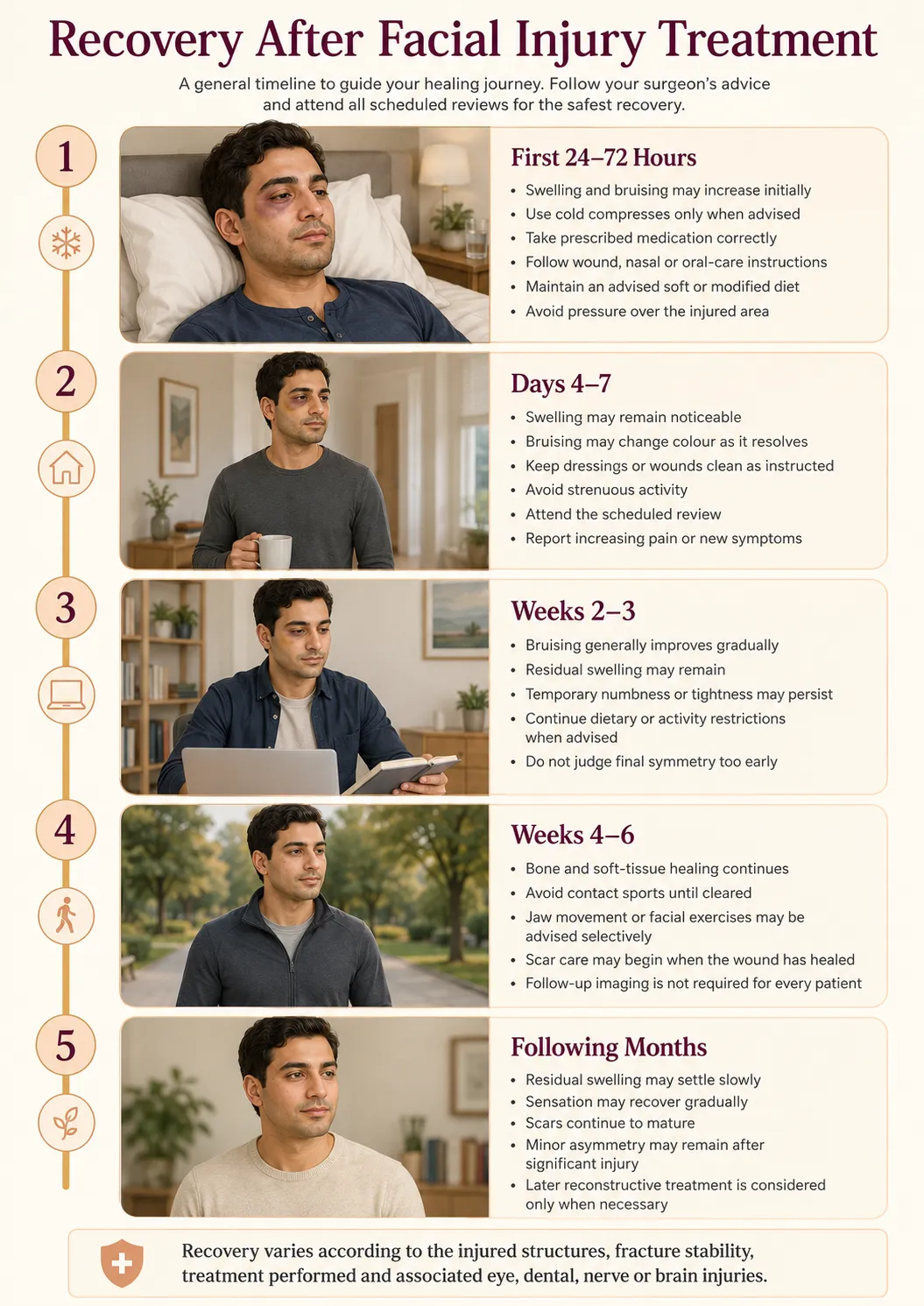
Recovery timeline after facial injury and maxillofacial treatment from the first days through later healing
Recovery depends on the original condition and the actual operation; this timeline is general guidance.
Recovery and Aftercare

What can recovery involve?

Swelling and bruising may increase during the first two to three days before gradually improving. Temporary tightness, altered sensation, difficulty chewing and restricted mouth opening can occur depending on the injury and treatment.

  • Head elevation: often advised during early recovery.
  • Diet: liquid, soft or modified diet may be required when the jaws or mouth are involved.
  • Oral and wound care: instructions vary according to incision location and treatment.
  • Activity: avoid strenuous exercise, facial pressure and contact sports until cleared.
  • Work: desk work may be possible after one to three weeks in selected cases; complex treatment may require longer.
  • Final settling: residual swelling, sensation and scar maturation may continue for months.
Do not judge symmetry too early. Swelling may resolve unevenly, and healing tissues can temporarily feel firm or look different on the two sides.
Patient Safety

When does a facial condition need urgent medical attention?

An online page cannot determine the severity of acute trauma. Seek emergency evaluation after severe injury or when any of the following symptoms are present.
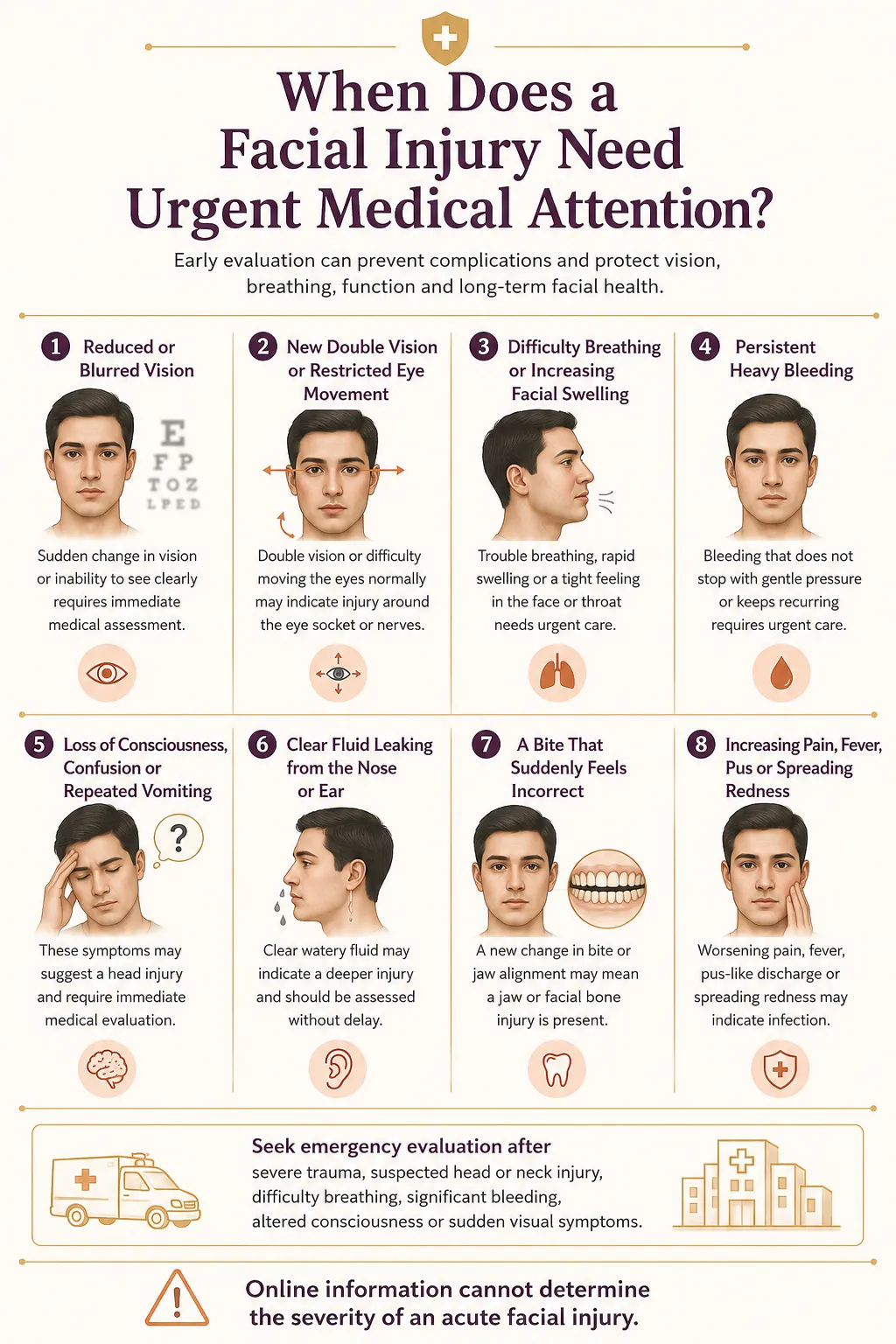
Urgent warning signs after facial injury including visual symptoms, breathing difficulty, heavy bleeding, confusion and an altered bite
Urgent warning signs after facial trauma. Use emergency services or a hospital rather than waiting for a routine appointment.

Vision or eye movement changes

Reduced vision, blurred vision, new double vision, severe eye pain or restricted eye movement.

Airway or major bleeding

Difficulty breathing, rapidly increasing swelling, persistent heavy bleeding or blood obstructing the mouth or nose.

Possible head injury

Loss of consciousness, confusion, repeated vomiting, seizure, worsening drowsiness or clear fluid from the nose or ear.

Sudden bite change

The teeth no longer meet normally, the jaw feels unstable or mouth opening becomes significantly restricted.

Infection warning signs

Increasing pain, fever, pus, spreading redness, worsening swelling or an unpleasant taste from a wound.

New weakness or numbness

Rapidly worsening facial weakness, new extensive numbness or other neurological symptoms require prompt assessment.

Risks and Realistic Expectations

What should patients understand before surgery?

The risk profile depends on the original injury or condition, the structures involved and the planned procedure. Surgery cannot always recreate the exact pre-injury anatomy or fully reverse nerve damage.

Swelling and asymmetry

Temporary asymmetry is common during healing. Some residual difference may persist after severe or delayed injuries.

Altered sensation

Numbness, tingling or sensitivity may improve gradually, but nerve recovery is variable and may be incomplete.

Vision-related risk

Orbital injuries require careful assessment because vision, eye movement or eye position can be affected.

Bite and jaw function

Bite changes, stiffness, restricted mouth opening or jaw-joint symptoms may need dental care or rehabilitation.

Scars and contour

Incisions are planned carefully, but scars are permanent and mature over months. Contour irregularity can occur.

!

General surgical risks

Bleeding, infection, delayed healing, anaesthesia complications, fixation problems or additional procedures are possible.

Transparent Planning

What affects maxillofacial surgery cost in Nagpur?

There is no single standard price because the term “maxillofacial surgery” includes conditions ranging from a stable injury needing follow-up to complex facial-bone and soft-tissue reconstruction. A written estimate should follow examination and review of relevant imaging.

Diagnosis and urgencyAcute trauma, old deformity and planned reconstruction have different requirements.
Areas involvedOne stable bone differs from multi-bone, orbital, jaw or soft-tissue injury.
Imaging and testsCT, dental imaging, blood tests and additional specialist assessment may be required.
Anaesthesia and facilityLocal, sedation or general anaesthesia and the need for inpatient care affect cost.
Fixation or reconstructionPlates, screws, implants, grafts or staged procedures may change the estimate.
Follow-up and rehabilitationDental care, physiotherapy, scar care or further procedures may be part of the plan.
Frequently Asked Questions

Common questions about maxillofacial surgery

These answers are general. Individual advice requires examination and review of the relevant records or imaging.

What problems are evaluated on a maxillofacial surgery page?
Evaluation may include facial fractures, orbital and cheekbone injuries, jaw or bite changes after trauma, facial wounds, scars, soft-tissue loss and selected reconstructive concerns. The required specialist team depends on the diagnosis.
Does every facial fracture require an operation?
No. Selected stable and non-displaced fractures may be managed with observation and follow-up. Surgery may be considered when displacement, instability, vision, bite, breathing, mouth opening or facial support is affected.
Which symptoms after a facial injury need urgent assessment?
Urgent assessment is important for breathing difficulty, heavy bleeding, altered consciousness, repeated vomiting, sudden vision loss, new double vision, clear fluid from the nose or ear, rapidly increasing swelling or a suddenly incorrect bite.
How are facial and jaw injuries assessed?
Assessment may include injury history, facial symmetry, vision and eye movement, dental bite, mouth opening, facial sensation, breathing, wound condition and imaging such as CT when clinically indicated.
Can swelling hide the true extent of a facial injury?
Yes. Swelling can temporarily hide asymmetry, bone displacement and contour changes. Examination and appropriate imaging are used to understand the actual injury pattern.
What treatment options may be considered?
Depending on the diagnosis, treatment may include observation, wound care, scar planning, fracture reduction and fixation, soft-tissue reconstruction, dental or orthodontic coordination and rehabilitation.
Will plates or screws always be required?
No. Fixation is used only when needed to restore and maintain bone alignment. The decision depends on the location, displacement, stability and functional effect of the fracture.
How long does recovery take after maxillofacial surgery?
Recovery varies widely. Bruising and major swelling often improve over the first few weeks, while bone healing, sensation, scar maturation and final contour may continue for several months.
When can a patient return to work?
Return to work depends on the injury, operation and type of work. Selected patients may resume desk work after one to three weeks, while physically demanding work may require a longer restriction.
Can facial numbness occur after an injury or operation?
Yes. Facial injuries and surgical treatment may temporarily or sometimes persistently affect sensory nerves. The area and expected recovery should be discussed during assessment and follow-up.
What affects the cost of maxillofacial treatment in Nagpur?
Cost depends on the diagnosis, imaging, number of bones or soft-tissue areas involved, urgency, anaesthesia, hospital requirements, implants or fixation materials, specialist coordination and follow-up needs.
Which specialist may be involved in treatment?
Care may involve plastic and reconstructive surgery with oral and maxillofacial surgery, dentistry, orthodontics, ophthalmology, ENT, neurosurgery or physiotherapy when the condition requires multidisciplinary treatment.
Mayflower Clinic · Dhantoli

Arrange a maxillofacial and facial reconstruction consultation

Bring previous reports, CT or dental imaging, discharge summaries, operative notes and a list of current medicines when available. Acute emergency symptoms should be taken directly to a hospital.

Medical Disclaimer: All surgical procedures carry inherent risks, and individual outcomes vary based on the original injury or condition, anatomy, soft-tissue damage, associated injuries and healing biology. Surgical results are not guaranteed. Formal in-person consultation with Dr. Pawan Shahane and referral to other appropriate specialists when required are necessary before any surgical decision. This page is for general educational purposes only and does not constitute medical advice, emergency assessment or a treatment recommendation.
Mayflower Clinic Nagpur

Plastic, cosmetic and reconstructive surgery consultation led by Dr. Pawan Shahane, M.Ch. Plastic Surgery.

Clinic

Surdham Complex, Dhantoli,
Nagpur — 440012, Maharashtra
Monday–Saturday: 11 AM–6 PM
Sunday: Closed