
Stretch or conduction block
The nerve remains continuous but temporarily transmits signals poorly. Selected injuries may improve with observation and rehabilitation.

A brachial plexus injury can affect shoulder stability, elbow movement, wrist and hand function, sensation and pain. Treatment begins by identifying exactly which nerve levels are injured, which muscles remain available and which functional priorities matter most to the patient.

Select the question closest to what you need to know.
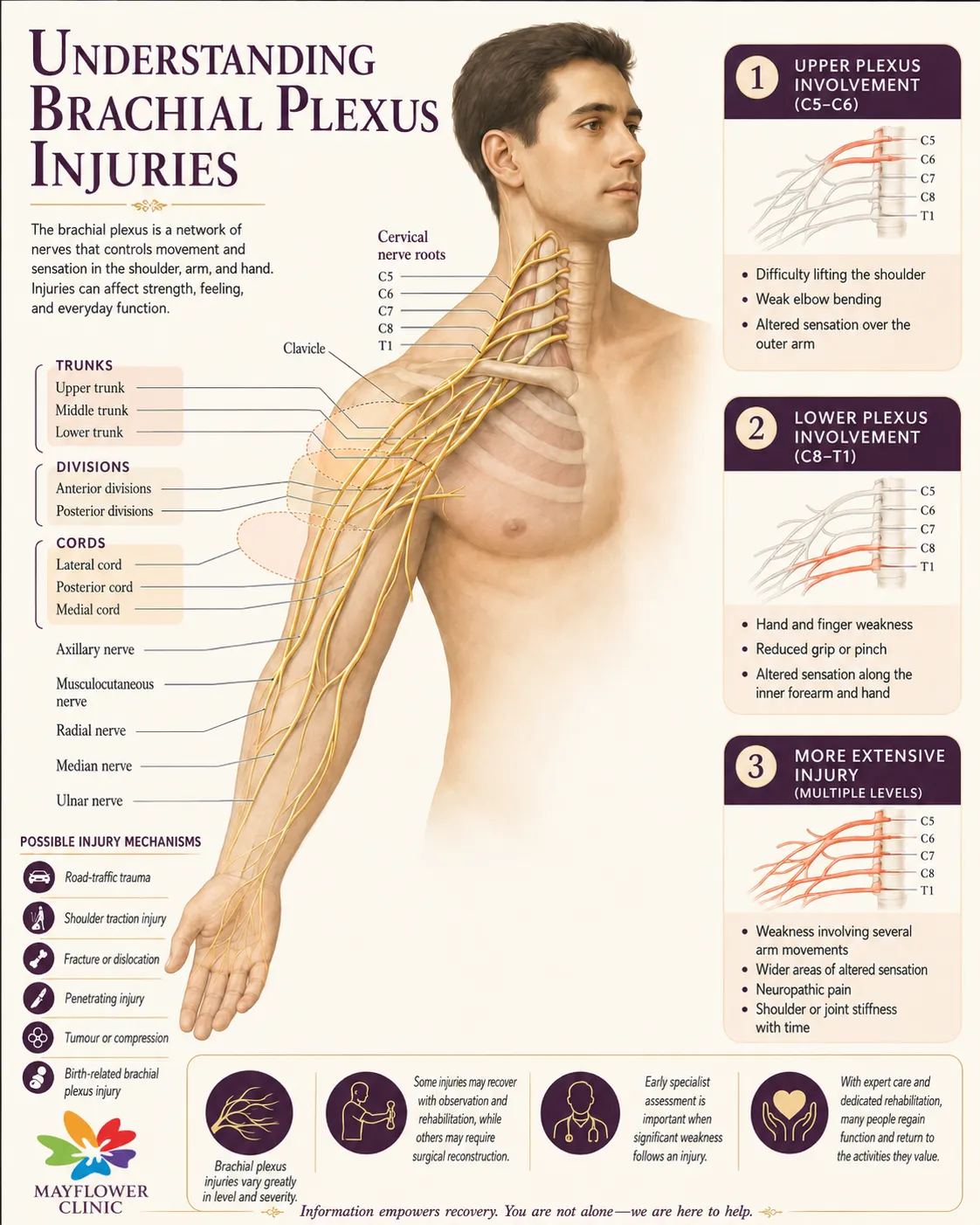
The brachial plexus is formed mainly by the C5, C6, C7, C8 and T1 nerve roots. These roots combine into trunks, divisions and cords before continuing into the axillary, musculocutaneous, radial, median and ulnar nerves. Together, these pathways help control movement and sensation from the shoulder to the fingertips.
An injury may involve one part of the plexus or nearly the entire network. An upper-plexus injury may particularly affect shoulder elevation and elbow bending. Lower-plexus involvement may have a greater effect on hand and finger function. Complete injuries can affect the whole limb.
Words such as stretch, rupture and avulsion describe different biological problems. They should not be used as interchangeable labels before clinical and imaging assessment.
The nerve remains continuous but temporarily transmits signals poorly. Selected injuries may improve with observation and rehabilitation.
The nerve is torn away from the spinal cord. Exploration, grafting or transfers may be considered according to the level and tissue quality.
A root is pulled away from the spinal cord. Direct repair is generally not possible, so reconstruction relies on donor nerve transfers or later functional procedures.
Some muscles may remain strong while others are paralysed, or the entire limb may be affected. Priorities are set from the remaining function.
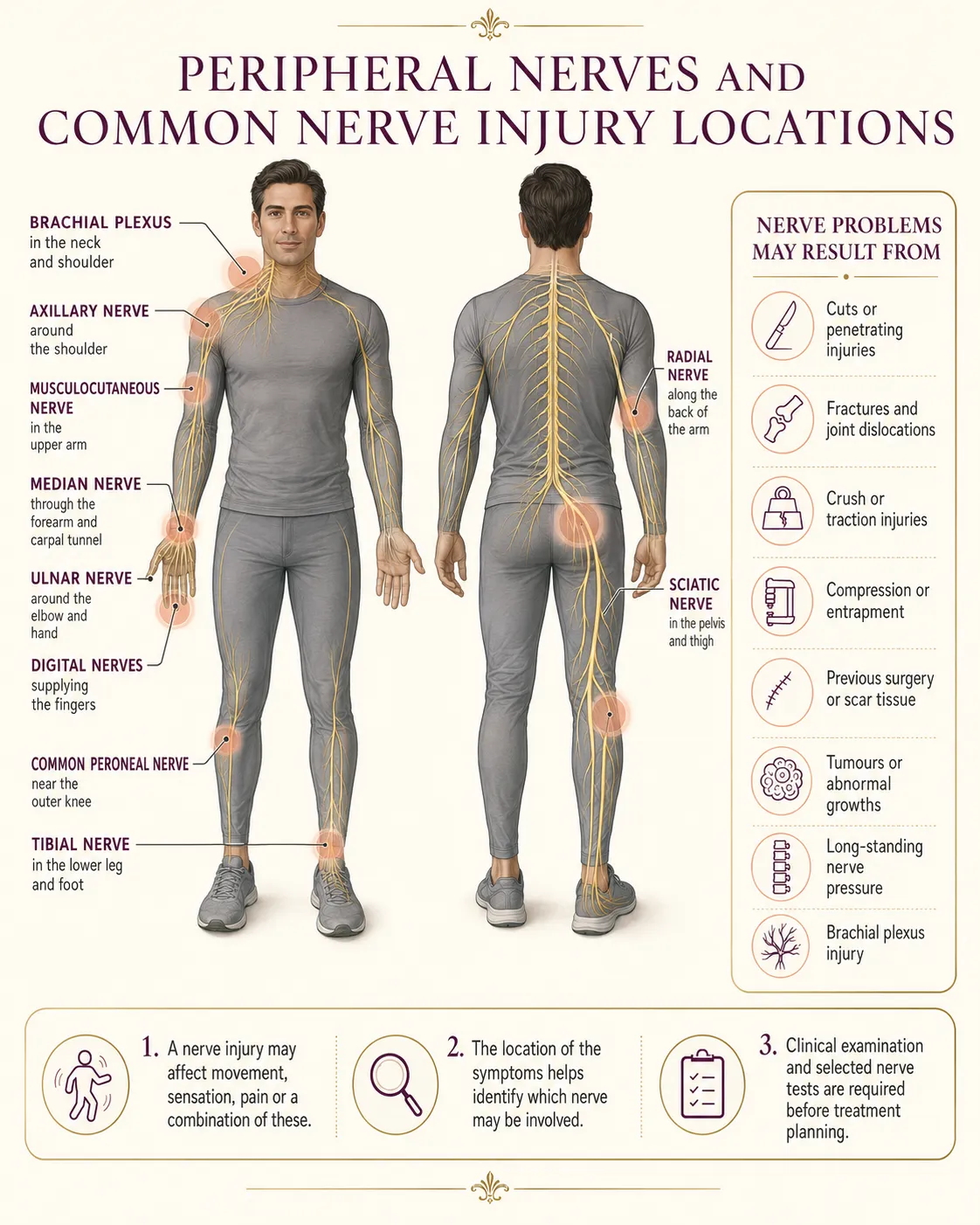
High-energy road accidents, falls, traction or crush injuries, penetrating wounds, fracture-dislocations, postoperative scarring, tumours and inflammatory conditions can affect the plexus. Associated blood-vessel, chest, neck, bone and joint injuries must also be considered.
A useful examination does not simply record “arm weakness.” Shoulder abduction and rotation, elbow flexion and extension, wrist movement, finger and thumb function, grip, pinch, sensation, pain, joints and circulation are assessed separately. This creates a functional map for planning and follow-up.
Previous operation notes, imaging, electrodiagnostic reports and therapy records should be brought to the consultation when available.
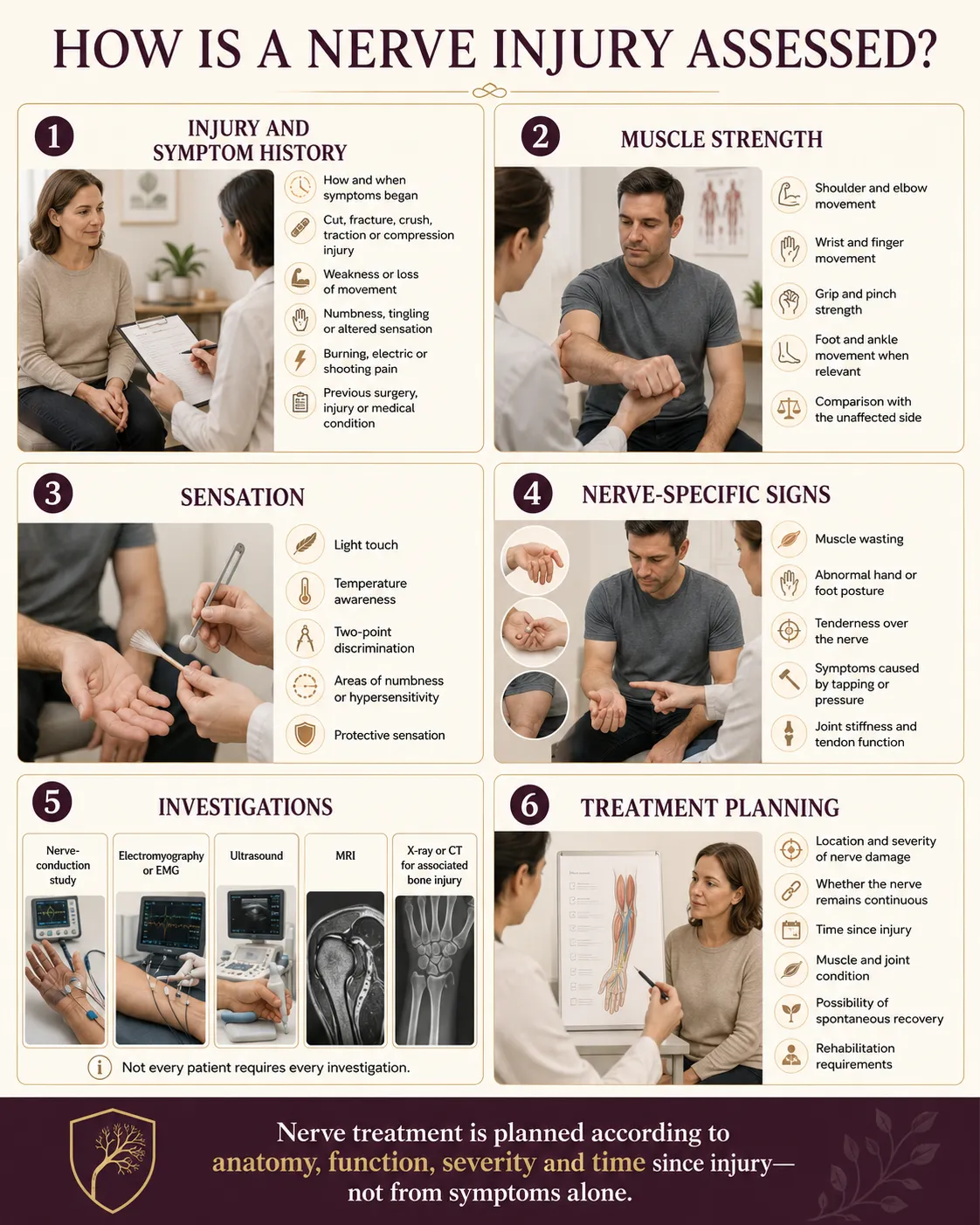
Direction of force, open or closed injury, fractures, operations, pain, early recovery and change over time are documented.
Individual muscles, sensation zones, pain, joint range, stiffness, scars and any remaining useful movement are examined.
Circulation, fractures, shoulder stability, chest and neck injury, wounds and vascular repair history can change priorities.
MRI or other imaging, nerve conduction studies and electromyography may help define the injury and monitor recovery. Tests are interpreted alongside the examination.
The plan considers age, injury level, elapsed time, available donor nerves and muscles, pain, occupation, rehabilitation access and the patient’s goals.
Open nerve injury, vascular compromise, expanding swelling, severe associated trauma or a contaminated wound may need urgent hospital treatment.
Serial examinations and selected tests may be used to look for recovery. Observation should have clear milestones rather than indefinite waiting.
As time passes, some denervated muscles may become less responsive. The plan may shift from nerve reconstruction toward tendon, muscle or joint-based procedures.
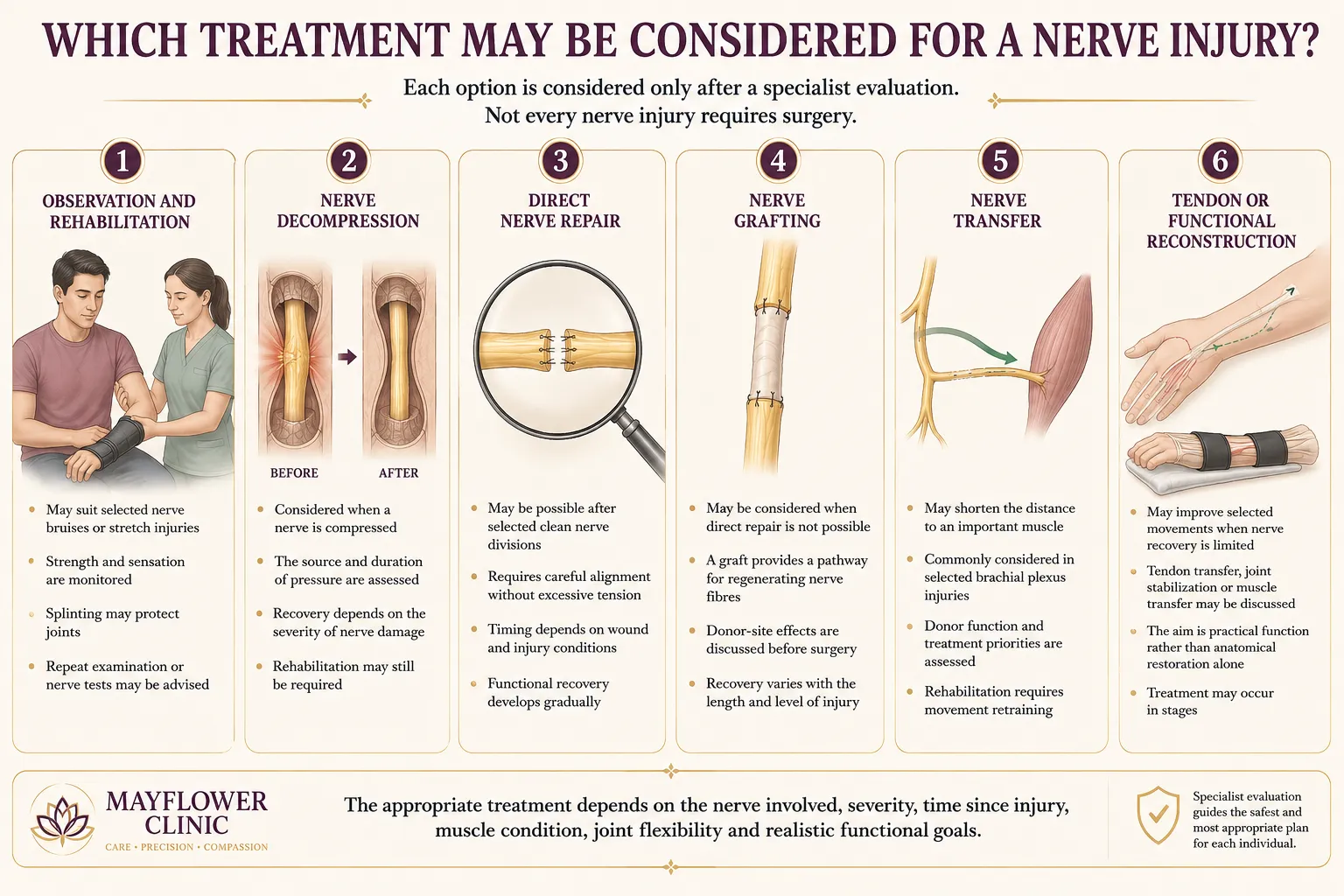
Surgery is not selected from the diagnosis name alone. The operation must match the injury level, time since injury, target muscle and available donor nerve or muscle.
May suit selected incomplete injuries showing useful recovery. Joints are protected while strength, sensation and pain are monitored.
The nerve may be explored and freed from restrictive scar in selected injuries where continuity remains and compression is relevant.
Possible only in selected clean divisions when healthy ends can be joined without excessive tension.
A graft bridges a damaged segment when useful proximal and distal nerve tissue is available but direct repair is not possible.
A working donor nerve branch is redirected to a priority target, often creating a shorter route to a denervated muscle.
A functioning tendon or muscle is redirected to restore a specific movement when nerve recovery is inadequate or the injury is older.
In selected severe or delayed injuries, a functioning muscle with its nerve and blood supply may be transplanted to create a priority movement.
Pain management, splinting, contracture release, joint stabilization or fusion may be part of a broader functional plan.
In a complex injury, every movement may not be recoverable. A staged plan usually concentrates on functions that make the largest difference to positioning, reach, self-care and practical use of the limb.
A technically possible operation is not automatically the most useful operation. The chosen reconstruction should have a clear target, an available donor, a realistic rehabilitation pathway and a functional purpose meaningful to the patient.

Dressings, a sling or splint and movement restrictions depend on the operation. Uninvolved joints may be moved as instructed.
Therapy helps prevent shoulder, elbow, wrist and hand stiffness while avoiding stress on the repair or transfer.
Clinical examination and selected tests may monitor whether nerve signals are reaching target muscles.
A nerve transfer may require learning a new movement strategy before the target muscle becomes more automatic.
Strengthening, task practice, splints, adaptive techniques and further staged procedures may be considered.
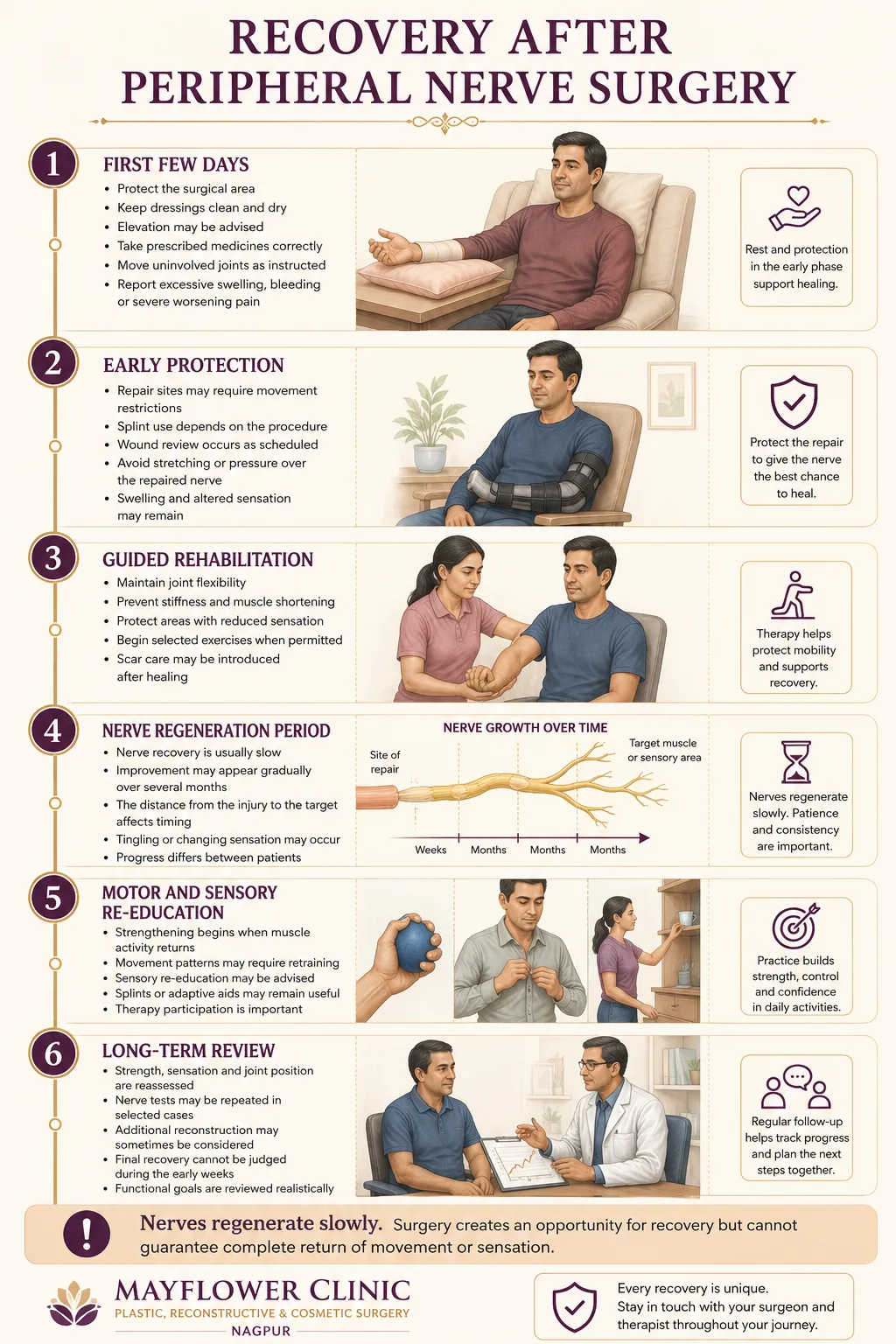
Nerve regeneration may not reach every target, and recovered strength or sensation may remain limited.
Nerve, tendon, muscle or graft harvest may cause weakness, altered sensation, scar or functional trade-offs at the donor site.
Nerve pain, hypersensitivity or numbness may persist, change or require separate treatment.
Joint stiffness and muscle shortening can limit function even when nerve recovery occurs, making therapy essential.
Bleeding, infection, wound problems, scarring, anaesthesia-related complications and injury to nearby structures are possible.
A staged reconstruction, tendon transfer, contracture release, joint procedure or additional rehabilitation may be needed.
Last medically reviewed for website publication: 27 July 2026.
Bring your injury records, imaging and nerve-test reports for a focused examination. The consultation will clarify the injury pattern, whether further testing is needed, which functions may be prioritized and whether surgery or continued rehabilitation is appropriate.

Case of the Month: Grade 3 Gynecomastia…

The Science of Facial Aging: Why Wrinkles,…