0712 6692706 / 0712 3551170 / +91 8087471244   |   contact@mayflowerclinic.in
Home / Male Intimate Procedures / Dorsal Slit Circumcision Surgery
M.Ch. Plastic Surgery · Confidential Male Care · Nagpur

Dorsal Slit Circumcision Surgery in Nagpur

A dorsal slit is a surgical way to release a tight foreskin. In some patients it is a foreskin-preserving release; in others, the dorsal slit is one step within a complete circumcision. The correct choice depends on the diagnosis, anatomy, urgency, scarring and your treatment goals.

Quick answer: “Dorsal slit” does not automatically mean “full circumcision.” It describes an incision along the upper aspect of the foreskin to release constriction. If complete circumcision is planned, the slit may be used to expose the foreskin before controlled removal. If a slit-only release is planned, the foreskin is not necessarily removed completely.
Dr. Pawan Shahane
Reviewed by Dr. Pawan Shahane, M.Ch. Plastic Surgery 21+ years surgical practice · Ex-Asst. Prof. GMC Nagpur · IAAPS Member · Mayflower Clinic, Nagpur
Dr. Pawan Shahane consulting an adult male patient privately at Mayflower Clinic Nagpur
Private consultation · Mayflower Clinic · Dhantoli, Nagpur
Confidentiality first: male intimate concerns are discussed privately. Examination is performed only when clinically required and with consent.
M.Ch.Plastic Surgery qualification
21+ yrsSurgical practice
IAAPSProfessional membership
Doctor-ledPersonally performed surgery
Page Guide · Quick Navigation

What do you need to know before deciding?

This page separates a dorsal slit release from complete circumcision and compares it with other circumcision approaches without assuming one method is automatically better.

Understand the Procedure

What is a dorsal slit?

A dorsal slit is a controlled longitudinal opening made along the upper side of a tight foreskin. Its purpose is to release a constricting ring and improve exposure of the glans and urethral opening when the foreskin cannot be retracted safely.

The phrase is used in two related ways. A slit-only dorsal release opens the foreskin without necessarily removing it completely. A dorsal-slit circumcision technique uses the slit as an access step, followed by planned removal of foreskin and surgical closure.

This distinction matters. If preserving foreskin is important, the discussion is different from a consultation in which complete circumcision is already indicated or preferred.

Important terminology: the legacy page name “Dorsal Slit Circumcision Surgery” is preserved for search continuity, but the consultation should establish whether you actually need a dorsal slit release, a complete circumcision, another foreskin-preserving operation, or non-surgical treatment.

What problems may lead to this discussion?

  • A tight foreskin that cannot be retracted comfortably or safely.
  • Scarring or a tight fibrotic ring around the foreskin opening.
  • Selected symptomatic phimosis where surgical release is being considered.
  • Paraphimosis when a retracted foreskin becomes trapped behind the glans and urgent reduction is unsuccessful or unsuitable.
  • Situations where exposure is difficult and a dorsal opening is needed as part of a circumcision technique.
Indications Need Examination

When might a dorsal slit be considered?

A symptom such as “tight foreskin” can have different causes. The decision is based on clinical examination rather than the procedure name alone.

Selected Phimosis

When a foreskin is pathologically tight or scarred and conservative treatment is not appropriate or has not solved the problem, surgical options can be discussed.

!

Paraphimosis

A foreskin trapped behind the glans can become an emergency. If reduction cannot be achieved, a dorsal slit may be used to release the constriction; definitive treatment may be planned after swelling settles.

Difficult Exposure

In some circumcisions, a dorsal slit provides controlled access so the foreskin can be visualised and removed under direct vision.

Foreskin Preservation

Some patients may ask whether a release can preserve more foreskin. The trade-off includes the postoperative appearance and the possibility of persistent or recurrent tightness.

Scarring or Recurrent Inflammation

Repeated inflammation or scar-related narrowing may change which operation is appropriate. A clear diagnosis matters before selecting a technique.

?

When Not to Rush

Not every non-retractile foreskin needs surgery. Age, symptoms, scarring, infection, medical history and previous treatment all influence the decision.

Paraphimosis warning: a painful, swollen glans with foreskin trapped behind it can compromise blood flow. This is not a routine appointment issue. Seek urgent medical assessment, especially with severe pain, increasing swelling or dark/blue colour change.
Compare the Purpose, Not the Marketing Label

Dorsal slit vs circumcision, laser and stapler techniques

These terms describe different things: a release incision, complete foreskin removal, an energy tool, or a circumcision device. A consultation should first define the medical problem, then the technique.
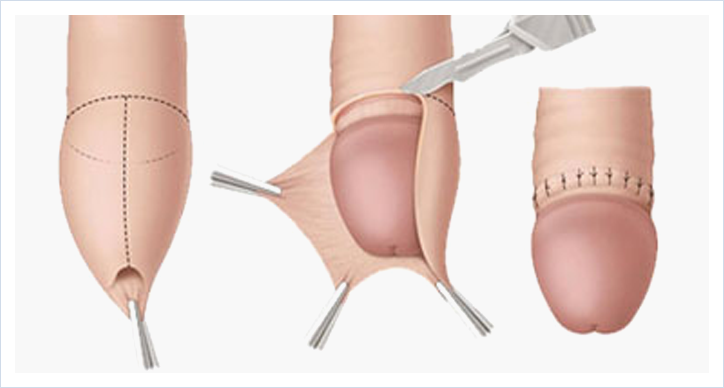
General circumcision technique illustration used for patient education at Mayflower Clinic Nagpur
General circumcision illustration from the clinic media library. It is not a patient photograph and does not represent a guaranteed postoperative appearance.

Three decisions are often being mixed together

  • Do we need to release tightness? A dorsal slit may address this in selected cases.
  • Do we need or want complete foreskin removal? That is the circumcision decision.
  • If circumcision is planned, which technique is suitable? Conventional, dorsal-slit based, stapler-assisted or laser-assisted approaches have different practical features and are not interchangeable.

Read the Circumcision Surgery in Nagpur overview →

OptionMain conceptForeskin removalImportant limitation
Dorsal slit releaseOpens a tight constricting foreskin.Not necessarily complete.Appearance differs from circumcision; tightness may persist or recur in some cases.
Complete circumcisionRemoves foreskin around the glans.Yes.Permanent anatomical change; wound healing and scar are expected.
Laser-assisted circumcisionUses laser energy as a cutting/coagulation tool during circumcision.Yes, when used for complete circumcision.“Laser” does not remove the general surgical risks or make the operation automatically superior.
Stapler circumcisionUses a circular device to remove foreskin and secure the wound.Yes.Device suitability depends on anatomy, age, indication and surgeon assessment.
Typical Patient Journey

From private consultation to follow-up

The sequence differs if the problem is an emergency. For a planned procedure, the pathway is usually structured around diagnosis, choice of operation and safe healing rather than speed alone.

1
Before treatment

Private consultation

Discuss symptoms, how long the foreskin has been tight, prior infections, medicines, diabetes or bleeding issues, previous procedures and what you want to preserve or change.

2
Assessment

Confirm the actual diagnosis

The examination looks for a tight ring, scarring, inflammation, trapped foreskin, adhesions, skin disease or another reason that may change the plan.

3
Decision

Choose slit-only release, circumcision or an alternative

Dr. Pawan Shahane discusses the purpose, expected anatomical change, scar, limitations, alternatives and why a particular option may or may not fit your case.

4
Procedure day

Anaesthesia and controlled release

The anaesthesia plan is individual. If a dorsal slit is performed, the tight foreskin is opened in a controlled manner; if full circumcision is planned, foreskin removal and wound closure follow the chosen technique.

5
Early recovery

Swelling, dressing and urination

Some swelling, sensitivity and discomfort can occur. Before discharge or early follow-up, instructions cover dressing care, hygiene, medications, urination and activity.

6
Following days

Protect the healing wound

Avoid unnecessary handling, friction and strenuous activity. Wear loose clothing and follow the exact advice given for the wound and dressing.

7
Follow-up

Review healing and function

Follow-up checks wound healing, swelling, pain, infection, urination, scar and whether a slit-only procedure has adequately relieved the original problem.

Risks, Trade-offs & Limits

What should be discussed before surgery?

A dorsal slit may be a useful surgical solution in selected patients, but it is not risk-free and it does not guarantee a particular cosmetic appearance.

Bleeding & swelling

Bleeding, bruising and swelling can occur after foreskin surgery. Ongoing or heavy bleeding needs prompt assessment.

Infection

Increasing redness, warmth, discharge, fever or worsening pain may indicate infection and should be reviewed.

Wound healing problems

Wound separation, delayed healing or troublesome scar formation can occur, particularly when local or health factors interfere with healing.

Appearance after slit-only release

A slit-only procedure leaves a different foreskin contour than complete circumcision. Patients should understand that appearance before agreeing to treatment.

Persistent or recurrent tightness

If the underlying scarring or disease remains, a foreskin-preserving procedure may not permanently solve the problem and further treatment may be required.

Anaesthesia & uncommon complications

Anaesthesia reactions, urinary difficulty, significant tissue injury or other uncommon complications are part of informed consent and require appropriate management if they occur.

Recovery & Aftercare

Protect the wound while swelling settles

Your surgeon's specific instructions take priority because a slit-only release and complete circumcision do not have identical wounds.

Dressing & hygiene

Keep the area and dressing as instructed. Do not repeatedly pull, stretch or manipulate the wound unless specifically told to do so.

Swelling & comfort

Use prescribed medicines as directed. Loose clothing and avoiding friction can make early recovery more comfortable.

Activity

Walking and light activity may be possible before complete healing, but exercise, cycling, friction and sexual activity require a longer restriction based on the wound.

Follow-up

Attend scheduled review even if recovery seems straightforward, particularly if the procedure was performed for scarring, recurrent inflammation or severe tightness.

Urination

Make sure you can pass urine. New inability to urinate or significant worsening difficulty needs prompt medical assessment.

Contact the surgical team promptly for worsening pain, increasing redness, unexpected discharge, fever, wound opening or swelling that is rapidly increasing rather than settling. Seek urgent medical care for uncontrolled bleeding, inability to pass urine, severe rapidly worsening pain/swelling, or dark blue/black colour change of the glans or surrounding tissue.
Dr. Pawan Shahane Indian Association of Aesthetic Plastic Surgeons membership and professional credentials
Surgeon & Continuity of Care

Dr. Pawan Shahane, M.Ch. Plastic Surgery

Assessment and surgical planning at Mayflower Clinic are led by Dr. Pawan Shahane. The clinic's care model states that planned surgical procedures under his care are personally performed by Dr. Shahane rather than delegated as routine production-line surgery.

Qualifications recorded in the clinic knowledge bank: MBBS, MS General Surgery, M.Ch. Plastic Surgery, Fellowship in Aesthetic Surgery, Fellowship in Cosmetic Laser Surgery; former Assistant Professor at GMC Nagpur & NKPSIMS; member of IMA and IAAPS.

View Dr. Pawan Shahane's full profile →

Verified Patient Feedback

What verified reviews can — and cannot — tell you

Reviews can help you judge communication and follow-up, but they cannot predict your medical or cosmetic outcome.

Review integrity: the current project source does not identify a dorsal-slit-specific Google review quotation. To avoid inventing a circumcision outcome, the cards below use verified Google feedback already documented for Dr. Pawan Shahane and clearly label the procedure actually mentioned by the reviewer.

★★★★★
“Hi I am from Pune and recently had nose surgery performed by Dr. Pawan Shahane, and I am absolutely thrilled with the results! From the initial consultation to the post-operative care, Dr. Shahane demonstrated exceptional skill, professionalism, and a genuine care for my well-being...”
Nishant MenghareVerified Google reviewer · Rhinoplasty feedback
★★★★★
“Rhinoplasty, nose surgery done for my sister. We are very happy with results and strongly recommend Dr. Pawan Shahane sir for anyone seeking rhinoplasty. He explains everything and how to take care. He support at every stage and do the surgery as planned.”
Kunal ThakurVerified Google reviewer · Rhinoplasty feedback
★★★★★
“I am very happy with my nose surgery, rhinoplasty. It's been 3 weeks and results are awesome. I wanted a sharp tip, and I was having a broad nose. So went to many doctors but no one is as intelligent and artist as Dr. Pawan Shahane...”
Kajal MeshramVerified Google reviewer · Rhinoplasty feedback
Frequently Asked Questions

Dorsal Slit Circumcision Surgery — FAQs

The answers below are general education. They do not diagnose a foreskin condition online.

What is dorsal slit circumcision surgery?
A dorsal slit is a controlled longitudinal opening made in a tight foreskin to release constriction. It may be used as a foreskin-release procedure by itself or as part of a complete circumcision technique, depending on the clinical indication and planned treatment.
Is a dorsal slit the same as full circumcision?
Not always. A slit-only procedure opens the tight foreskin but does not necessarily remove it completely. In a dorsal-slit circumcision technique, the slit is one step that helps expose and remove the foreskin under direct vision.
When may a dorsal slit be considered?
It may be considered in selected cases of a very tight or scarred foreskin, when exposure is difficult, or when urgent release of constriction is needed. The choice depends on examination, severity, age, infection or scarring, previous treatment and whether circumcision is appropriate.
Is a dorsal slit used for paraphimosis?
It can be used when paraphimosis causes a tight constricting band and non-surgical reduction is unsuccessful or unsuitable. Paraphimosis can threaten blood flow and requires urgent medical assessment rather than routine online advice.
Can a dorsal slit be used for phimosis?
Yes, a dorsal slit may be one surgical option for selected phimosis. However, not every case of phimosis requires surgery, and treatment may instead involve observation, topical treatment, preputioplasty or circumcision depending on age, cause and severity.
Does every patient with phimosis need surgery?
No. Some cases, particularly physiologic non-retractability in younger patients or selected non-scarred phimosis, may be managed without surgery. Pathologic scarring, recurrent symptoms or complications change the decision and require clinical assessment.
What anaesthesia is used for a dorsal slit procedure?
Anaesthesia depends on age, urgency, anxiety, medical history and whether the plan is a slit-only release or complete circumcision. Local anaesthesia is commonly used in appropriate adults, while other anaesthesia plans may be chosen when clinically indicated.
How long does recovery take after a dorsal slit or circumcision?
Recovery varies with whether the procedure was slit-only or a complete circumcision, the amount of swelling, wound closure, health factors and healing biology. Light activity may resume before complete wound healing; strenuous activity and sexual activity should wait until the treating surgeon considers healing adequate.
What are the risks of dorsal slit circumcision surgery?
Possible risks include bleeding, infection, swelling, pain, wound separation, scarring, altered foreskin appearance, persistent or recurrent tightness after a slit-only procedure, urinary difficulty and anaesthesia-related problems. Uncommon serious complications require prompt medical review.
What aftercare is needed after the procedure?
Follow the surgeon's dressing and hygiene instructions, take prescribed medicines as directed, avoid unnecessary manipulation and friction, use loose clothing, and attend follow-up. Activity restrictions depend on the exact procedure and healing progress. See the Patient Care Guide for broader postoperative guidance.
When should I seek urgent medical care after a dorsal slit or circumcision?
Seek urgent assessment for uncontrolled bleeding, inability to pass urine, rapidly worsening swelling or pain, fever with spreading redness or discharge, wound breakdown, or dark, blue or black colour change of the glans or surrounding tissue. Severe or rapidly worsening symptoms should not wait for routine messaging.
How is dorsal slit different from laser or stapler circumcision?
Dorsal slit describes a surgical incision pattern or release step. Laser refers to an energy tool that may be used to cut or coagulate tissue, while stapler circumcision uses a circular device for tissue removal and closure. These are not interchangeable labels, and no technique is automatically best for every patient.

Not sure whether you need a dorsal slit or full circumcision?

Start with the diagnosis. A private consultation can clarify whether the problem is phimosis, paraphimosis, scarring, recurrent inflammation or another foreskin concern — and whether surgery is necessary at all.

Medical review references: World Health Organization manual on male circumcision techniques; British Association of Urological Surgeons patient information on dorsal slit; Merck Manual/NCBI clinical references on phimosis and paraphimosis. These references support general educational content and do not replace individual clinical assessment.
Medical Disclaimer: All surgical procedures carry inherent risks, and individual outcomes vary based on anatomy, skin type, medical conditions and healing biology. Surgical results are not guaranteed. Formal in-person consultation with Dr. Pawan Shahane is required before any planned surgical decision. This page is for general educational purposes only and does not constitute medical advice or a treatment recommendation. Paraphimosis with significant pain, swelling or colour change can be an emergency and requires urgent medical assessment.

Mayflower Clinic

Surdham Complex, Dhantoli,
Nagpur — 440012, Maharashtra, India

Clinic Hours

Monday–Saturday
11 AM–6 PM
Sunday closed