
Internal laser-assisted lipolysis
A thin fibre passes through a small access point into the fat layer. It is invasive, requires anaesthesia and sterile technique, and may be followed by aspiration. This is the procedure discussed on this page.
Laser assistance can be useful for selected localized fat concerns, but the word laser does not automatically make a procedure safer, scarless, non-surgical or better than conventional liposuction. The useful question is whether controlled thermal energy adds a specific benefit for your anatomy without adding unnecessary risk.
Quick answer: this page discusses internal laser-assisted lipolysis, where a thin fibre is passed through a small access point into the subcutaneous fat layer. It is a minimally invasive surgical technique—not the same as an external non-surgical laser device. Fat may be aspirated after treatment, and any skin-contraction effect is variable rather than guaranteed.


Ask a simple question about this page. The matcher runs only in your browser and points you to the relevant section.
Start here: laser lipolysis is an internal energy-assisted contouring technique, not automatically a non-surgical treatment or a superior form of liposuction.
This tool cannot examine you, diagnose a condition, recommend surgery, calculate candidacy or replace consultation.
“A laser is useful only when it adds a clearly defined advantage for a selected area. It cannot decide how much fat to leave, how to blend the edges, when skin is too loose, or when another operation is safer and more appropriate.”Dr. Pawan Shahane, M.Ch. Plastic Surgery · Founder, Mayflower Clinic, Nagpur
Laser-assisted lipolysis is one of several energy-assisted liposuction approaches. After markings and appropriate anaesthesia, a narrow fibre is introduced through a small skin access point into the fatty layer. Controlled thermal energy is delivered while the surgeon moves the fibre, monitors the treatment plane and protects the overlying skin and deeper structures.
The energy can disrupt fat cells and coagulate small vessels. In many protocols, the treated fat is then removed by gentle suction. The operation therefore remains a contouring procedure that requires sterile preparation, anaesthesia planning, access sites, postoperative care and management of surgical risks.
Laser assistance may be considered when the surgeon expects it to help in a selected small, delicate or fibrous zone, or when a limited thermal effect may complement contouring. It is not automatically the best choice for large-volume reduction, every body area or every degree of skin laxity.
A thin fibre passes through a small access point into the fat layer. It is invasive, requires anaesthesia and sterile technique, and may be followed by aspiration. This is the procedure discussed on this page.
Energy is applied through intact skin without an inserted fibre. Treatment mechanism, expected reduction, sessions, risks and downtime differ. Read the non-surgical fat reduction guide.
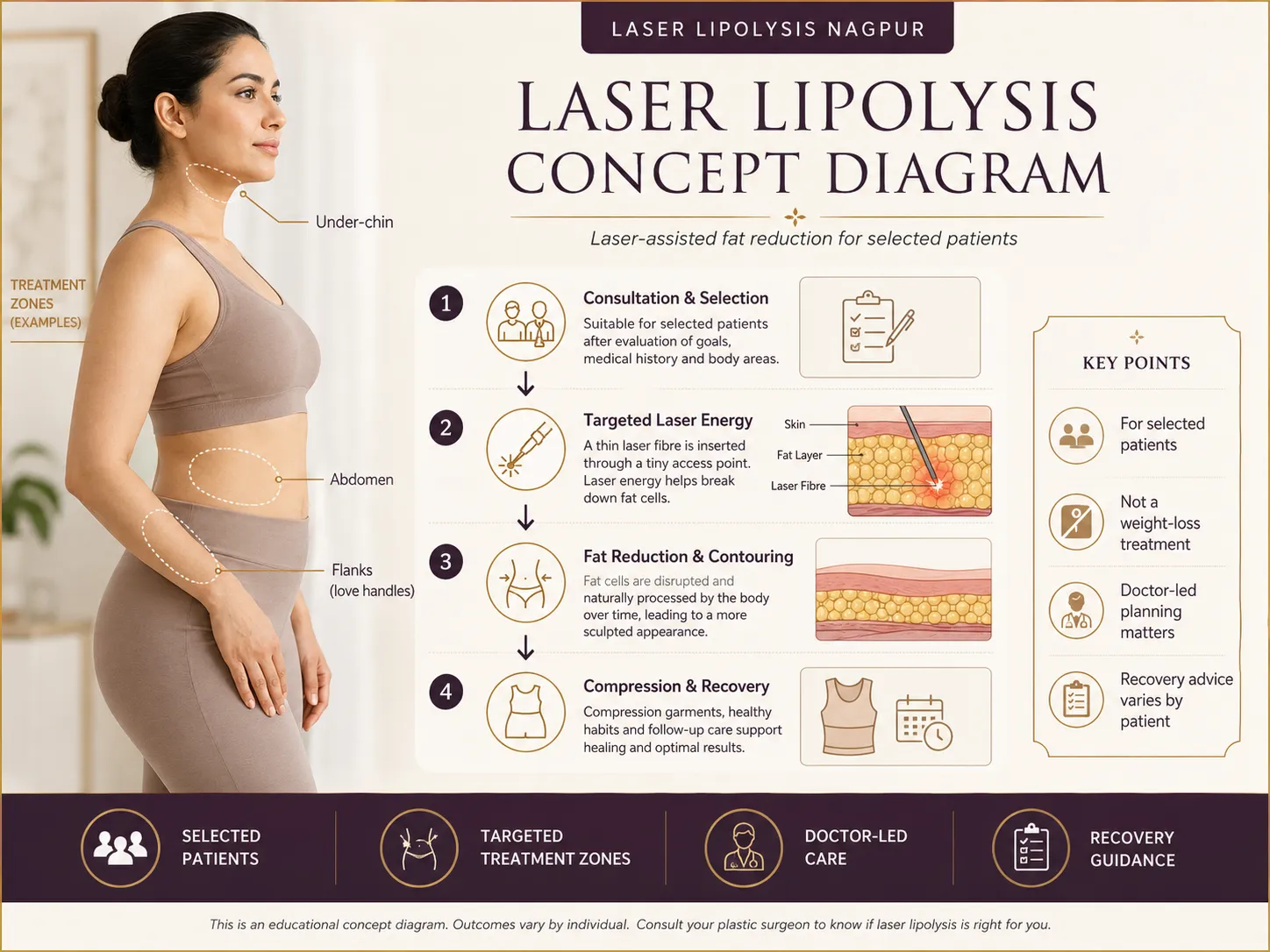
Examination distinguishes subcutaneous fat from loose skin, muscle laxity, gland tissue, scar, oedema or a structural concern needing another plan.
The fibre is kept in the planned fat layer while the surgeon controls movement, energy, dwell time and distance from skin and deeper structures.
Removing fat is only part of the operation. The borders between treated and untreated areas must be feathered to reduce steps, grooves and asymmetry.
Compression, walking, wound care, hydration, review and delayed return to heavy activity support recovery while the contour gradually settles.
No area is chosen by name alone. Fat thickness, skin quality, previous scars, nearby nerves and vessels, total treatment extent and the desired transition decide whether laser assistance adds value.
Small-volume contouring may be considered when fat—not primarily loose skin, platysmal bands or a small chin—is the dominant concern.
Assessment must separate fat from skin laxity. Energy assistance cannot replace an arm lift when redundant skin is substantial.
Localized fat may be treatable, but pregnancy-related skin excess, stretch damage or muscle separation can require a different operation.
These are transition zones; circumferential planning may matter more than treating one visible bulge in isolation.
Skin looseness, cellulite, knee transition and asymmetry influence how much reduction is safe and whether another technique is preferable.
Delicate areas need precise depth control and conservative removal to avoid visible hollows or injury near important structures.
Fibrous tissue can be technically demanding. The surgeon chooses the tool that offers controlled release without excessive heat or trauma.
Scarred or uneven areas require revision capability and cautious expectations; laser energy is not an automatic correction for every irregularity.
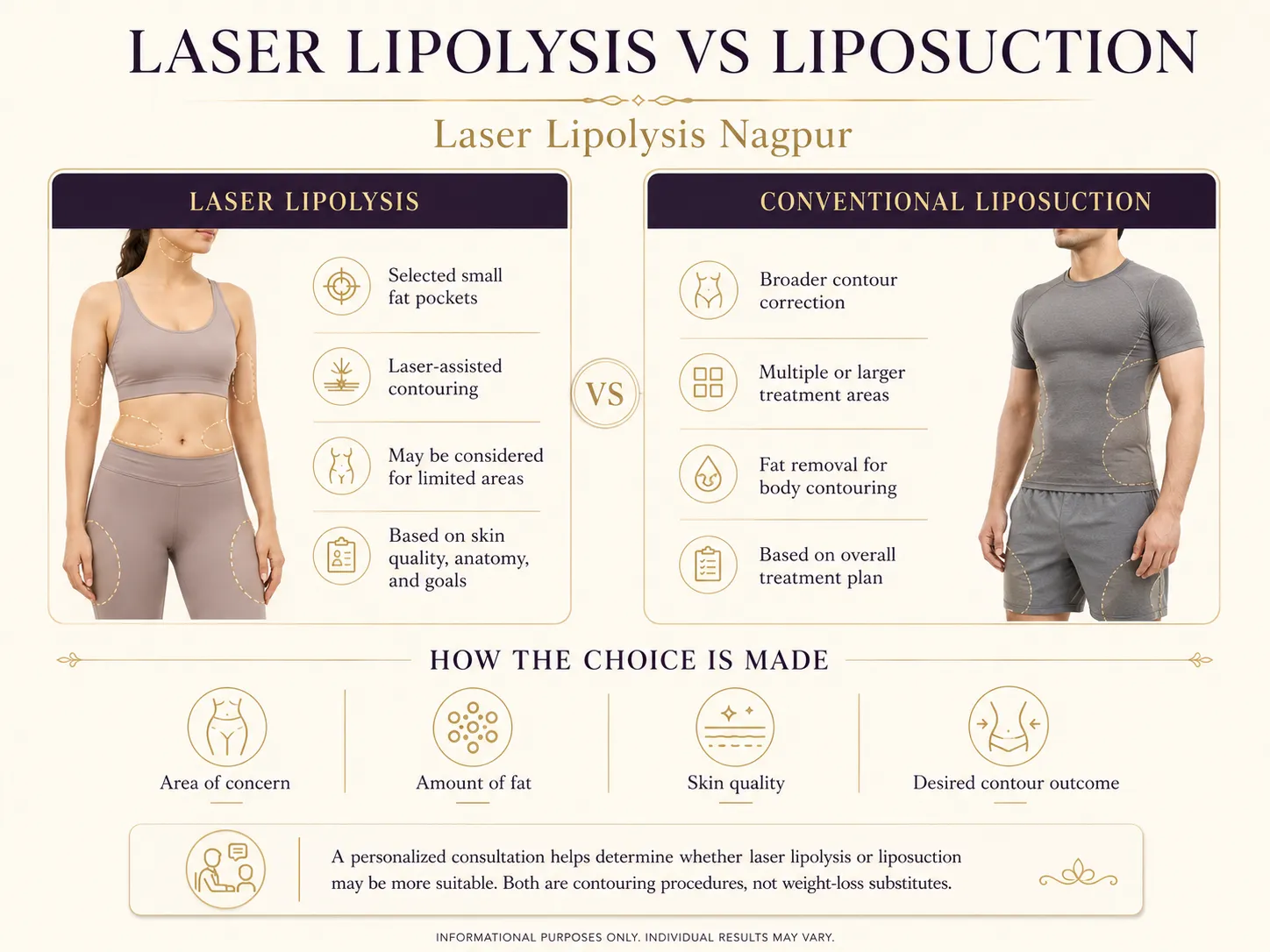
| Planning question | Laser-assisted lipolysis | Conventional liposuction |
|---|---|---|
| Energy | Laser energy used within the fat layer | Mechanical cannula and suction without laser energy |
| Best use | Selected zones where the surgeon expects a defined benefit | Versatile option for many localized or broader contour plans |
| Fat removal | May include aspiration after laser treatment | Fat is mechanically loosened and aspirated |
| Skin contraction | Possible thermal contribution; degree variable | Depends mainly on natural skin elasticity and technique |
| Unique risk | Thermal injury or burn in addition to liposuction risks | No laser burn, but standard surgical risks remain |
| Evidence | No universal superiority established | Long-established reference technique |
Relatively good-quality skin with mild laxity may redrape after limited fat reduction, and controlled thermal injury may contribute to collagen remodelling over time.
Ageing, stretch marks, pregnancy, large weight loss, repeated weight fluctuation, thin skin and previous procedures can reduce the ability to contract evenly.
Substantial hanging skin, an abdominal apron, major arm or thigh laxity, or abdominal muscle separation may require tummy tuck or lift surgery rather than energy alone.
Published comparisons have reported possible improvements in skin retraction, but study quality and consistency are limited. A responsible consultation should describe the likely range—not promise a “tightening percentage” or scarless alternative to skin removal.
Fasting, medicines, nicotine avoidance, transport, compression garment and investigations are confirmed according to the anaesthesia and treatment extent.
Markings are made in a natural standing position because fat thickness and folds can look different when lying down.
Tumescent local anaesthesia, sedation or general anaesthesia is selected according to area, duration, patient factors and combined procedures.
Access sites are chosen to reach the zone while considering scars, skin folds and the direction needed for even treatment.
The fibre is moved in the planned layer; energy and passes are controlled to avoid prolonged heating near one point or excessive treatment close to skin.
Fat removal is balanced against the need to leave a smooth, supported layer and gradual transitions at the borders.
Monitoring continues until the patient is stable, mobile as appropriate, tolerating fluids and has written instructions, contact details and a responsible escort when required.
The fibre must remain in the intended fat layer, away from prolonged contact with the underside of skin and protected structures.
Energy, movement, dwell time and treatment density are controlled to reduce focal overheating, burns and tissue injury.
Number of zones, duration, fluid, anaesthesia and total surgical load must remain appropriate for the patient and facility.
Early review looks for excessive pain, blistering, colour change, drainage, infection, seroma and circulatory or clot-related warning signs.
Small access sites may drain tumescent fluid initially. Walking is encouraged as advised. Compression and prescribed medicines begin.
Desk work can be possible after a limited treatment, but bruising, swelling, tightness or fatigue may still be noticeable.
Exercise returns in stages after review. Compression duration is individualized; excessive pressure or garment folding should be reported.
Residual swelling and tissue firmness can take months to settle. Revision decisions should not be rushed while healing is evolving.
The intended result is a smoother proportion and transition—not a particular number of kilograms, a guaranteed dress size or a perfectly tight surface. Early swelling may temporarily hide the contour, and areas can feel firm, numb or uneven while healing.
Results depend on pre-existing asymmetry, fat distribution, skin quality, scars, treatment extent, healing biology and long-term weight stability. Cellulite, stretch marks and lax skin may remain even when the fatty bulge improves.
Remaining fat cells can enlarge after weight gain, and pregnancy, ageing or hormonal change can alter the contour later. Healthy weight maintenance supports longevity but cannot freeze the body in time.
A responsible fee cannot be calculated from the procedure name alone. It follows examination and a written treatment plan.
Small under-chin treatment differs from several circumferential body zones in time, staff, fluid, garment and recovery needs.
Laser system, fibre or single-use components, maintenance and safety requirements may affect cost.
Local treatment, sedation or general anaesthesia require different monitoring, personnel and operating-facility resources.
Investigations, medicines, compression garment, planned reviews and management of unexpected issues should be clarified.
Patients travelling from Vidarbha, Madhya Pradesh, Chhattisgarh or other regions should not assume that a small access point means immediate long-distance travel is always appropriate. Treatment extent, anaesthesia, pain control, early review and access to urgent care affect the plan.
Before fixing travel, ask how long you should remain in Nagpur, when the first review is due, whether drains or garment adjustment may be needed, and which symptoms require local emergency care rather than a remote message.
The following are authentic general cosmetic-surgery testimonials from the clinic’s WordPress testimonial inventory. They are not presented as laser-lipolysis-specific outcome claims.
“Amazing experience with Dr Pawan Shahane. I recommend him for all cosmetic surgery. He is good in knowledge… and he is very kind in nature… I am happy with results and now feeling full of confidence.”
“Good experience. Highly skilled surgeon. Post op care and consultation was also done nicely… Thanks.”
“I am happy with results. I recommend him for cosmetic surgery. His staff are also good… honest and explains everything well.”
Laser lipolysis is a minimally invasive, energy-assisted body-contouring technique. A thin laser fibre is introduced through a small access point to deliver controlled energy within the subcutaneous fat layer; depending on the plan and device, treated fat may then be aspirated. It is not a weight-loss treatment.
No. This page refers to internal laser-assisted lipolysis, which involves a small skin access point and is planned as a surgical or minimally invasive procedure. External non-surgical devices work through intact skin and belong to a different treatment category with different indications, results and limitations.
Not for every patient or every area. Laser assistance may be useful in selected small, delicate or fibrous zones, but systematic reviews have not established that it is universally superior to well-performed conventional liposuction. The safest useful technique depends on anatomy, treatment extent, skin quality, equipment and surgeon judgement.
Potential candidates are generally healthy adults with stable weight, a localized subcutaneous fat concern, reasonable skin quality and realistic expectations. Medical illness, smoking, unstable weight, pregnancy, poor skin elasticity, clotting risk or a need for major skin removal may change or rule out the plan.
Selected concerns may involve the under-chin area, upper arms, abdomen, waist or flanks, thighs, knees, back or other localized deposits. The number and size of areas, skin thickness, nearby nerves and vessels, scars and total treatment extent all affect suitability.
Thermal energy may contribute to collagen remodelling and some skin contraction in selected patients, but the degree is variable and cannot be guaranteed. It does not reliably correct substantial hanging skin, major post-pregnancy laxity or the tissue excess that may require a tummy tuck or lift.
No. A tummy tuck addresses excess abdominal skin and may repair abdominal-wall laxity or muscle separation. Laser lipolysis mainly targets selected subcutaneous fat and may provide limited skin contraction; it cannot remove a large skin apron or repair separated muscles.
Local or tumescent anaesthesia, sedation or general anaesthesia may be used depending on the area, number of zones, expected duration, patient health and whether aspiration or another procedure is combined. The word laser does not mean that anaesthesia or facility planning can be skipped.
Often, laser assistance is followed by gentle aspiration of the treated fat. Some small-volume protocols may differ, but the exact method depends on the device, indication and surgeon’s plan. Patients should ask whether aspiration is intended and what evidence supports the proposed approach.
Recovery varies with treatment area and extent. Light walking is encouraged early; desk work may be possible within several days for a limited procedure, while swelling, bruising, firmness and altered sensation can last weeks. Contour often continues to settle over three to six months or longer.
A compression garment is commonly advised for body areas, although the type and duration depend on the zone, amount treated, skin response and surgeon preference. The garment should support comfort and swelling control without causing excessive pressure, numbness or skin injury.
Risks include bruising, swelling, infection, seroma, contour irregularity, asymmetry, sensory change, scarring, skin injury, anaesthesia complications and venous thromboembolism. Laser-specific concerns include excessive heat, burns and thermal injury, which is why controlled technique, equipment checks and postoperative review matter.
Fat cells removed or destroyed in the treated zone do not simply regenerate in the same pattern, but remaining fat cells can enlarge with weight gain and body proportions can change with age, hormones or pregnancy. Stable weight and healthy habits help preserve the contour.
Cost depends on the number and size of areas, complexity, device and disposables, anaesthesia, operating facility, investigations, compression garment, medicines, follow-up and whether aspiration or another procedure is combined. A written quote should follow examination and explain what is included.
The choice should follow examination of fat thickness, skin quality, body-zone transitions, scars, treatment volume and medical risk. Ask what specific benefit laser assistance is expected to add in your case, what alternative technique would be used, what device and safety protocol are planned, and what evidence supports the recommendation.
Bring a clear description of the area that concerns you, your health and medicine history, previous procedure details and your recovery constraints. Consultation should determine whether laser assistance adds value—or whether standard liposuction, skin-excision surgery, non-surgical treatment or no procedure is the better decision.

Case of the Month: Grade 3 Gynecomastia…

The Science of Facial Aging: Why Wrinkles,…