
What can it treat?
Prominence, disproportionate size, selected fold or contour differences, asymmetry, earlobe concerns and previous-surgery problems may be assessed.

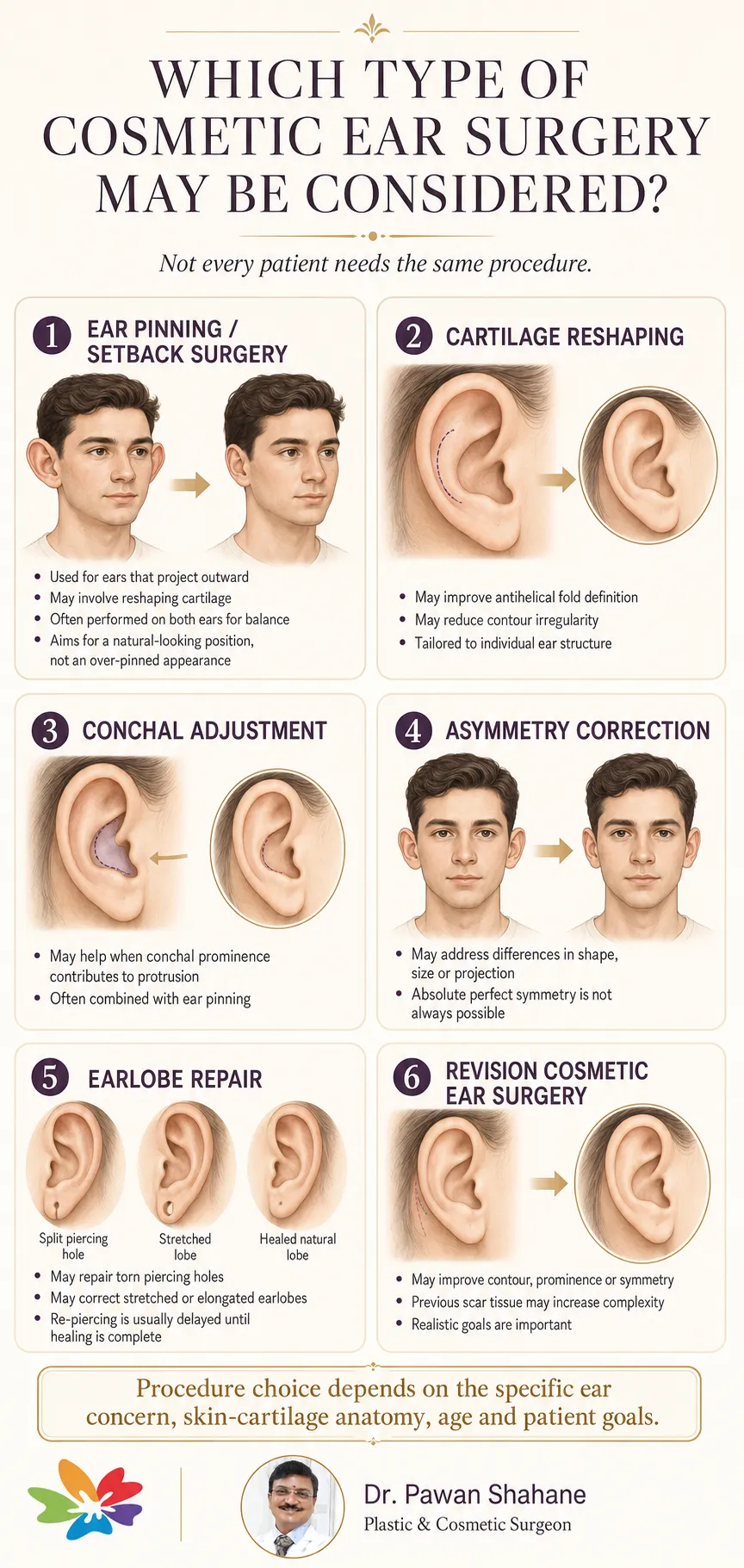
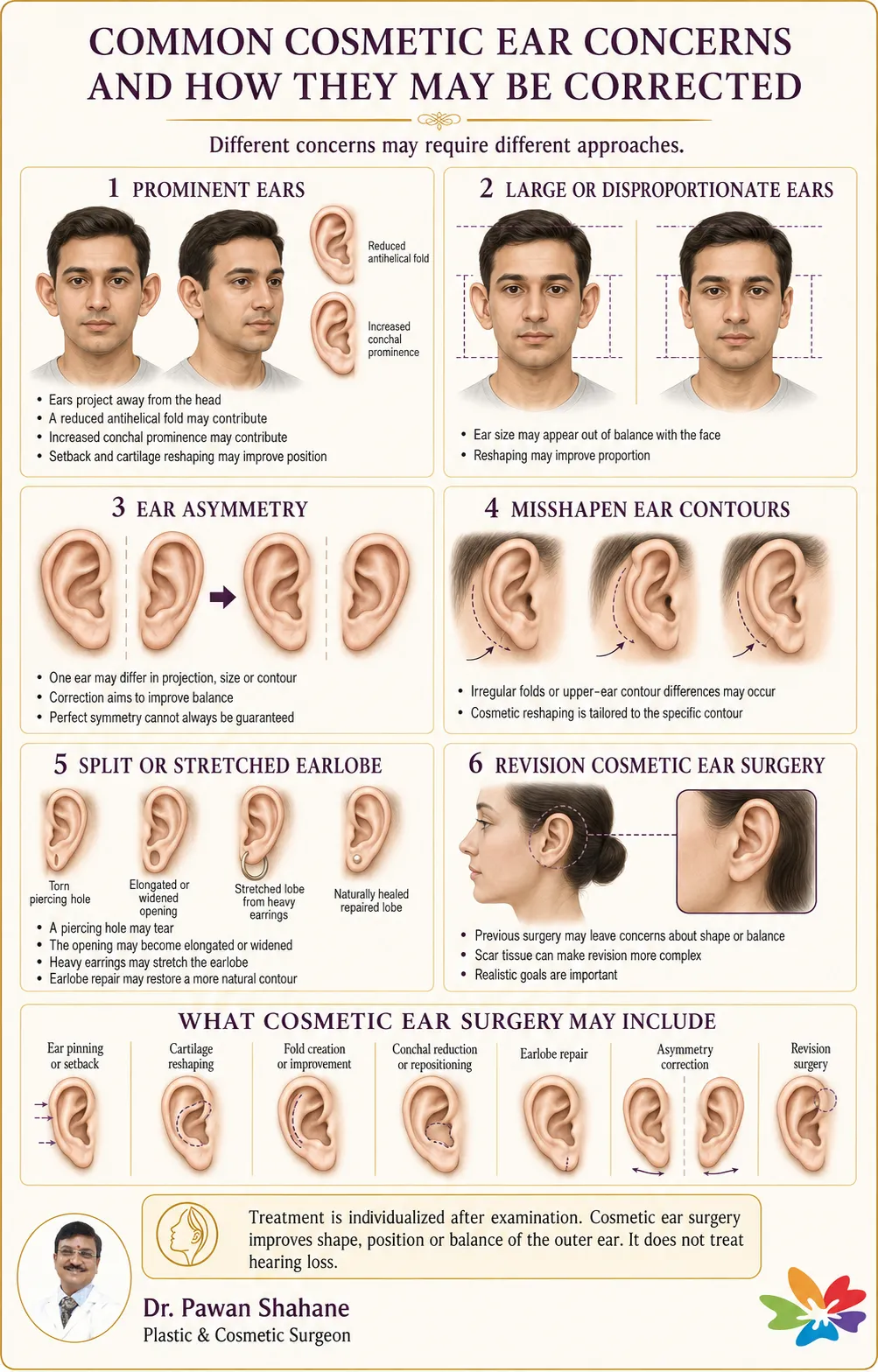
Visible-ear concerns are not limited to ears that “stick out.” Planning may involve prominence, size, weak or unusual folds, asymmetry, earlobe shape, a previous operation or a selected post-injury contour problem. The goal is an individualized ear that remains natural beside the face—not an identical or over-flattened pair.


Choose a question for a quick answer. All answers remain visible below for patients, search engines and assistive technologies.
It can include prominent-ear correction, size reduction, reshaping, selected earlobe repair and revision—depending on the visible concern.
Prominence, disproportionate size, selected fold or contour differences, asymmetry, earlobe concerns and previous-surgery problems may be assessed.
No. Otoplasty is central to cartilage correction, while this broader page also covers earlobes, reduction, revision and reconstructive boundaries.
Cosmetic outer-ear surgery usually does not improve hearing. Pain, discharge, infection, tinnitus or hearing loss requires a different assessment pathway.
Both may be evaluated. A child should be developmentally ready, able to follow aftercare and personally willing to proceed.
Common locations are behind the ear, in a natural fold or on the earlobe. Scar quality varies and depends on healing biology and care.
Early social recovery is often measured in one to two weeks, but headband use, swelling and sports restrictions continue according to the procedure.
Quick guidance only. Examination is needed to determine whether the concern is cosmetic, reconstructive or related to ENT/hearing care.
Assessment looks at the ear’s projection from the head, antihelical fold, conchal bowl, upper and lower pole, lobe, height, skin, scar tendency and relationship to the opposite side. Over-flattening one part can create a less natural result than the original concern.
Dr. Pawan Shahane’s surgeon-led planning focus · Mayflower Clinic, NagpurCosmetic ear surgery is a broad group of procedures that alter the visible outer ear—the auricle or pinna—and, when required, the earlobe. The operation may improve position, projection, proportion, fold definition, contour or symmetry. It does not automatically mean that both ears require the same manoeuvre.
For prominent ears, the operation is commonly called otoplasty, pinnaplasty or ear pinning. A surgeon may create a missing fold, reduce the depth of the conchal bowl, rotate part of the cartilage closer to the head, or combine these techniques. Large ears may need a reduction plan, and an earlobe concern requires different incisions and expectations.
The consultation should also identify concerns that do not belong in a cosmetic pathway. Hearing loss, repeated discharge, active infection, ear-canal disease, dizziness or tinnitus are not corrected by changing the external ear’s appearance.
The following are categories for assessment, not a menu that every patient needs.
Cartilage is reshaped or repositioned to reduce excessive projection while preserving a natural groove and avoiding an over-pinned appearance.
Selected skin and cartilage may be reduced when overall ear size or a particular segment is disproportionate. Reduction scars and contour trade-offs require careful planning.
Specific folds, the upper pole, conchal bowl or other visible contours may be adjusted when anatomy—not simply projection—is the main concern.
Split, stretched, elongated or enlarged earlobes are treated through lobe-specific excision and closure rather than standard cartilage otoplasty.
Revision may address recurrent prominence, overcorrection, sharp folds, suture problems, visible scars or asymmetry. Scarred cartilage can make revision less predictable.
Partial ear loss, significant congenital differences or major trauma may require staged reconstruction and should not be reduced to a routine cosmetic procedure.
Position alone is not enough. Both ears and the whole face are assessed from the front, side and back.
| Pathway | Main purpose | Typical concerns | What it does not automatically cover |
|---|---|---|---|
| This page: cosmetic ear surgery | Broad visible-ear assessment | Prominence, size, contour, asymmetry, earlobe and revision concerns | Hearing disease, active infection or complex total-ear reconstruction |
| Otoplasty in Nagpur | Focused cartilage repositioning and reshaping | Prominent ears, weak folds, enlarged conchal bowl, ear pinning | Every earlobe problem or major partial-ear loss |
| Reconstructive plastic surgery | Restore structure after significant loss or deformity | Major congenital difference, trauma, tumour-related loss, complex scars | A routine one-stage cosmetic package |
| ENT / audiology care | Diagnose hearing and ear disease | Hearing loss, discharge, recurrent infection, tinnitus, vertigo, canal or eardrum disease | Cosmetic repositioning of a healthy outer ear |
Suitability depends on anatomy, health, expectations and the ability to protect the ear during healing. Adults should be medically fit, preferably nonsmoking, and understand that natural asymmetry remains. A child should be old enough for the cartilage and care plan, able to cooperate and personally comfortable with the idea of surgery.
The operation is one step in a longer process of diagnosis, consent, protection and follow-up.
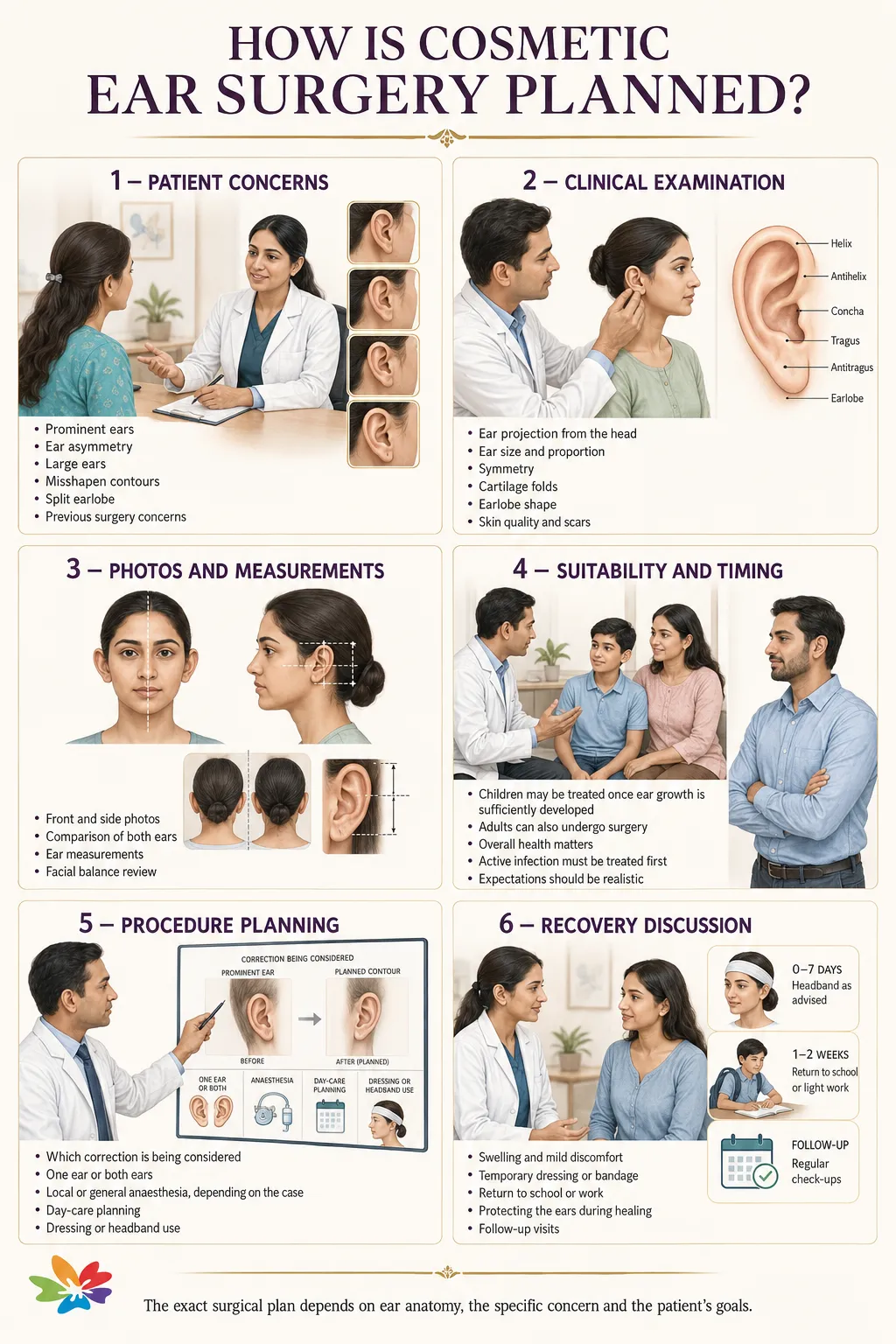
You describe what bothers you, when it was first noticed, whether it affects one or both ears, previous surgery or injury, piercing history and any hearing or infection symptoms.
Projection, fold definition, conchal depth, upper and lower poles, lobe position, skin, scars and natural asymmetry are documented from several views.
The plan may involve sutures, cartilage reshaping, limited reduction, earlobe repair, revision or a staged reconstructive pathway. One ear may need a different technique from the other.
Investigations, anaesthesia review, medicine adjustments, nicotine cessation, hair and skin preparation, transport home and first-night support are individualized.
The planned cartilage or earlobe work is performed under the selected anaesthesia. Closure aims to support the new contour without creating an unnaturally flattened or sharply folded ear.
Dressings must remain clean and dry. The ear may feel sore, tight, numb, itchy or swollen. Sleeping position and headband instructions are especially important.
Reviews assess healing, suture or dressing needs, early symmetry, scar behaviour and return to activity. The appearance continues to soften as swelling resolves.
Timelines vary by age, procedure, anaesthesia, healing and the surgeon’s written protocol.
Protective dressing, soreness, pressure, swelling and possible itching. Keep the head elevated and do not disturb the bandage.
Dressing or non-dissolving suture review commonly occurs in this period. Hair washing resumes only when specifically allowed.
Many patients return to school or desk work when comfortable and when the ear can be safely protected. Bruising and tenderness may remain.
Exercise increases gradually. Swimming and contact-sport timing require approval because bending or impact can damage the healing correction.
Swelling, firmness, numbness and scar colour continue to settle. The ear often feels more natural and flexible with time.
Cosmetic ear surgery is elective surgery. A balanced decision includes the possibility of an imperfect result or revision.
Early treatment matters when bleeding, pressure or infection is suspected.
This webpage is not an emergency service. Seek urgent local medical care when symptoms are severe or rapidly worsening.
A good plan seeks proportion and a believable contour, not a standardized ear. The upper, middle and lower parts should relate naturally to the scalp and face. One side may require more correction, and small differences commonly remain.
Prominent-ear correction can look changed as soon as the dressing is removed, but this is not the final result. Swelling, compression marks, firmness and asymmetry can fluctuate during early healing. Scar maturation and cartilage softening continue for months.
Exact symmetry, an invisible scar, zero recurrence and complete satisfaction cannot be guaranteed. Revision may improve a specific problem but can also introduce more scar tissue and unpredictability.
There is no single responsible fee for every ear operation because “cosmetic ear surgery” may mean a limited earlobe repair, one-sided correction, bilateral otoplasty, ear reduction, revision surgery or a more complex reconstructive plan.
Cost is influenced by the exact concern, one or both ears, age, technique, primary or revision surgery, anaesthesia, operating facility, investigations, medicines, dressings, follow-up and whether a separate ENT assessment is required.
Mayflower Clinic provides a transparent, itemised recommendation after examination. The operation should be selected because it is appropriate—not because it fits a low advertised package.
There is no procedure-matched ear-surgery review in the verified inventory used for this page. The quotations below are clearly labelled general or other-procedure feedback and are not presented as ear-surgery outcome claims.
“Good Work on Cosmatic surgery.”
Verified Google review · 5 stars“Had a great experience with Dr. Pawan Shahane. He was extremely helpful, patient, and always took the time to address my concerns. His calm and reassuring approach made the entire process much more comfortable. Truly appreciate the care and support provided throughout. Highly recommended.”
Verified Google review · 5 stars“Had a treatment for the injury and it was a great experience. It was like after removing stitches it looks as it was almost before the injury”
Verified Google review · 5 starsQuick guidance · Detailed explanations below.
Cosmetic ear surgery is an umbrella term for operations that change the visible outer ear’s shape, position, size, symmetry or earlobe contour. The exact procedure may involve prominent-ear correction, reduction, fold or contour reshaping, earlobe repair, or revision of a previous operation.
Otoplasty is the main surgical category used for reshaping or repositioning the outer ear, but the phrase cosmetic ear surgery is broader. This page covers several visible-ear concerns, while the separate otoplasty page focuses more closely on prominent-ear correction and cartilage-fold techniques.
Depending on anatomy, surgery may address ears that project prominently, appear disproportionately large, have weak or unusual folds, differ noticeably from each other, have selected contour irregularities, or have torn, stretched or enlarged earlobes. Not every concern requires the same operation.
Usually no. Cosmetic ear surgery changes the visible outer ear and is not a treatment for hearing loss, ear discharge, recurrent infection, eardrum disease or middle- and inner-ear disorders. Those symptoms may require ENT or audiology assessment.
Prominent-ear surgery is often considered after roughly five years of age, when the ear is sufficiently developed and the child can cooperate with dressings and aftercare. The child’s own understanding and wish for treatment are important; surgery should not be performed simply to satisfy another person’s preference.
The surgeon may create or strengthen a natural cartilage fold, reduce an enlarged conchal bowl, reposition the ear closer to the head, or combine these steps. Incisions are commonly placed behind the ear, although selected contour corrections may use incisions hidden in natural folds.
Yes, treatment may involve one or both ears. Even when one side is the main concern, both ears are assessed because exact symmetry is uncommon and the plan should preserve a natural relationship between the two sides.
All surgery creates scars. Many otoplasty incisions are placed in the groove behind the ear or within natural folds, while earlobe procedures leave a scar on the lobe. Scar visibility depends on the technique, skin biology, tension, infection, smoking and aftercare, and cannot be guaranteed to be invisible.
Adults having a limited procedure may be suitable for local anaesthesia with or without sedation. Children, extensive reshaping, revision surgery or complex reconstruction may require general anaesthesia. The safest choice is made after medical and anaesthesia assessment.
A protective dressing is commonly used during early healing. Many adults plan about one to two weeks away from public-facing work, while children often return to school after the dressing is removed and the surgeon is satisfied. Exercise and contact-sport restrictions last longer, and swelling, tenderness or altered sensation may take weeks to months to settle.
The duration varies with the operation and surgeon’s protocol. A dressing may be worn initially, followed by a soft protective headband—often at night—for a number of weeks. The individual written plan should take priority over a generic online timeline.
Selected split, elongated or stretched earlobes can often be repaired by removing the damaged tract and closing the lobe in a planned shape. Re-piercing, when appropriate, is delayed until healing is mature and should not pass directly through a weak scar.
Cartilage and lobe reshaping can be long-lasting, but no result should be described as guaranteed or completely permanent. Healing biology, injury, scar behaviour, cartilage memory, ageing and future piercing can alter the result, and a small number of patients may need revision.
Risks include bleeding or haematoma, infection, cartilage inflammation, poor healing, painful or thick scars, skin-sensation change, asymmetry, contour irregularity, overcorrection, undercorrection, recurrence of prominence, suture problems, anaesthesia complications and revision surgery.
Cost depends on whether one or both ears are treated, the concern and technique, earlobe or cartilage work, primary or revision surgery, anaesthesia, operating facility, investigations, dressings, medicines and follow-up. Mayflower Clinic provides an itemised quotation after examination rather than one fixed public package.
Cosmetic surgery mainly refines the visible ear’s proportion, position or contour. Reconstructive ear surgery may address partial ear loss, significant congenital difference, tumour-related loss or trauma and can require staged cartilage, skin, flap or prosthetic planning. Complex reconstruction is assessed as a separate pathway.
References support general patient education. They do not replace an examination or define Dr. Shahane’s final technique for an individual patient.
Dr. Pawan Shahane, M.Ch. Plastic Surgery
Mayflower Clinic, Nagpur
Reviewed: 31 July 2026
The page distinguishes visible external-ear surgery from hearing and ENT disease, avoids guaranteed outcomes and provides procedure-specific risk and recovery guidance.
Bring photographs of the concern if it changes with hairstyle or angle, details of previous surgery or injury, information about hearing or infection symptoms, your medicine list and your questions about scars, headbands, work, school or sport. Dr. Pawan Shahane will explain whether the appropriate pathway is cosmetic otoplasty, earlobe surgery, revision, reconstruction or ENT referral.

Case of the Month: Grade 3 Gynecomastia…

The Science of Facial Aging: Why Wrinkles,…