
Concerns it may address
- Underprojected or recessed-looking chin
- Insufficient chin width in frontal view
- Selected chin asymmetry
- Disproportion between nose and chin in profile
- Soft lower-face transition needing modest contour support

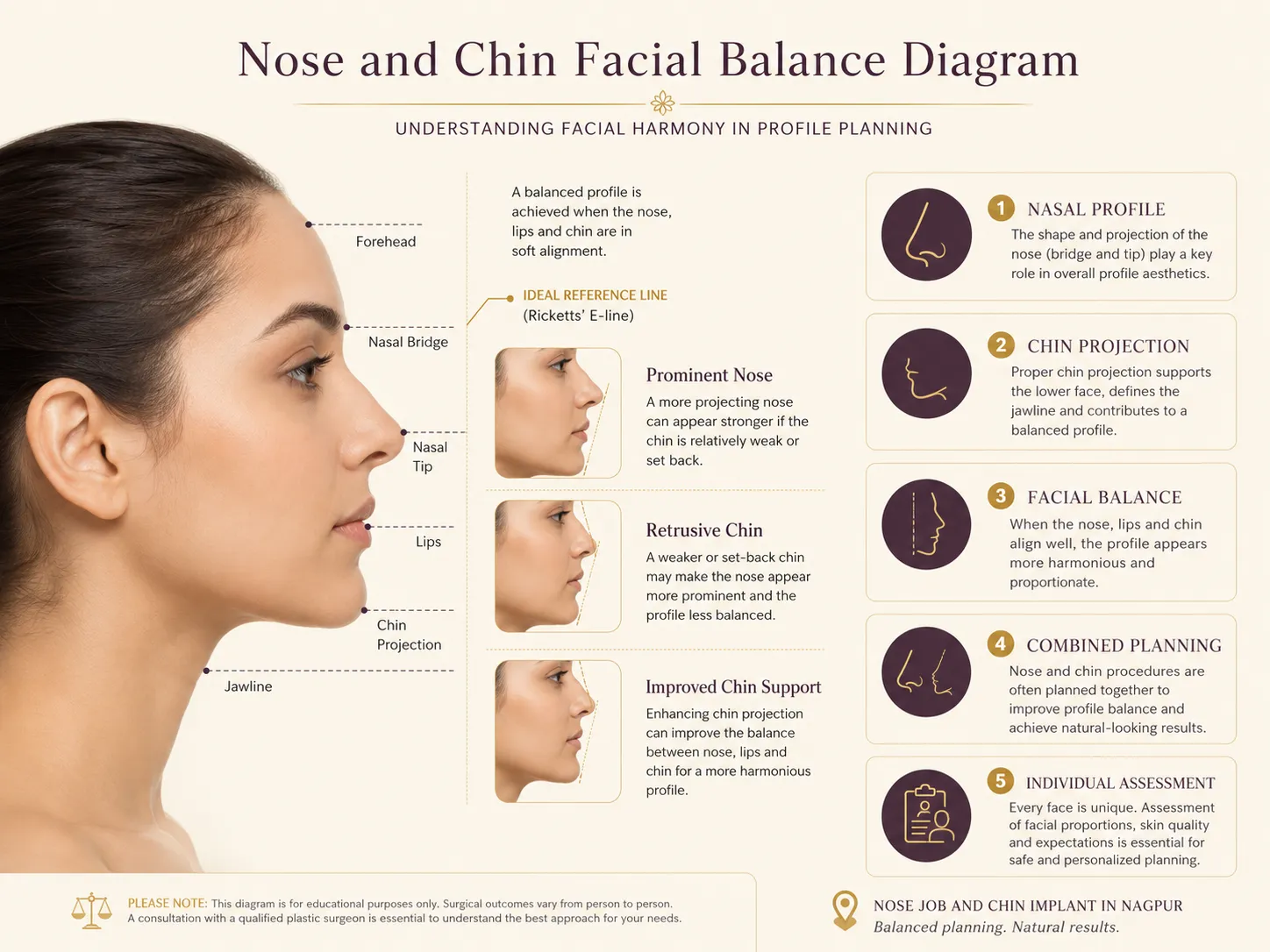
Chin augmentation should improve the relationship between the chin, lips, nose, jawline and neck—not simply add the largest possible implant. Dr. Pawan Shahane assesses projection, width, vertical height, asymmetry, soft tissue, dental bite and the wider jaw before recommending an implant, fat grafting or another pathway.

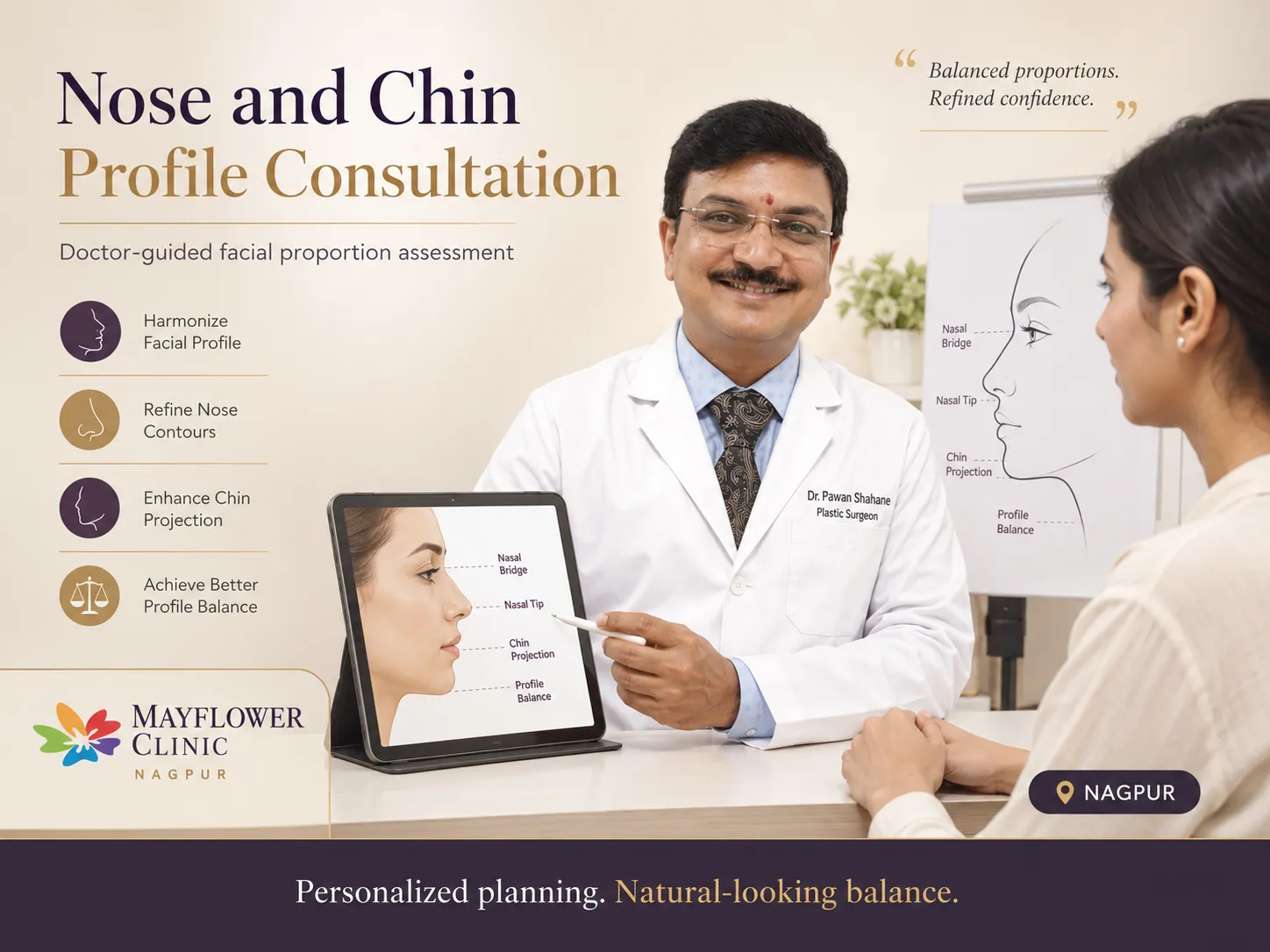
“I assess the chin from the front, side and three-quarter views, but I also check the bite and lower-jaw relationship. Adding projection without understanding width, height, asymmetry and soft-tissue response can exchange one imbalance for another.”Dr. Pawan Shahane, M.Ch. Plastic Surgery · Founder, Mayflower Clinic, Nagpur
Ask a chin-augmentation question or choose a common topic.
Start here: The safest choice depends on whether the concern is small-volume contour, predictable structural projection, chin-bone position or a broader jaw/bite problem. See what is assessed.
Chin augmentation, also called mentoplasty, is used when the front of the chin is underprojected, narrow, short or selectively asymmetric. A carefully selected change can alter how the lower face reads in profile and may improve the visual transition from the lower lip to the chin, jawline and neck.
The treatment may use an implant placed over the chin bone, a limited amount of the patient’s own fat, or a different skeletal procedure when the chin bone itself must move. These are not interchangeable solutions. Each changes projection, width, vertical height and soft-tissue support differently.
The consultation must also separate a genuinely small chin from other concerns that can create a similar appearance: a prominent nose, increased submental fat, loose neck skin, a deep labiomental fold, dental protrusion, an abnormal bite or a retruded lower jaw.
A profile photograph alone is not enough. The plan should explain what structure creates the concern and what the proposed procedure can realistically change.
How far forward the chin sits relative to the lips, nose and lower facial plane.
Whether the chin is narrow, broad, rounded, square or needs extension toward the jawline.
A short or long lower third may need a different solution from simple forward projection.
Midline position, side-to-side bone difference and soft-tissue imbalance are assessed separately.
Overbite, underbite, crossbite, dental midline and jaw position determine whether chin-only treatment is appropriate.
Skin thickness, muscle, submental fat and neck laxity influence how added structure will appear.
The forehead, nose, lips, chin and neck are considered together without assuming that every feature needs surgery.
Health conditions, smoking, medicines, dental infection, previous surgery and healing history affect timing and risk.
CT or CBCT and virtual planning may help complex asymmetry, revision, skeletal movement or customised implant cases—not every routine augmentation.
The correct question is not “Which is best?” but “Which option matches the required structural change with acceptable trade-offs?”
| Feature | Chin implant | Fat grafting | Sliding genioplasty |
|---|---|---|---|
| Main effect | Adds a shaped implant over the existing bone | Adds soft-tissue volume using the patient’s own processed fat | Repositions the patient’s own chin bone |
| Best suited to | Predictable projection and selected width/contour changes | Modest, softer contour adjustment or blending | Greater skeletal movement, vertical change or selected asymmetry |
| Predictability | Implant dimensions are known, but final appearance still depends on anatomy and healing | Less predictable because some transferred fat is reabsorbed | Planned bony movement is measurable; healing and soft tissue still vary |
| Incision | Inside the mouth or beneath the chin | Small harvest and injection sites | Usually inside the mouth |
| Important limitations | Foreign material, possible movement, edge visibility or revision | Donor area, resorption, irregularity and possible repeat session | More invasive bone surgery, fixation, numbness and longer recovery |
| Does it correct bite? | No | No | Not by itself; orthognathic surgery addresses tooth-bearing jaw position when required |
Non-surgical filler is a separate temporary alternative. It may help selected small contour changes but has its own vascular and product-related risks and is not equivalent to structural surgery. See the dermal fillers page for a separate decision pathway.
The implant’s forward dimension must suit the lips, nose, labiomental fold and lower facial height.
Shorter central implants and wider extended designs create different frontal and three-quarter contours.
Some patients need more height, less apparent height or a different skeletal operation rather than simple forward augmentation.
A pocket, implant shape or custom design may need to account for unequal bony contours; perfect symmetry cannot be promised.
Thin coverage may reveal edges or produce an over-defined result, while thicker tissue can soften the visible change.
The implant should sit directly over the intended bony position in a controlled pocket; fixation and route are decided according to the case.
A well-selected preformed implant may provide the required projection and width without custom manufacturing. The plan still depends on careful sizing and placement.
For significant asymmetry, unusual bone shape, revision surgery or broader jawline contouring, CT/CBCT-based virtual planning and a customised implant may be considered. It is not necessary for every patient and adds planning time and cost.
3d-implantsThe incision lies inside the lower lip, so there is no external skin scar. Early care may include a soft diet, mouth rinses and careful oral hygiene. The route also has specific contamination and mentalis-muscle considerations.
A small incision is placed in the crease beneath the chin. It creates an external scar but may offer direct pocket access and avoids an intraoral wound. Scar quality varies with skin, tension and healing biology.
Dr. Shahane discusses why a particular route is recommended rather than promising that one incision is universally superior.
Discuss the front, side and three-quarter views that bother you, previous treatment, medical history and realistic goals.
Compare implant, fat grafting, filler as a separate temporary option, sliding genioplasty or no surgery.
Follow instructions regarding smoking, medicines, tests, dental or skin infection, fasting, transport and home support.
The selected operation is performed under the planned anaesthesia. For an implant, position and symmetry are checked before closure. Fat grafting includes harvesting, processing and careful placement.
Expect swelling, tightness and altered sensation. Follow wound, mouth-rinse, diet, sleeping and activity instructions.
Visible swelling improves, but the implant and surrounding tissues are still healing. Exercise and pressure restrictions are lifted only as advised.
Residual swelling, firmness and sensation may continue changing. Final judgment should not be made during the early swollen phase.
Swelling and tightness may increase. Use prescribed medicines, elevation and cold applications only as directed.
Bruising and visible swelling usually begin to improve. Desk work may be possible when comfort, appearance and medication use allow.
Most social swelling settles progressively, but the chin may feel firm, numb or unfamiliar. Avoid unapproved pressure and impact.
An intraoral incision may require a soft diet and prescribed mouth rinses. Follow exact instructions rather than generic internet advice.
Fat transfer adds bruising, swelling and garment or wound care at the harvest site as well as the chin.
Contour and sensation can continue evolving for months. Fat-graft volume is assessed only after early swelling and expected resorption.
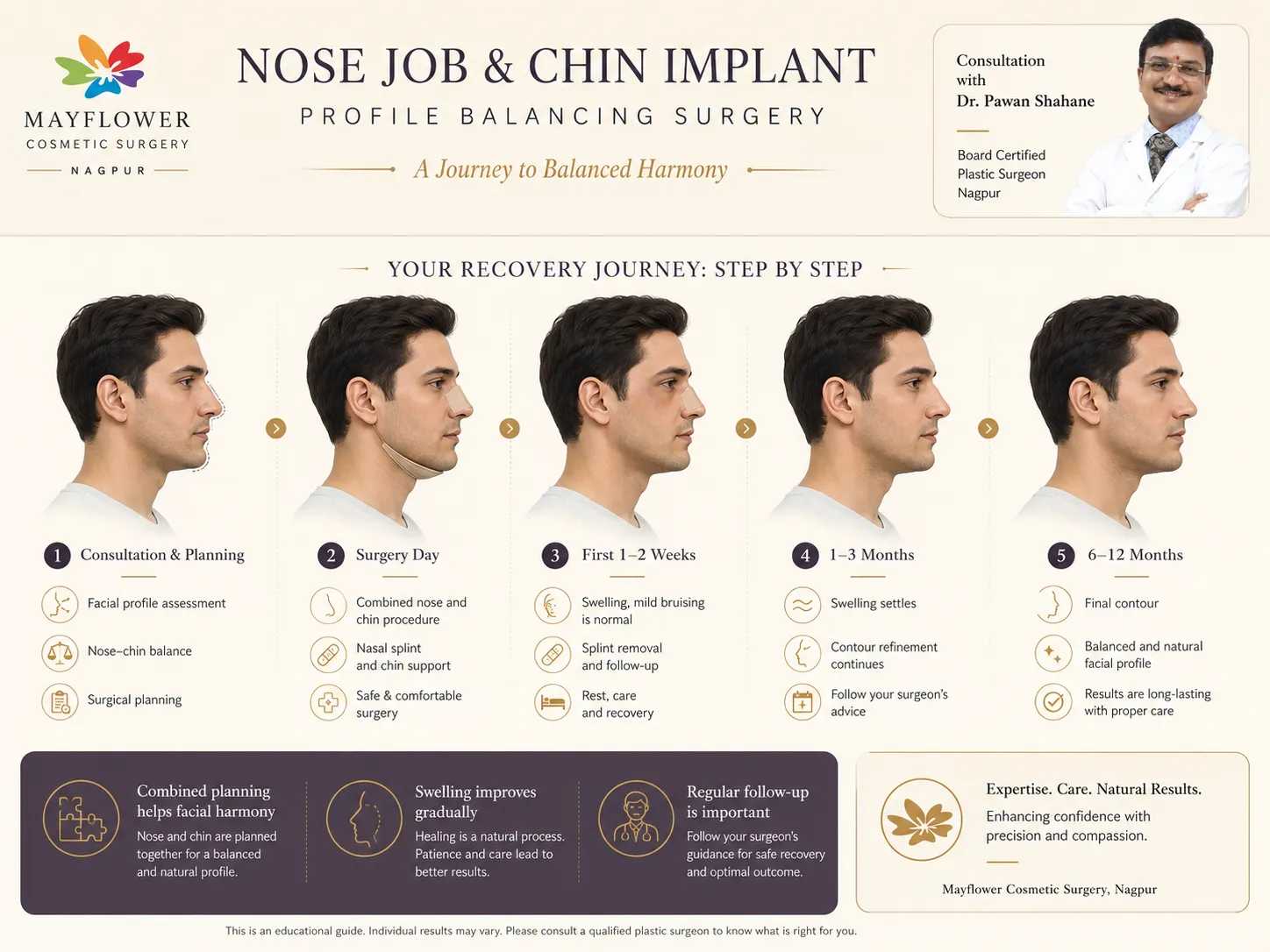
Use the advised position to help manage swelling and avoid direct pressure on the chin.
Avoid pressing, massaging or repeatedly checking the implant unless specifically instructed.
For intraoral surgery, prescribed rinses, soft food and dental hygiene are part of wound care.
Nicotine impairs blood flow and healing and can increase wound and infection problems.
Heavy lifting, bending, contact sport and impact should wait until the surgeon clears them.
Position, sensation, wound healing and early signs of infection cannot be assessed reliably through photographs alone.
Emergency symptoms require immediate emergency care; do not wait for a website or WhatsApp reply.
A low headline price is not meaningful until the surgeon determines whether the plan requires a standard implant, custom planning, fat harvest, sliding genioplasty, a combined procedure or referral for a broader jaw problem.
Implant, fat grafting, genioplasty or combined treatment have different theatre and follow-up requirements.
Standard versus customised design, imaging, virtual planning and manufacturing affect cost.
Local anaesthesia with sedation, general anaesthesia, operating facility and stay must be specified.
Tests, medicines, dressings, review visits and management of early concerns should be clarified in writing.
These clinic-wide testimonials are reproduced from the existing website export. They are not presented as chin-augmentation-specific outcome claims, and individual results vary.
“Good experience. Highly skilled surgeon. Post op care and consultation was also done nicely. Husband and wife make a good team! Thanks”Mahika GoelExisting Mayflower Clinic testimonial
“Amazing experience with Dr Pawan Shahane. I recommend him for all cosmetic surgery. He is good in knowledge… and he is very kind in nature.”Jithin RajExisting Mayflower Clinic testimonial · excerpt
“The surgery was really good and the doc is always there to help.”Dhanashree SadawartiExisting Mayflower Clinic testimonial · excerpt from another procedure
Chin augmentation may increase projection, refine width, improve selected asymmetries and change the relationship between the chin, lips, nose, jawline and neck profile. It cannot correct every cause of lower-face imbalance.
An implant is generally considered when predictable structural projection or width is required. Fat grafting may suit smaller, softer contour adjustments, but part of the transferred fat may be reabsorbed and repeat treatment can be required.
Sliding genioplasty may be considered when the patient’s own chin bone needs forward, backward, vertical or asymmetric repositioning, or when an implant alone cannot achieve the required skeletal change. It is a different operation with different recovery and risks.
No. A chin implant or fat grafting changes chin contour but does not reposition the tooth-bearing jaw or correct malocclusion. An abnormal bite or major jaw discrepancy needs separate assessment and may require orthodontic or jaw-surgery input.
Increasing deficient chin projection can reduce the apparent dominance of the nose in side view, but it does not physically alter the nose. Profile planning should identify whether the concern comes from the chin, nose or both.
No. Many patients can be treated with an appropriately selected standard implant. CT or CBCT-based virtual planning and a patient-specific implant may be considered for unusual anatomy, significant asymmetry, revision surgery or broader jawline augmentation.
A chin implant may be placed through an incision inside the mouth or a small incision beneath the chin. Each route has different scar, oral-hygiene, infection and pocket-control considerations, so the approach is selected individually.
Swelling and tightness are usually most noticeable during the first week. Many patients plan about 7 to 10 days before desk work or social activity, while residual swelling and contour refinement continue for several weeks or longer.
Risks include bleeding, infection, altered sensation, asymmetry, visible or palpable edges, implant movement or malposition, scar problems, persistent discomfort and the possible need for removal or revision.
Fat grafting gives a softer contour change and requires a donor area. Retention is less predictable than a fixed implant, some volume is absorbed, irregularity or fat necrosis can occur, and more than one session may be needed.
Yes, both areas may be planned together when each contributes to profile imbalance and the patient is medically suitable. Combined treatment is not automatically better; some patients need correction of only one feature. Read the nose job and chin implant guide.
Cost depends on the selected procedure, implant type, need for custom planning or imaging, anaesthesia, facility charges, fat-harvest requirements and follow-up. A personalised written estimate should follow examination.
Medical review date: 23 July 2026. External references are provided for general education; an in-person examination determines individual advice.
Bring your questions about projection, implant shape, fat grafting, scars, asymmetry, bite and recovery. The consultation should leave you understanding not only what can be changed, but also what should not be treated with a chin implant alone.
Surdham Complex, Dhantoli, Nagpur — 440012, Maharashtra, India
Monday–Saturday
11 AM–6 PM
Sunday closed

Case of the Month: Grade 3 Gynecomastia…

The Science of Facial Aging: Why Wrinkles,…