

0712 6692706 / 0712 3551170 / +91 8087471244   |   contact@mayflowerclinic.in

Penile Lengthening Treatment in Nagpur

Private male-intimate consultation: discreet scheduling, consent-led examination and realistic discussion without judgement.
M.Ch. Plastic Surgery · Private Consultation · Nagpur

Penile Lengthening Treatment in Nagpur

A penile-length concern can have different causes—normal anatomical variation, a buried penis, acquired shortening, congenital conditions or body-image distress. The correct first step is measurement and diagnosis, not an automatic promise of surgery.

Important: suspensory ligament release mainly aims to improve visible or hanging length in selected adults. It does not create new erectile tissue, and erect-length change is variable.
Dr. Pawan Shahane, M.Ch. Plastic Surgery
Reviewed by Dr. Pawan Shahane, M.Ch. Plastic Surgery 21+ years surgical practice · Ex-Asst. Prof. GMC Nagpur · IAAPS Member · personally performed surgery when indicated
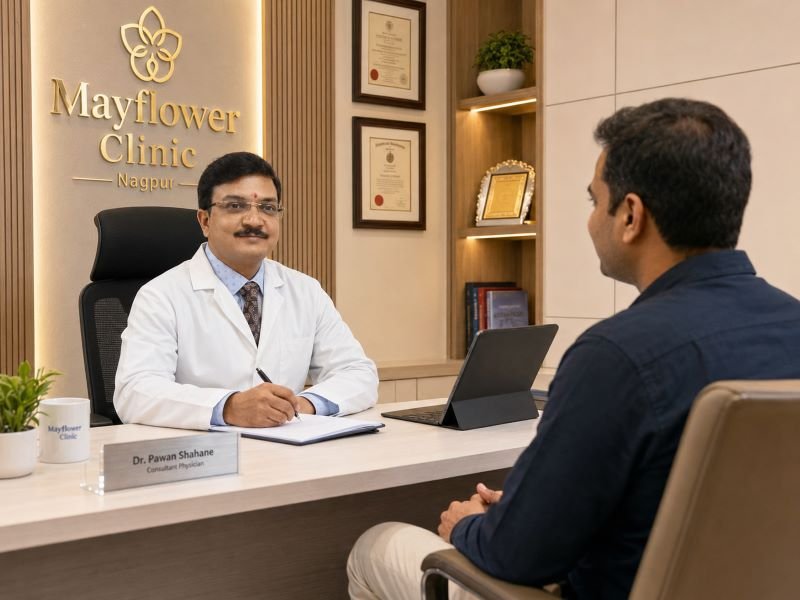
Dr. Pawan Shahane discussing a private male intimate concern with an adult patient at Mayflower Clinic Nagpur
Privacy-first assessment · no explicit photography required for an initial appointment request
21+Years surgical practice
M.Ch.Plastic Surgery qualification
PersonalDoctor-led assessment and surgery
DiscreetMale-intimate consultation pathway
Page guide

Common questions about penile lengthening

Mayflower Clinic · Nagpur
Will surgery increase erect length? Erect-length change is variable and cannot be promised. The operation is mainly considered for visible or hanging length in carefully selected adults.

The aim is not to sell a centimetre figure. It is to identify the cause, explain the limits and choose the least invasive reasonable option.

“For male intimate procedures, an honest assessment is more important than an impressive promise. Some patients need reassurance, some need treatment for a buried penis or acquired shortening, and only selected patients should consider ligament-release surgery.”
— Dr. Pawan Shahane, M.Ch. Plastic Surgery · Mayflower Clinic, Nagpur
Understanding the concern

Penile lengthening is not one single treatment

A request for penile lengthening may refer to several different situations. The penis may be within the usual anatomical range but appear shorter because of viewing angle, suprapubic fat or comparison anxiety. In other patients, part of the shaft may be genuinely concealed by a buried-penis condition, or there may be acquired shortening after Peyronie’s disease, pelvic surgery, trauma, scarring or previous procedures.

True micropenis is uncommon and has a different developmental or endocrine background. It should not be diagnosed from photographs or self-measurement. Standardised stretched penile length, the amount of visible shaft, pubic tissue, erection quality, curvature, prior operations and the effect on urination, hygiene and sexual function all matter.

Clinical distinction: visible length, stretched length and erect length are not identical measurements. A treatment that improves shaft exposure may change appearance without producing the same change during erection.

For men whose measurements are within the normal range but who experience severe distress, repeated checking or unrealistic expectations, counselling or psychological support may be more helpful—and safer—than surgery. This is part of responsible selection, not dismissal of the concern.

Why length may appear reduced

Different causes require different treatment plans

Classification prevents an unsuitable cosmetic operation from being used for a medical, reconstructive or psychological concern.

📏

Normal anatomical variation

Measurement may be within the expected range even when the patient feels dissatisfied. Education and expectation counselling may be the safest first step.

Often no surgery needed
◼️

Adult acquired buried penis

Suprapubic fat, skin changes, inflammation or scarring can conceal a normal shaft and may also affect hygiene, urination or sexual function.

Cause-specific reconstruction
↘️

Acquired shortening

Peyronie’s disease, pelvic surgery, trauma, radiation, priapism or previous penile procedures can reduce length or change shape.

Functional assessment first
🧬

Congenital shortness or micropenis

A rare developmental or endocrine condition that requires accurate measurement and, when relevant, urology or endocrinology input.

Not a routine cosmetic diagnosis
🧠

Body-image or dysmorphic distress

Persistent preoccupation can continue even after a technically successful operation. Psychological assessment may be recommended before invasive treatment.

Support may be the treatment
📐

Penoscrotal web or skin tethering

Skin configuration at the underside of the shaft can reduce visible length. Selected patients may benefit from skin-plasty rather than ligament release.

Different surgical target
Treatment ladder

Options considered before and instead of surgery

The least invasive suitable option should be discussed first. Not every option below is appropriate for every patient.

💬

Measurement, education and reassurance

Standardised examination may show that size is within the expected range. Clear information can reduce unnecessary treatment and prevent harm.

↔️

Clinician-guided penile traction

A traction device may be considered in selected adults. Benefit depends on consistent use, condition and device protocol; unsupervised forceful stretching is discouraged.

⚖️

Weight and suprapubic tissue management

When suprapubic tissue conceals the shaft, weight management, liposuction, skin surgery or a combination may improve exposure according to anatomy.

🛡️

Buried-penis reconstruction

Reconstructive treatment may release scarred tissue, remove diseased skin or excess tissue, restore shaft coverage and address hygiene or urinary problems.

✂️

Selected suspensory ligament release

In carefully assessed adults, partial release may increase the visible or hanging portion. It has limitations and risks, including a change in erection angle or stability.

🏥

Disease-specific reconstruction

Shortening caused by Peyronie’s disease, trauma or previous surgery may require specialised reconstructive methods rather than cosmetic lengthening.

Do not confuse length and girth procedures. Fillers or fat grafting primarily address circumference, not true penile length. PRP injections, botulinum toxin and penile implants are also not cosmetic lengthening treatments; they have different indications.
Selected surgery

What suspensory ligament release may—and may not—change

What it may help

  • Increase the externally visible or hanging portion in selected anatomy.
  • Improve stretched length measurements in some patients.
  • Complement treatment of suprapubic tissue when concealment is present.
  • Address a carefully defined cosmetic concern after full counselling.

What it cannot promise

  • A fixed centimetre gain or predictable erect-length increase.
  • Creation of new erectile tissue or increased glans size.
  • Improved erections, ejaculation, fertility or sexual satisfaction.
  • Freedom from scarring, reattachment, angle change or revision surgery.
Evidence limitation: available studies use different measurement methods, techniques and patient groups. Major professional guidance therefore emphasises careful selection, psychological screening when appropriate, detailed consent and treatment in experienced centres.
Consultation to follow-up

How the treatment journey is planned

1
Private consultation

Understand the concern and its impact

Discussion covers what feels short, when the concern began, sexual and urinary function, previous surgery or trauma, health conditions and the result being sought.

2
Clinical assessment

Use standardised measurement—not photographs alone

Visible and stretched length, pubic tissue, skin, scarring, curvature, erection quality and penoscrotal anatomy are examined with consent.

3
Cause classification

Separate normal variation, concealment and acquired shortening

The plan changes depending on whether the concern is cosmetic, buried penis, Peyronie’s disease, post-surgical shortening, congenital shortness or body-image distress.

4
Options discussion

Consider conservative and reconstructive alternatives

Reassurance, traction, weight management, suprapubic tissue treatment or referral to urology, endocrinology, sexual medicine or psychology may be appropriate.

5
Informed decision

Discuss likely benefit, uncertainty and risks

No operation is scheduled until the patient understands that erect-length change is unpredictable and that erection angle, scarring and satisfaction can change.

6
Procedure day

Perform only the anatomy-specific operation selected

When ligament release is appropriate, an infrapubic approach may be used. Buried-penis or suprapubic treatment requires a different or combined operative plan.

7
Healing and review

Protect the wound and monitor function

Follow-up checks healing, infection signs, scar behaviour, erection angle and satisfaction. Traction is used only when prescribed, with a device and schedule chosen by the treating clinician.

Recovery

Typical healing stages after selected surgery

These are broad planning bands, not a promise. The actual schedule depends on the operation, wound, job and healing response.

First 48–72 hours

Rest, wound care and prescribed pain control. Mild swelling, bruising or tightness can occur. Urgent contact is needed for heavy bleeding, fever, increasing redness or difficulty passing urine.

About 1–2 weeks

Wound review and gradual return to light desk activity in suitable cases. Avoid friction, heavy lifting and unapproved stretching.

About 3–6 weeks

Activity is increased gradually after review. Scar maturation continues. Traction, when advised, follows a personalised protocol rather than internet instructions.

Six weeks and beyond

Sexual activity resumes only after surgeon clearance. Final appearance and scar behaviour take longer to settle, and revision decisions should not be rushed.

Report promptly: increasing pain, spreading redness, discharge, fever, wound opening, dark skin changes, new numbness, urinary difficulty or a sudden change in erection quality.
Risks and limitations

What must be understood before deciding

🩸

General surgical risks

Bleeding, infection, wound separation, anaesthetic complications, delayed healing and visible or tender scarring.

📐

Angle or stability change

The erection may sit lower or feel less supported after ligament release because the supporting anatomy has been altered.

↩️

Reattachment or retraction

Scar formation can reduce the initial gain. Traction may be prescribed, but it cannot assure maintenance.

Sensation or discomfort

Numbness, altered sensation, pain with erection or scar sensitivity can occur and may persist in a minority of patients.

🪞

Appearance dissatisfaction

Asymmetry, scar position, skin bunching or a result smaller than expected may lead to dissatisfaction despite technically adequate surgery.

🔁

Further treatment

Persistent concealment, scar problems or functional symptoms may require prolonged follow-up or revision surgery.

Dr. Pawan Shahane with Indian Association of Aesthetic Plastic Surgeons membership recognition
Doctor-led care

Why assessment matters more than the procedure name

Penile-length concerns sit at the intersection of reconstructive anatomy, cosmetic expectations, sexual health and psychological wellbeing. A technically possible operation is not automatically the right operation.

Dr. Pawan Shahane evaluates whether the concern is visible concealment, ligament anatomy, acquired shortening, curvature, skin tethering or a normal measurement accompanied by distress. When surgery is selected, it is personally performed by Dr. Shahane, with follow-up focused on wound healing, function and realistic satisfaction.

MBBS · 2003Yavatmal
MS General Surgery · 2007Government Medical College, Nagpur
M.Ch. Plastic Surgery · 2011SSG Hospital, Baroda
Professional membershipsIMA and IAAPS
Questions patients often ask

Penile lengthening treatment FAQs

Answers are educational and cannot replace an examination.

Does penile lengthening surgery increase erect length?

Not predictably. Suspensory ligament release is mainly intended to change the visible or hanging portion of the penis and may improve stretched length in selected patients. Any change in erect length is variable, and a fixed centimetre gain cannot be promised.

What does suspensory ligament release actually change?

The operation partially releases the ligament that supports the penile root at the pubic bone. This can allow more of the existing shaft to project externally, but it does not create new erectile tissue and may alter the angle or stability of erection.

How much length can be gained?

Published studies report variable results and are generally based on small or heterogeneous patient groups. The likely change depends on the cause of the concern, measurement method, anatomy, body habitus, healing and aftercare. An individual estimate can only be discussed after examination, and no specific result can be assured.

Is penile traction an alternative to surgery?

Penile traction therapy may be considered as a conservative option in selected adults. It requires consistent use over time and should be prescribed or supervised by a clinician because device choice, duration and suitability vary.

Can weight loss or pubic fat reduction improve visible length?

Sometimes. When a normal-sized penis is partly concealed by suprapubic fat, skin or scarring, treating the underlying buried-penis problem may improve exposure. Weight management, liposuction or reconstructive surgery may be considered according to the cause; they are not interchangeable treatments.

What is an adult acquired buried penis?

It is a condition in which a penis of normal internal size becomes partly hidden by surrounding skin, fat, inflammation or scarring. It can affect hygiene, urination, sexual function and confidence, and its treatment is different from purely cosmetic lengthening.

Who should not undergo penile lengthening surgery?

Surgery may be unsuitable when expectations are unrealistic, measurements are within the normal range but distress is severe, body dysmorphic disorder is suspected, medical conditions increase operative risk, or a less invasive approach is more appropriate. Psychological or sexual-health support may be recommended before any invasive treatment.

Can the operation affect erection angle or stability?

Yes. Because the suspensory ligament contributes to support, release can produce a lower erection angle or a feeling of reduced stability. This possibility must be discussed during consent, along with the risk of scarring, reattachment, retraction and dissatisfaction.

Does penile lengthening improve erectile dysfunction or sexual performance?

No. Penile lengthening is not a treatment for erectile dysfunction, premature ejaculation, fertility problems or sexual satisfaction. These concerns require their own medical assessment and should not be used as expected outcomes of cosmetic lengthening surgery.

What are the main risks of penile lengthening surgery?

Potential risks include bleeding, infection, wound problems, visible or tender scarring, altered sensation, change in erection angle or stability, reattachment or retraction, asymmetry, dissatisfaction, anaesthetic complications and the possible need for revision surgery.

How long is recovery?

Recovery depends on the exact procedure and whether buried-penis correction, suprapubic tissue treatment or another operation is combined. Many patients need several days of rest, a few weeks of restricted exercise and a longer period before sexual activity. The final schedule is provided after examination and surgery.

Is the consultation private?

Yes. Male intimate concerns are discussed in a discreet consultation pathway with consent-led examination and limited sharing of clinical information within the care team. WhatsApp should be used only for appointment coordination and not for sending intimate photographs unless the clinic specifically requests them through an approved secure process.

Clinical references

Evidence used for patient education

The evidence base for cosmetic penile enhancement remains limited and heterogeneous. These references support the page’s emphasis on diagnosis, counselling, conservative options and careful selection.

Book a Private Penile Length Concern Consultation

Begin with measurement, diagnosis and a frank discussion of what can—and cannot—be changed. No decision for surgery is required at the first visit.

Medical Disclaimer: All surgical procedures carry inherent risks, and individual outcomes vary based on anatomy, skin type, health and healing biology. Surgical outcomes cannot be assured. Formal in-person consultation with Dr. Pawan Shahane is required before any surgical decision. This page is for general educational purposes only and does not constitute medical advice or a treatment recommendation. Do not send intimate photographs through ordinary contact forms or unsolicited WhatsApp messages.