

0712 6692706 / 0712 3551170 / +91 8087471244   |   contact@mayflowerclinic.in

M.Ch. Plastic Surgery · Nagpur

Dimple Creation Surgery in Nagpur — Planned Around Your Smile.

Dimpleplasty is a small facial procedure, but its planning is highly individual. The aim is not simply to make an indentation; it is to choose a position, depth and movement that relate naturally to your cheek anatomy and smile.

Dr. Pawan Shahane, M.Ch. Plastic Surgery
Reviewed by Dr. Pawan Shahane, M.Ch. Plastic Surgery 21+ years surgical practice · Ex-Assistant Professor · IAAPS Member · Personally performed procedure
Dr. Pawan Shahane discussing facial cosmetic surgery planning with a patient at Mayflower Clinic, Nagpur
Mayflower ClinicSurdham Complex, Dhantoli, Nagpur Mon–Sat · 11 AM–6 PM
21+Years surgical practice
M.Ch.Plastic Surgery qualification
IAAPSProfessional membership
PersonalSurgery by Dr. Shahane
Quick Answer

Common questions about dimple creation

Quick guidance · Detailed explanations below.

Consultation at Mayflower Clinic, Nagpur
Often, yes. Many dimpleplasty techniques use a small opening inside the cheek, avoiding a planned external incision. The exact method is chosen after examination, and some techniques use tiny external puncture points.
Clinical perspective

A convincing dimple is a movement, not merely a mark.

“The smile must guide the plan. I assess cheek thickness, facial proportions and natural asymmetry before deciding where the dimple may sit and how strongly it should engage.”
Dr. Pawan Shahane, M.Ch. Plastic Surgery · Founder, Mayflower Clinic, Nagpur
Procedure overview

What is dimple creation surgery?

Dimple creation surgery, also called dimpleplasty, is a cosmetic procedure intended to create a small indentation in one cheek or both cheeks. Natural dimples are related to variations in cheek anatomy and the way skin connects to deeper facial tissues. Surgery attempts to recreate part of that tethering effect.

In many techniques, the surgeon works through a small opening inside the mouth and creates a controlled connection between the inner cheek tissues and the underside of the skin. The early dimple is commonly deeper than the intended mature appearance and may show even without smiling. It may soften as swelling settles and the internal attachment matures.

The final appearance depends on anatomy, tissue thickness, the strength of the internal attachment and healing. A created dimple can become faint, disappear, remain too deep, appear asymmetric or require revision. These possibilities should be discussed before surgery.

What the procedure may address

  • A desire for a cheek dimple on one side or both sides.
  • Preference for a subtle smile-linked indentation.
  • Planning of dimple position according to facial proportions.
  • Selected revision concerns after a previous dimple procedure.

What it cannot promise

  • Perfect symmetry between two naturally different sides of the face.
  • An exact copy of another person’s natural dimple.
  • A guaranteed depth, shape or permanence.
  • A particular social, emotional or confidence outcome.
Patient education visual

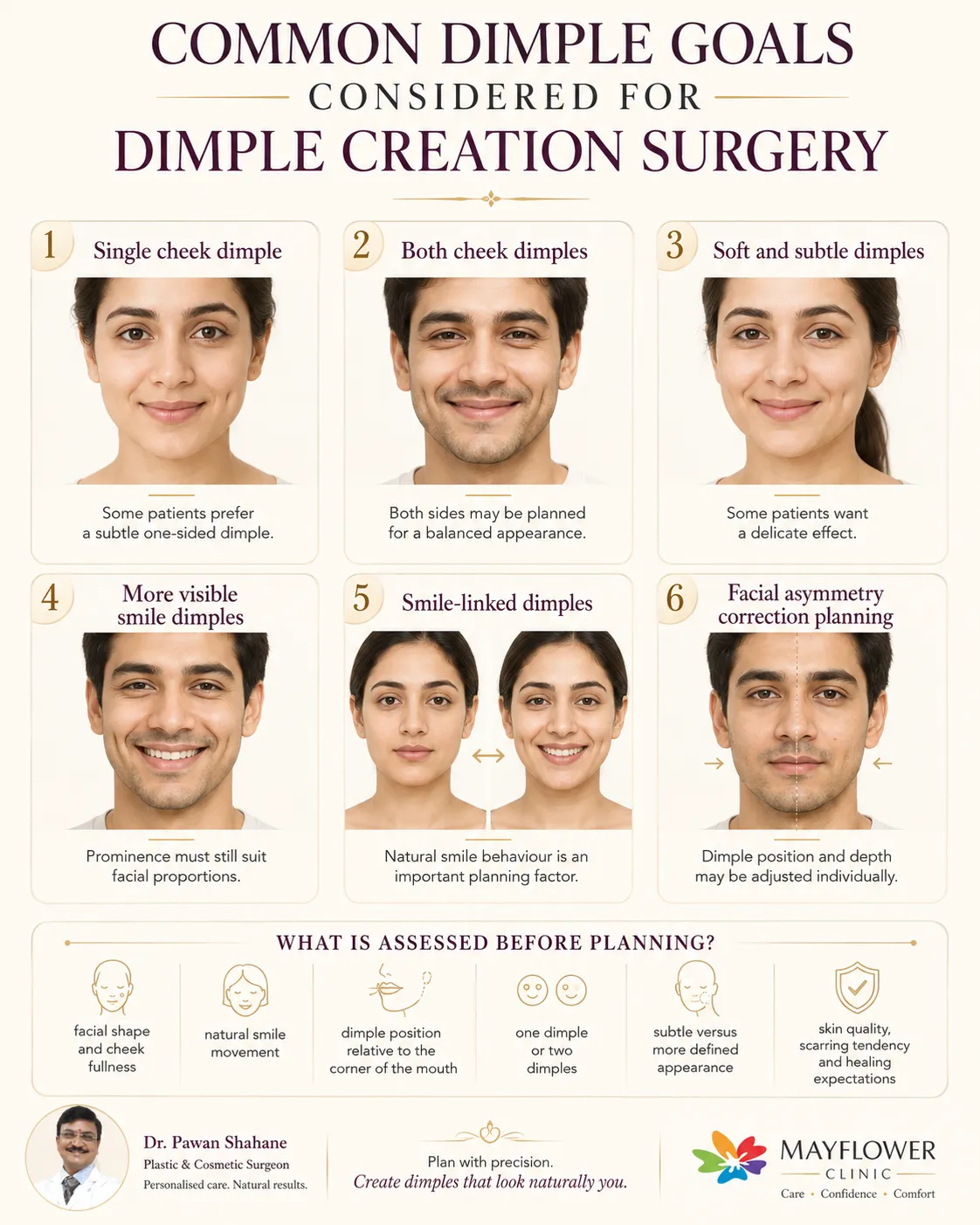
Common dimple goals and smile patterns

Patients may prefer one dimple or two, a soft smile-linked effect or a more visible indentation. These examples support consultation; they are not a menu of guaranteed outcomes.

Common dimple goals and smile patterns considered for dimple creation surgery, including one or two dimples, subtle or more visible dimples and facial asymmetry planning
Educational guide showing common preferences and the facial factors assessed before individualized dimple planning. Illustrations do not predict an individual result.
Consultation to early recovery

How is dimple creation surgery planned?

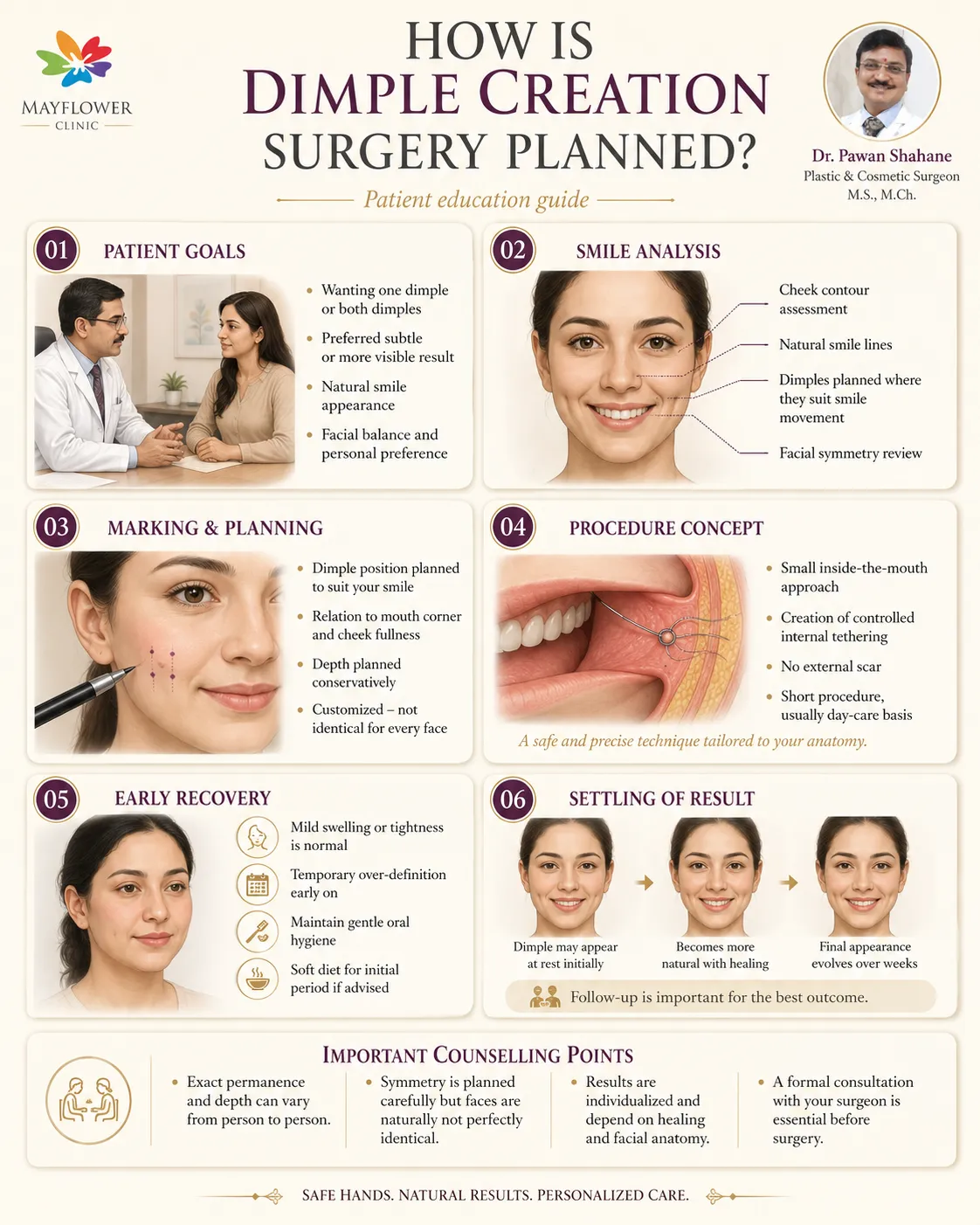
Planning begins with the patient’s goals and smile analysis, followed by conservative marking, selection of an individualized technique and clear counselling about early over-definition and gradual settling.

How dimple creation surgery is planned, showing patient goals, smile analysis, cheek marking, the inside-the-mouth procedure concept, early recovery and settling of the result
Patient-education pathway from consultation and smile assessment to procedure planning and early recovery. The exact approach, depth and healing pattern vary by anatomy.

Planning considers more than equal markings.

  • How each cheek moves during a natural smile.
  • Facial shape, cheek fullness and tissue thickness.
  • Existing right–left facial asymmetry.
  • One dimple versus bilateral dimples.
  • A subtle versus more defined intended appearance.
  • The possibility that an early dimple may be visible at rest.

Important: markings, measurements and reference photographs guide shared planning, but they cannot guarantee the final depth, symmetry or permanence of a surgically created dimple.

Individual choices

Questions decided before surgery

The consultation is used to define the intended effect and to identify anatomy or health factors that may make surgery unsuitable.

1

One dimple

A unilateral dimple may be chosen deliberately. Existing natural asymmetry is discussed so the result does not look accidental.

2

Two dimples

Bilateral dimples are planned as a pair, but perfect mirror symmetry is not realistic because both sides of the face move differently.

Position

Placement is marked using facial proportions and smile analysis. A single traditional landmark may not suit every facial form.

Depth

A stronger early indentation is common. The dimple may soften with healing, yet the degree of softening is not fully predictable.

Movement

The desired appearance is usually more dynamic during smiling, while accepting that it can remain visible at rest in some patients.

Revision planning

Previous surgery, scar tissue, weak definition, excessive depth or asymmetry require separate assessment and may limit predictability.

Suitability

Who may be considered for dimple creation?

Realistic expectations

A suitable patient understands that the final dimple can differ from reference photographs and may change during healing.

Stable facial maturity

The procedure is generally considered for adults after facial growth is substantially complete and the choice is independently made.

Reasonable health

Medical history, allergies, medicines, smoking and conditions that affect bleeding or healing are reviewed before planning.

×

Active oral problems

Dental or oral infection, ulcers or inflamed tissues may require treatment and postponement before an intraoral procedure.

!

Healing concerns

Uncontrolled medical illness, significant bleeding risk or poor wound healing may make elective surgery inappropriate or require modification.

?

Unrealistic pressure

Surgery should not proceed because of coercion, a deadline, a social trend or the expectation that one facial feature will transform life circumstances.

Patient journey

How dimple creation surgery is typically carried out

The description below is educational. The exact technique, medicines and follow-up schedule are individualized.

1
Consultation

Goals, health and smile assessment

Dr. Shahane reviews your preferred look, facial anatomy, cheek movement, medical history, medicines, oral health and whether one or two dimples are being considered.

2
Planning

Photographs and placement marking

The face is assessed at rest and during smiling. Proposed points are marked and discussed; natural asymmetry is shown rather than hidden.

3
Preparation

Local anaesthesia and sterile setup

Many procedures use local anaesthesia. The mouth and cheek are prepared, and the treatment plan is reconfirmed before starting.

4
Access

Small opening inside the cheek

In commonly used approaches, a small intraoral opening is made at the planned site. Some methods may also use tiny external punctures.

5
Creation

Controlled tissue attachment

A measured connection is formed between deeper cheek tissue and the underside of the skin. The strength of this attachment influences the early dimple.

6
Day care

Observation and home instructions

After a short observation period, most suitable patients can return home with written instructions for oral hygiene, diet, medicines and warning signs.

7
Follow-up

Healing, depth and symmetry review

Follow-up checks the inner cheek wound and the way the dimple is settling. Revision is not judged too early unless there is an urgent concern.

Recovery timeline

What may happen after dimpleplasty

Healing varies. The dimple often starts deeper than expected and may become softer over time.

First 24 hours

Swelling and tenderness

The cheek can feel sore or tight. Follow prescribed medicines, oral-rinse instructions and food guidance. Do not press or test the dimple.

Days 2–7

Early oral healing

Swelling usually begins to reduce. Soft foods may remain easier. Continue mouth care and avoid tobacco, alcohol or irritants as advised.

Weeks 1–4

Deep dimple phase

The indentation may show even at rest and can look stronger than the planned mature effect. Internal scar attachment is still developing.

Weeks 4–12+

Gradual settling

The dimple may become more smile-dependent. Some dimples weaken, disappear, remain deep or settle unevenly, which is reviewed over time.

🥣

Food

Choose soft, non-irritating foods for the period advised. Avoid chewing trauma near the inner cheek wound.

🪥

Oral hygiene

Use the prescribed mouth-care routine. Do not apply unapproved antiseptics or home remedies to the wound.

🧊

Swelling control

Use cold compresses only as instructed and never place ice directly on the skin for prolonged periods.

🚭

Avoid smoking

Smoking and nicotine can interfere with tissue healing and increase complications. Discuss cessation before surgery.

Do not manipulate

Avoid pressing, massaging, stretching or repeatedly checking the dimple unless specifically advised.

📅

Attend review

Do not skip follow-up because the outer cheek looks normal; the important healing area is internal.

Balanced decision-making

Risks, limitations and reasons revision may be needed

Possible concerns

  • Swelling, bruising, discomfort or temporary difficulty chewing.
  • Bleeding, hematoma or infection of the intraoral wound.
  • Asymmetry or difference in depth between both cheeks.
  • Overcorrection with an excessively deep or resting dimple.
  • Undercorrection, loosening or disappearance of the dimple.
  • Unfavourable scar attachment, contour irregularity or revision need.
  • Rare injury to nearby facial nerve branches, salivary duct or other structures.

A large published clinical series reported that 159 of 2,048 patients underwent reoperation; the most frequent reasons were undercorrection and disappearance. This figure is from one technique and one clinical setting, so it should not be treated as a universal personal risk percentage.

Cost factors

Dimple creation surgery cost in Nagpur

A responsible estimate is given after examining the face and clarifying whether treatment is unilateral, bilateral or a revision. Publicly quoting one number can be misleading because the plan and follow-up needs are not identical for every patient.

Your estimate may reflect

  • One-sided or two-sided dimple creation.
  • Primary surgery versus revision surgery.
  • Cheek anatomy, tissue thickness and intended depth.
  • Facility, sterile supplies, medicines and planned reviews.
  • Any additional medical assessment required for safe surgery.

Mayflower Clinic provides a transparent written estimate after consultation, including what is and is not part of the planned care.

Patient experience

Verified Google reviews about care at Mayflower Clinic

Transparency note: Mayflower Clinic does not currently have a verified dimple-creation review in the approved review inventory. The reviews below concern other surgical treatments and are shown only to describe consultation, guidance and postoperative care—not to predict dimpleplasty results.
★★★★★
“From the initial consultation to the post-operative care, Dr. Shahane demonstrated exceptional skill, professionalism, and a genuine care for my well-being.”
N
Nishant MenghareVerified Google review · rhinoplasty care
★★★★★
“Had a treatment for the injury and it was a great experience. It was like after removing stitches it looks as it was almost before the injury”
M
Maroti NawghadeVerified Google review · injury treatment
★★★★★
“Best cosmetic surgeon, I strongly recommend, him for all plastic surgery. He is very intelligent and guides you very well.”
S
Sachin BatraVerified Google review · family surgical experience
Questions patients often ask

Clear answers about dimple creation surgery

These answers support consultation; they do not replace examination or individualized medical advice.

What is dimple creation surgery?
Dimple creation surgery, or dimpleplasty, is a cosmetic procedure intended to create a cheek indentation. The aim is usually a dimple that becomes more noticeable with smiling, although the final depth and movement vary.
Is dimpleplasty performed under local anaesthesia?
Many dimple creation procedures can be performed under local anaesthesia as a day-care procedure. The anaesthesia plan is confirmed after medical assessment and discussion with the surgeon.
Can I choose one dimple or two?
One cheek or both cheeks may be considered. The choice should account for facial proportions, natural asymmetry, smile pattern and the patient’s preference.
How is the dimple position selected?
Placement is planned while assessing the face at rest and during smiling. Facial shape, cheek thickness, mouth position and existing asymmetry are considered rather than relying on one fixed landmark for every person.
Is there a scar on the outside of the cheek?
Many techniques use access from inside the mouth, so there may be no planned external incision. Technique varies, and small external puncture marks may be used in selected methods.
Will the dimple be visible when I am not smiling?
A newly created dimple can look deeper and may be visible at rest during early healing. It often softens over several weeks, but the final resting appearance cannot be guaranteed.
How long does recovery take?
Many people resume light routine within a few days, while swelling and tenderness can continue for one to two weeks. The dimple may keep changing for several weeks or months as internal tissues mature.
What should I eat after dimple creation surgery?
A soft, easy-to-chew diet may be advised for the early healing period. Follow the surgeon’s oral-hygiene instructions and avoid foods that irritate the inner cheek wound.
What are the risks of dimple creation surgery?
Possible risks include swelling, bleeding, infection, pain, asymmetry, overcorrection, undercorrection, a dimple that persists at rest, weakening or disappearance of the dimple, scarring and need for revision. Injury to nearby structures is uncommon but possible.
Can a created dimple become weak or disappear?
Yes. The attachment may loosen or the dimple may become less visible as healing progresses. Published clinical series report undercorrection and disappearance among reasons for revision.
Can dimple creation surgery be revised or reversed?
Revision may be considered for excessive depth, weak definition, asymmetry or loss of the dimple. Complete reversal is not always predictable because scar tissue and tissue attachment can persist.
How much does dimple creation surgery cost in Nagpur?
Cost depends on one-sided or two-sided treatment, anatomy, technique, facility requirements and follow-up needs. Mayflower Clinic provides an individual written estimate after consultation.
Medical references

Evidence used for patient education

  1. Lee KJ, Cutri RM. Dimple Creation Surgery. Facial Plast Surg. 2025. PMID: 40555380. PubMed record.
  2. Kim et al. Analysis of the clinical and aesthetic results of facial dimple creation surgery. Arch Craniofac Surg. 2020. PMID: 32971599. PubMed record.
  3. Alam M et al. New Landmarks for the Surgical Creation of Dimples Based on Facial Form. Plast Reconstr Surg Glob Open. 2018. PMID: 29785234. PubMed record.
  4. Kumar et al. Anatomical basis of dimple creation – A new technique: Our experience of 100 cases. Indian J Plast Surg. Full text.
Medically reviewed: 1 August 2026Educational page · Individual evaluation required
Mayflower Clinic · Dhantoli

Book your dimple creation consultation in Nagpur

Bring your questions, preferred reference images and details of any previous facial procedure. Dr. Pawan Shahane will assess your smile, explain realistic limitations and discuss whether surgery is suitable.

Medical Disclaimer: All surgical procedures carry inherent risks, and individual outcomes vary based on anatomy, tissue thickness, health and healing biology. Surgical results are not guaranteed. Formal in-person consultation with Dr. Pawan Shahane is required before any surgical decision. This page is for general educational purposes only and does not constitute medical advice or a treatment recommendation. Contact the clinic or seek urgent medical care for significant postoperative symptoms.