

0712 6692706 / 0712 3551170 / +91 8087471244   |   contact@mayflowerclinic.in

M.Ch. Plastic Surgery · Nagpur

Lip Reduction Treatment in Nagpur — Proportion Without Losing Expression.

Lip reduction is not simply about making a lip smaller. It is a carefully planned facial operation that considers upper-to-lower lip balance, tooth show, the chin and nose profile, smiling movement, comfortable mouth closure and the reason the lip is enlarged.

Dr. Pawan Shahane, M.Ch. Plastic Surgery
Reviewed by Dr. Pawan Shahane, M.Ch. Plastic Surgery 21+ years surgical practice · Ex-Asst. Prof. GMC Nagpur · IAAPS Member · 9 yrs ThreeBestRated Nagpur
Dr. Pawan Shahane discussing individualized facial surgery planning at Mayflower Clinic Nagpur
Mayflower Clinic · Dhantoli
Consultation comes before reduction. Natural lip size, swelling, fillers and facial balance require different plans.
21+Years surgical practice
M.Ch.Plastic Surgery qualification
IAAPSProfessional membership
PersonalSurgeon-led planning and surgery
Quick guidance · detailed explanations below

Common questions about lip reduction

Consultation in Nagpur
What can it change?
It may reduce selected upper-lip, lower-lip or combined fullness and improve proportion. It cannot guarantee mathematical symmetry or replace diagnosis when enlargement is caused by inflammation, allergy, filler reaction or a vascular condition.
Dr. Shahane's planning principle

The goal is not the smallest lip. It is the right lip for the face.

“A lip has to look balanced at rest, move naturally during speech and smiling, and still close comfortably. Reduction should be measured in millimetres, but planned in three dimensions.”
— Dr. Pawan Shahane, M.Ch. Plastic Surgery · Founder, Mayflower Clinic, Nagpur
Understanding the procedure

What is lip reduction surgery?

Lip reduction, also called reduction cheiloplasty, removes a carefully designed amount of soft tissue from the upper lip, lower lip or both. The incision is commonly placed on the inner surface of the lip. The design may be a simple transverse ellipse or a more tailored pattern chosen to address central, side-to-side or asymmetric fullness.

The operation is not planned from lip width alone. Dr. Shahane examines the face at rest and while smiling, the amount of red lip show, upper-to-lower lip relationship, tooth and gum display, lip competence, chin projection, nose proportion and the patient's ethnic and personal facial characteristics.

Some patients seek correction of naturally prominent lips. Others have a congenital double lip, asymmetry, persistent enlargement after trauma or treatment, or an unsatisfactory result after a previous lip procedure. These situations do not all require the same operation.

Concerns that may be assessed

  • Naturally prominent upper or lower lip
  • Upper-to-lower lip disproportion
  • Congenital or acquired double lip
  • Stable asymmetry or contour imbalance
  • Selected difficulty with comfortable lip closure
  • Persistent enlargement after prior treatment
Important distinction: lip reduction treats stable tissue excess. A lip that is newly swollen, painful, fluctuating, progressively enlarging or associated with breathing difficulty needs diagnostic assessment—not a cosmetic booking.
Common concerns · assessment comes first

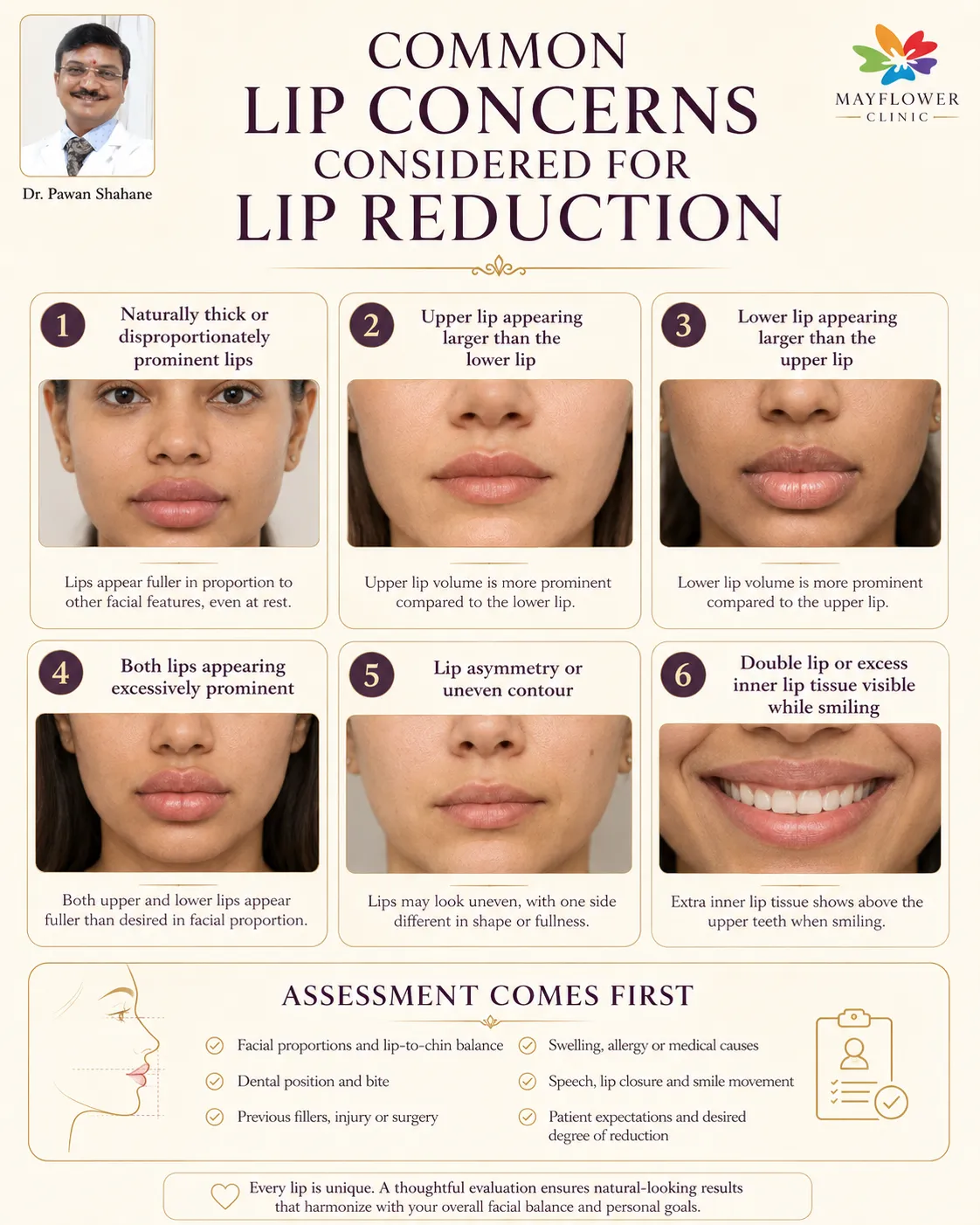
Which lip concerns may be considered for reduction?

Naturally prominent lips, upper-to-lower imbalance, asymmetry and double lip may be assessed for reduction. New, painful, fluctuating or progressive enlargement must first be evaluated for filler reaction, allergy, inflammation or another medical cause.

Common lip concerns assessed before lip reduction surgery, including prominent lips, asymmetry, double lip and imbalance between the upper and lower lips
Common patterns that may be discussed during consultation. The illustration is educational; suitability and the amount of reduction require an in-person facial and oral assessment.
Naturally full lipsStable anatomy present for years may be considered for elective reduction after facial-proportion assessment.
Previous lip fillerFiller type, timing and location matter. Reversible filler may have a non-surgical option; permanent material or fibrosis needs more complex evaluation.
Inflammatory or allergic swellingFluctuating swelling, hives, pain, tongue swelling or breathing symptoms require medical evaluation and may be urgent.
Congenital double lipA fold of redundant mucosa may become more visible during smiling and can require a design different from generalized lip reduction.
Vascular, lymphatic or granulomatous enlargementThese conditions may need imaging, specialist investigation, staged treatment or pathology rather than routine cosmetic reduction.
Facial and dental balanceLip prominence can be influenced by tooth position, bite, chin projection and the relationship between the lips and the rest of the face.
Suitability

Who may be a candidate—and who should wait?

A thoughtful consultation may conclude that surgery is suitable, that a different treatment should come first, or that no procedure is advisable.

01

Stable lip size

The size and contour should be stable rather than changing from day to day or progressively enlarging without explanation.

02

Clear, personal concern

The decision should come from the patient—not pressure from a partner, social media trend or a desire to copy another person's lips.

03

Realistic target

The goal is improved proportion, not perfect symmetry, a guaranteed celebrity shape or complete control over healing.

04

Good oral and general health

Active dental infection, mouth ulcers, uncontrolled illness or untreated swelling should be addressed before elective surgery.

05

Smoking plan

Nicotine affects blood flow and healing. A safe cessation plan before and after surgery is discussed during consultation.

06

Time for recovery

The patient should be able to follow a soft-food plan, maintain oral hygiene, attend reviews and allow swelling to settle.

Surgery is postponed or reconsidered when there is active infection, unexplained swelling, uncontrolled medical illness, unrealistic expectations, inability to follow aftercare, or concern that further reduction could impair lip closure or facial balance.
Individualized surgical design

How lip reduction is planned

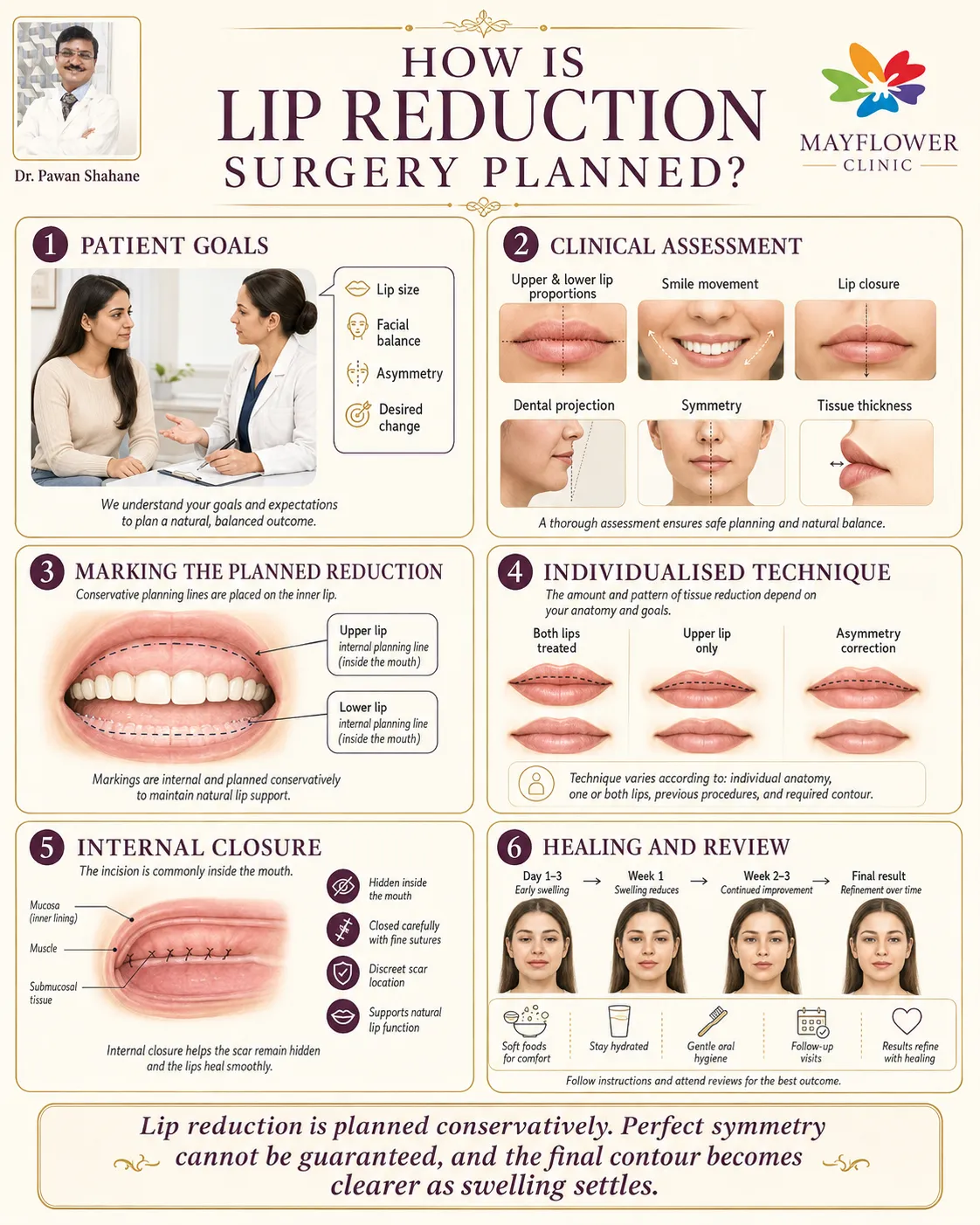
Published techniques include transverse elliptical patterns and tailored designs such as “bikini” or “crab-claw” variants. A technique name is less important than choosing a design suited to the patient's tissue distribution, smile and facial proportions.

Six-step illustration showing consultation, assessment, conservative marking, internal-incision planning, closure and recovery after lip reduction surgery
How lip reduction is planned—from patient goals and clinical assessment to conservative internal marking, closure and follow-up. The exact technique is individualized.
A

Upper lip reduction

Planning considers the Cupid's bow, central and lateral fullness, tooth show, philtral relationship and whether the upper lip can close comfortably after reduction.

B

Lower lip reduction

The lower lip is usually fuller than the upper lip. Reduction must respect that natural relationship and avoid a flattened or tight appearance.

C

Both lips

Treating both lips requires coordinated planning so the new upper-to-lower balance remains natural at rest and during expression.

D

Asymmetric reduction

Different amounts may be planned on each side, but pre-existing skeletal, dental or muscle asymmetry can limit perfect correction.

E

Double-lip correction

Redundant mucosal folds, often more visible on smiling, are mapped separately and may require preservation of important central structures.

F

Revision or filler-related cases

Scar tissue, permanent filler, nodules or previous over-reduction make planning less predictable and may require staged treatment.

Technique is chosen after examination. This page explains general principles; it does not state that every named technique is appropriate or performed in every patient.
From consultation to settled contour

Your lip reduction journey

The sequence below shows how a surgeon-led pathway protects both appearance and function.

1
Consultation

Define the concern

Discuss which lip feels disproportionate, how long it has been enlarged, previous fillers or surgery, functional symptoms, expectations and motivation.

2
Examination

Assess anatomy and cause

Dr. Shahane examines lip size at rest and on smiling, oral competence, sensation, oral mucosa, dental relationship, facial profile and signs that need diagnostic work-up.

3
Planning

Agree on a conservative target

Photographs and measurements guide a personalized design. The limitations of symmetry, scar behavior and swelling are explained before consent.

4
Procedure day

Anaesthesia and tissue reduction

After marking and anaesthesia, the planned inner-lip tissue is removed while preserving appropriate muscle and contour. Fine absorbable sutures usually close the incision.

5
First days

Protect the wound

Swelling is expected. Follow prescribed medicines, mouth-care instructions and diet advice; avoid stretching the lip, smoking and strenuous exertion.

6
Early reviews

Monitor healing and symmetry

Follow-up checks the wound, oral hygiene, swelling, movement and any warning signs. Do not judge final size during early swelling.

7
Following months

Allow tissues to soften

Firmness and minor asymmetry often improve as swelling resolves and scar tissue matures. A final assessment is made only after sufficient settling.

Recovery timeline

What recovery after lip reduction may look like

Recovery varies with one versus both lips, the amount of reduction, previous procedures, healing biology and how closely aftercare is followed.

FIRST 48 HOURS

Swelling peaks

  • Use cold therapy only as instructed
  • Keep the head elevated
  • Take prescribed medicines correctly
  • Choose cool, soft foods and adequate fluids
DAYS 3–7

Early wound care

  • Swelling and tightness remain visible
  • Maintain prescribed mouth hygiene
  • Avoid hot, spicy, acidic or sharp foods
  • Limit wide smiling and lip stretching
WEEKS 2–4

Return gradually

  • Many patients appear more social-ready
  • Speech and eating usually feel easier
  • Resume exercise only after clearance
  • Small firmness or unevenness may persist
6–12+ WEEKS

Contour refines

  • Residual swelling continues to settle
  • Internal scar tissue gradually softens
  • Final proportion is assessed later
  • Revision is never judged too early
🥣

Food

Begin with a soft, cool diet as advised. Avoid foods that irritate, contaminate or mechanically stretch the healing incision.

🪥

Oral hygiene

Follow the exact brushing and mouth-rinse instructions given. Over-aggressive cleaning can injure the wound; poor hygiene can increase infection risk.

🚭

No nicotine

Smoking, vaping and nicotine products can impair blood flow and healing. Follow the cessation period advised by the surgeon.

🛏

Elevation

Sleeping with the head elevated during the early period may help control swelling. Avoid pressure and accidental trauma to the lips.

💄

Lip products

Do not apply lipstick, unapproved balms or cosmetic products over the healing area until the surgical team says they are safe.

📅

Follow-up

Keep scheduled reviews even if healing seems straightforward. Early review helps identify wound, swelling or symmetry concerns.

Informed decision-making

Risks, limitations and warning signs

A concealed incision does not mean a risk-free operation. The lips are mobile, vascular, exposed to saliva and central to eating, speech and expression.

Bleeding or haematomaMinor oozing may occur; persistent or heavy bleeding needs urgent assessment.
InfectionIncreasing pain, pus, fever, foul taste or spreading redness should be reported.
Wound separationStretching, trauma, smoking or infection can contribute to the incision opening.
Asymmetry and contour irregularityPre-existing asymmetry, swelling and scar behavior can affect the final contour.
Under- or over-reductionConservative reduction may leave residual fullness; excessive reduction can create tightness or imbalance.
Altered sensation or firmnessNumbness, tingling, stiffness and palpable internal scar tissue may be temporary but can persist.
Functional changeTemporary speech and eating difficulty is expected; persistent lip incompetence or movement change is an important risk.
Revision surgeryFurther surgery may be needed for persistent asymmetry, scar, contour concern or an unsatisfactory result.
Contact the clinic urgently for rapidly increasing swelling, breathing or swallowing difficulty, uncontrolled bleeding, severe worsening pain, fever, pus, a dusky or pale area of lip, sudden marked asymmetry, or significant wound opening. Breathing difficulty is an emergency.
Transparent consultation

What affects lip reduction cost in Nagpur?

A public one-price figure can be misleading because an isolated lower-lip reduction is different from bilateral lip surgery, a double-lip correction or a revision case involving filler and scar tissue. The quote is provided after examination and a treatment plan.

Upper, lower or both lips
Primary or revision procedure
Complexity and asymmetry
Previous filler or scar tissue
Anaesthesia and facility needs
Tests, medicines and follow-up
Surgeon-led facial planning

Why patients consult Mayflower Clinic

The decision is based on anatomy, cause, function and proportion—not a standard amount of tissue removal.

M

M.Ch. Plastic Surgery training

Facial soft-tissue surgery is planned by Dr. Pawan Shahane, M.Ch. Plastic Surgery, with aesthetic-surgery fellowship training.

0

Zero-delegation surgery

The operative plan and procedure are personally performed by Dr. Shahane rather than transferred to an unqualified operator.

3D

Whole-face assessment

Lip size is reviewed alongside the nose, teeth, chin, smile, facial profile and the patient's natural features.

Conservative consent

Expected swelling, scar behavior, asymmetry, functional risks, limits and alternatives are discussed before a decision.

Structured follow-up

Recovery reviews monitor wound healing, mouth care, movement, symmetry and gradual contour settling.

Dhantoli location

Consultation and follow-up are available at Mayflower Clinic, Surdham Complex, Dhantoli, Nagpur.

Verified Google feedback

What facial-surgery patients say about their care

Context note: the reviews below are from verified rhinoplasty patients and describe consultation, surgery planning and follow-up. They are not presented as lip-reduction result claims.

★★★★★
“From the initial consultation to the post-operative care, Dr. Shahane demonstrated exceptional skill, professionalism, and a genuine care for my well-being.”
N
Nishant MenghareGoogle review · Rhinoplasty patient
★★★★★
“He explains everything and how to take care. He support at every stage and do the surgery as planned.”
K
Kunal ThakurGoogle review · Rhinoplasty family review
★★★★★
“When I met him, I was fully impressed.”
S
Sushil MoonGoogle review · Rhinoplasty patient
Questions patients often ask

Clear answers about lip reduction surgery

These answers are educational. Your own anatomy, health, previous treatment and goals may change the advice.

What is lip reduction surgery?
Lip reduction, also called reduction cheiloplasty, is an operation that reduces selected soft tissue from an upper lip, lower lip or both lips. The objective is a more proportionate contour while preserving movement, sensation and comfortable lip closure as far as possible.
Who may consider lip reduction?
It may be considered by a healthy adult with naturally prominent lips, disproportion between the upper and lower lips, a congenital double lip, stable enlargement after prior treatment, or selected functional concerns. Suitability requires examination and realistic expectations.
Can only the upper lip or lower lip be reduced?
Yes. One lip may be treated when the imbalance is mainly in the upper or lower lip. The untreated lip, teeth, chin, nose and facial profile are considered before deciding how much reduction is appropriate.
Where is the incision placed for lip reduction?
The incision is commonly planned on the inner surface of the lip so the scar is usually concealed inside the mouth. Exact placement and design depend on anatomy and the amount and distribution of tissue being reduced.
Does every large or swollen lip need cosmetic surgery?
No. New, painful, fluctuating or progressive enlargement may be caused by allergy, inflammation, infection, filler reaction, granulomatous disease, or vascular or lymphatic conditions. The cause should be evaluated before cosmetic surgery is considered.
Can lip reduction correct filler-related enlargement?
The first step is to identify the filler type, timing and tissue response. Reversible hyaluronic-acid filler may sometimes be treated without surgery, while permanent filler or scar-related enlargement may require a different plan. Surgery is not automatically the first option.
What anaesthesia is used for lip reduction?
Selected procedures may be performed under local anaesthesia, sometimes with sedation. More extensive, combined or revision surgery may require a different anaesthesia plan. The safest option is chosen after medical assessment.
How long does lip reduction surgery take?
Operating time commonly falls within about one to two hours, but it varies with whether one or both lips are treated, the technique, asymmetry, previous fillers or surgery, and whether another procedure is combined.
How much swelling is expected after lip reduction?
Noticeable swelling is expected and can temporarily make the lips look larger or uneven. It usually improves substantially over the first one to two weeks, while smaller changes in firmness and contour continue for several weeks.
When can I return to work after lip reduction?
Many patients plan approximately seven to fourteen days away from highly visible work because swelling, speech discomfort and diet restrictions vary. A quieter or remote routine may be possible earlier, while strenuous activity generally needs a longer pause.
Will lip reduction affect speaking, smiling or eating?
Temporary tightness, swelling and altered movement can affect speech, smiling and eating in the early healing period. The operation is planned to preserve oral competence and muscle function, but functional disturbance is a recognized risk and must be discussed before surgery.
Are lip reduction results permanent?
Removed tissue does not grow back in the same way, so the change is intended to be long lasting. Ageing, weight change, swelling disorders, filler use, scarring and individual healing can still alter appearance over time.
What are the main risks of lip reduction?
Risks include bleeding, infection, wound opening, delayed healing, asymmetry, under- or over-reduction, contour irregularity, altered sensation, firmness, visible or uncomfortable scarring, temporary or persistent functional change and possible revision surgery.
How is lip reduction cost decided in Nagpur?
Cost depends on whether one or both lips are treated, the complexity of the design, previous fillers or surgery, anaesthesia and facility requirements, tests, medicines and follow-up. A transparent individualized quote follows examination.

References reviewed for patient education

Technique names and general principles were checked against peer-reviewed surgical literature. These references do not prescribe an individual treatment plan.

  1. Karim RB, et al. The “bikini lip reduction”: a detailed approach to hypertrophic lips.
  2. Chung S, et al. Simultaneous reduction of the upper lip using a modified bikini technique.
  3. Puri S, et al. Crab claw reduction cheiloplasty: the Indian way.
  4. Lamster IB, et al. Management of double lip.

Page updated: 1 August 2026 · Educational content for in-person consultation at Mayflower Clinic.

A measured decision starts with examination

Book your lip reduction consultation in Nagpur

Bring details of any previous fillers, lip procedures, allergies, episodes of swelling and current medicines. Dr. Pawan Shahane will assess whether reduction is suitable and explain the safest realistic options.

Medical Disclaimer: All surgical procedures carry inherent risks, and individual outcomes vary based on anatomy, skin and mucosal characteristics, previous treatments, health and healing biology. Surgical results are not guaranteed. Formal in-person consultation with Dr. Pawan Shahane is required before any surgical decision. This page is for general educational purposes only and does not constitute medical advice or a treatment recommendation. Sudden lip or tongue swelling, difficulty breathing or swallowing, or rapidly worsening symptoms require urgent medical care.

Cosmetic, plastic and hair transplant surgery led personally by Dr. Pawan Shahane, M.Ch. Plastic Surgery, with transparent, ethical consultation and structured follow-up.

Clinic

Mayflower Clinic
Surdham Complex, Dhantoli
Nagpur — 440012
Maharashtra, India

Contact & hours

0712 6692706
+91 80874 71244
contact@mayflowerclinic.in
Monday–Saturday, 11 AM–6 PM
Sunday closed

Educational webpage for Lip Reduction Treatment in Nagpur · WordPress Page ID 348 · Canonical URL: /lip-reduction/