
Target reduction
How much weight and volume can be removed while preserving circulation and a viable breast shape.

For disproportionately heavy breasts, the decision is not only about appearance. It may involve neck or back discomfort, shoulder-grooving, under-breast irritation, difficulty exercising, clothing limitations and the daily strain of breast weight. Reduction planning must balance symptom goals with tissue safety, scars, nipple position, sensation, breastfeeding considerations and realistic long-term shape.


Ask a general question about this page. Answers stay in your browser and link to the relevant section.
Start with a suggested question or type a general breast-reduction question.
This local guide cannot examine you, diagnose a condition, recommend surgery, calculate candidacy or replace an in-person consultation.
A sound plan reduces weight and excess skin while protecting blood supply, repositioning the nipple–areola complex, accounting for asymmetry and creating a shape that the remaining tissues can reasonably support. The safest achievable reduction may not be the smallest imaginable size.
Mayflower Clinic · Surgeon-led breast reduction planningBreast reduction, or reduction mammaplasty, removes a planned amount of breast tissue, fat and skin. The remaining tissue is reshaped, and the nipple–areola complex is usually moved to a higher position. The operation therefore combines volume reduction with reshaping and lifting.
The functional aim may be to reduce the burden created by heavy breasts. The shape aim is to create a smaller breast that remains proportionate to the chest and body. These aims overlap, but they are not identical: the maximum possible tissue removal is not always the safest or most supportable option.
Symptoms should still be assessed thoughtfully. Back, neck or shoulder discomfort can have more than one cause, and surgery cannot guarantee that every symptom will disappear. Consultation considers breast weight alongside posture, skin irritation, bra-strap pressure, activity limitation, weight stability and other health factors.
The consultation should document how breast size affects comfort, skin, movement, clothing and everyday function—not only how the breasts look.

Educational infographic: symptoms may improve after reduction, but individual relief varies and other causes of pain may require assessment.
A safe plan is not based on cup size alone. It considers the breast footprint, tissue composition, skin envelope, nipple movement, body proportions and asymmetry.
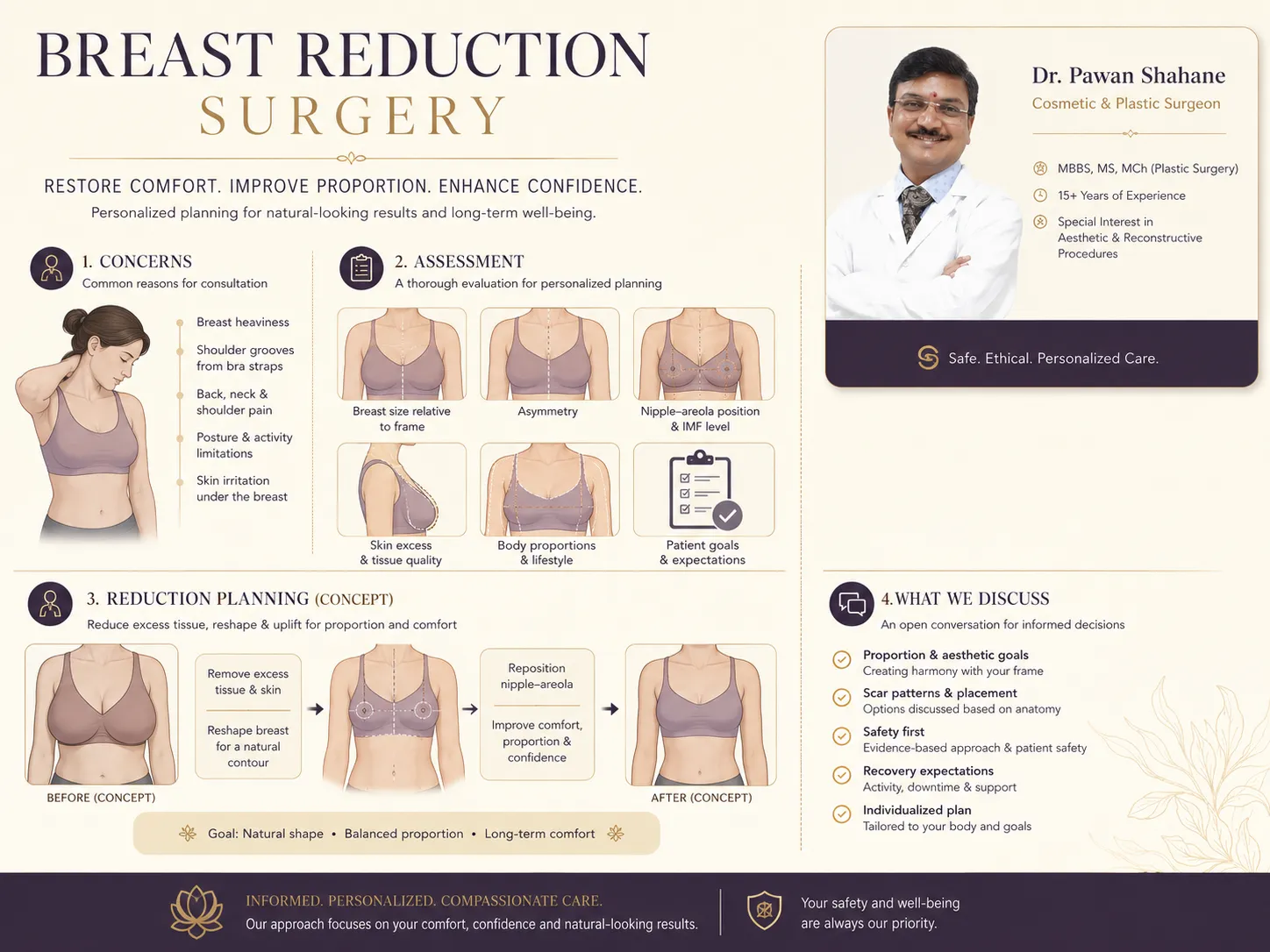
Concept illustration only. Actual markings and tissue-removal patterns are individualized.
How much weight and volume can be removed while preserving circulation and a viable breast shape.
How much stretched skin must be reduced so the remaining tissue can be reshaped.
How far the nipple needs to move and how it can remain safely attached to blood supply.
The tissue connection carrying blood vessels, nerves and ducts to the nipple–areola complex.
Vertical or anchor pattern selected according to skin excess, volume and reshaping needs.
Different tissue removal or nipple movement may be planned on each side, without promising identical breasts.
All breast reductions leave permanent scars. They usually soften and fade with time, but scar quality varies by skin biology, tension, healing, smoking or nicotine exposure and aftercare.
| Pattern | Typical scar location | Where it may be considered | Important limitation |
|---|---|---|---|
| Periareolar + vertical | Around the areola and vertically to the breast crease. | Selected moderate reductions where skin excess can be managed without a long crease scar. | Not suitable for every large or markedly drooping breast; lower-pole settling and skin pleating may take time. |
| Anchor / inverted-T | Around the areola, vertically downward and horizontally within the breast crease. | Larger reductions or greater skin-envelope reduction. | Longer total scar length; the T-junction may be more prone to delayed healing. |
| Free nipple graft — uncommon | Usually associated with an anchor-type reduction. | Selected very large reductions where keeping the nipple attached may create excessive blood-supply risk. | Nipple sensation and breastfeeding potential are generally lost; colour or projection may change. |
The surgeon selects the pattern that fits anatomy and safety; the shortest scar is not automatically the most appropriate operation.
Most breasts differ naturally in volume, base width, fold height, nipple position and chest-wall support. Reduction planning can use different markings or tissue-removal amounts on the two sides, but surgery cannot make the underlying rib cage or breast footprint identical.
As swelling settles, small differences may become more or less visible. Scar length and nipple position may also differ because the starting anatomy differs. The goal is a meaningful improvement in balance, not mirror-image breasts.
One breast may require more tissue removal than the other.
Each nipple may need a different movement distance.
The fixed breast base and chest wall continue to influence shape.
Skin quality and stretch may differ on each side.
Scar length or position may not be perfectly identical.
The two breasts can swell and settle at different rates.
These are not minor consent details. The nipple–areola complex is moved, breast tissue is removed and ducts or nerves may be affected.
Temporary numbness or sensitivity is common during healing. A permanent decrease, increase or altered sensation is possible.
Some people can breastfeed after reduction, while others have partial or no milk production. The chance depends on technique and individual anatomy and cannot be guaranteed.
Pregnancy, breastfeeding, weight change, ageing and gravity can alter breast volume and shape after surgery.
Reduction planning does not replace breast-health evaluation. New or unexplained breast symptoms should be assessed before an elective operation is scheduled.
Consultation includes previous breast problems or surgery, lumps, nipple discharge, skin change, focal pain, family history and any earlier imaging or biopsy reports.
The breasts, skin, nipples, asymmetry and relevant lymph-node areas are examined as clinically appropriate before surgical planning is finalized.
Age-, symptom- and risk-appropriate ultrasound, mammography or other imaging may be advised according to clinical findings and the treating team's judgment.
Bring previous mammograms, sonography reports, biopsy results, operation notes and a complete medicine list, including hormonal treatment and supplements.
Blood tests, anaesthesia assessment and optimization of diabetes, anaemia, blood pressure or other health concerns may be required before surgery.
Smoking, vaping and all nicotine exposure must be disclosed because nicotine can reduce tissue blood flow and increase wound-healing risk.
The operation is one part of the pathway. Good planning includes health assessment, consent, recovery support and realistic follow-up.
Discuss heaviness, discomfort, rashes, bra grooves, activity limits, desired size range, pregnancy plans, breastfeeding priorities and concerns about scars or sensation.
Breast volume, skin excess, nipple position, breast footprint, fold level and side-to-side differences are assessed. Medical history, medicines, nicotine exposure and breast-health screening needs are reviewed.
The surgeon explains the likely tissue removal, nipple movement, pedicle and scar pattern, along with what cannot be guaranteed—including exact cup size and perfect symmetry.
Markings are made before anaesthesia. Tissue and skin are reduced, the remaining breast is reshaped and the nipple–areola complex is repositioned according to the planned technique.
Soreness, swelling, bruising and tightness are expected. A support garment, medicine, wound instructions and follow-up schedule are provided. Short walks are encouraged as advised.
Desk work may be possible in about 1–2 weeks for many people. Driving, lifting, upper-body exercise and strenuous activity resume only when healing and the surgeon’s advice allow.
The breasts soften, swelling reduces and the lower pole settles. Scars commonly remain pink or firm early and continue maturing for a year or longer.
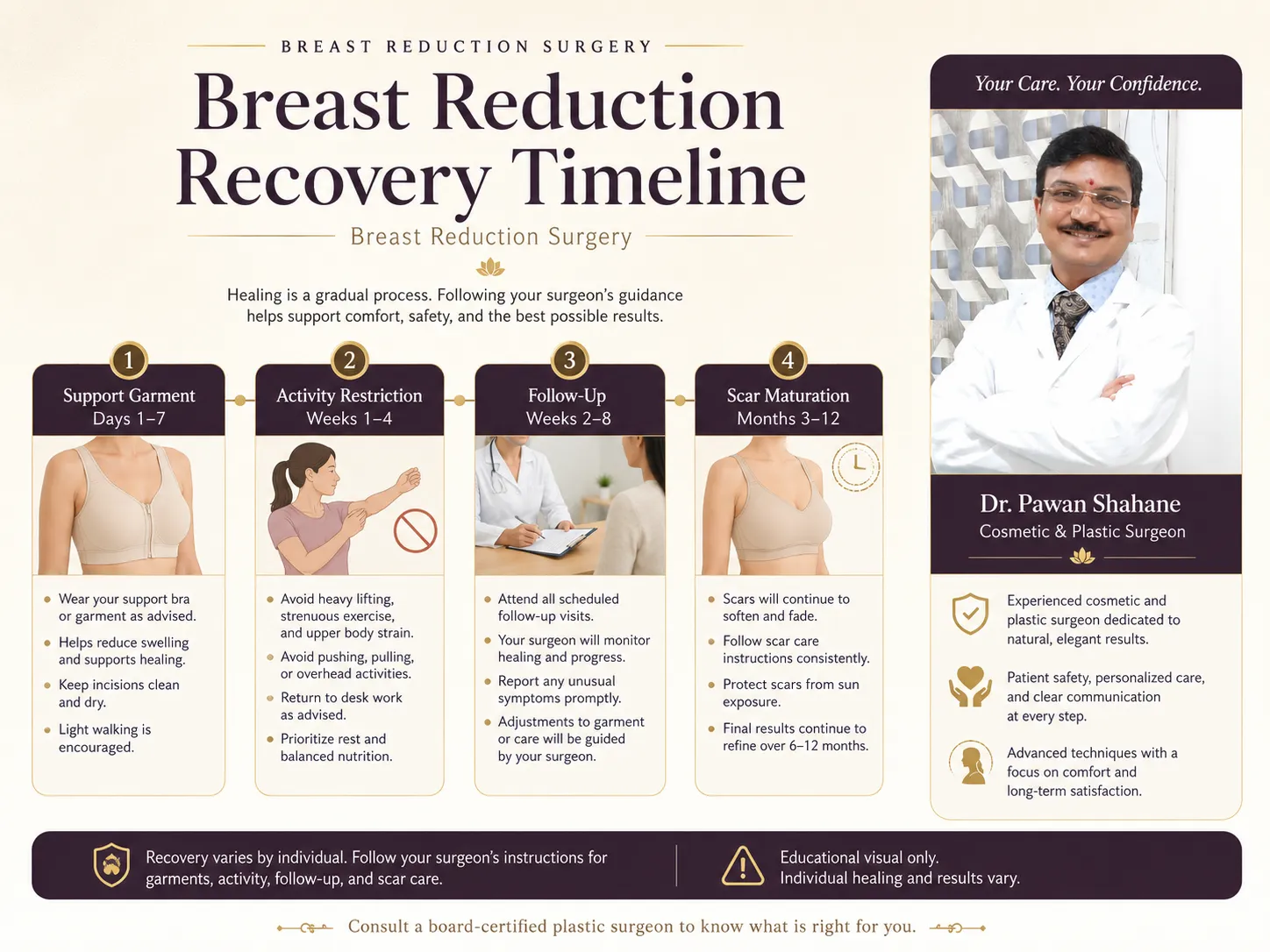
Recovery illustration: exact milestones vary; follow the instructions given for your operation.
Increasing one-sided swelling, severe or worsening pain, heavy bleeding, fever, spreading redness, foul discharge, shortness of breath, calf pain, sudden colour change of breast skin or nipple, or any unexpected symptom that concerns you.
A meaningful reduction is the central outcome, although the exact final bra size cannot be guaranteed.
The remaining tissue is reshaped and the nipple usually repositioned to create a smaller, lifted breast.
Many patients seek relief from heaviness, bra-grooving, skin friction and activity difficulty, but symptom relief varies.
Scars usually fade and are planned within bra-covered areas where possible, but they do not disappear.
Pre-existing chest-wall and breast-footprint differences continue to influence size, shape, scars and nipple position.
Ageing, gravity, pregnancy, hormones and weight change can alter the breast after surgery.
Risk is influenced by health, body mass index, diabetes, anaemia, nicotine exposure, breast size, extent of reduction, previous surgery and individual healing. Smoking, vaping and nicotine products can impair blood flow and wound healing and must be discussed honestly.
For skin laxity and low nipple position when major volume reduction is not the main goal.
Compare with mastopexy →Professionally fitted bras, skin care, activity modification, physiotherapy or weight management may help selected symptoms but cannot remove breast tissue or excess skin.
Liposuction alone has a limited role in carefully selected breasts with fatty tissue and good skin; it does not reposition a low nipple or remove major skin excess.
New lumps, discharge, skin change or focal pain require breast-health assessment rather than cosmetic treatment planning alone.
A safe quotation cannot be based on a photograph, cup size or online message alone. It follows examination, medical review and an individualized operative plan.
The amount of tissue and skin to be removed, nipple movement and degree of breast asymmetry influence surgical complexity.
The selected pedicle, vertical or anchor pattern, tissue reshaping and additional asymmetry correction affect the operative plan.
The quotation reflects the planned anaesthesia, operating-facility requirements, monitoring and whether day care or a short stay is appropriate.
Blood tests, anaesthesia review and age-, symptom- or risk-appropriate breast imaging may be required before surgery.
Dressings, support garment guidance, prescribed medicines, wound reviews and planned postoperative follow-up form part of the care pathway.
Diabetes, anaemia, previous surgery, wound-healing risk or other health factors may require additional preparation or monitoring.
The following review is reproduced from google review . Individual experiences, recovery and surgical outcomes vary.
“My overall experience with Dr. Pawan Sahane was excellent. From the initial consultation through surgery, recovery, and post-operative follow-ups, the care I received was outstanding.
Dr. Sahane was approachable and always available on phone to address any concerns, which made the entire process reassuring. The surgery itself went very well, and the recovery was as smooth as I could have hoped for.
I am extremely satisfied with the results and grateful for the professionalism and support provided throughout. I would highly recommend Dr. Pawan Sahane to anyone considering breast reduction surgery.”
An in-person consultation can assess breast volume, skin, nipple position, asymmetry, health factors and realistic reduction options. No surgical decision should be made from an online page alone.

Case of the Month: Grade 3 Gynecomastia…

The Science of Facial Aging: Why Wrinkles,…