
Is every full upper arm caused by fat?
No. Loose skin, triceps shape, shoulder anatomy and tissue distribution can create fullness that liposuction cannot completely change.
Upper-arm fullness may come from localized fat, loose skin, muscle shape, natural shoulder-to-arm proportions—or a combination. The right treatment begins by identifying what can actually change and what should be preserved.

Quick guidance first, with detailed explanations and medical limitations below.
No. Loose skin, triceps shape, shoulder anatomy and tissue distribution can create fullness that liposuction cannot completely change.
It may suit selected, pinchable fat when weight is reasonably stable and skin elasticity is adequate enough to redrape after treatment.
When loose or stretched skin is the main concern, removing fat alone may leave laxity. Brachioplasty trades excess skin for a longer scar.
No. They may offer a smaller change in selected deposits and may require more than one session. Device-specific suitability and risks still matter.
No body is perfectly symmetrical. Planning aims for balanced improvement while respecting natural differences in fat, muscle and skeletal shape.
Early change can be hidden by swelling. Contour, firmness and symmetry usually settle progressively over weeks and months.
Type a question about suitability, loose skin, recovery, risks or cost factors.
Select a question or type your own. This tool provides page navigation, not diagnosis.
“The shoulder, armpit, upper arm and elbow transition must be assessed together. The aim is a proportional contour that still looks like the patient’s own arm—not an unnaturally thin or hollowed result.”Dr. Pawan Shahane, M.Ch. Plastic Surgery · Founder, Mayflower Clinic, Nagpur
Arm fat removal is an umbrella term rather than a single treatment. In suitable patients, upper-arm liposuction removes selected subcutaneous fat through small access points. It can improve the inner arm, posterior arm or shoulder-to-arm transition when those zones contain pinchable fat and the skin can adapt reasonably well.
However, liposuction cannot remove muscle, narrow the upper-arm bone, correct major skin laxity or guarantee perfectly smooth and identical arms. When excess skin is the dominant concern, an arm lift or brachioplasty may provide more meaningful tightening, but it creates a longer visible scar.
Non-surgical body-contouring devices may be discussed for selected smaller deposits. Their change is generally more limited than surgical liposuction, and risks vary by technology. Treatment should be chosen only after examining the actual tissue.
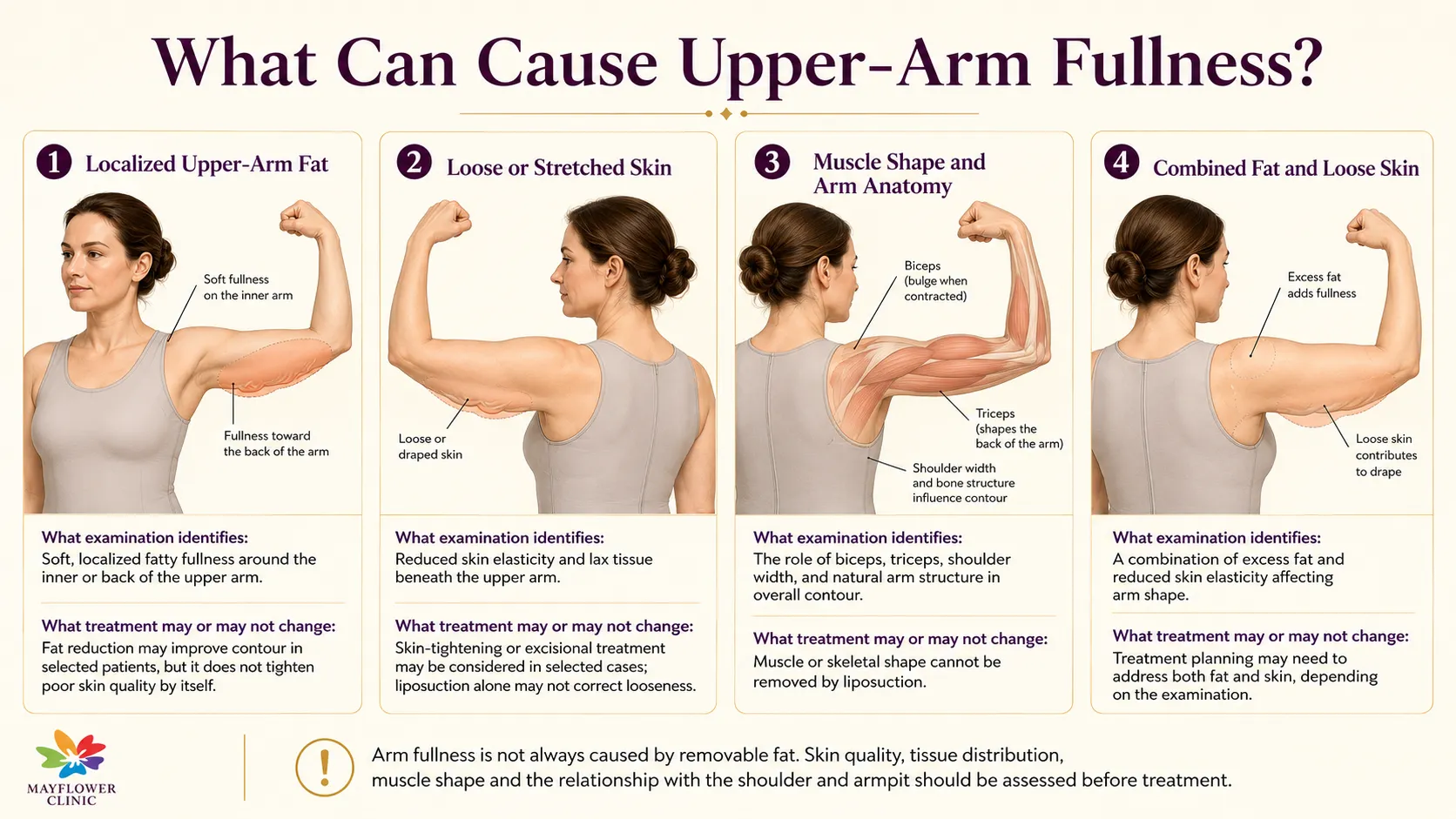
Soft, pinchable fullness around the inner or posterior upper arm may respond to controlled fat reduction.
Skin laxity can hang beneath the arm. Liposuction may expose or worsen this if elasticity is poor.
Biceps, triceps, shoulder width and bone structure influence contour and cannot be removed by liposuction.
Fat and loose skin frequently coexist, especially after weight fluctuation, ageing or major weight loss.
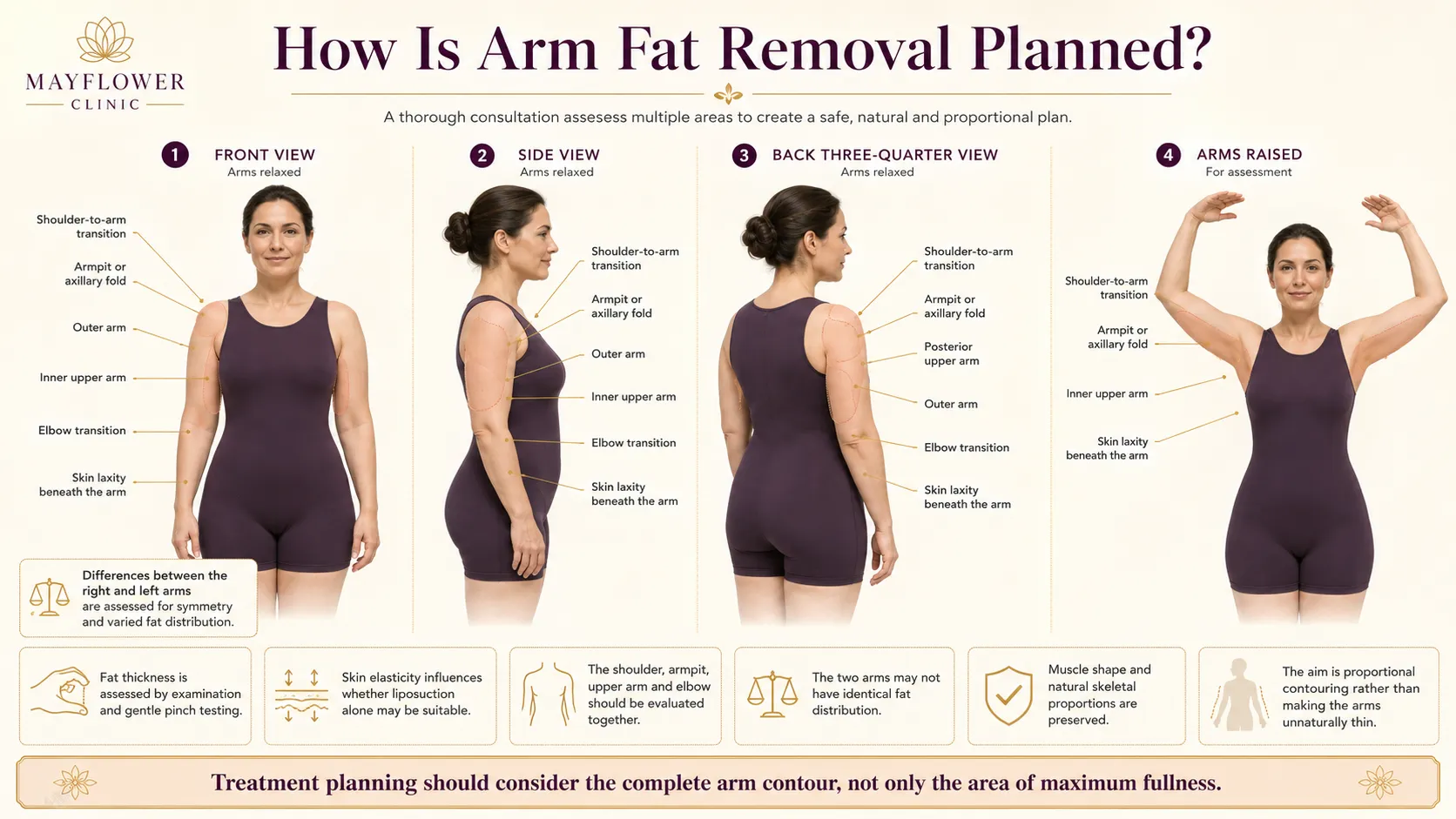
Planning includes the full arm rather than only the point of maximum fullness. Dr. Shahane examines the arms relaxed and raised, from the front, side and back, and compares both sides.
The consultation should also clarify the trade-off between a smaller change with fewer scars and a more substantial skin-tightening operation with a longer scar.
The most appropriate option depends on whether the dominant issue is fat, skin, or a combination.
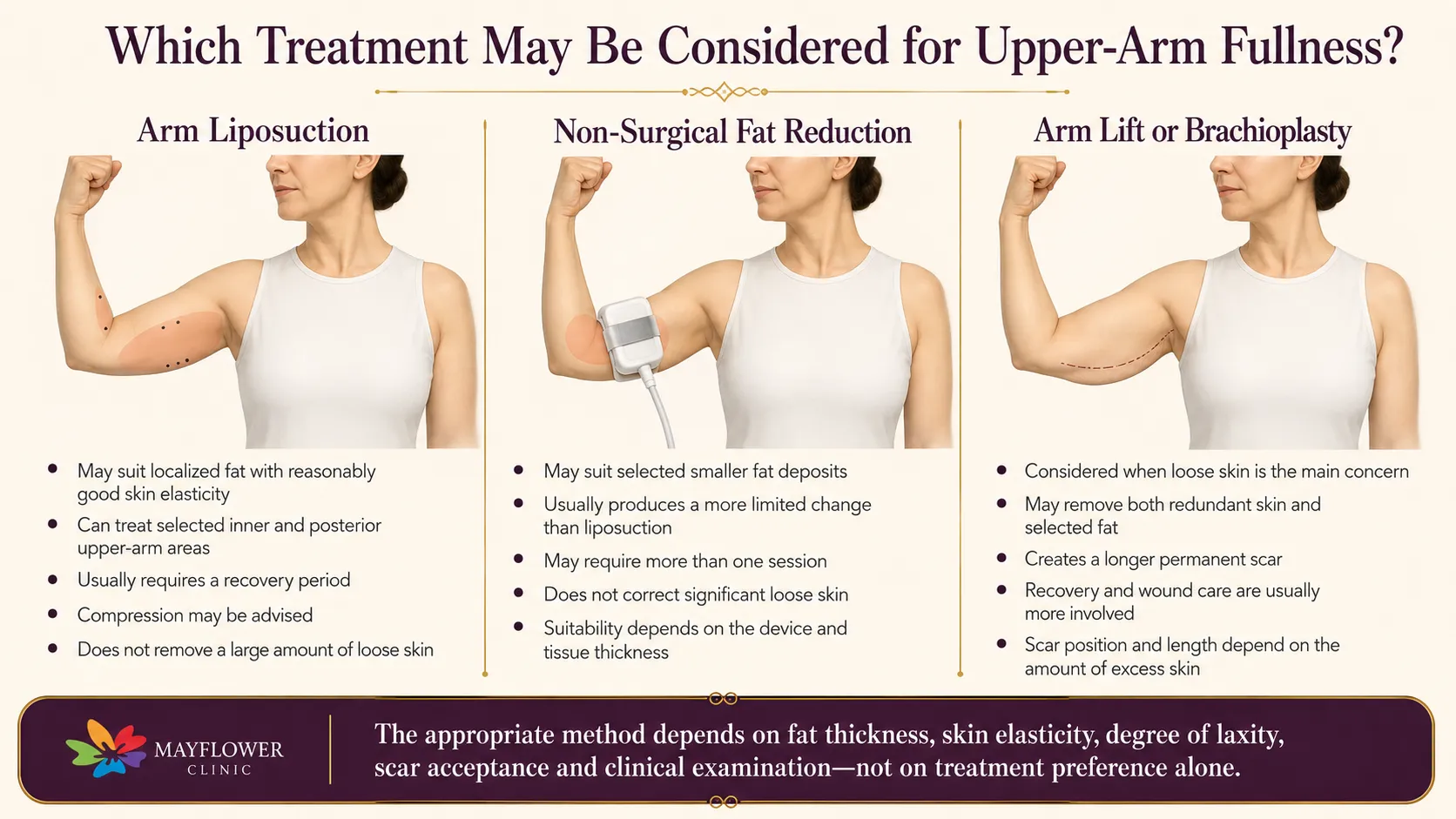
May suit localized, pinchable fat with reasonably good skin elasticity. It allows more controlled contour change than non-surgical methods, but requires recovery and carries surgical risks.
May be discussed for a smaller, well-defined deposit when a patient understands that the change is usually more limited and may require multiple sessions.
Considered when loose skin is the main limitation. Excess skin is removed through an incision planned along the inner or posterior arm, sometimes with liposuction.
Clarify whether the concern is mostly fat, skin, muscle shape or mixed anatomy. Discuss goals, scars, asymmetry, medical history and alternatives.
Mark treatment zones, document baseline asymmetry, review medicines and smoking, and arrange investigations or anaesthesia assessment when needed.
For liposuction, small access points are used to treat selected fat while preserving a smooth transition around the shoulder, armpit and elbow. Arm lift steps differ and include skin removal.
Dressings protect access points or incisions. Gentle hand, elbow and shoulder movement and short walks may be encouraged. Compression is used only as instructed.
Bruising, tightness, altered sensation and uneven swelling can occur. Desk work may resume before lifting or strenuous upper-body exercise.
Residual swelling and firmness improve gradually. Final judgement should wait until tissues have settled and, for arm lift, scars have matured.
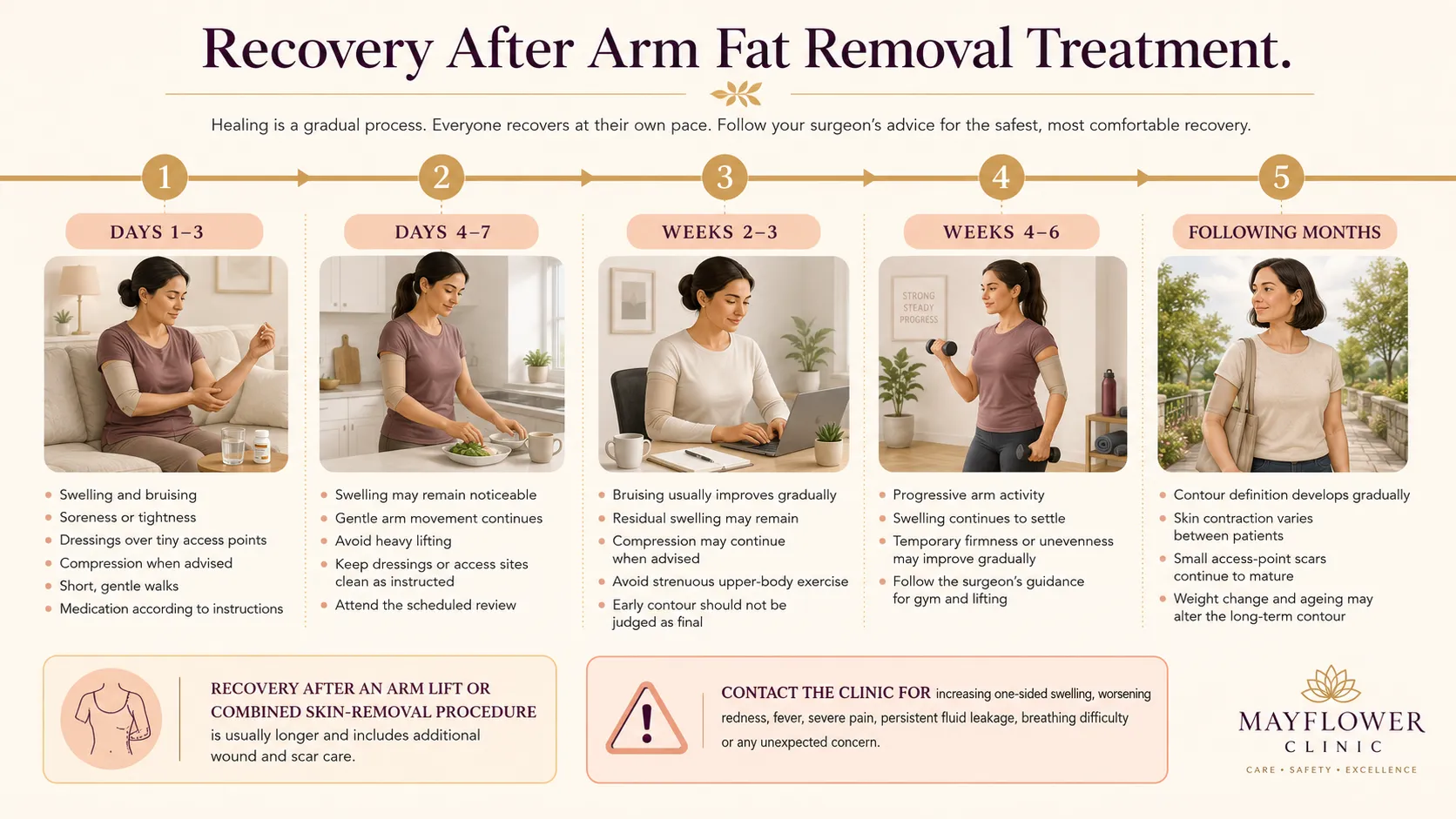
Swelling, bruising, soreness or tightness are common. Keep dressings clean, take medication as prescribed, walk gently and use compression only if advised.
Comfortable household activity usually increases. Avoid heavy lifting, vigorous reaching and strenuous exercise. Attend the scheduled review.
Many people return to desk-based work. Bruising improves, but residual swelling and temporary firmness may remain. Early contour is not final.
Activity may progress after medical review. Gym work, lifting and repetitive upper-arm exercise should follow the surgeon's specific advice.
Definition develops as swelling settles. Weight variation, ageing and skin quality continue to influence the long-term appearance.
Asymmetry, waviness, depressions, residual fullness, loose skin or a need for revision may occur.
Bruising, swelling, fluid collection, firmness, pigmentation change, delayed healing or infection are possible.
Temporary or persistent numbness, altered sensation and visible access-point or arm-lift scars may occur.
Bleeding, anaesthesia complications, damage to deeper structures and blood clots are uncommon but important risks.
These photographs show individual outcomes from real patients. They are educational examples, not a prediction or guarantee.
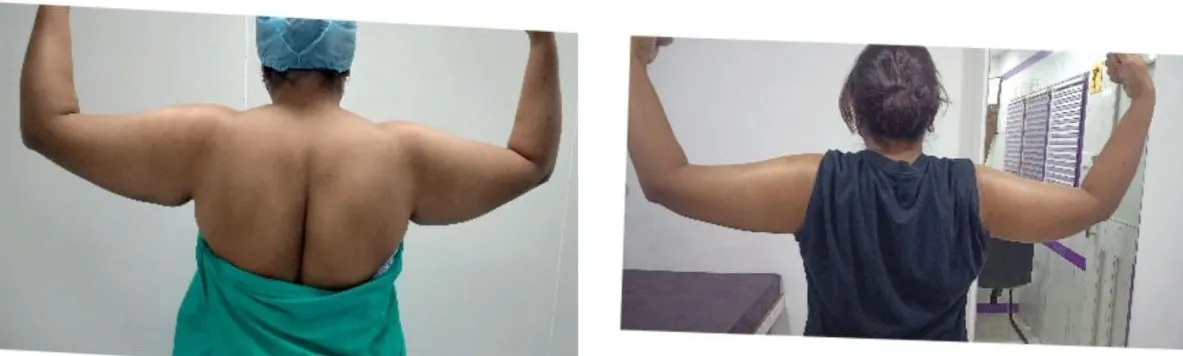
Before-and-after comparison following a personally planned arm-contouring procedure. Individual healing and contour vary.
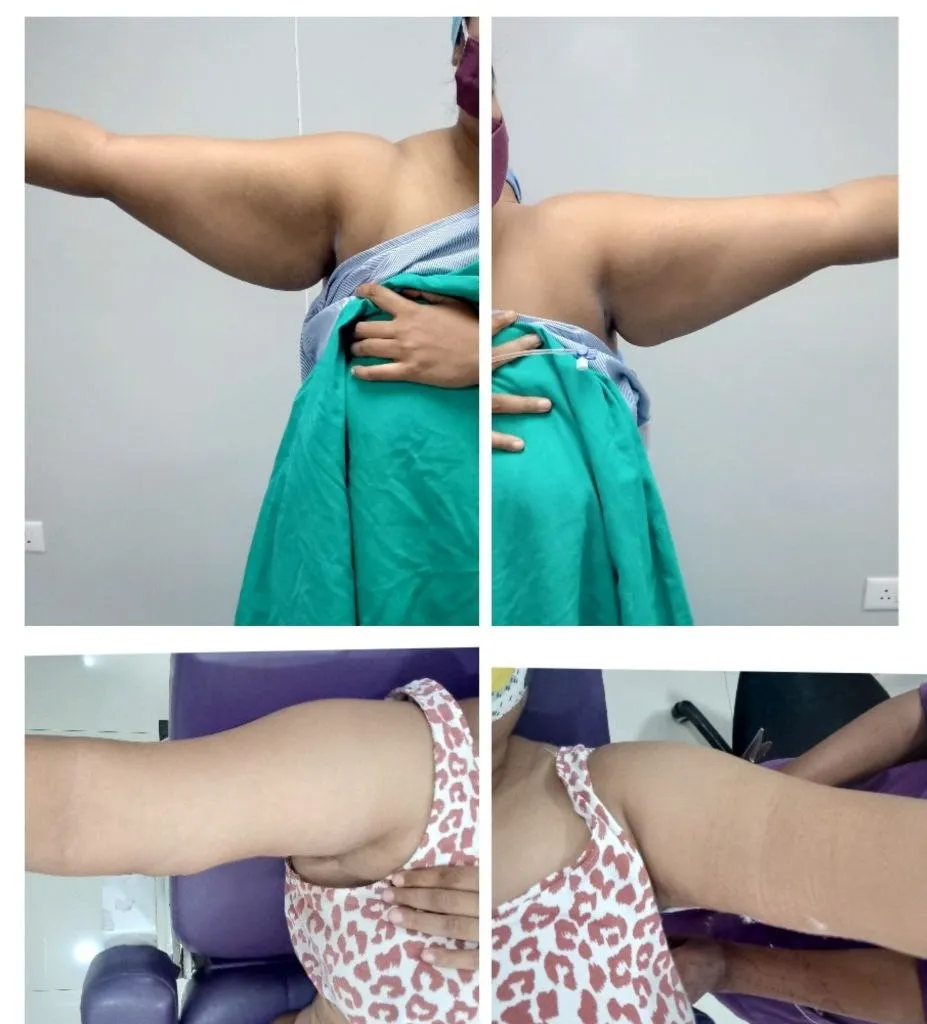
A second patient example demonstrating that treatment plans and outcomes differ according to anatomy.
A responsible estimate follows examination because “arm fat removal” may refer to very different procedures.
Inner arm, posterior arm, shoulder transition and axillary folds differ in complexity and time.
Liposuction, brachioplasty and combined treatment have different facility, anaesthesia and aftercare requirements.
The safest appropriate setting depends on procedure extent, health, associated treatment and anaesthesia plan.
Treating the armpit, chest, back or another body area changes the surgical plan and recovery.
Compression when indicated, dressings, reviews and scar care may form part of the total treatment plan.
Mayflower Clinic provides a transparent procedure-specific estimate after examination, with inclusions explained.
Arm fat removal is a body-contouring approach for selected upper-arm concerns. Depending on examination, treatment may involve liposuction for localized fat, a limited non-surgical option for a small deposit, or an arm lift when loose skin is the main issue.
A possible candidate usually has localized, pinchable upper-arm fat, reasonably stable weight, acceptable skin elasticity, realistic expectations and no uncontrolled medical condition that would make elective surgery unsafe. Suitability must be confirmed in person.
Liposuction removes selected fat but does not remove a large amount of loose skin. Some skin may contract during healing, but significant laxity may remain and may be better addressed with brachioplasty or another carefully selected plan.
Arm liposuction treats selected fat through small access points. An arm lift, or brachioplasty, removes excess skin and may also address fat, but it creates a longer scar whose position and length depend on the amount and location of loose tissue.
No. Arm contouring is intended to change proportion in a specific area; it is not a treatment for obesity and does not replace nutrition, activity or medical weight management.
Liposuction uses small access points planned around relatively concealed arm or armpit areas when possible. Brachioplasty requires a longer incision, commonly along the inner or posterior upper arm. Exact scar planning depends on anatomy.
Anaesthesia varies with the extent of treatment, associated procedures, patient health and surgeon assessment. Selected smaller procedures may use local anaesthesia with sedation, while more extensive contouring may require general anaesthesia.
Soreness, bruising, tightness and swelling are expected early. Many patients resume desk-based work in roughly five to ten days, while lifting and strenuous upper-body exercise are restricted longer. Final contour develops gradually over several months.
A medically appropriate upper-arm compression garment may be advised after liposuction. Its fit and duration should follow the surgeon's instructions because excessive tightness or incorrect use can cause problems.
Possible risks include bleeding, infection, fluid collection, asymmetry, contour irregularity, persistent swelling, numbness or altered sensation, loose skin, scarring, anaesthesia complications, blood clots and the possible need for revision.
Cost depends on the amount and distribution of tissue, whether one or more arm zones are treated, liposuction versus skin excision, anaesthesia, facility requirements, compression garments and follow-up. A transparent written estimate follows examination.
No. The photographs on this page show individual patient outcomes and do not predict another person's result. Anatomy, skin elasticity, healing, weight stability, technique and aftercare all influence the final contour.
Find out whether your concern is mainly fat, loose skin, anatomy or a combination—and understand the realistic treatment choices before deciding.
Page medically reviewed: 26 July 2026. External references support general patient education; individual care follows in-person assessment.

Case of the Month: Grade 3 Gynecomastia…

The Science of Facial Aging: Why Wrinkles,…