
Is every armpit bulge caused by fat?
No. It may be localized fat, accessory breast tissue, loose skin, a lateral chest fold, clothing compression or another lump.
See the five common possibilities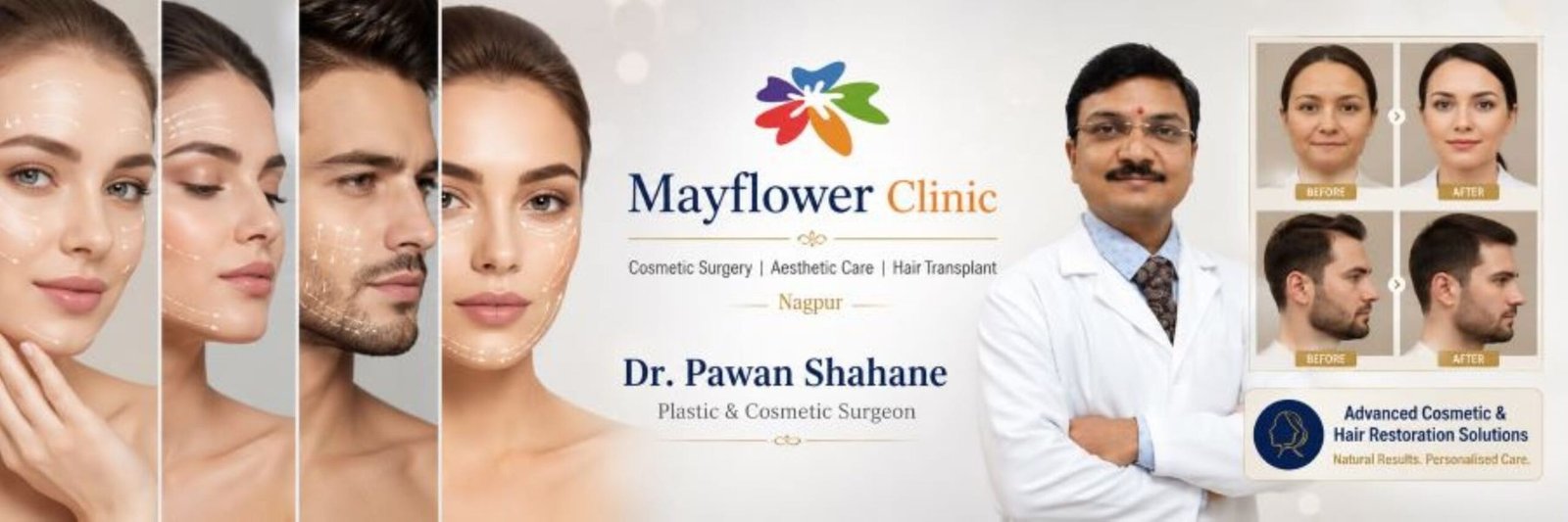
Underarm fullness may be soft fat, firm accessory breast tissue, loose skin, a lateral chest or bra-line fold—or a lump that should be medically evaluated rather than cosmetically treated.


Ask a simple question about this page. The matcher runs only in your browser and points you to the relevant section.
These brief answers help you identify the right section. A physical examination is still necessary before a treatment recommendation.
No. It may be localized fat, accessory breast tissue, loose skin, a lateral chest fold, clothing compression or another lump.
See the five common possibilitiesIt may reduce a fatty component, but firm glandular tissue often needs excision. Some patients need both.
Compare treatment pathwaysOnly to the extent allowed by existing skin elasticity. Substantial loose skin may remain or become more apparent.
Understand skin behaviourLiposuction scars are small access marks. Excision scars are longer and planned within or near natural folds when possible.
Review scar planningGentle movement begins early, but overhead reaching, lifting and exercise return gradually according to comfort and review.
See the recovery timelineA new, hard, enlarging, painful or one-sided lump—or associated breast, skin or arm changes—needs diagnostic assessment.
Read the diagnostic red flags“The axilla is a transition between the breast, lateral chest, back and upper arm. A smooth result depends on identifying the layer creating the fullness and preserving a natural fold—not simply removing the largest possible volume.”Dr. Pawan Shahane, M.Ch. Plastic Surgery · Founder, Mayflower Clinic, Nagpur
The armpit or axilla contains skin, fat, lymph nodes, nerves, vessels and tissue extending from the breast and lateral chest. That makes casual self-diagnosis unreliable. The treatment that helps one person may be inappropriate for another person with a similar-looking bulge.
Assessment is usually performed standing with the arms relaxed and raised. The surgeon considers texture, mobility, skin excess, breast-tail continuity, asymmetry, tenderness, prior breast or axillary surgery, hormonal change and whether further imaging or another specialist review is needed.
Soft, pinchable subcutaneous tissue that blends into the upper arm, lateral chest or back.
Fatty and/or glandular tissue along the milk line, sometimes hormonally sensitive or tender.
A redundant fold after ageing, pregnancy, weight change or reduced elasticity.
A contour transition influenced by fat, skin, posture and garment compression.
Lymph node, cyst, infection or another condition that needs diagnosis rather than cosmetic treatment.
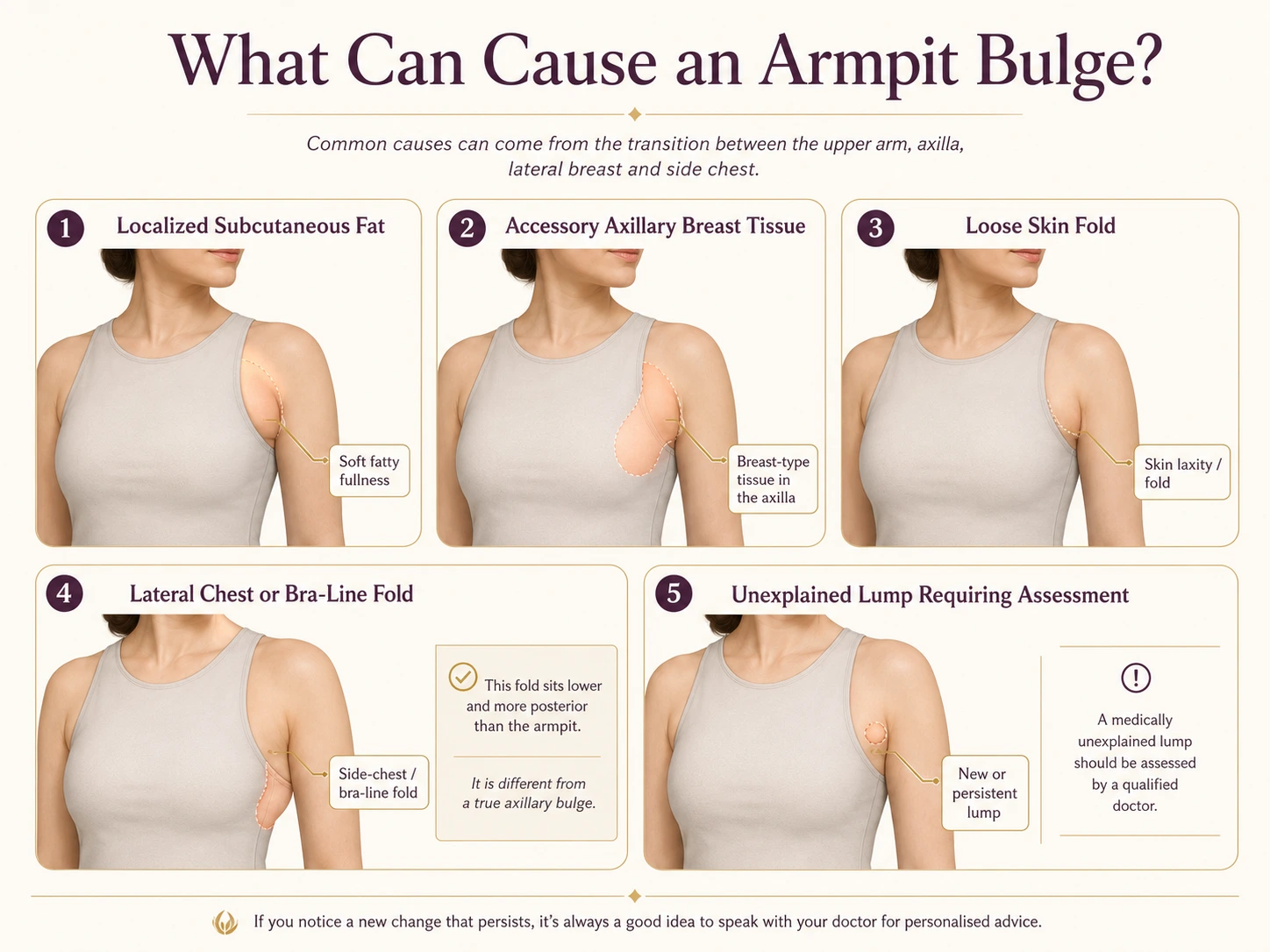
Treatment is chosen by tissue composition, skin quality, symptoms, scar trade-offs and medical safety—not by a device name.
| Option | Best suited to | What it can change | Scar / recovery | Important limitation |
|---|---|---|---|---|
| Observation, garment and weight stability | Mild concern, uncertain diagnosis, changing weight or preference to avoid treatment | May reduce garment-related prominence and clarify whether the contour is stable | No surgical scar | Does not remove persistent tissue |
| Non-surgical fat reduction | Small, clearly fatty, safely accessible bulge in a suitable patient | Modest gradual fat reduction | Usually lower downtime; may need sessions | Does not remove gland, skin or an unexplained lump |
| Localized liposuction | Fat-dominant fullness with adequate skin elasticity | Reduces selected subcutaneous fat and blends transitions | Small access scars; swelling and compression may be needed | Cannot reliably remove firm glandular tissue or major skin excess |
| Limited tissue excision | Accessory breast tissue or discrete glandular component | Directly removes tissue that cannot be suctioned | Longer incision; wound and scar care | Excision alone may not blend surrounding fat |
| Liposuction plus excision | Mixed fat and glandular tissue | Contour blending plus direct removal | Both access marks and an excision scar | More extensive recovery than a single method |
| Skin excision / extended contour surgery | Substantial loose skin or fold-dominant concern | Removes redundant skin and selected tissue | Longer scar; greater wound-care trade-off | A small scar cannot remove a large amount of loose skin |
Injectable fat-dissolving treatment should not be assumed appropriate for the axilla. The region contains important neurovascular and lymphatic structures, and any off-label treatment requires a clear diagnosis, informed discussion and clinician-specific judgement.
This is educational screening, not a candidacy decision. In-person examination and medical assessment determine suitability.
The area is examined in several positions because a fold can change with shoulder movement, posture and bra pressure.
Texture, pinch thickness, mobility, skin excess and continuity with the breast and lateral chest guide the diagnosis.
New, asymmetric, painful or changing tissue is not treated cosmetically until diagnostic uncertainty is resolved.
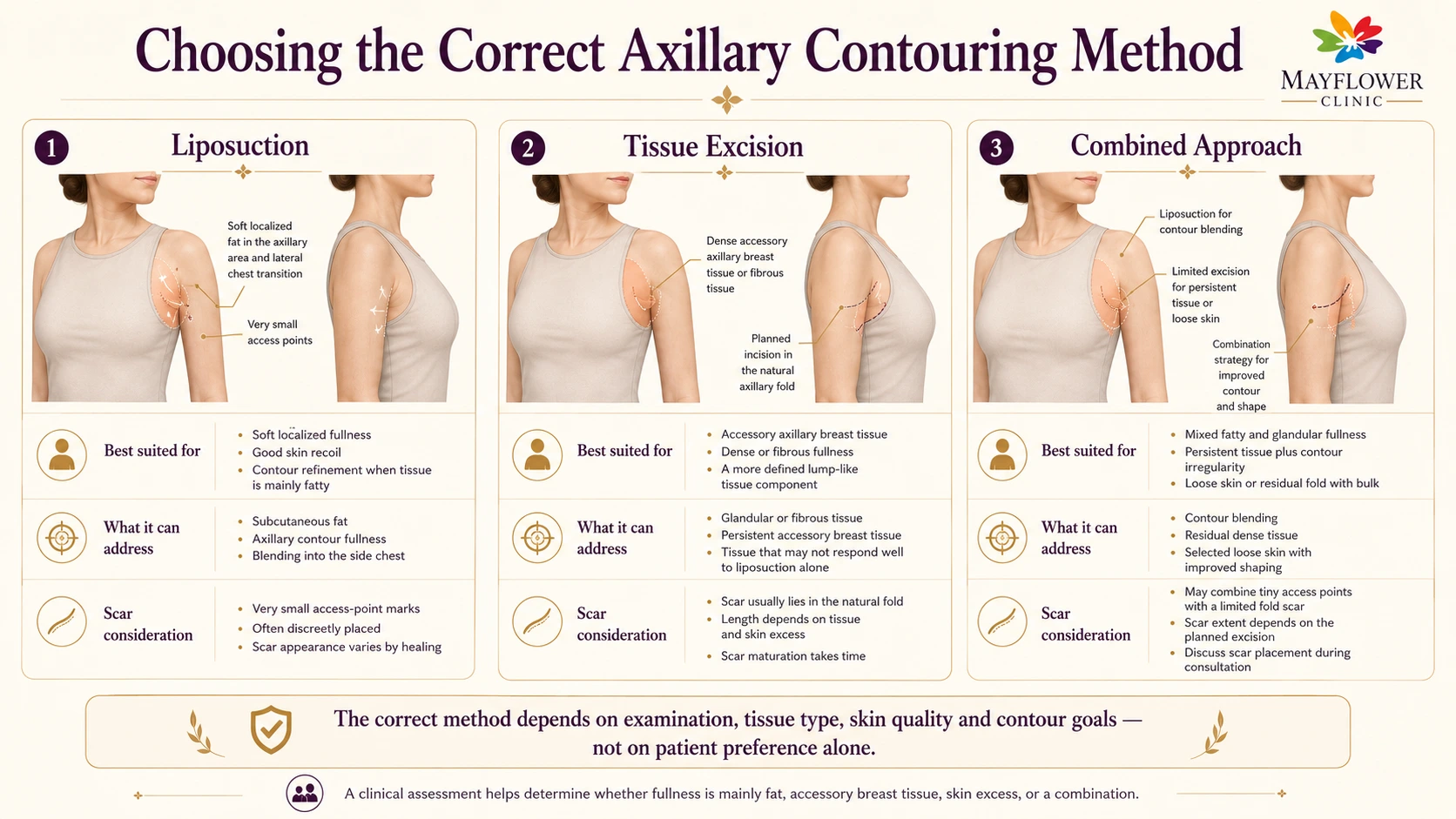
Liposuction access points, limited excision and skin removal create different scars. The shortest scar is not always the most effective or safest plan.
Planning extends beyond the visible bulge to avoid abrupt edges, over-hollowing and untreated adjacent rolls.
Medical conditions, medicines, supplements, smoking, prior surgery, previous lymph-node procedures and allergy history matter.
Arm movement, garment fit, household support and distance from Nagpur are built into the plan.
The diagnosis, sides, target tissue, scar plan, expected residual features and consent are reconfirmed.
The arms are positioned carefully to expose the region without excessive stretch or pressure on nerves.
Small access points and deliberate cannula passes reduce selected fat while preserving smooth thickness and natural transitions.
The incision is selected according to the amount, location and need for skin removal. Tissue may be sent for pathology when clinically indicated.
Both sides are compared while recognizing that perfect pre-existing or postoperative symmetry cannot be promised.
Closure is planned to reduce tension. Compression must support the area without causing excessive axillary pressure.
Pain, bleeding, swelling, sensation, garment comfort, walking and home support are checked before discharge.
These are small but not invisible. Their location depends on the contour map and cannula direction. Pigmentation, thickening or tethering can occur.
Accessory breast tissue or loose skin may require a longer incision. The scar may be placed in or near a natural fold when anatomy allows, but arm movement, skin tension and individual scar biology affect its final appearance.
Young, elastic skin may contract more effectively than thin, stretch-marked or previously distended skin. No energy device can guarantee tightening, and removing fat can make pre-existing laxity easier to see.
Rest is balanced with walking and gentle elbow/shoulder movement as advised. Dressings and garment pressure are checked.
Light desk work may be possible depending on surgery, commute and pain medicine. Avoid heavy bags and forceful overhead reaching.
Swelling, firmness and temporary altered sensation can persist. Excision wounds and sutures need individual review.
Exercise and lifting return according to healing, comfort and the exact operation. Scar care may begin or continue.
Residual swelling softens and scars continue to fade and flatten. Final judgement should not be made during early swelling.
Early contour is obscured by swelling. As swelling settles, the transition between the upper arm, lateral chest, breast tail and back becomes easier to judge. Scars continue to mature for many months.
These photographs show individual patients and are grouped by the tissue treated and the operation performed. They should not be interpreted as a guaranteed or typical result.
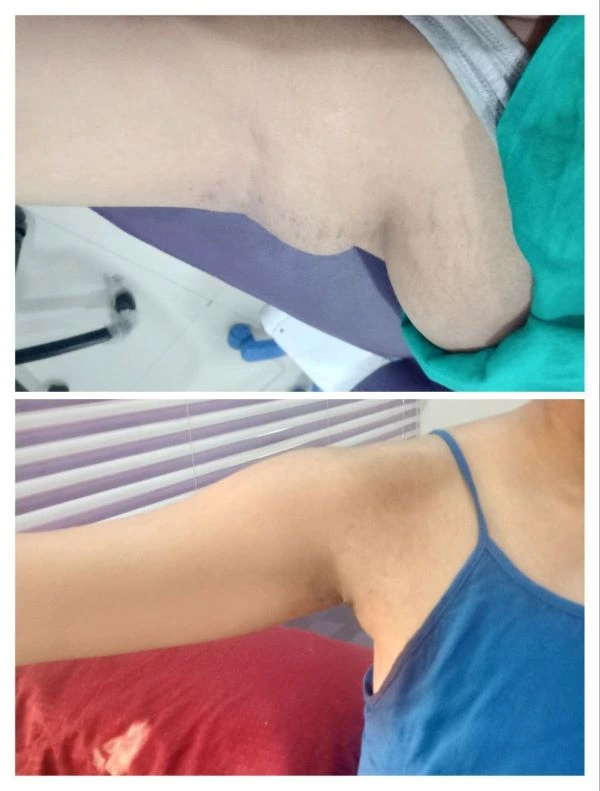
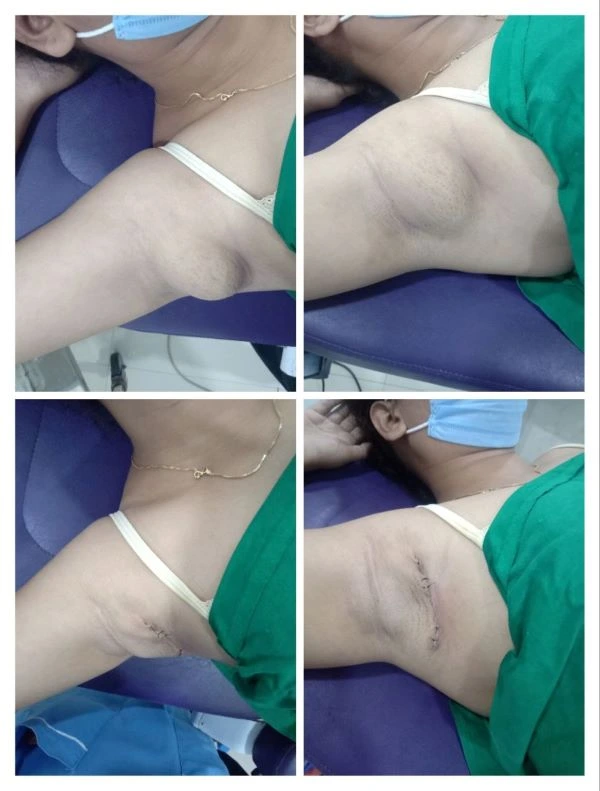
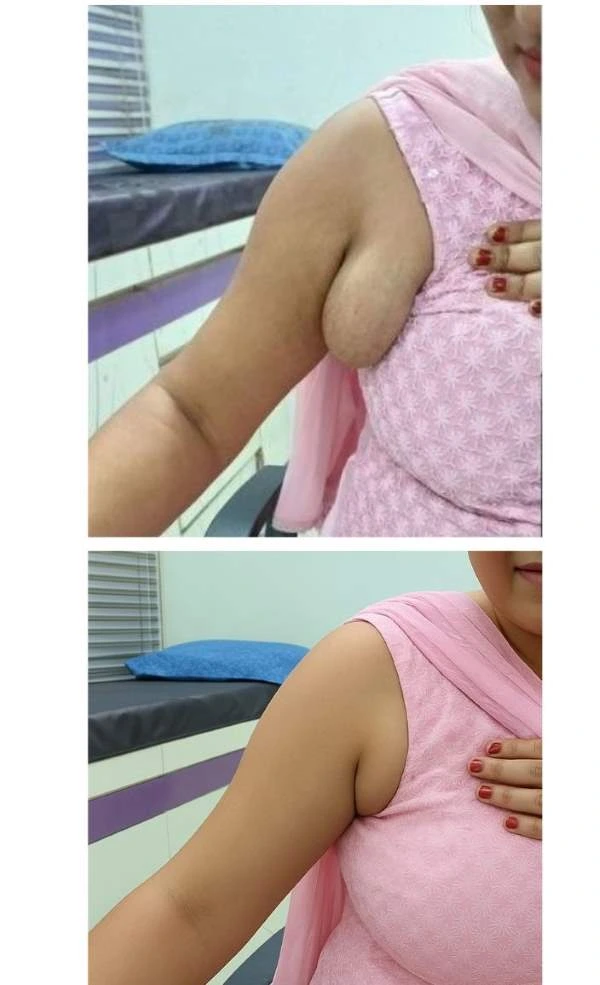
Real patient photographs published with consent. Images are presented for education; individual anatomy, scars, healing and results vary.
Liposuction alone, gland excision, skin excision and combined surgery require different time and resources.
Unilateral evaluation and correction differ from symmetrical bilateral planning.
Local anaesthesia, sedation or general anaesthesia and day-care or hospital needs affect cost.
Investigations, pathology when indicated, garment, medicines, dressings and follow-up should be stated clearly.
Mayflower Clinic provides a patient-specific estimate after examination. Ask what is included, whether pathology is expected, how follow-up is handled and what could create an additional charge. A low advertised price should not replace diagnosis, qualification, anaesthesia safety and continuity of care.
Patients may travel from Vidarbha, Madhya Pradesh and Chhattisgarh. A remote conversation can organize records and questions, but final diagnosis, markings and surgical suitability require in-person assessment.
These are authentic clinic testimonials about broader cosmetic-surgery care. They are not presented as armpit-fat-removal outcome evidence, and individual experiences do not predict another patient’s result.
“Amazing experience with Dr Pawan Shahane. I recommend him for all cosmetic surgery. He is good in knowledge… and he is very kind in nature… I am happy with results and now feeling full of confidence.”Patient testimonial
“Good experience. Highly skilled surgeon. Post op care and consultation was also done nicely… Thanks.”Patient testimonial
“I am happy with results. I recommend him for cosmetic surgery. His staff are also good… honest and explains everything well.”Patient testimonial
Armpit fat removal is a patient-facing term for contour treatment around the axilla or lateral chest. The correct treatment depends on whether the prominence is mainly subcutaneous fat, accessory breast tissue, loose skin, a bra-line fold or another cause.
Fat is usually soft and pinchable, while accessory breast tissue may feel denser and can change with hormones, pregnancy or breastfeeding. Examination is needed because photographs alone cannot reliably distinguish fat, glandular tissue, skin folds and other lumps.
Liposuction may help when the prominence is mainly localized subcutaneous fat and the skin is likely to redrape adequately. It does not reliably remove firm glandular tissue, significant loose skin or a medically unexplained lump.
Excision may be considered when accessory breast tissue, a discrete glandular component or substantial loose skin is present. Some patients need a combined plan using liposuction for contour blending and limited excision for tissue that cannot be suctioned.
A non-surgical option may be considered for a small, clearly fatty and safely accessible bulge in a suitable patient. Results are generally more modest and gradual than surgical removal, and these treatments do not remove glandular tissue or excess skin.
Liposuction uses small access points that leave small scars, while excision requires a longer incision positioned according to the tissue and natural folds. Scar length and visibility depend on the required operation, skin biology and aftercare.
A limited treatment may be performed with local anaesthesia, sometimes with sedation, while more extensive or combined surgery may need general anaesthesia. The choice depends on the tissue, extent, medical history, operating setting and anaesthesia assessment.
A limited procedure may take roughly one to two hours, while bilateral excision, combined liposuction or another simultaneous operation can take longer. The final estimate is made after examination and surgical planning.
Soreness, swelling and bruising are common during the first week. Many patients manage light desk work within several days to about a week, but lifting, vigorous arm movement and exercise return gradually after review. Swelling and scar maturation continue for months.
Compression or a supportive garment may be advised after liposuction or combined surgery, but it must fit without excessive pressure in the axilla. The exact garment and duration are individualized.
Removed fat cells do not regrow in the same number, but remaining cells can enlarge with weight gain and the surrounding body can change with ageing, hormones or pregnancy. Accessory breast tissue may also respond to hormonal changes if residual glandular tissue remains.
Risks include bruising, swelling, infection, seroma, bleeding, altered sensation, visible or thick scars, asymmetry, contour irregularity, residual fullness, skin laxity and possible revision. The axilla also contains important nerves, vessels and lymphatic structures, so precise planning is essential.
A new, enlarging, hard, painful or one-sided lump; skin or nipple change; fever; discharge; unexplained weight loss; or swelling of the arm should be medically assessed. Cosmetic treatment should not proceed until an uncertain lump has been appropriately evaluated.
Cost depends on whether treatment is unilateral or bilateral, liposuction alone or excision, anaesthesia, operating setting, investigations, garment, pathology when indicated and follow-up. Mayflower Clinic provides a patient-specific written estimate after examination.
It may be combined with selected breast, upper-arm or body-contouring procedures when the anatomy, total operating time and medical risk make combination surgery reasonable. Staging may be safer when several areas or longer operations are planned.
References support general education. The exact diagnostic, operative, pathology and aftercare plan must be individualized by the treating clinical team. Medically reviewed 24 July 2026.
Bring details of when the fullness appeared, whether it changes with hormones or weight, previous breast or axillary reports, medicines and your work or travel schedule. The goal is to identify the tissue first and then compare the safest reasonable options.
Medical Disclaimer: All surgical procedures carry inherent risks, and individual outcomes vary based on anatomy, skin type, medical health, treatment extent and healing biology. Surgical results are not guaranteed. Formal in-person consultation with Dr. Pawan Shahane is required before any surgical decision. A new or unexplained axillary lump may require diagnostic evaluation before cosmetic treatment. This page is for general educational purposes only and does not constitute medical advice, diagnosis or a treatment recommendation. It is not for emergencies.

Case of the Month: Grade 3 Gynecomastia…

The Science of Facial Aging: Why Wrinkles,…