

Unilateral dimple
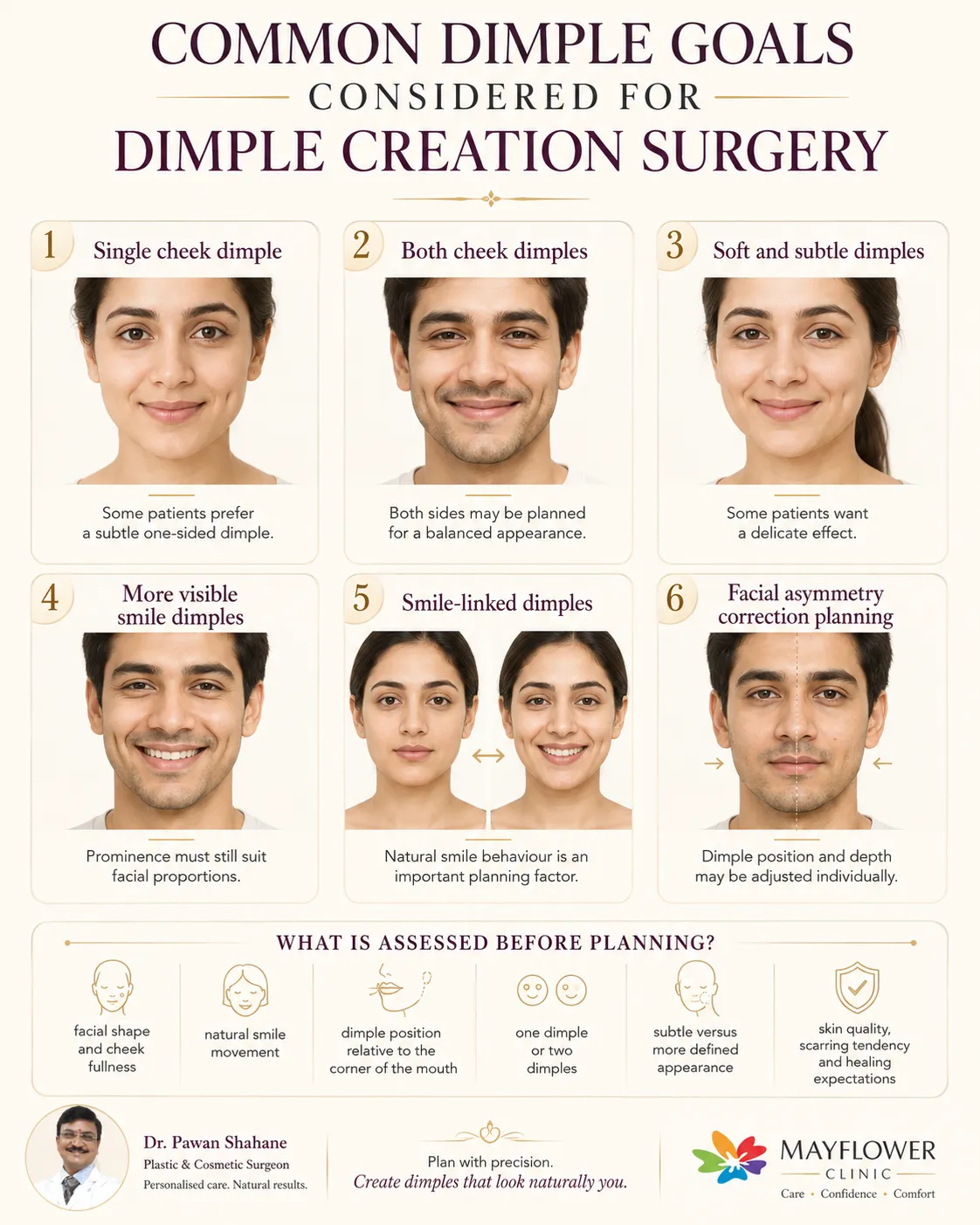
One dimple may suit a naturally asymmetrical smile or a patient who prefers a less formal, less mirrored appearance.

Dimpleplasty is a small facial procedure, but the planning is not trivial. Position, depth, one cheek versus both cheeks, cheek thickness, smile movement and the possibility of a visible resting indentation all need to be discussed before surgery.


Ask a common question or select a suggestion. Answers are drawn only from this medically reviewed page.
“The most important decision is not simply whether to create a dimple. It is where to place it, how deep to make it, and whether one or two dimples will suit the patient’s actual smile dynamics.”Dr. Pawan Shahane, M.Ch. Plastic Surgery · Founder, Mayflower Clinic, Nagpur
Natural cheek dimples are dynamic indentations produced by the relationship between skin and underlying facial tissues during expression. Dimple creation surgery attempts to reproduce a similar tether through an incision placed inside the mouth.
The goal is a modest indentation that complements the smile. It is not a method for lifting the cheek, slimming the face, changing dental alignment or correcting major facial asymmetry. A person with a broad smile, thick cheek tissue, pre-existing asymmetry or strong smile lines may need a different placement or may be advised that the requested appearance is not predictable.
Immediately after surgery, the dimple may look much deeper than expected and may remain visible when the face is relaxed. Swelling and early scar attachment can exaggerate the indentation. The appearance usually evolves during healing, but it may soften, remain conspicuous, fade or become unequal.
One dimple may suit a naturally asymmetrical smile or a patient who prefers a less formal, less mirrored appearance.
Two dimples are planned independently. Exact mirror-image placement may not look natural when the two sides of the face move differently.
Assessment considers the mouth corner, smile line, cheek prominence, dental show and the point of natural inward movement.
A conservative dimple may soften or fade; an aggressive dimple may remain visible at rest. The trade-off should be discussed before surgery.
You understand that depth, symmetry, visibility at rest and long-term persistence vary, and that a surgically created dimple may not behave exactly like a natural dimple.
Facial growth is complete, smile pattern is stable and the proposed position can be assessed during expression.
There is no active mouth ulcer, dental infection, facial skin infection or untreated inflammatory condition near the surgical area.
Diabetes, blood pressure, clotting risk and medicines are reviewed and controlled before an elective procedure.
Smoking, vaping and nicotine products can affect healing. Disclosure and a surgeon-guided cessation plan may be required.
Active infection, uncontrolled illness, high bleeding risk, poor oral hygiene, unrealistic demands or uncertain motivation may require treatment, delay or a decision not to operate.
Do not rely on a fixed “standard point.” Published anatomical landmarks can guide discussion, but the final mark should be individualized to the patient’s face and smile.
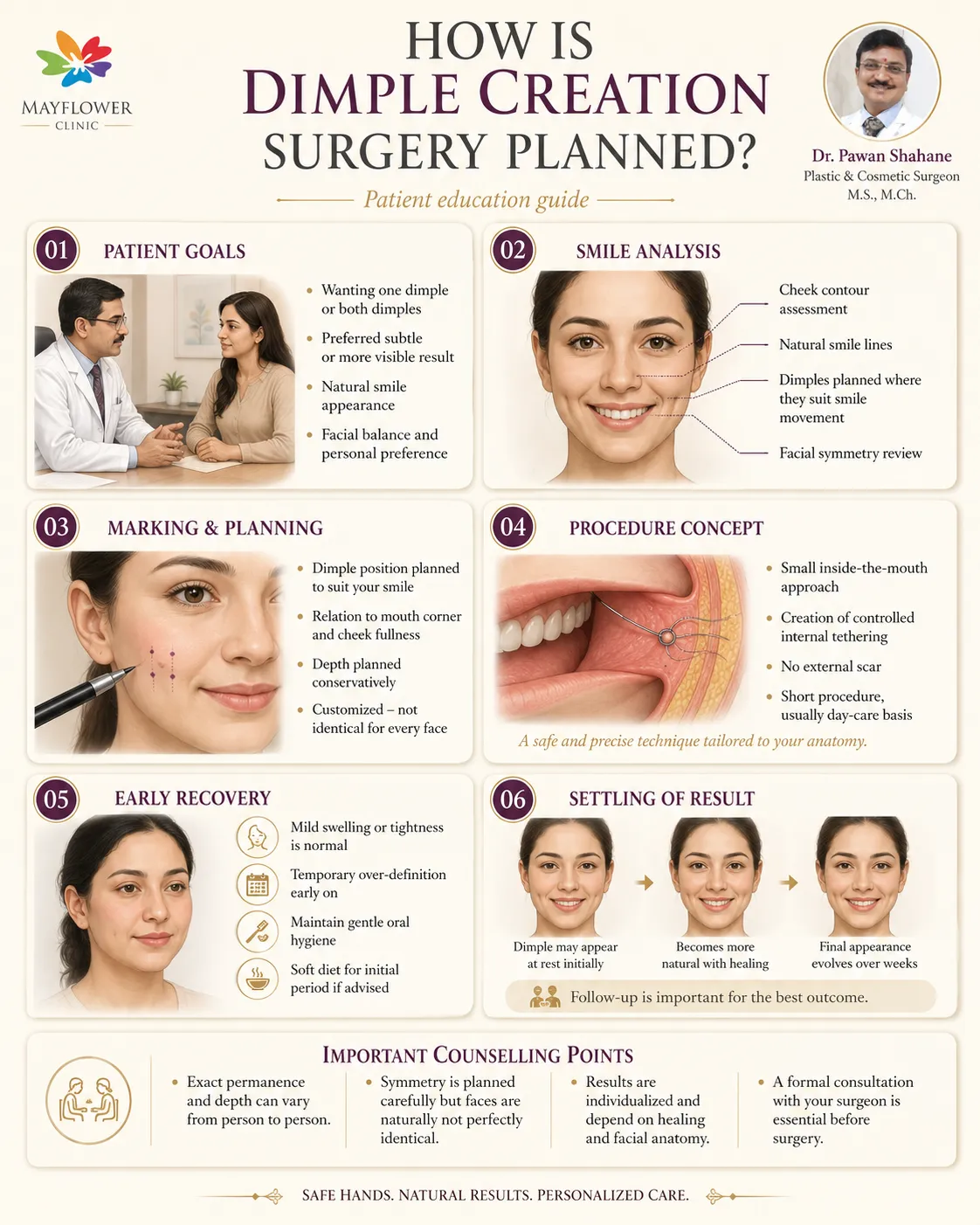
Health history, medicines, oral condition, cheek thickness and smile movement are reviewed. Surgery is deferred if infection or medical risk is not controlled.
The proposed site is checked from the front and oblique views. One side may be marked differently from the other to respect natural asymmetry.
The cheek and inner-mouth lining are prepared and local anaesthesia is administered. Additional anaesthesia planning depends on the patient and setting.
A limited opening is made through the inner cheek so there is usually no external skin incision. The approach is designed to avoid unnecessary tissue trauma.
A suture-based or limited tissue-adjustment method creates a planned attachment between deeper cheek tissue and the skin. Technique is adapted to anatomy and desired depth.
The surgeon checks the indentation, bleeding control and the inner-mouth wound. Early depth is not the final appearance because swelling is present.
The patient receives guidance on mouth care, diet, medicines, swelling, activity and warning signs. Follow-up assesses healing and the evolving dimple.
Swelling, tenderness, cheek tightness and a deeper-than-planned indentation are common. The dimple may be visible continuously, including at rest.
Swelling often begins to reduce. Continue prescribed mouth care and diet instructions. Do not press, massage or repeatedly test the dimple unless advised.
Many patients feel socially comfortable, although firmness, asymmetry and resting indentation can still be present.
The internal attachment and surrounding tissues continue to soften. Smile-dependent movement may become clearer.
The dimple can continue to settle. Final depth and persistence vary; some dimples soften significantly or recur less strongly.
Increasing pain, fever, pus, rapidly enlarging swelling, persistent bleeding, facial weakness or difficulty opening the mouth require prompt review.
Seek prompt clinical advice for severe or increasing pain, fever, foul taste or discharge, pus, rapidly increasing swelling, persistent bleeding, marked difficulty opening the mouth, new facial weakness, breathing difficulty or any sudden deterioration.
Call the clinicCommon early changes can temporarily make the dimple look deeper or uneven.
Bleeding within the cheek can increase swelling and may require assessment or treatment.
The intraoral wound is exposed to mouth bacteria. Infection can become significant and requires prompt treatment.
Two dimples may heal differently because the two sides of the face are not anatomically identical.
An aggressive or persistent tether may produce a fixed-looking indentation rather than a smile-only dimple.
The attachment may soften or release, reducing dimple definition and occasionally prompting discussion of revision.
Irritation, extrusion, delayed healing or an uncomfortable internal knot can occur.
Firmness, tethering or an unnatural crease may persist beyond the expected swelling period.
Injury to facial nerve branches or other nearby structures is uncommon but can affect facial movement and may require further care.
Mayflower Clinic does not use a single public “starting price” as a substitute for assessment. The surgical plan differs between one cheek and both cheeks, and the degree of tissue work, facility requirements and follow-up can vary. After consultation, the patient should receive a clear written estimate explaining what is included.

Dimpleplasty may be short, but it is still surgery in a mobile anatomical area close to facial nerve branches and oral tissues. A safe consultation should discuss anatomy, infection prevention, asymmetry, resting visibility, reversibility limitations and the possibility of revision—not only the desired photograph.
These visible answers match the FAQ structured data supplied with this page so patients, search engines and language-model crawlers receive the same information.
Dimple creation surgery, or dimpleplasty, is a cosmetic facial procedure that creates a controlled connection between the inner cheek tissues and the overlying skin so an indentation appears, usually during smiling.
The consultation, planning and surgery are personally led by Dr. Pawan Shahane, M.Ch. Plastic Surgery, at Mayflower Clinic in Dhantoli, Nagpur.
After marking the proposed position, the cheek is numbed. A small opening is made inside the mouth and a carefully placed suture or limited tissue adjustment creates a controlled skin-to-deeper-tissue attachment. The exact technique is selected after examining cheek thickness, smile movement and symmetry.
Yes. Unilateral or bilateral dimple creation may be considered. The decision should account for natural facial asymmetry, smile pattern and whether two perfectly identical dimples would look artificial.
Placement is planned while the face is at rest and while smiling. Dr. Shahane evaluates smile lines, cheek fullness, the mouth corner, facial proportions and the point where an indentation would move naturally with expression.
It is commonly performed under local anaesthesia as a short day-care procedure. Anaesthesia and facility planning are finalized only after medical evaluation.
A straightforward procedure often takes about 30 to 60 minutes, although planning, preparation and observation add to the total clinic time. Bilateral surgery or unusual anatomy may take longer.
A newly created dimple may initially look deeper and may be visible at rest because of swelling and the fresh internal attachment. It often becomes softer and more expression-dependent during healing, but the final depth and resting visibility vary.
The surgical access is generally inside the mouth, so an external skin incision is usually not required. Internal healing can still produce firmness, tethering or contour irregularity, and no procedure can be described as scar-free.
Swelling, tenderness and a tight or deep-looking dimple are common early. Many people resume light routine within a few days, while visible settling may continue for several weeks. Individual recovery depends on anatomy, technique, oral hygiene and healing biology.
A soft, non-spicy diet and good hydration are commonly advised for the early period. The clinic may recommend gentle mouth rinsing and temporary avoidance of very hot, hard or sharp foods that could irritate the inner-cheek wound.
Possible risks include swelling, bruising, bleeding, infection or abscess, asymmetry, a dimple that is too deep or too shallow, persistent indentation at rest, fading or loss of the dimple, suture reaction, mucosal wound problems, contour irregularity and the possible need for revision. Injury to nearby nerves or structures is uncommon but possible.
Yes. A dimple may soften, become less visible, remain visible at rest or change with facial ageing and weight variation. Results are not guaranteed to be perfectly symmetrical or permanent.
Revision may sometimes reduce, deepen or reposition a dimple, but complete reversal is not always predictable because the procedure intentionally creates internal scar attachment. This is why conservative planning is important before the first surgery.
Suitability may be limited by active oral or facial infection, uncontrolled medical illness, bleeding risk, medicines that affect clotting, smoking or nicotine exposure, poor oral hygiene, problematic scarring history, unrealistic expectations or anatomy that cannot support the requested dimple safely.
Cost depends on whether one or both cheeks are treated, the planned technique, cheek anatomy, anaesthesia and facility requirements, medical tests when indicated, medicines, dressings, follow-up and whether any combined procedure is planned. A written estimate is provided after consultation.
WhatsApp can be used to arrange a consultation and share general information, but an exact surgical quote should follow an in-person assessment of cheek anatomy, medical history and the intended position and depth.
Contact the clinic promptly for rapidly increasing swelling, severe or worsening pain, fever, pus or foul discharge, persistent bleeding, difficulty opening the mouth, facial weakness, breathing difficulty or any symptom that feels unexpected or severe.
References support general education. Technique and suitability are individualized after examination.
Projection, implants, fat grafting and profile balance.
Eyelid surgeryUpper and lower eyelid assessment, scars and recovery.
Ear surgeryProminent-ear correction and cartilage planning.
Lip surgeryProportion, incision placement, swelling and scar considerations.
Cheek contourAssessment of facial fullness and limitations of buccal-fat reduction.
Scar careScar assessment, revision options and realistic improvement.
A consultation should answer three questions clearly: where the dimple will sit, how it may look at rest and while smiling, and what happens if it heals too deep, too shallow or asymmetrically.
Mayflower Clinic is Central India's premier multi-specialty hub for advanced aesthetic and reconstructive plastic surgery. Every procedure is planned and executed exclusively by board-certified M.Ch. Plastic Surgeon Dr. Pawan Shahane, ensuring an absolute commitment to zero-delegation surgery, patient safety, and transparent pricing.

What Is Acne Scar Correction? A Complete…

Who Is a Good Candidate for Lip…
Clinic Address: Surdham Complex, Behind Silver Palace Building, 2nd Lane from Panchsheel Square, Opp. Yashwant Stadium, Dhantoli, Nagpur, Maharashtra - 440012
Landline Connect: 0712-6692706 / 0712-3551170
Secure WhatsApp Line: +91 8087471244