0712 6692706 / 0712 3551170 / +91 8087471244 | contact@mayflowerclinic.in

M.Ch. Plastic Surgery · Facial Injectables · Nagpur

Dermal Fillers Treatment in Nagpur — Volume, Proportion and Facial Anatomy First.
Dermal fillers can add or restore volume in carefully selected facial areas, but the right question is not simply “where can filler be injected?” It is whether volume is actually the cause of the concern, which tissue plane is appropriate, how much change is reasonable, and what risks are relevant to that anatomy.


21+Years surgical practice
M.Ch.Plastic Surgery
IAAPSProfessional membership
Doctor-ledAnatomy-based planning
Page Guide · Quick Answer
What should you know before considering facial filler?
Filler is a volume tool—not a universal wrinkle, pigment, scar or lifting treatment. The safest plan starts by identifying the actual anatomical problem.
Clinical planning principle
Anatomy first. Conservative treatment. Doctor-led planning. Safety priorities.
Facial fullness changes with age, genetics, weight, dental support, bone structure, fat compartments and skin quality. Adding volume can help selected concerns, but excess filler can create heaviness, imbalance or an over-treated appearance. A responsible plan may recommend a smaller amount, staged treatment, a different procedure—or no filler.
1. Identify the causeVolume loss, muscle movement, skin texture and true laxity require different treatments.
2. Respect facial vesselsInjection depth and site are chosen with vascular anatomy and risk in mind.
3. Prefer proportional changeTreatment should support existing features rather than chase maximum volume.
4. Review after settlingEarly swelling is not the final result; additional filler should not be rushed.
Dermal filler overview
What dermal fillers do—and what they do not do
Dermal fillers are injectable materials used to add, restore or shape soft-tissue volume. Hyaluronic acid is one commonly used filler material, while other filler types exist with different properties, duration and reversibility. The exact material should be chosen according to the treatment area, indication and clinician’s judgement rather than by brand popularity alone.
Filler may be considered for selected age-related volume loss, naturally shallow contours, lip or chin proportion, some folds that are partly volume-related, and carefully selected depressed scars. It does not switch off muscle movement, remove pigmentation, resurface acne scars, tighten substantially loose skin or stop facial ageing.
For movement-related forehead, frown or crow’s-feet lines, botulinum toxin treatment may be the more relevant discussion. For texture, photoageing or selected scars, the clinic’s Femto Derma CO2 laser (Coherent USA, RF metallic tube, 70W) or other skin-focused options may be assessed instead. Significant tissue descent may need a thread-based or surgical conversation rather than repeated volumising.
Filler may help when the issue is…
- Selected cheek or midface volume loss
- Under-projected chin or selected jawline contour concerns
- Thin lips or loss of selected lip definition
- Selected facial hollows after medical assessment
- Some folds or depressed scars where volume is part of the problem
Filler is not the main answer when the issue is…
- Dynamic expression lines caused mainly by muscle movement
- Melasma, pigmentation or uneven skin tone
- Acne scar texture that needs subcision, microneedling or laser
- Large fat deposits or a double chin caused mainly by fat
- Substantial loose skin or deeper tissue descent
Facial volume zones
Where can volume loss or contour concerns occur?
These are assessment zones, not a checklist of areas that should automatically be injected.

Educational volume-zone map. Actual treatment depends on anatomy, indication and risk assessment.
Cheeks
Selected volume loss can flatten the midface and deepen shadowing. Restoring volume is different from simply making cheeks larger.
Lips
Lip treatment may address selected volume or definition concerns while respecting tooth show, facial proportions and baseline asymmetry.
Chin & jawline
Selected projection or contour issues may respond to filler, but bone shape, muscle, fat and skin laxity must be considered first.
Temples
Temple hollowing can occur with age or low facial volume. This is an anatomically complex area requiring careful assessment.
Under-eye hollows
Not all dark circles are caused by hollowness, and under-eye filler is not suitable for every patient. Pigment, skin quality, bags and fluid tendency matter.
Nasolabial & marionette areas
Folds may reflect several levels of ageing. Direct filling is only one option and may not be the most proportionate approach.
Choose by cause, not trend
Filler, Botox, laser, threads or surgery?
Different facial concerns can look similar in a mirror. This comparison helps explain why diagnosis matters before choosing a procedure.
| Main concern | Possible pathway | Why |
|---|---|---|
| Expression lines that deepen with frowning, smiling or raising the brows | Botulinum toxin | Temporarily reduces selected muscle activity rather than adding volume. |
| Selected facial hollows or loss of soft-tissue support | Dermal filler | Adds or restores volume in selected tissue planes when filler is appropriate. |
| Fine surface lines, photodamage, selected scars or texture change | Fractional CO2 laser / skin treatment | Targets skin surface and remodelling rather than replacing volume. |
| Mild tissue descent in a selected patient | Thread lift | Provides limited mechanical repositioning; it is not a substitute for significant lifting. |
| Substantial jowling or loose skin | Surgical facelift assessment | Addresses deeper tissue position and excess skin in ways filler cannot reproduce. |
| Under-eye darkness without true volume loss | Cause-specific dark-circle plan | Pigment, vessels, skin, bags and shadowing need different treatment pathways. |
Safety planning
Why anatomy and conservative dosing matter
Facial blood vessels travel through and between the tissue planes used for filler injection. Product can also behave differently depending on its physical properties, depth of placement, surrounding movement and the amount injected. This is why injection technique is not a simple beauty-service step.
Before treatment, Dr. Shahane assesses facial proportions, baseline asymmetry, skin and soft-tissue quality, previous filler, prior surgery or dental work, medicines and the specific concern. A staged plan may be safer and aesthetically more predictable than attempting a large correction in one visit.
Emergency readiness matters: accidental filler entry into or compression of a blood vessel can cause serious injury. Patients should know which symptoms require immediate contact and when emergency medical care is necessary.

Educational safety-planning graphic. Professional qualifications do not eliminate procedure risk.
Treatment journey
A typical dermal filler visit is more than the injection itself
1
ConsultationDefine the concern
Describe what bothers you and the degree of change you want, rather than requesting a fixed number of syringes.
2
HistoryReview medical factors
Previous filler, surgery, dental work, medicines, allergies, infection, bleeding tendency and relevant health history are discussed.
3
AssessmentMap the anatomy
Volume, bone structure, muscle, fat, skin quality, symmetry and facial proportions are assessed in motion and at rest.
4
PlanSelect the least treatment needed
The doctor decides whether filler, another procedure, staged treatment or no treatment is most appropriate.
5
ConsentDiscuss product and risks
The material, treatment area, expected limits, temporary side effects, uncommon complications and aftercare are reviewed.
6
ProcedureInject conservatively
The selected product is placed in planned amounts and tissue planes, with ongoing assessment of contour and symmetry.
7
ReviewLet swelling settle
Early swelling can mimic asymmetry or excess volume. Further treatment is considered only after appropriate review.
Risks, limitations & warning signs
Dermal fillers are minimally invasive—but not risk-free
Any injectable procedure can cause side effects, and facial filler has uncommon but potentially serious vascular complications. Patients should understand both the likely short-term effects and the warning signs that need urgent review.
Common early effects
- Swelling or puffiness
- Redness or tenderness
- Bruising
- Temporary firmness
- Early asymmetry while swelling settles
Other possible problems
- Under- or over-correction
- Lumps, nodules or palpability
- Infection
- Delayed inflammatory reactions
- Persistent asymmetry or contour irregularity
Uncommon but serious
- Vascular occlusion and tissue ischaemia
- Skin ulceration or necrosis
- Visual disturbance or blindness
- Stroke or neurological injury
- Severe allergic reaction
Seek urgent medical assessment for severe or rapidly increasing pain, marked blanching, dusky or mottled skin colour, visual change, sudden weakness or other neurological symptoms, rapidly worsening swelling, breathing difficulty, severe allergic symptoms or other severe unexpected deterioration. Visual or neurological symptoms should not wait for a routine clinic review.
Aftercare
Protect the treated area and give swelling time to settle
Your individual instructions take priority over generic internet advice, especially when different areas or products have been used.
🧊
Comfort care
Use a cool compress only if advised. Do not apply excessive pressure to the treated area.
✋
Avoid unnecessary massage
Do not rub, press or self-massage filler unless the treating doctor specifically instructs you to do so.
🏃
Follow activity limits
Strenuous exercise, excess heat and alcohol may be restricted temporarily to reduce swelling or bruising.
🧼
Keep the area clean
Follow the clinic’s guidance for makeup, skincare and touching injection sites during the early period.
⏳
Do not chase symmetry early
Swelling is uneven. Avoid adding more filler simply because the first few days look different from side to side.
📅
Attend review
Review is used to assess settling, contour, symmetry and whether any additional treatment is justified.
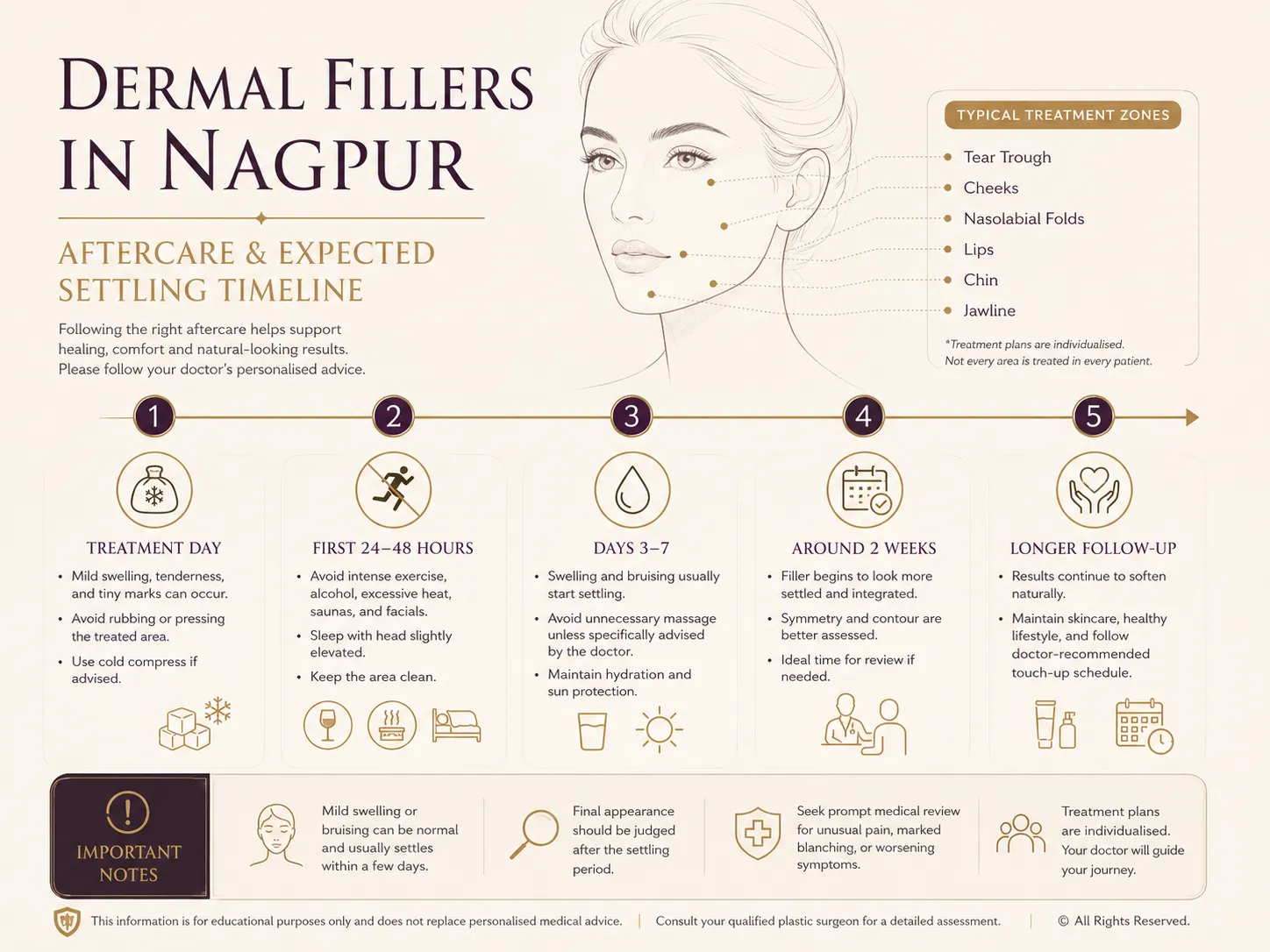
General educational aftercare timeline. Follow the personalised instructions you receive after your own treatment.
Realistic expectations
What filler can—and cannot—promise
Improvement, not reinvention
Filler may support balance or restore selected volume. It should not be expected to create a completely different face.
Not a facelift
Volume can camouflage selected hollows, but it cannot remove substantially loose skin or reposition deeper facial tissues.
Temporary effect
Most facial fillers are not permanent. Duration varies, and ageing continues regardless of treatment.
Maintenance is optional
Repeat treatment should be based on the return of a concern and a fresh assessment, not an automatic schedule.
Previous filler matters: Tell the doctor what was injected, where, when and whether you have ever had swelling, nodules, infection, vascular problems or dissolving treatment. Bring product records if available.
Cost factors
Dermal filler treatment cost in Nagpur
There is no single responsible online price because “filler treatment” can mean a small, highly targeted correction in one patient or a staged multi-area plan in another. Quoting by syringe count alone can also encourage over-treatment when a smaller amount—or another procedure—would be more appropriate.
The written estimate is based on whether filler is suitable, the selected treatment zone, the material, amount required, anatomical complexity, whether treatment is staged, previous filler history and follow-up needs.
Mayflower Clinic provides a transparent recommendation after assessment rather than promising a fixed package before examination.
Doctor & professional context
Why facial anatomy matters with injectable treatment
Dr. Pawan Shahane is an M.Ch. Plastic Surgeon with fellowship training in aesthetic surgery and cosmetic laser surgery. Plastic-surgery training provides structural understanding of facial soft tissue, muscles, eyelids, fat compartments, bone support and the surgical alternatives that may matter when a non-surgical procedure reaches its limits.
Professional credentials do not guarantee a particular result. Patients should still ask about the exact product, treatment rationale, amount, possible complications, emergency plan and follow-up.

Patient feedback
Verified Google reviews from Mayflower Clinic
These reviews are displayed in their original treatment context. They describe patient experiences with Mayflower Clinic and are not presented as dermal-filler outcome claims.
★★★★★
General cosmetic surgery
Ashish Barokar
“Good Work on Cosmatic surgery.”
★★★★★
Injury / reconstruction
Maroti Nawghade
“Had a treatment for the injury and it was a great experience. It was like after removing stitches it looks as it was almost before the injury”
★★★★★
Gynecomastia surgery
Sachin Batra
“Best cosmetic surgeon, I strongly recommend, him for all plastic surgery. He is very intelligent and guides you very well.”
Frequently asked questions
Dermal filler questions patients commonly ask
What are dermal fillers?
Dermal fillers are injectable materials used to add, restore or reshape volume in selected facial areas. They are used for anatomical volume or contour concerns rather than movement-related wrinkles, and suitability depends on the product, treatment area and individual assessment.
Which facial areas can be assessed for dermal fillers?
Common assessment areas include the cheeks or midface, lips, chin, selected jawline concerns, nasolabial or marionette folds, temples and selected under-eye hollows. Not every area should be filled, and some areas have greater vascular or aesthetic complexity than others.
What is the difference between dermal fillers and Botox?
Dermal fillers add or restore volume. Botulinum toxin temporarily reduces selected muscle activity that contributes to expression lines. They treat different anatomical problems and are not interchangeable.
Are hyaluronic acid fillers permanent?
No. Hyaluronic acid fillers are temporary. How long an effect remains varies by product, treatment area, amount, tissue movement and individual biology, so a fixed duration cannot be promised for every patient.
Can dermal fillers look natural?
A conservative plan aims to support proportion and replace selected volume rather than enlarge every feature. The visible result depends on baseline anatomy, filler choice, placement, amount, swelling and the patient’s goals, so natural-looking improvement cannot be guaranteed.
Is there downtime after dermal filler treatment?
Many patients return to routine activities quickly, but redness, tenderness, swelling or bruising can occur and may take days to settle. Some areas, particularly lips or under-eye regions, can show more visible swelling.
What are the common side effects of dermal fillers?
Temporary swelling, redness, tenderness and bruising are common. Other possible problems include asymmetry, under- or over-correction, palpable or visible lumps, infection, inflammatory reactions and delayed nodules.
What is vascular occlusion after filler?
Vascular occlusion occurs when filler compromises blood flow in a vessel. It is uncommon but can cause tissue injury or skin necrosis and, in rare cases involving facial vessels, visual loss, stroke or other serious harm. Severe pain, skin colour change or visual symptoms require urgent assessment.
Can filler be dissolved?
Some hyaluronic acid fillers can be treated with the enzyme hyaluronidase when clinically appropriate. Other filler materials are not reversed in the same way. Dissolving treatment also has its own risks and should be performed after medical assessment.
Who may need to postpone or avoid dermal filler treatment?
Treatment may need to be postponed when there is active infection or inflammation at the proposed site, and medical history, allergies, previous filler complications, medicines, immune or bleeding concerns, pregnancy or breastfeeding and planned dental or facial procedures should be discussed before treatment.
What should I do after dermal filler treatment?
Follow the personalised instructions from the treating doctor. Avoid unnecessary rubbing or self-massage unless specifically advised, keep the area clean, follow temporary activity or heat restrictions if given, and allow swelling to settle before judging the result.
When should I seek urgent help after dermal fillers?
Seek urgent medical assessment for severe or rapidly increasing pain, marked blanching, dusky or mottled skin colour, visual change, sudden weakness or other neurological symptoms, rapidly worsening swelling, breathing difficulty, severe allergic symptoms or other severe unexpected deterioration.
What does dermal filler treatment cost in Nagpur?
There is no responsible single price for every patient because cost depends on whether filler is appropriate, the treatment area, product, amount, complexity, whether treatment is staged and whether previous filler requires assessment. A transparent estimate is provided after consultation.
Related treatment pathways
Explore the Non-Surgical Aesthetics cluster
Explore Mayflower Clinic
Clinic, doctor, services and patient-safety resources
All Services
Browse cosmetic, plastic, reconstructive and hair-restoration services.
Services →Dr. Pawan Shahane
Qualifications, training, professional memberships and clinical background.
Doctor profile →Mayflower Clinic
Clinic identity, location and the wider patient-care structure.
About clinic →Patient Care Guide
Aftercare, warning signs and practical recovery principles across procedures.
Patient Care Guide →Medical references
Patient-safety sources reviewed for this guide
These references support general information on dermal-filler uses, side effects and vascular complications. They do not replace individual assessment.
- U.S. Food and Drug Administration. Dermal Fillers (Soft Tissue Fillers).
- American Society of Plastic Surgeons. Dermal Fillers.
- American Society of Plastic Surgeons. Dermal Fillers Risks and Safety.
Medically reviewed: 17 August 2026 · Re-review earlier if major product-safety guidance changes.
Consultation in Nagpur
Book Your Dermal Filler Consultation
Bring the concern, not a pre-decided syringe count. Dr. Pawan Shahane can assess facial volume, proportions, movement, skin quality, previous filler and whether dermal filler—or another treatment—is the most reasonable option.
Medical Disclaimer: Dermal filler treatment is a minimally invasive medical procedure and individual response varies. Results are not guaranteed and depend on anatomy, filler material, treatment area, amount, technique and biological factors. Temporary swelling and bruising can occur, and uncommon vascular complications can cause serious tissue, visual or neurological injury. Formal in-person consultation with Dr. Pawan Shahane is recommended before treatment. This page is for general educational purposes only and does not constitute a prescription, diagnosis or treatment recommendation.
Latest Posts
-
Case of the Month: Grade 3 Gynecomastia in a 24-Year-Old Man After Weight Loss

Case of the Month: Grade 3 Gynecomastia…
-
The Science of Facial Aging: Why Wrinkles, Volume Loss & Sagging Develop

The Science of Facial Aging: Why Wrinkles,…

