

Rhinoplasty Surgery in Nagpur
A surgical planning page for patients who want to understand how rhinoplasty is actually planned and performed: open versus closed approach, anaesthesia, procedure-day steps, limitations, risks and recovery.
This Page Is About the Surgery Itself
The completed rhinoplasty in Nagpur pillar page explains the broad overview, indications and facial harmony goals. This branch page goes deeper into the surgical pathway: how a plan is made, how the approach is selected, what happens on the day of surgery, and what a patient should realistically expect during recovery.
Planning
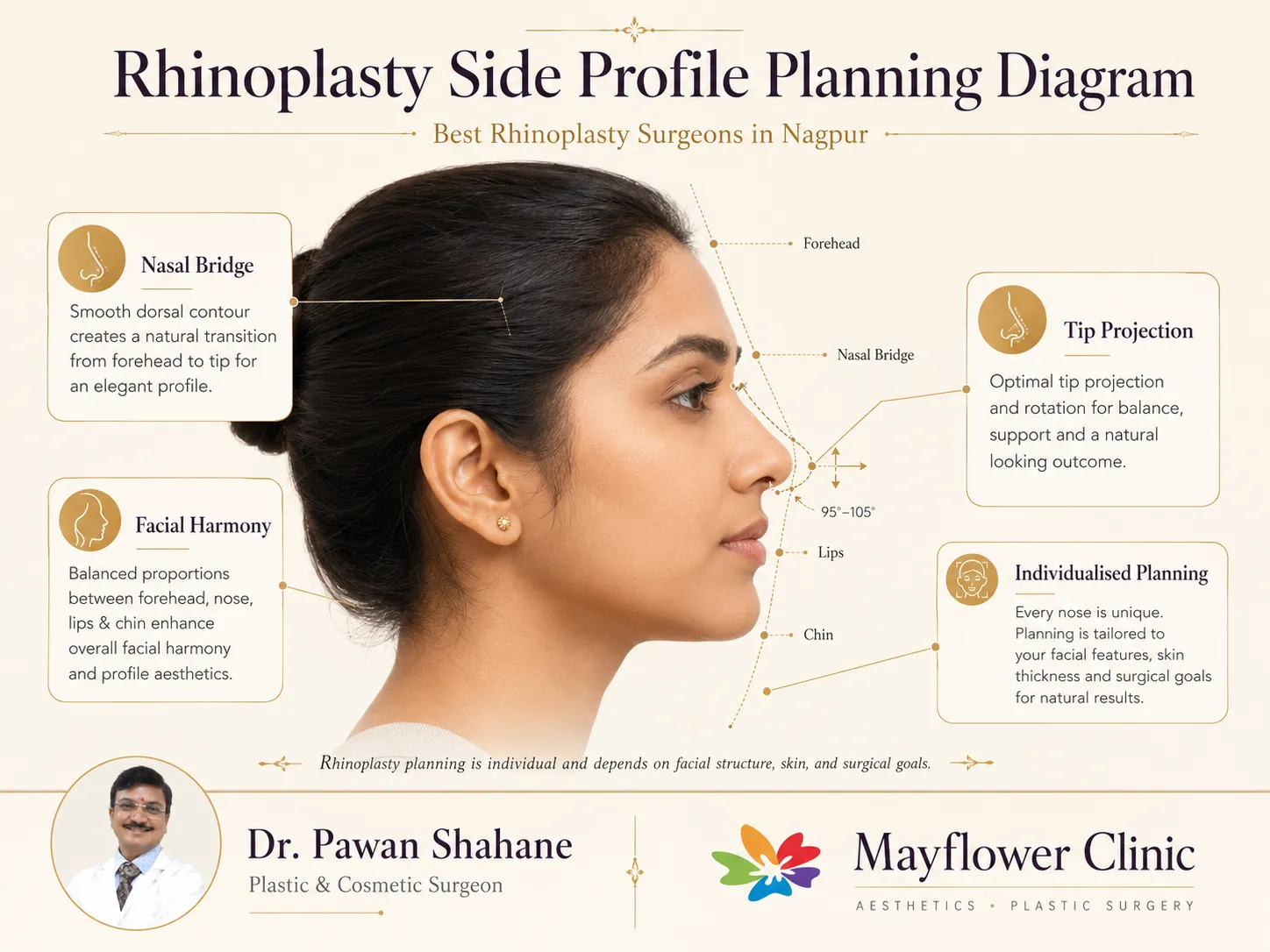
Facial proportions, side profile, skin thickness, breathing symptoms, past injury and realistic goals are studied together.
Approach
Open or closed rhinoplasty is selected according to the correction needed, not simply by preference or trend.
Anaesthesia
The anaesthesia plan depends on surgical complexity, patient fitness, comfort, and whether septal correction is also required.
Recovery
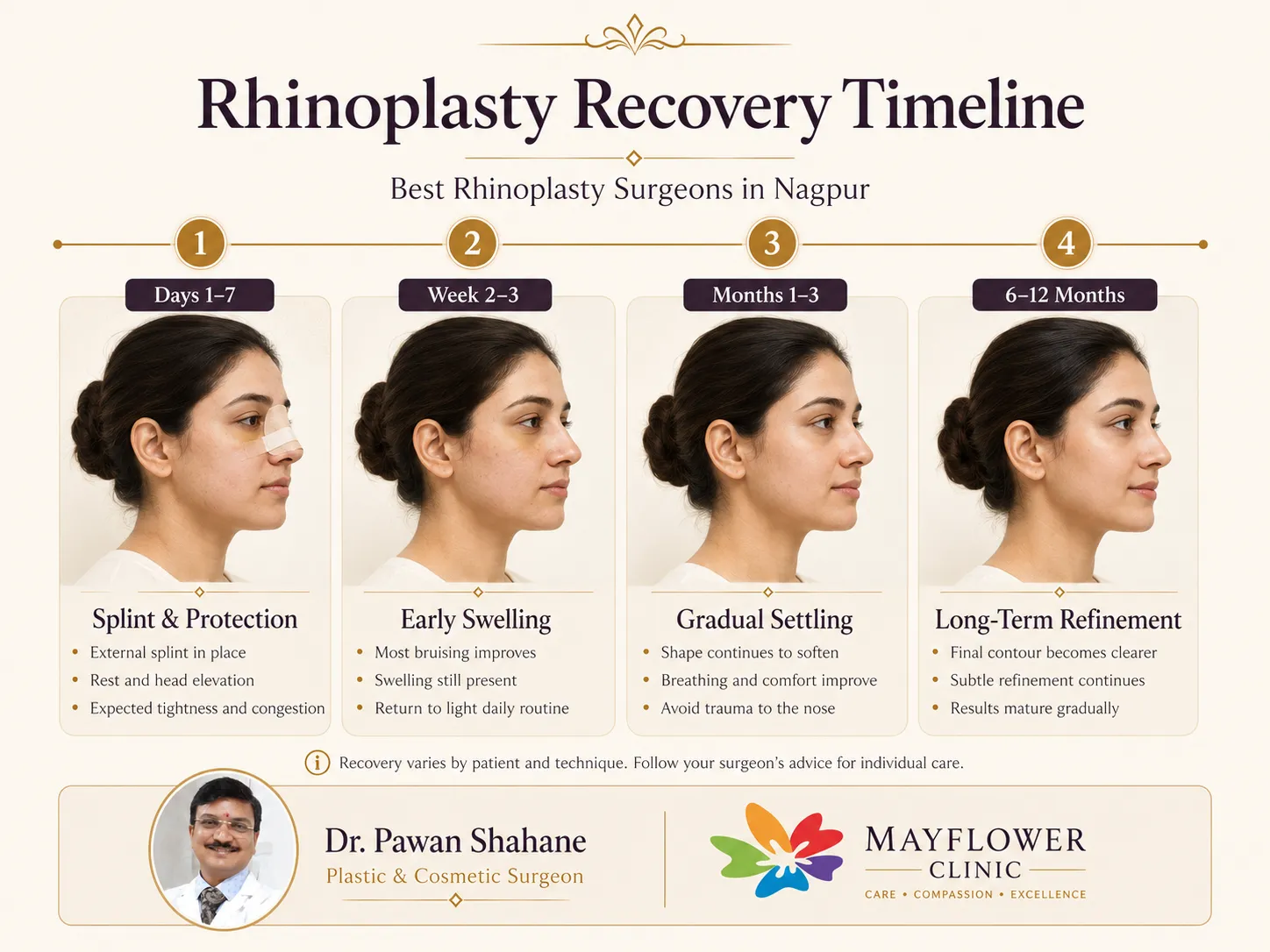
Early bruising and swelling improve first, while fine nasal definition settles slowly over months.
Rhinoplasty Starts With a Plan, Not With an Incision
A good rhinoplasty plan respects both the visible nose and the internal support system. The aim is not to copy another person's nose, but to create a balanced shape that suits the patient's own face and heals predictably.
What is assessed in consultation?
- Nasal bridge height, hump, width and deviation.
- Tip shape, projection, rotation and support.
- Nostril width, alar base and facial symmetry.
- Skin thickness, scarring tendency and healing pattern.
- Breathing, septal deviation, allergy or sinus history.
What is decided before surgery?
- Whether the goal is cosmetic, functional or both.
- Whether open, closed or septorhinoplasty is appropriate.
- Whether cartilage grafting, implant support or tip sutures may be needed.
- What changes are possible, limited or inadvisable.
- Expected downtime, splint care and follow-up schedule.
Open and Closed Rhinoplasty: How the Approach Is Chosen
Patients often ask which approach is better. The honest answer is that the better approach is the one that allows accurate correction for that nose. Some noses can be managed through hidden internal incisions; others need open exposure for safer reshaping of the nasal framework.
| Point | Open Rhinoplasty | Closed Rhinoplasty |
|---|---|---|
| Incision placement | A small incision is placed across the columella and continues inside the nostrils. | Incisions are placed inside the nostrils, without an external columellar incision. |
| Exposure | Gives direct view of cartilage and bony framework, useful in complex tip, crooked nose and revision-type planning. | Less external exposure, useful for selected bridge or limited corrections when anatomy is favorable. |
| Scar concern | The columellar scar is small and usually becomes subtle, but it must be discussed honestly. | No visible columellar scar, but internal access may limit complex reshaping in some noses. |
| Common use | Tip refinement, crooked nose, wide nose, saddle nose, grafting, asymmetry, detailed framework work. | Selected dorsal hump, minor bridge refinement, limited changes where support and symmetry are good. |
| Decision rule | Chosen when precision and exposure are more important than avoiding a small external scar. | Chosen when the planned correction can be done accurately through internal access. |
The final choice is made after physical examination. A planned open approach is not a sign that surgery is "bigger"; it may simply be the more controlled way to reshape a difficult nasal framework.
Before Surgery: Fitness, Anaesthesia and Preparation
Rhinoplasty may be performed under general anaesthesia or local anaesthesia with sedation in selected cases. The decision depends on the complexity of correction, expected duration, patient comfort and medical fitness.
Medical fitness
Blood tests and fitness evaluation are advised before surgery. Diabetes, hypertension, thyroid disease, bleeding tendency, medicines and smoking history should be disclosed.
Anaesthesia plan
General anaesthesia is commonly preferred for detailed rhinoplasty because it keeps the airway controlled and the patient comfortable throughout the procedure.
Medication instructions
Blood-thinning medicines, supplements and smoking may need to be stopped as advised. Do not stop prescribed medication without medical guidance.
What Happens on the Day of Rhinoplasty Surgery?
The exact sequence may vary by case, but this is the usual structure of the surgery day at a planned plastic surgery setup.
Admission and confirmation
Identity, consent, fasting status, investigations, medical history and planned procedure are checked before shifting to the operation area.
Marking and final discussion
The surgeon reviews the planned changes, photographs, breathing concerns and approach. This is the time to confirm priorities, not add rushed new goals.
Anaesthesia and preparation
Anaesthesia is given as planned. The nose and surrounding area are prepared under sterile precautions.
Framework correction
Depending on the plan, the surgeon may refine the bridge, reshape cartilage, adjust the nasal bones, correct deviation, place grafts or support the tip.
Closure, splint and recovery room
Incisions are closed, dressing and external splint are applied if needed, and the patient is observed until recovery from anaesthesia is satisfactory.
Different Noses Need Different Surgical Moves
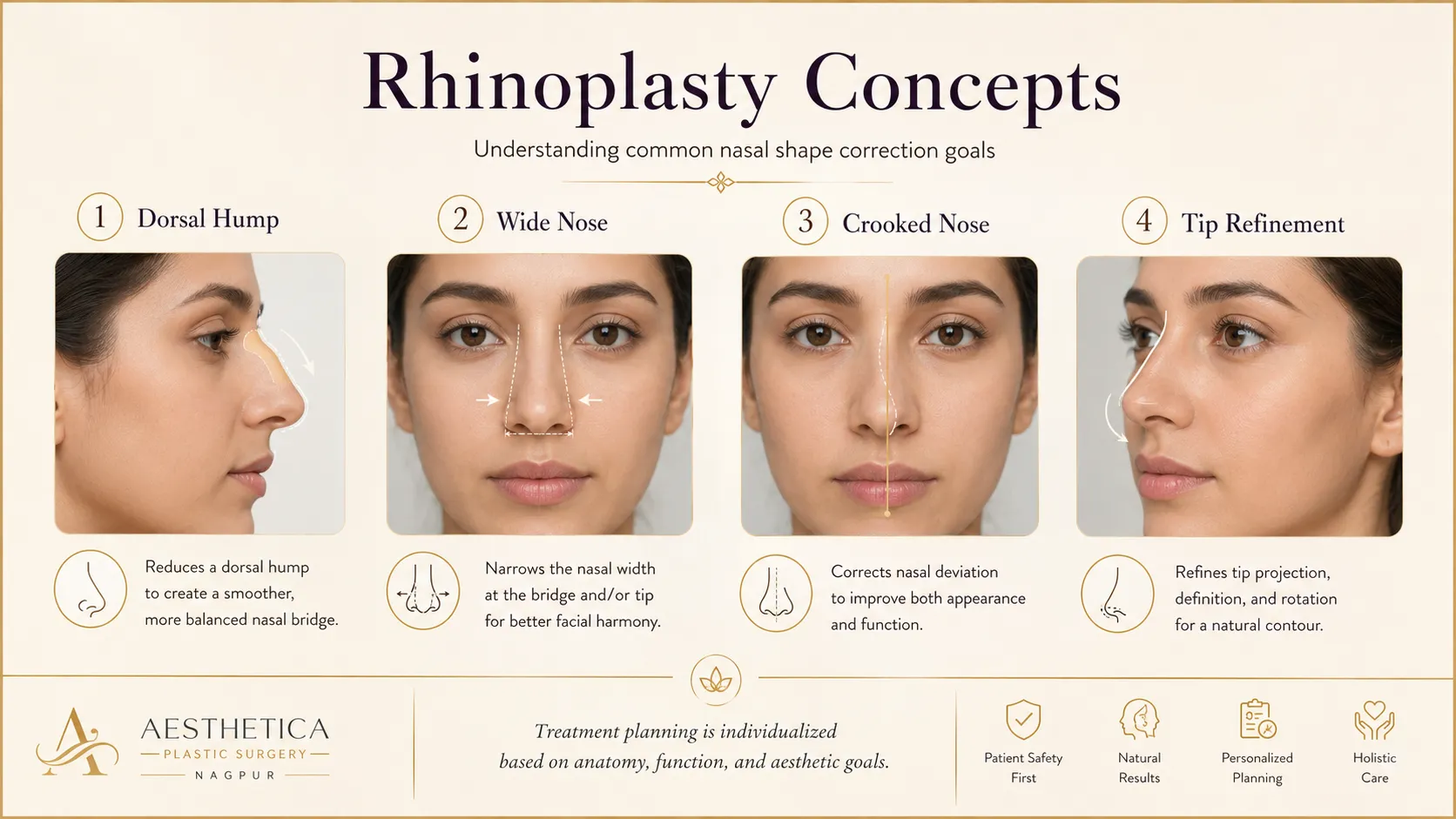
Rhinoplasty is not one standard operation. The visible concern may be "broad nose" or "hump," but the surgical plan depends on cartilage shape, bone width, skin thickness, septal support and facial proportions.
Bridge and upper nose
- Dorsal hump reduction.
- Nasal bridge narrowing.
- Saddle nose augmentation where appropriate.
- Crooked bony pyramid correction.
Tip and lower nose
- Bulbous tip refinement.
- Tip projection and rotation adjustment.
- Nostril or alar base narrowing in selected cases.
- Cartilage support using sutures or grafts.
What Rhinoplasty Surgery Can and Cannot Promise
A responsible rhinoplasty consultation includes limitations and risks. This protects the patient from unrealistic expectations and helps the surgeon choose a plan that is anatomically sensible.
Limitations
- Exact replica of another person's nose is not realistic.
- Thick skin may limit fine tip definition.
- Facial asymmetry can persist even after nasal correction.
- Swelling can make early results look wider or less defined.
Possible risks
- Bleeding, infection, bruising or prolonged swelling.
- Scar visibility in open rhinoplasty, usually small.
- Breathing change, crusting, numbness or stiffness.
- Asymmetry, contour irregularity or need for revision.
How risk is reduced
- Careful pre-operative assessment and fitness check.
- Technique selection based on anatomy.
- Strict aftercare and follow-up.
- Patience before judging final results.
Website information cannot replace personal examination. Final advice on suitability, technique, anaesthesia and risks must come from an in-person consultation with the operating surgeon.
Rhinoplasty Recovery After Surgery
Rhinoplasty recovery has two phases: visible early healing and slow internal refinement. Many patients feel functional within days, but the nose continues to settle for months.
Cosmetic Rhinoplasty and Breathing Correction
If a patient has blockage, snoring symptoms, history of injury, visible deviation or septal issues, the surgical plan may need to include functional correction. This is where rhinoplasty may overlap with septoplasty.
Ask specifically if you have:
- One-sided nasal blockage.
- Past nasal fracture or injury.
- Crooked nose with breathing difficulty.
- Frequent mouth breathing or sleep disturbance.
Useful related page
For breathing plus shape correction, read the focused page on rhinoplasty and septoplasty in Nagpur. It should be used when function is an important part of the surgical plan.
Rhinoplasty Experiences Shared by Patients
Reviews reflect individual patient experiences and do not guarantee the same result for every person.
"Best experience of rhinoplasty, my sister was having depressed nose and broad nose. We met with Dr. Shahane and discussed the issue. We got best result. Thanks to Dr. Shahane."Ratnesh Mudgal, Google Review
"I am very happy with my results. I always wanted to improve my nose but did not know where to go. Then I got to know about Dr. Pawan Shahane, plastic surgeon in Nagpur."Sushil Moon, Google Review
Continue Reading in the Rhinoplasty Cluster
These pages should support a spoke-wheel pattern: this surgical technique page links back to the main hub and to closely related decision pages.
FAQs About Rhinoplasty Surgery in Nagpur
Is open rhinoplasty better than closed rhinoplasty?
Neither is automatically better. Open rhinoplasty gives wider exposure and is useful for complex tip, crooked nose or grafting work. Closed rhinoplasty can be suitable for selected limited corrections. The surgeon chooses the approach after examination.
Is rhinoplasty done under general anaesthesia?
Many detailed rhinoplasty surgeries are performed under general anaesthesia for comfort and airway control. Selected limited cases may be considered differently depending on patient fitness and surgical plan.
Will I need a nasal implant or cartilage graft?
Not every patient needs an implant or graft. Support may be required in saddle nose, weak tip support, revision-type cases or selected augmentation plans. The material and need must be discussed individually.
How many days are needed for visible recovery?
Most patients need about one week for splint and early wound care, and one to two weeks for social recovery depending on bruising and swelling. Fine swelling and definition continue improving over months.
Can rhinoplasty improve breathing?
Rhinoplasty can improve breathing when structural airway problems are addressed as part of the plan. If septal deviation or obstruction is present, septoplasty or septorhinoplasty may be discussed.
Can results be guaranteed?
No surgical result should be guaranteed. A realistic consultation explains possible improvement, limitations, healing variability, asymmetry, risks and the small possibility of revision.
Planning Rhinoplasty Surgery?
Meet Dr. Pawan Shahane at Mayflower Clinic, Dhantoli, Nagpur for a personal surgical evaluation of nasal shape, breathing, approach selection, realistic limitations and recovery.

