0712 6692706 / 0712 3551170 / +91 8087471244   |   contact@mayflowerclinic.in
M.Ch. Plastic Surgery · Nagpur

Breast Augmentation in Nagpur — Implant Planning Beyond Cup Size

Breast augmentation with implants is a long-term surgical and device decision. The useful questions are not only “how many cc?” but also implant width, shape, profile, tissue cover, pocket placement, scar position, safety monitoring and what future revision may involve.

Dr. Pawan Shahane, M.Ch. Plastic Surgery
Reviewed by Dr. Pawan Shahane, M.Ch. Plastic Surgery 21+ years surgical practice · Ex-Asst. Prof. GMC Nagpur · IAAPS Member · Surgery personally performed
Implants are not lifetime devices. A sound consultation includes the expected benefit, the possibility of reoperation and a practical long-term monitoring plan—not only the early cosmetic result.
Dr. Pawan Shahane during a private surgical consultation at Mayflower Clinic Nagpur
Private, proportion-led consultation Implant dimensions, tissue support, scar trade-offs, safety information and future monitoring are discussed before surgery.
21+Years of surgical practice
M.Ch.Plastic Surgery qualification
IAAPSProfessional membership
PersonalSurgeon-led planning and surgery
Page Guide

Quick Answer

● Private · On-page · No login

Choose a common question or type a short phrase. The answer is selected locally within this page.

Start here:

Implant planning is three-dimensional. Width determines fit on the chest, profile determines forward projection, and volume is only one part of the decision.

Go to implant planning ↓ This guide cannot examine you, diagnose a condition, calculate candidacy, recommend surgery or replace a consultation.
Surgical Perspective

The right implant is not the largest implant the skin can temporarily hold.

“I plan from the patient’s breast base, chest width, skin quality and soft-tissue cover. Volume matters, but it must work with width, profile, pocket and the tissues that will support the implant for years.”
Dr. Pawan Shahane, M.Ch. Plastic Surgery · Founder, Mayflower Clinic, Nagpur
Procedure Overview

What breast augmentation with implants can—and cannot—do

Breast augmentation with implants adds volume and projection using a medical device placed in a surgically created pocket. It may help a patient who has naturally small breasts, loss of upper-pole fullness after pregnancy or weight change, developmental asymmetry or a preference for a more predictable volume increase than fat transfer can usually provide in one session.

It does not automatically lift a significantly drooping breast. When the nipple position and skin excess are the main issues, a breast lift, with or without an implant, may be a more suitable discussion. Implant surgery also does not create perfect symmetry, prevent future ageing or remove the possibility of later revision.

Concerns commonly discussed

  • Small breast volume relative to the patient’s frame
  • Loss of fullness after pregnancy, breastfeeding or weight change
  • Unequal breast volume or chest-wall asymmetry
  • Desire for greater and more predictable projection
  • Volume restoration as part of a combined lift-and-augmentation plan
Distinct from fat transfer: this page focuses on implant augmentation. Patients who prefer no implant, have adequate donor fat and accept a more limited or variable volume increase can read Breast Augmentation with Fat Transfer in Nagpur.
Size · Shape · Profile

Implant planning is a dimensional decision—not a cup-size order

Two implants with the same volume can look different because their width, height, projection, gel behaviour and relationship to the patient’s tissue are different.

Base width

The implant should relate to the measured breast base and chest width. Excessive width can extend beyond the natural footprint; insufficient width may leave an abrupt or narrow contour.

Fit before volume

Volume

Volume is measured in cubic centimetres, but the same number does not produce the same result in different bodies. Existing breast tissue, rib cage, skin and height alter the visual effect.

Not a cup-size guarantee

Profile

Profile describes forward projection relative to base width. Lower, moderate and higher profiles distribute a similar volume differently and affect upper-pole fullness and side-view projection.

Projection choice

Round shape

Round implants are symmetrical, so rotation does not alter the shape. The final look still depends on gel characteristics, pocket, tissue and the way the implant settles.

Common option

Anatomical shape

Anatomical implants have a shaped profile. They require careful selection and pocket control because rotation can change the breast contour. Surface characteristics and device availability must be reviewed.

Selected cases

Soft-tissue cover

Thin tissues may show implant edges or rippling more readily. Placement, implant dimensions and sometimes fat grafting are considered to improve coverage, but no method removes all visibility risk.

Tissue-led planning
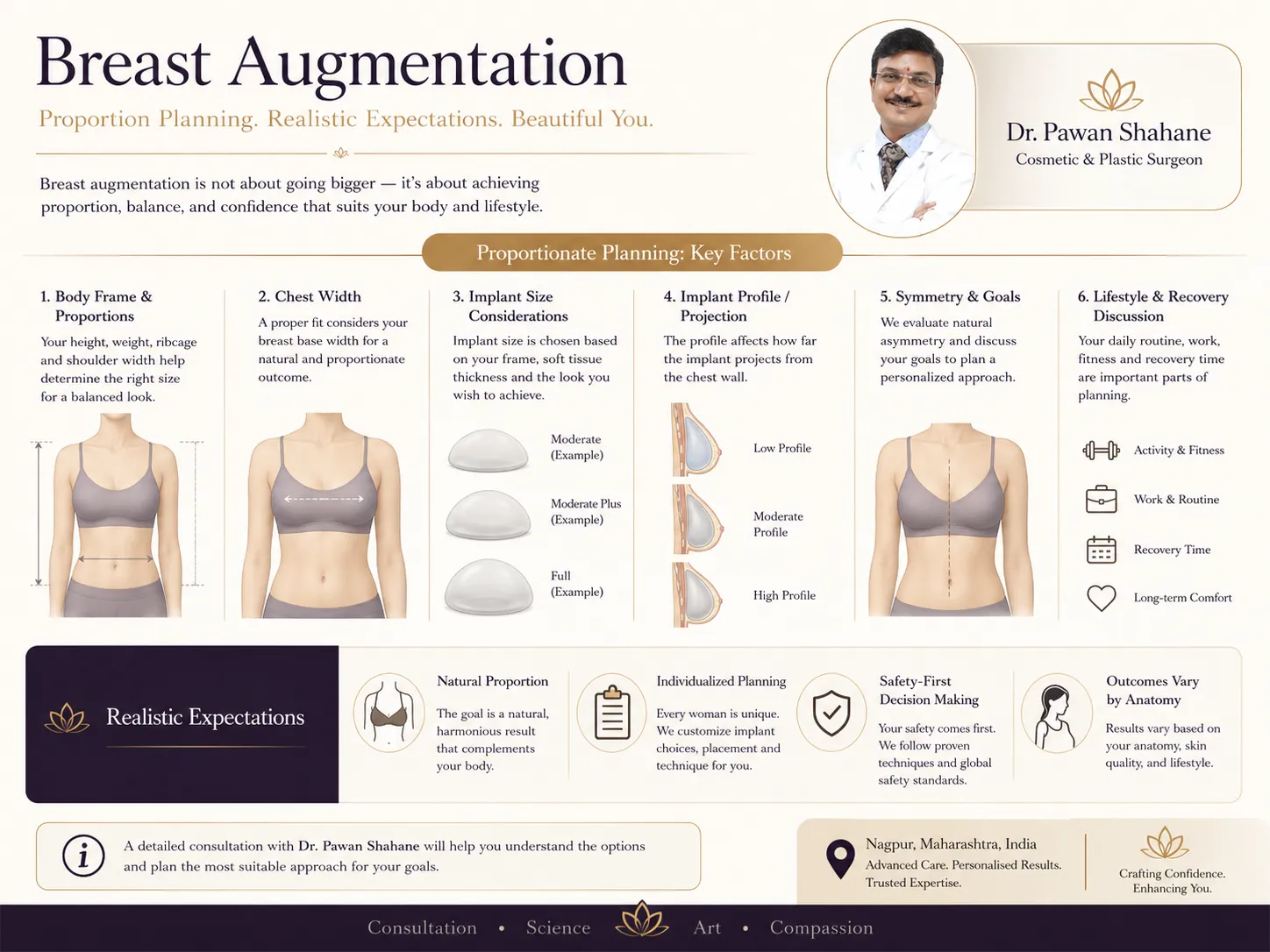
Breast augmentation proportion planning graphic showing chest width, implant size and profile
Educational planning visual. Implant selection must be based on an in-person examination and the current manufacturer information for the proposed device.
Implant Pocket

Above the muscle, below the muscle or dual plane?

No single pocket suits every patient. The choice balances tissue cover, animation, recovery, implant visibility, breast shape and the patient’s activity.

Subglandular

Implant below breast tissue and above the chest muscle.

  • No muscle animation over the implant
  • May suit selected patients with adequate tissue cover
  • Edges or rippling may be more visible in thin tissue
Decision depends on coverage and breast shape

Submuscular

Implant partly or more fully beneath the pectoralis muscle.

  • Additional upper-pole coverage in thin patients
  • May involve more early tightness
  • Muscle contraction can move or distort the implant
Coverage benefit with animation trade-off

Dual plane / subfascial

Modified pockets designed to balance coverage and lower-pole expansion.

  • Can help shape selected constricted or mildly drooping breasts
  • Requires precise dissection and individualized planning
  • Not a universal solution for all anatomy
Used when anatomy supports the strategy
Incision Planning

The scar position is chosen together with access and pocket control

Every incision leaves a scar. The aim is to place it thoughtfully, protect tissue and maintain adequate control of the implant pocket.

Inframammary fold

Placed in or near the lower breast crease. It offers direct access and precise pocket control, but the scar position must account for the planned new fold and implant size.

Periareolar

Placed at the border of the areola. It can provide central access, but areolar size, pigment contrast, bacterial exposure, sensation and future breastfeeding considerations require discussion.

Transaxillary

Placed in the armpit. It avoids a scar on the breast itself, but pocket creation and future revision through the same route may be more limited in some situations.

Scar quality depends on biology, tension, infection, smoking, sun exposure and aftercare. A hidden incision cannot be promised to become invisible.

Implants or Fat Transfer?

This page focuses on implants because the trade-offs are different

Implants can provide a larger and more predictable increase in one operation, with a choice of width and projection. They also introduce a permanent device that requires informed consent, monitoring and the possibility of future revision.

Fat transfer uses the patient’s own fat and avoids an implant, but the achievable increase is usually more limited, depends on donor fat and tissue survival, and may need staged treatment. It also has its own risks, including fat necrosis, oil cysts, calcification and contour irregularity.
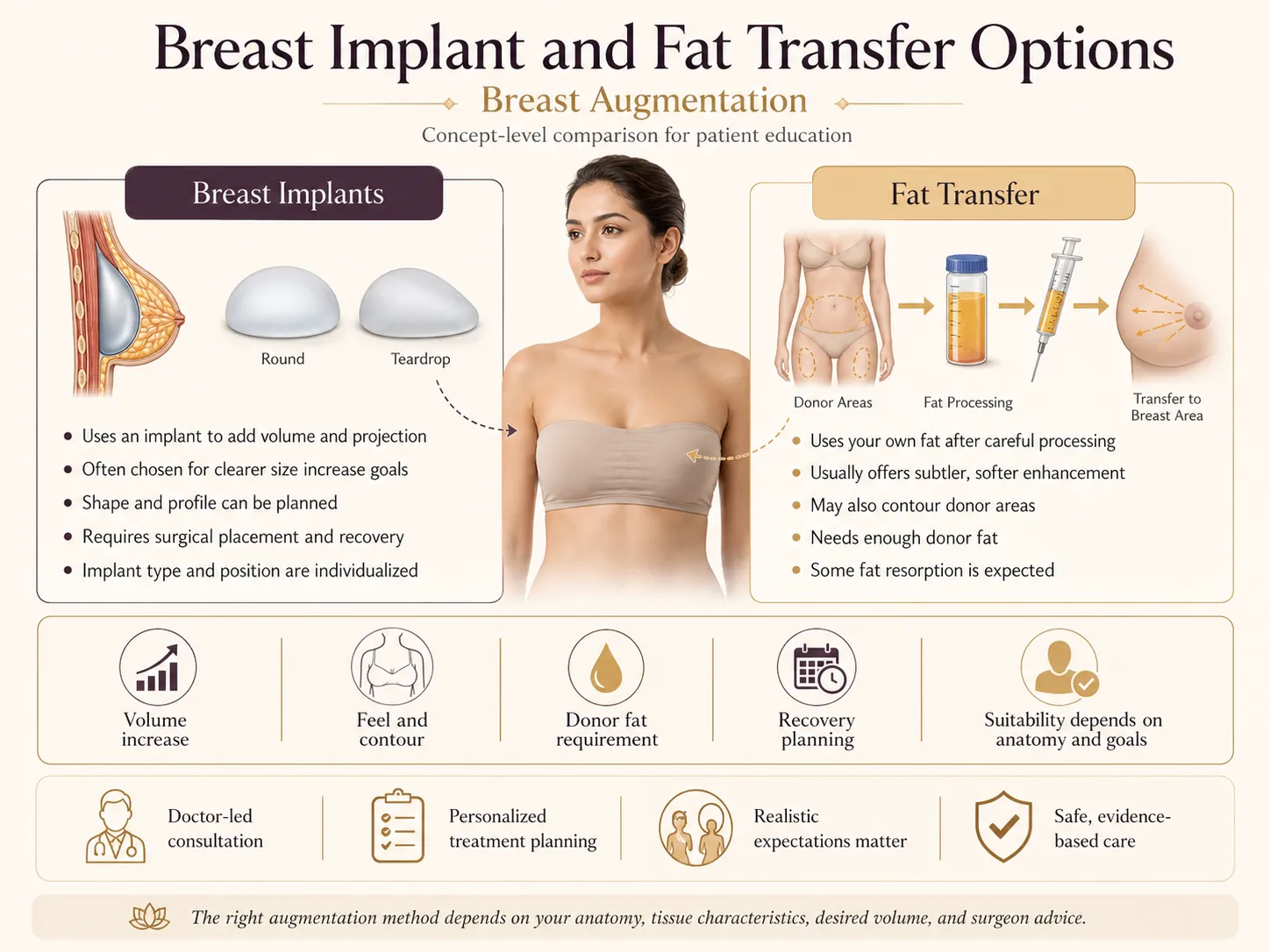
Non-explicit educational comparison of breast implants and fat transfer
Concept comparison only. Individual suitability depends on examination, goals, tissue quality and medical history.
Patient Journey

From consultation to implant settling

1
Consultation

Goals, anatomy and alternatives

Discussion begins with the reason for considering surgery, desired proportion, pregnancy plans, breast symptoms, previous operations, health conditions and alternatives including no surgery, fat transfer or lift.

2
Planning

Measurements and implant matrix

Breast-base width, chest shape, nipple position, skin stretch, tissue thickness and asymmetry are assessed. Implant width, volume, profile, shape and pocket are considered together.

3
Informed consent

Device information and long-term responsibilities

The proposed implant’s manufacturer information, surface, fill, risks, device card, monitoring and likely future revision considerations should be reviewed without rushing.

4
Pre-operative phase

Medical and anaesthesia assessment

Tests and breast imaging are arranged according to age, history and examination. Medicines, supplements, nicotine use, fasting and home support are reviewed.

5
Surgery day

Marking, pocket creation and implant insertion

Dr. Pawan Shahane marks the breast and planned fold, creates the selected pocket, checks haemostasis and symmetry, inserts the implant using a controlled technique and closes the incision in layers.

6
First weeks

Support, swelling and activity protection

Early tightness, swelling and a high implant position can occur. A support bra, wound instructions, sleeping position, arm movement and lifting limits are individualized.

7
Long term

Breast health and implant surveillance

Clinical review continues beyond scar healing. New changes should be assessed, routine breast screening continues and silicone implant integrity imaging is planned according to current guidance.
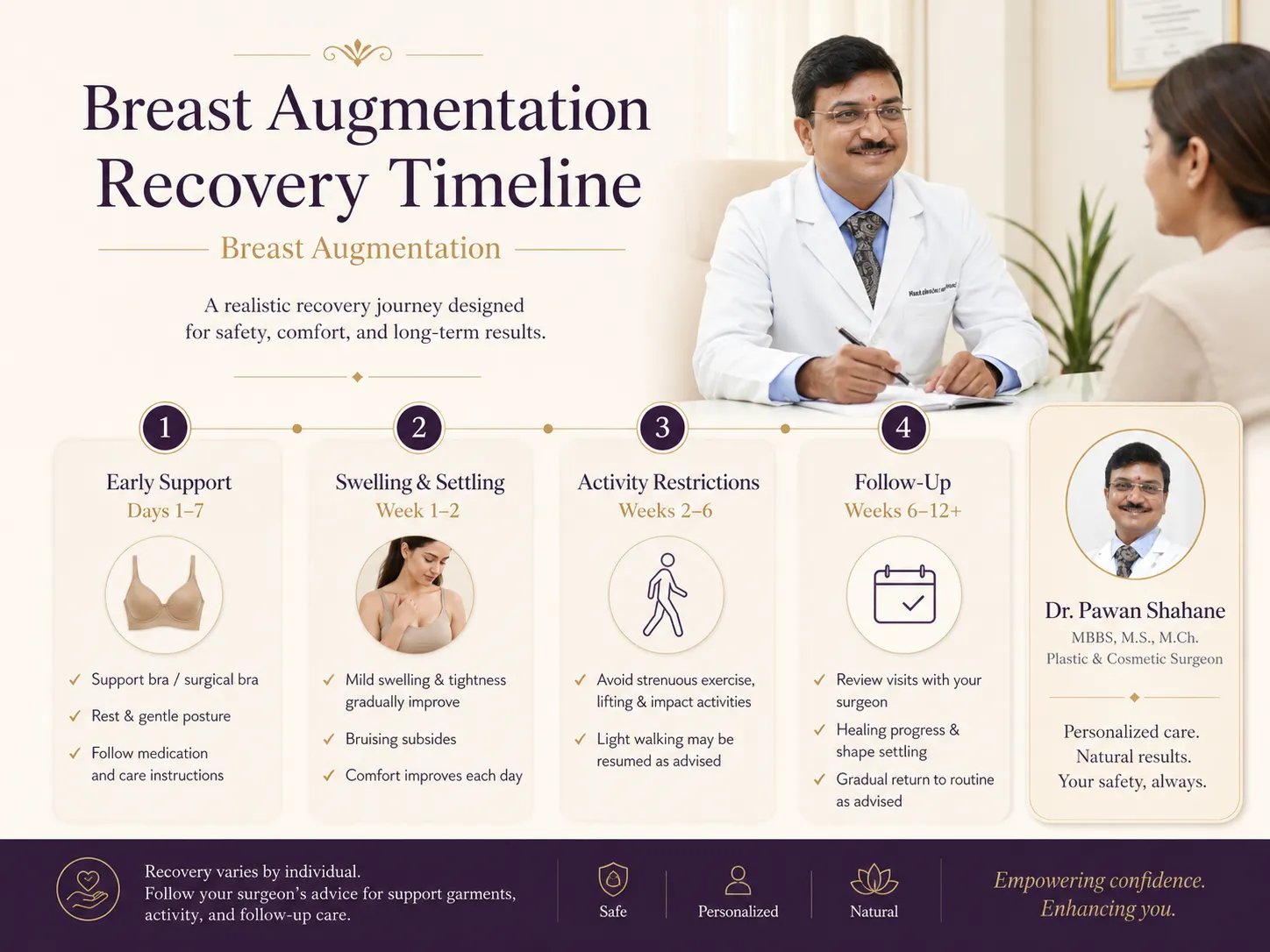
Breast augmentation recovery timeline showing support, activity restriction and follow-up
Recovery milestones are approximate and may differ for submuscular pockets, combined lift surgery, physically demanding work or complications.
Recovery Timeline

Recovery is staged, not a single “back to normal” date

  • First 48 hours: tightness, pressure and swelling are common; prescribed medicines and short walks are important.
  • Days 3–10: light routine and desk work may resume if comfortable; driving waits until safe arm movement and no sedating medicine.
  • Weeks 2–4: bruising and swelling reduce; wounds and scar care are reviewed; heavy lifting remains limited.
  • Weeks 4–6: exercise is restarted gradually only after clearance; chest training may require a slower return.
  • Months 2–6: implants settle, tissues soften and scars continue to mature.
Contact the clinic promptly for fever, spreading redness, increasing one-sided swelling, severe pain, wound opening, breathlessness or a sudden shape change.
Implant Safety

Capsular contracture, rupture and rare implant-associated conditions

Balanced counselling should explain common local complications, serious but uncommon conditions, warning symptoms and the fact that some complications require another operation.

🛡️ Capsular contracture

A thin capsule forms naturally around every implant. Contracture means the capsule tightens more than expected.

  • May cause firmness, discomfort, distortion or implant displacement
  • Can appear months or years after surgery
  • Management depends on severity and may include revision surgery

🔍 Rupture or deflation

Saline deflation is usually visible. Silicone rupture can be silent and may not be detected by examination alone.

  • MRI is the most effective method for detecting silent silicone rupture
  • Ultrasound is an accepted alternative for asymptomatic screening
  • New shape change, lumps, pain or swelling require evaluation

⚠️ BIA-ALCL and other rare capsule cancers

BIA-ALCL is a lymphoma, not breast cancer. The FDA reports higher risk with textured surfaces than smooth surfaces.

  • Typical warning symptoms include persistent swelling, a mass or pain around the implant
  • Symptoms often occur years after implantation
  • Late fluid or a mass needs proper imaging and specialist assessment—not simple implant exchange without diagnosis

🗓️ Long-term monitoring

Keep the implant device card and operative record. Continue routine breast-health screening and contact the surgeon when changes occur.

  • For silicone implants: ultrasound or MRI at 5–6 years
  • Repeat every 2–3 years thereafter under current FDA/ASPS guidance
  • Earlier imaging when symptoms, trauma or clinical concern arise
Breast implant illness (BII): some patients report systemic symptoms such as fatigue, “brain fog,” rash or joint pain. The cause remains poorly understood. Symptoms deserve a respectful medical assessment rather than dismissal or an overly certain explanation.
Long-Term Revision

There is no automatic “10-year expiry,” but future surgery must be expected as a possibility

Implants are not lifetime devices. Some remain satisfactory for many years; others need earlier revision. Decisions are based on symptoms, examination, imaging, breast changes and patient preference—not a calendar alone.

Long-term issueWhat may happenPossible next step
Capsular contractureFirmness, pain, distortion or displacementClinical grading; imaging when indicated; possible capsulectomy, pocket change or implant exchange
Rupture / deflationVisible deflation with saline or silent rupture with siliconeUltrasound or MRI; removal or exchange discussed according to findings
MalpositionImplant moves too low, too lateral, too medial or rotatesPocket repair, size change, reinforcement or alternative plan
Rippling / visibilityEdges or folds visible, especially with thin tissueImplant or pocket change, fat grafting, or acceptance of limitations
Pregnancy / ageing / weight changeNatural breast tissue and skin change around the implantObservation, lift, exchange, removal or combined revision depending on goals
Personal preferencePatient later wants a different size or implant removalDiscuss expected tissue appearance after removal, with or without lift or fat transfer
Private Consultation

What should be decided before scheduling surgery?

1

Goal in words and images

Discuss fullness, proportion, upper-pole preference and what you do not want. Reference images communicate direction, not a promise of a duplicate result.

2

Implant specification

Manufacturer, fill, surface, width, height, profile and volume should be documented. Ask for the device card after surgery.

3

Pocket and incision

Understand why the suggested pocket and scar location suit your tissues, and what trade-offs would change with another approach.

4

Lift requirement

An implant adds volume but does not reliably correct substantial skin excess or a low nipple position. Clarify whether augmentation alone is sufficient.

5

Risk and revision plan

Discuss contracture, rupture, infection, malposition, sensation, scars, rare capsule conditions, monitoring and who manages later concerns.

6

Recovery logistics

Plan transport, home support, work leave, childcare, sleeping position, support bra and restrictions before the operation.

Breast augmentation consultation in Nagpur discussing implant size, profile and safety
Existing educational consultation visual used as a wide crop. The consultation image is displayed as a wide crop; the current clinic contact actions are provided directly on this page.
Patient Feedback

Selected verified feedback about Dr. Shahane’s surgical care

These excerpts describe individual experiences with Mayflower Clinic and are not predictions of another patient’s outcome.

★★★★★
“Good experience. Highly skilled surgeon. Post op care and consultation was also done nicely.”
Mahika Goel · Verified clinic testimonial
★★★★★
“Amazing experience with Dr Pawan Shahane… He is good in knowledge… and he is very kind in nature.”
Jithin Raj · Verified clinic testimonial
★★★★★
“The surgery was really good and the doc is always there to help.”
Dhanashree Sadawarti · Verified clinic testimonial

The supplied clinic inventory also lists Nilam Drugwar under breast augmentation. Her exact wording should be added only after the original review screenshot is re-verified; it has not been invented here.

Patient Questions

Breast implant FAQs

How is breast implant size chosen?
Implant size is selected from breast-base width, chest dimensions, existing tissue, skin stretch, asymmetry, implant profile and your proportion goals. A cup-size request alone is not a reliable sizing method because bra sizing varies between brands and bodies.
Is a bigger breast implant always better?
No. An implant that is too wide or heavy for the tissue envelope may increase implant visibility, rippling, stretching, bottoming-out, malposition and revision concerns. The aim is a proportionate implant that the tissues can reasonably support.
What is the difference between round and anatomical breast implants?
Round implants provide symmetrical fullness and do not change breast shape if they rotate. Anatomical implants have a shaped profile but require careful selection and carry rotation considerations. Availability, surface type and manufacturer information must be discussed.
What does breast implant profile mean?
Profile describes how far an implant projects forward relative to its base width. Low, moderate and higher profiles can create different proportions even at a similar volume. Profile should be selected after measuring the breast base and assessing tissue cover.
Is the breast implant placed above or below the chest muscle?
Placement may be subglandular, subfascial, submuscular or dual-plane. The choice depends on tissue thickness, activity, breast shape, desired upper-pole contour and the risk of implant visibility or muscle-related movement.
Where are breast augmentation incisions made?
Common options include the inframammary fold, the edge of the areola and the armpit. The incision is chosen according to anatomy, implant type, pocket control, scar trade-offs and future access. Every approach leaves a scar.
How long is recovery after breast augmentation?
Many patients return to light desk work in about one week, while lifting and strenuous exercise usually need a longer restriction. Swelling and implant position settle gradually over weeks to months. Your recovery may be slower after a submuscular pocket or combined lift.
What is capsular contracture?
A thin scar capsule normally forms around every implant. Capsular contracture occurs when that capsule tightens excessively, causing firmness, shape change, displacement or pain. Significant cases may need revision surgery.
Can a silicone breast implant rupture without symptoms?
Yes. Silicone implant rupture may be silent and may not be detected by physical examination alone. MRI is the most effective method for detecting silent rupture, and ultrasound is an accepted screening alternative for asymptomatic patients.
What long-term monitoring is needed after silicone breast implants?
Current FDA and ASPS guidance recommends ultrasound or MRI five to six years after silicone implant placement and every two to three years thereafter. Earlier assessment is needed whenever symptoms, trauma, a new breast change or clinical concern occurs.
Do breast implants need replacement every 10 years?
There is no universal date when every implant must be replaced. However, implants are not lifetime devices, and future surgery may become necessary because of rupture, contracture, position change, ageing, pregnancy-related change or personal preference.
What symptoms after breast implants need prompt review?
Seek prompt assessment for persistent one-sided swelling, a new mass, increasing firmness, pain, redness, fever, sudden size or shape change, wound problems or suspected implant displacement. Late swelling around an implant should not be ignored.
Can I breastfeed after breast augmentation?
Many patients can breastfeed after augmentation, but no technique can guarantee future milk production. Existing gland development, the incision, surgery near ducts and nerves, pregnancy and other individual factors all matter.
Will breast implants affect mammography?
Breast cancer screening remains important. Tell the radiology team that implants are present so implant-displacement views or other imaging can be planned. Implants do not replace routine breast-health evaluation.

Medical references and patient-safety resources

  1. U.S. FDA — Things to Consider Before Getting Breast Implants
  2. U.S. FDA — Risks and Complications of Breast Implants
  3. U.S. FDA — Questions and Answers about BIA-ALCL
  4. American Society of Plastic Surgeons — Breast Augmentation Risks and Safety
  5. ACR Appropriateness Criteria — Breast Implant Evaluation

References support general patient education. Device availability, regulatory status, manufacturer labelling and follow-up recommendations should be checked for the actual implant proposed in India at the time of consultation.

Mayflower Clinic · Dhantoli

Book a breast implant planning consultation

Bring your questions about size, profile, pocket, scars, monitoring and future revision. The consultation is designed to determine whether augmentation alone, a lift, fat transfer, a combination—or no surgery—is the more appropriate pathway.

Medical Disclaimer: All surgical procedures carry inherent risks, and individual outcomes vary based on anatomy, skin type, tissue quality, implant characteristics and healing biology. Breast implants are not lifetime devices, and future monitoring or revision surgery may be required. Surgical results cannot be promised. Formal in-person consultation with Dr. Pawan Shahane is required before any surgical decision. This page is for general educational purposes only and does not constitute medical advice or a treatment recommendation.

Cosmetic, plastic and hair transplant surgery led personally by Dr. Pawan Shahane, M.Ch. Plastic Surgery.

Visit Mayflower Clinic

Surdham Complex, Dhantoli
Nagpur — 440012
Maharashtra, India

Contact & Hours

0712 6692706
+91 80874 71244
Monday–Saturday, 11 AM–6 PM
Sunday closed