
0712 6692706 / 0712 3551170 / +91 8087471244   |   contact@mayflowerclinic.in

Gummy Smile Correction in Nagpur | Dr. Pawan Shahane
M.Ch. Plastic Surgery · Nagpur

Gummy Smile Correction in Nagpur — Treat the Cause, Not Just the Gum Show.

A gummy smile may arise from the upper lip, gums and teeth, bite, jaw proportions—or several factors together. At Mayflower Clinic, the first step is a careful smile assessment so that any correction remains proportionate, conservative and natural in movement.

Not every gummy smile needs surgery.
Some patients need no treatment; others may benefit from temporary injection-based correction, lip repositioning or coordinated dental, periodontal, orthodontic or jaw assessment.
Dr. Pawan Shahane, M.Ch. Plastic Surgery
Reviewed by Dr. Pawan Shahane, M.Ch. Plastic Surgery 21+ years surgical practice · Ex-Asst. Prof. GMC Nagpur · IAAPS Member · 9 years ThreeBestRated Nagpur
How gummy smile correction is planned through consultation, smile assessment and cause-based treatment selection Mayflower Clinic · Dhantoli, Nagpur
21+ YearsSurgical practice
M.Ch.Plastic Surgery
Cause-ledIndividualised planning
0 DelegationDoctor-led procedure care
Questions patients often ask

Quick Answer

Nagpur patient guide
What causes it? A gummy smile can come from excessive upper-lip movement, a short upper lip, gum and tooth proportions, tooth or bite position, vertical upper-jaw proportions, asymmetry—or a combination. The cause matters because each needs a different plan.
Understanding the concern

What Does “Gummy Smile” Mean?

A gummy smile is the common term for excessive gingival display—showing more upper gum during a full smile than the individual finds balanced with their teeth, lips and face. There is no single smile measurement that suits everyone. Gum show can be entirely healthy and may simply be a normal personal feature.

Treatment is optional and should be guided by the patient’s own concern, not pressure to match a standardized smile. When correction is requested, the goal is usually to improve the relationship between the upper lip, visible tooth height and gum show while preserving normal speech, lip closure and natural expression.

Because the cause may be soft-tissue, dental, periodontal, orthodontic or skeletal, a one-treatment-fits-all approach can produce an under-correction, an over-correction or an unnatural smile.

What is assessed before recommending treatment?

  • Gum show at rest, during a spontaneous smile and during a full posed smile
  • Upper-lip length, resting position, symmetry and amount of upward movement
  • Visible tooth height, tooth proportions, bite and dental projection
  • Gum contour, gum health and whether tooth eruption is complete
  • Facial proportions and signs of vertical maxillary or jaw contribution
  • Previous injections, dental procedures, surgery, scars and medical history
  • The degree of change the patient wants—and what should remain unchanged
Why diagnosis matters

Common Gummy Smile Patterns and Possible Causes

The same amount of visible gum can have very different causes. A careful pattern analysis helps avoid choosing a temporary lip treatment for a dental problem—or a dental procedure for a predominantly muscular smile.

Hyperactive Upper Lip

The upper lip travels farther upward than expected during smiling because the elevator muscles are highly active.

Lip-dynamic cause

Short Upper Lip

A naturally shorter upper lip may reveal more gum even when lip movement itself is not markedly excessive.

Lip-anatomy cause

Altered Passive Eruption

More gum may cover the visible tooth crown, making teeth look shorter. Periodontal assessment is needed before contouring.

Gum-tooth cause

Tooth or Bite Position

Dentoalveolar extrusion, tooth position or the bite relationship can increase upper gum display and may need orthodontic input.

Dental cause

Vertical Jaw Proportion

Vertical maxillary excess can increase gum show and lower-face height. Significant cases require maxillofacial and orthodontic assessment.

Skeletal cause

Mixed or Asymmetrical Pattern

One side may rise more than the other, or several factors may coexist. Combination planning is often more appropriate than a single method.

Combined cause
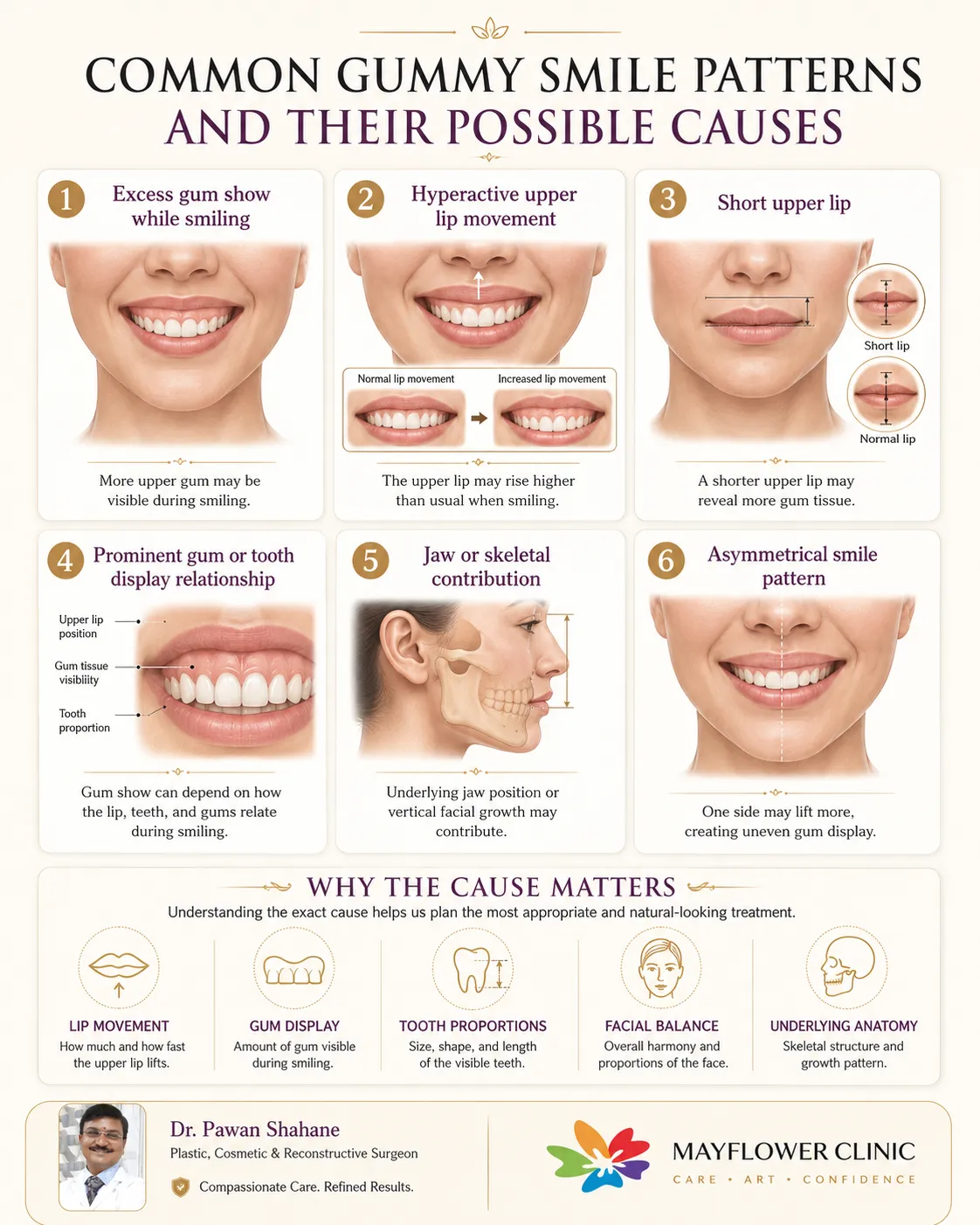
Medical infographic showing common gummy smile patterns including excessive gum display, hyperactive or short upper lip, gum-tooth relationship, jaw contribution and asymmetry
Patient-education infographic: common patterns are clues, not a diagnosis. An in-person smile assessment is required.
Dr. Shahane’s clinical perspective

A Natural Smile Is a Moving Relationship

“Gummy smile correction is not simply about lowering the lip or removing gum. We first identify which part of the smile is creating the imbalance, then choose the smallest appropriate intervention that preserves expression.”
Dr. Pawan Shahane, M.Ch. Plastic Surgery · Founder, Mayflower Clinic, Nagpur
Cause-based choices

Which Treatment May Be Considered?

The most suitable option depends on what is driving the gum show. Lip-related treatment at Mayflower Clinic is planned and personally performed by Dr. Pawan Shahane, while specialist assessment is coordinated when the main cause lies in the gums, teeth, bite or jaw.

Muscle-Relaxing Injection-Based Correction

Often searched as “Botox for gummy smile,” this may suit selected patients with excessive upper-lip elevation. Small doses may reduce the upward pull during smiling. The aim is moderation—not a stiff or expressionless upper lip.

TemporaryMinimal interruptionResults assessed after settling

Lip Repositioning Procedure

An intraoral procedure may limit excessive lip elevation in carefully selected patients. It is not suitable for every cause, and recurrence or residual gum show is possible.

Local anaesthesiaInside-mouth incision1–2 week early recovery

Gum Contouring or Crown-Lengthening Assessment

When visible teeth appear short because gum covers the tooth crown, periodontal treatment may be considered. Some cases involve gum only; others require bone-level planning by a periodontist.

Dental specialistGum-tooth proportionHealth first

Orthodontic or Restorative Dental Planning

Tooth position, bite, dentoalveolar extrusion or tooth proportions may be better treated with orthodontics or restorative dentistry rather than lip surgery.

Bite assessmentTooth positionMultidisciplinary

Orthognathic Assessment

Significant vertical maxillary excess is a skeletal issue. Jaw surgery is a major treatment and is considered only after formal orthodontic and oral-maxillofacial evaluation.

Selected severe patternsSpecialist pathwayMajor surgery

Combined or Conservative Approach

Mixed causes may need staged or combined care. Mild gum show may need no treatment at all when the patient is comfortable and oral health is normal.

IndividualisedStaged when usefulObservation is valid
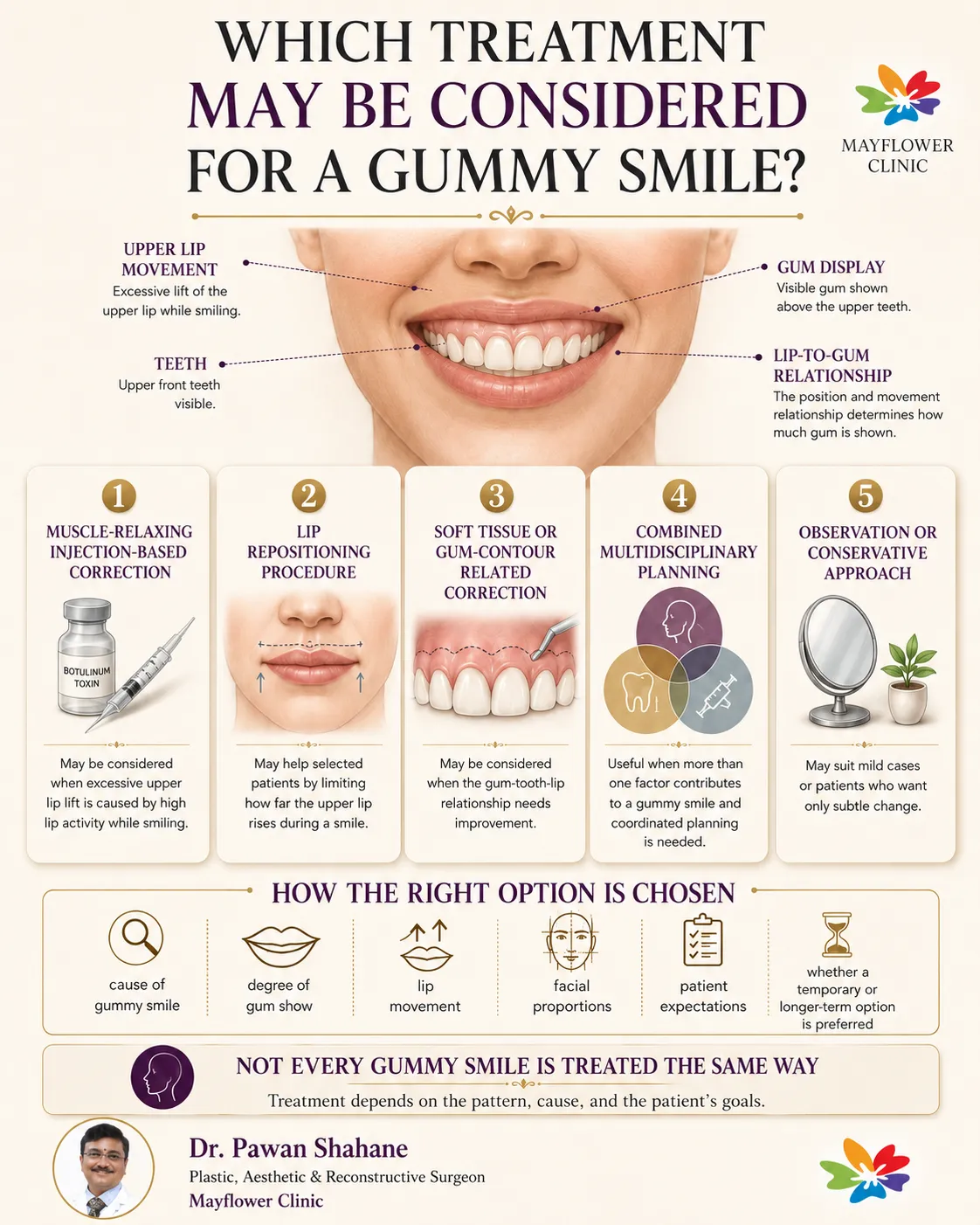
Comparison infographic of possible gummy smile treatments including injection-based correction, lip repositioning, gum-related correction, combined planning and conservative observation
The right option is selected according to cause, gum show, lip movement, facial proportions, oral health and patient expectations.
Consultation to follow-up

How Gummy Smile Correction Is Planned

Planning is more important than rushing to a treatment. The pathway below is adapted to the individual smile.

1
Patient priorities

Understand the concern and desired degree of change

Discussion includes confidence, smile preferences, whether the gum show is central or asymmetrical, and whether the patient wants a temporary trial or a longer-lasting option.

2
Smile examination

Observe the lips, teeth and gum show in motion

Photos or video may be used to compare rest, spontaneous smile and full smile rather than relying on one still expression.

3
Cause analysis

Identify lip-dynamic, gum-tooth, dental or skeletal factors

Upper-lip length and mobility, tooth display, gum architecture, bite, facial proportions and asymmetry are reviewed together.

4
Suitability

Review health, prior treatment and realistic limitations

Previous injections, oral surgery, dental treatment, scarring, neuromuscular conditions, medicines, pregnancy status and healing considerations may affect the plan.

5
Options

Compare the least invasive appropriate choices

Expected duration, reversibility, recurrence, downtime, need for specialist referral and the possibility of staged treatment are explained.

6
Treatment and aftercare

Perform conservatively and protect oral hygiene

Instructions depend on the option and may include avoiding pressure or exercise after injections, modified oral care or a soft diet after intraoral surgery.

7
Review

Assess the settled smile, symmetry and function

Early swelling is not the final result. Review focuses on natural movement, lip closure, speech, comfort and whether any further treatment is truly needed.

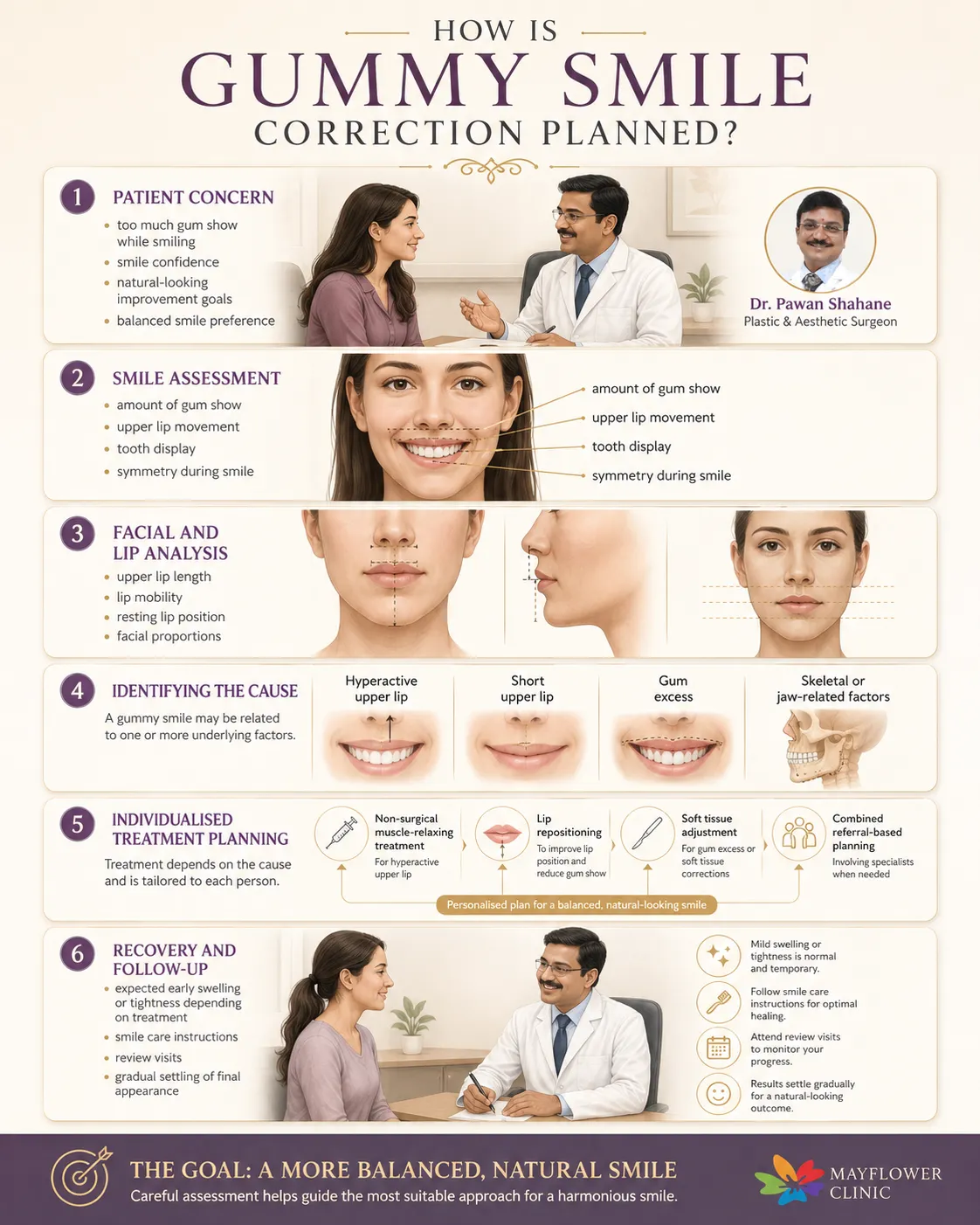
Step-by-step infographic explaining how gummy smile correction is planned from patient goals and smile assessment to cause identification, treatment selection and follow-up
Planning infographic: assessment precedes treatment because the same visible concern may have several underlying causes.
What recovery may feel like

Recovery Depends on the Selected Option

There is no single recovery timeline for “gummy smile correction.” These are general bands, not promises.

OptionEarly periodTypical review pointImportant limitation
Muscle-relaxing injectionSmall injection marks, mild tenderness or bruising may occur. Most routine activity continues.Effect is commonly reviewed after about 1–2 weeks.Temporary; asymmetry or unwanted smile change can occur if muscles respond differently.
Lip repositioningSwelling, tightness, restricted smiling and a soft or modified diet are common in the early days.Early healing review, then assessment after swelling settles over several weeks.Recurrence, residual gum show, scar tightness and altered lip movement are possible.
Periodontal treatmentGum tenderness and diet/oral-care modifications depend on whether gum only or gum-and-bone treatment is performed.Directed by the treating dentist or periodontist.Not appropriate when the main cause is lip movement or jaw structure.
Orthodontic or jaw treatmentTimelines are substantially longer and depend on the bite and skeletal plan.Managed by the orthodontic and maxillofacial team.These are not quick cosmetic treatments and require comprehensive planning.
Balanced consent

Risks, Limitations and Reasons to Pause

A technically simple treatment can still change the smile. Conservative dosing, careful selection and honest discussion of recurrence are essential.

Injection-Related Effects

Bruising, tenderness, headache, uneven effect, lip weakness, altered smile, difficulty using a straw or speech changes may occur. Effects are usually temporary but require review.

Intraoral Surgery Effects

Swelling, bleeding, infection, pain, temporary numbness, tightness, scar formation, asymmetry, restricted lip movement or recurrence can occur after lip repositioning.

Recurrence or Residual Gum Show

Soft tissues move and heal differently. A procedure may improve but not eliminate gum show, and the result can reduce over time.

Over-Correction

Too little upper-lip movement may look unnatural and can affect expression or lip function. The objective is balance, not complete immobilisation.

Wrong-Cause Treatment

Injection cannot correct significant skeletal excess, and gum contouring cannot correct excessive lip elevation. Misdiagnosis leads to disappointing results.

Need for Specialist Coordination

Active gum disease, bite problems, tooth eruption concerns or jaw disproportions may need dental, periodontal, orthodontic or maxillofacial care before cosmetic treatment.

Contact the treating doctor urgently for breathing or swallowing difficulty, marked lip weakness, rapidly increasing swelling, persistent bleeding, fever, pus, severe worsening pain or another unexpected reaction. Forms and WhatsApp are not for emergencies.
Patient feedback

Verified Google Reviews About Broader Care at Mayflower Clinic

These authentic reviews describe other procedures and general care by Dr. Shahane. They are included for transparency and are not gummy-smile outcome claims.

Individual experiences vary. Review wording is reproduced verbatim or shortened only with an ellipsis.
★★★★★
“Had a treatment for the injury and it was a great experience. It was like after removing stitches it looks as it was almost before the injury”
Maroti Nawghade
Google review · Injury/reconstructive care
★★★★★
“Rhinoplasty, nose surgery done for my sister. We are very happy with results… He explains everything and how to take care. He support at every stage and do the surgery as planned.”
Kunal Thakur
Google review · Rhinoplasty care
★★★★★
“Best cosmetic surgeon, I strongly recommend, him for all plastic surgery. He is very intelligent and guides you very well… And surgery was the best decision. Thanks sir.”
Sachin Batra
Google review · Gynecomastia care
Clear answers before treatment

Common Questions About Gummy Smile Correction

These general answers support consultation but do not replace examination.

What is a gummy smile?
A gummy smile, also called excessive gingival display, means that more upper gum is visible during smiling than the person would prefer. It is usually an aesthetic concern rather than a disease, and treatment is optional.
What causes a gummy smile?
Possible causes include a hyperactive or short upper lip, excess gum covering the teeth, tooth or bite position, vertical upper-jaw proportions, gum enlargement, asymmetrical lip movement or a combination of factors.
Is a gummy smile a medical problem?
Most gummy smiles are not harmful. Assessment is still useful because gum disease, gum enlargement, bite problems or a skeletal cause may need dental or maxillofacial evaluation.
Can gummy smile be corrected without surgery?
Yes. Selected patients with excessive upper-lip movement may benefit from carefully placed muscle-relaxing injections. Conservative observation, orthodontic or dental approaches may also be appropriate depending on the cause.
How do muscle-relaxing injections help a gummy smile?
They temporarily reduce excessive activity of selected upper-lip elevator muscles so the lip rises less during a full smile. Dose and placement must be conservative to protect natural expression, speech and lip function.
How long do injection results usually last?
The effect is temporary. It commonly becomes noticeable within days, settles over one to two weeks and may last around three to six months, although duration varies between individuals.
What is lip repositioning surgery?
Lip repositioning is an intraoral procedure that limits excessive upward movement of the upper lip in selected patients. The incision is placed inside the mouth. Suitability depends on the cause, anatomy and expected trade-offs.
Who may be suitable for lip repositioning?
It may be considered when increased upper-lip mobility or a short upper lip contributes significantly and the patient has realistic goals. Marked skeletal excess, certain periodontal conditions or unsuitable anatomy may require another plan.
Can gum contouring correct a gummy smile?
It may help when excess gum tissue or altered tooth eruption makes the visible teeth look short. A dentist or periodontist must assess whether gum-only contouring or crown lengthening involving bone is appropriate.
When is jaw surgery considered for a gummy smile?
Orthognathic surgery may be considered when significant vertical maxillary excess or another skeletal relationship is the main cause. This requires specialist orthodontic and oral-maxillofacial assessment and is not a minor cosmetic procedure.
How long is recovery after gummy smile correction?
Recovery depends on the treatment. Injections usually have minimal interruption, while lip repositioning may involve swelling, tightness and a modified diet for one to two weeks. Dental or jaw procedures have their own recovery plans.
Will gummy smile correction look natural?
The aim is a balanced smile that still moves naturally, not a frozen or standardized result. Conservative planning, correct cause identification and realistic goals are important.
Can a gummy smile return after treatment?
Yes. Injection effects wear off, and recurrence can occur after lip repositioning or soft-tissue treatment. The likelihood depends on the cause, technique, healing and lip movement.
How much does gummy smile correction cost in Nagpur?
Cost varies because injection treatment, lip repositioning, periodontal treatment, orthodontics and jaw surgery are very different. A transparent estimate is given only after examination and a cause-based plan.
Which specialist should assess a gummy smile?
Assessment may involve a plastic surgeon, dentist, periodontist, orthodontist or oral and maxillofacial surgeon. The correct specialist mix depends on whether the main cause is lip movement, gum and tooth anatomy, bite or jaw structure.
Medical references

Evidence Used for This Patient Guide

Clinical decisions remain individual. These references support the cause-based framework and treatment descriptions on this page.

Book a Gummy Smile Assessment in Nagpur

A consultation can clarify whether the main contributor is upper-lip movement, lip anatomy, gum and tooth proportions, bite, jaw structure or a mixed pattern—and whether treatment is worthwhile for you.

Medical Disclaimer: Gummy smile correction can involve non-surgical treatment, minor surgery, dental or periodontal procedures, orthodontics or major jaw surgery. Every option has limitations and possible risks, and individual outcomes vary with anatomy, diagnosis, technique and healing. Results are not guaranteed. Formal in-person assessment is required before any treatment decision. This page is for general educational purposes only and does not constitute medical advice or an individual treatment recommendation.