Blepharoplasty in Nagpur — Eyelid Surgery Planned Around Function, Support and Natural Expression
Upper-eyelid hooding, true eyelid droop, brow descent, lower-lid bags, tear-trough hollowing and dark circles can look similar—but they are not the same problem. Blepharoplasty planning begins by identifying which structure is actually responsible.
Reviewed by Dr. Pawan Shahane, M.Ch. Plastic Surgery21+ years surgical practice · Ex-Asst. Prof. GMC Nagpur · IAAPS Member · Surgeon-led consultation and follow-up
◉Answer-first: Blepharoplasty can address selected excess eyelid skin and fat. It cannot automatically correct true ptosis, low brows, pigmentation, every dark circle or every tear-trough hollow.
Mayflower Clinic · Dhantoli, Nagpur
Eyelid planning should assess skin, fat, brow position, lid opening, lid support, eye closure and dry-eye symptoms—not photographs alone.
21+Years surgical practice
M.Ch.Plastic Surgery qualification
IAAPSProfessional membership
PersonalSurgeon-led planning and care
Page Guide
Quick Answer
Choose a common question. The answer appears on this page without sending your information anywhere.
Private · On-page · No login
Start here: The correct procedure depends on whether the concern comes from upper-lid skin, true ptosis, brow position, lower-lid fat, skin laxity, a hollow tear trough or pigmentation. See the concern map.
This guide cannot examine your eyelids, diagnose a condition, recommend surgery, calculate candidacy or replace an in-person consultation.
Questions Patients Often Ask
Common questions about blepharoplasty
Clear answers to the questions patients most often ask before considering eyelid surgery.
Quick guidance · Detailed explanations below
Can blepharoplasty improve vision if upper-eyelid skin blocks my sight?
It may help selected patients. When redundant upper-eyelid skin genuinely narrows the upper visual field, conservative skin removal may improve the obstruction. Brow descent and true ptosis must first be separated from skin excess. See what is checked at consultation.
How do I know whether I need blepharoplasty or ptosis surgery?
The position of the eyelid margin is the key distinction. Blepharoplasty treats selected excess skin or fat; ptosis surgery treats the eyelid-lifting mechanism. Some patients have both problems and need a combined plan. Compare skin excess, ptosis and brow descent.
Can under-eye bags be treated without an external eyelid scar?
Sometimes. A transconjunctival approach uses an incision inside the lower eyelid and may suit selected patients whose main concern is fat prominence without significant external skin excess. It is not appropriate for every lower eyelid. Review lower-eyelid approaches.
Can I have blepharoplasty if I already have dry eyes?
Possibly, but dry-eye assessment is important. Existing dryness, incomplete eye closure, thyroid eye disease, contact-lens intolerance or previous eye surgery can change suitability and surgical planning. An ophthalmic opinion may be advised. See the preoperative eye checks.
When can I return to work, screens and contact lenses after blepharoplasty?
Many people plan about 10–14 days for social recovery. Screen comfort may return earlier or later depending on dryness and swelling. Contact lenses should wait until the surgeon confirms that the eye surface and eyelids have healed adequately. View recovery by phase.
Can upper and lower eyelid surgery be performed together?
Yes, in suitable patients. Combined surgery may treat upper-lid hooding and lower-lid bags in one plan, but it is more extensive and can produce more swelling than treating one area alone. The decision depends on eye health, anatomy and recovery needs. See the procedure journey.
How long do blepharoplasty results last?
The treated tissue usually remains improved for years, but ageing continues. Brow position, skin elasticity, fat distribution, sun exposure and general health can change the eyelid area over time. Surgery cannot permanently stop ageing. Read about result timing and limitations.
What causes an unnatural or hollowed look after eyelid surgery?
Excessive removal of skin or fat is one possible cause. An over-tight upper lid, over-resected lower-lid fat, unrecognised brow descent, poor lid support or failure to assess the lid–cheek transition can produce an operated appearance. Conservative, structure-specific planning reduces—but cannot eliminate—risk. Review risks and limitations.
Overview
What blepharoplasty can—and cannot—change
Blepharoplasty is surgery of the upper eyelids, lower eyelids or both. Depending on the anatomy, it may involve conservative removal of redundant skin, selective treatment of muscle, reduction or repositioning of fat, and support of the lower eyelid when required.
A good eyelid plan is not based on removing the largest possible amount of tissue. The eyelids must still close comfortably, protect the eye surface and maintain a natural relationship with the brow, cheek and eye opening.
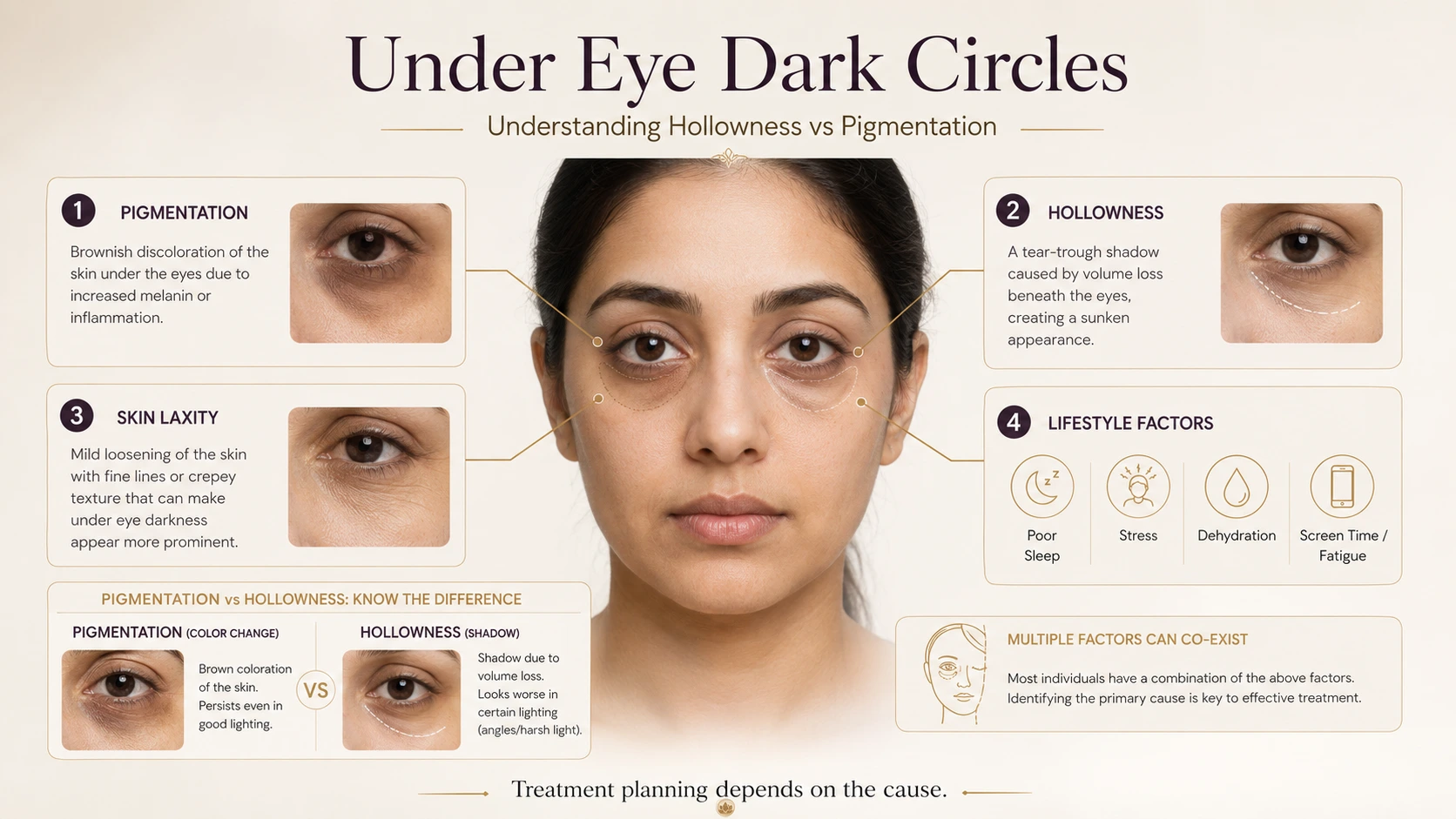
Upper-eyelid hooding may be caused by redundant skin, a low eyebrow, true ptosis or a combination. Lower-eye “bags” may result from prominent fat, skin laxity, a hollow tear trough, cheek descent or fluid retention. Dark circles may be caused by shadow, pigment, vessels, allergy or skin quality. Each cause requires a different discussion.
Important distinction: Blepharoplasty is not automatically a treatment for eyebrow descent, true ptosis, crow’s feet, pigmentation or every under-eye hollow. Treating the wrong structure can create an unnatural result or leave the main concern unchanged.
Concerns that may be assessed
Upper-eyelid skin folding onto or beyond the natural crease
Upper-lid heaviness or restricted upper visual field from excess skin
Lower-eyelid fat prominence or “eye bags”
Selected lower-lid skin excess and fine creasing
Asymmetry that can be improved within realistic anatomical limits
Previous eyelid surgery requiring careful reassessment
Assessment First
Which structure is causing the eyelid concern?
These six patterns can overlap. The purpose of consultation is to separate them before discussing surgery.
01
Upper-lid skin excess
Redundant skin folds into the crease and may create hooding. Upper blepharoplasty may be relevant when the eyelid-lifting mechanism and brow position are separately assessed.
Often a blepharoplasty concern02
True eyelid ptosis
The eyelid margin itself sits low because the lifting mechanism is weak or stretched. Skin removal alone may not correct this and can occasionally make the difference more obvious.
May need ptosis repair03
Brow descent
A low eyebrow can push skin downward over the upper lid. Removing lid skin without considering the brow may not address the full heaviness.
Consider brow position04
Lower-lid fat bags
Fat can project forward and create puffiness. Depending on the contour, conservative reduction or repositioning may be considered rather than aggressive removal.
Lower blepharoplasty pathway05
Tear-trough hollow
A groove between the lower eyelid and cheek can create a shadow. Lower-lid planning may help selected patients, but a hollow is not identical to a fat bag.
Contour problem06
Pigmentation or skin quality
Brown pigment, visible vessels, allergy, fine lines and thin skin are not reliably removed by eyelid surgery. Skin or medical assessment may be more relevant.
Not solved by surgery alone
Upper vs Lower
Upper and lower blepharoplasty answer different questions
Upper blepharoplasty
Usually focuses on redundant upper-eyelid skin and selected fat fullness. The incision is planned within the natural upper-eyelid crease. Assessment should include brow height, eyelid margin position, symmetry, eye closure and whether the skin genuinely interferes with vision.
Natural crease incision
Conservative skin planning
Ptosis and brow assessment
Protection of eyelid closure
Lower blepharoplasty
Usually focuses on lower-eye bags, selected skin excess and the transition between the eyelid and cheek. The plan may use internal transconjunctival access or an external incision below the eyelashes, depending on skin, fat and lid support.
Fat reduction or repositioning
Internal or lash-line access
Lower-lid support assessment
Conservative skin handling
1
Transconjunctival approach
Access is from inside the lower eyelid. It can be useful when fat prominence is the main concern and external skin removal is not required. It does not mean the procedure is suitable for every lower eyelid.
2
Subciliary or lash-line approach
An incision is planned just below the lower eyelashes when external skin access is required. Lower-lid tone and support must be assessed because excessive skin removal can pull the lid downward.
3
Fat reduction
Selected fat may be reduced when projection is excessive. Over-removal can create a hollow or skeletonised appearance, so tissue preservation matters.
4
Fat repositioning
In selected anatomy, fat may be redistributed to soften the lid–cheek transition rather than simply removed. This is not interchangeable with filler and is not appropriate in every case.
5
Canthopexy or canthoplasty
Support procedures may be considered when lower-lid tone, position or risk of malposition requires it. They are not automatically added to every blepharoplasty.
6
Combined upper and lower surgery
Both areas can be treated in one plan when appropriate, but the procedure and recovery are more extensive than treating one eyelid region alone.
Dark Circles
Why “dark circles” need a cause-based plan
Under-eye darkness is often a mixture of factors. Surgery may reduce shadow when a prominent fat bag or contour step is responsible, but it does not erase all pigment or vascular colour.
Shadow from bags or hollows: contour assessment matters
Brown pigmentation: skin-focused management may be required
Visible vessels or thin skin: surgery has limited effect
Allergy or rubbing: medical control may be more important
Cheek descent: lower blepharoplasty alone may not solve the transition
The consultation should look beyond photographs and include the eye surface, lid mechanics and medical history.
Upper and lower eyelid symmetry at rest and during gaze
Upper-lid skin excess versus true ptosis
Brow position and forehead compensation
Lower-lid tone, snap-back and position
Ability to close the eyes completely
Dryness, watering, irritation or light sensitivity
Contact-lens use and previous eye surgery
Thyroid eye disease, glaucoma or retinal history
Blood-thinning medicines and supplements
Smoking, diabetes, blood pressure and healing risks
Additional evaluation: When symptoms, previous eye disease, visual concerns or examination findings suggest it, an ophthalmic opinion or formal eye assessment may be advised before surgery.
Procedure Journey
From consultation to final review
1
Consultation
Define the actual concern
Upper-lid skin, eyelid margin, brow position, lower-lid bags, tear trough, skin quality, lid tone and eye symptoms are assessed separately.
2
Preoperative planning
Choose the least extensive appropriate plan
The discussion covers upper, lower or combined surgery; incision placement; fat preservation or repositioning; possible lid support; anaesthesia; limitations and risks.
3
Before surgery
Complete safety checks
Relevant tests, medicines, allergies, smoking, fasting instructions, transport home and postoperative support are reviewed. Medicines should never be stopped without the prescribing clinician’s advice.
4
Procedure day
Marking and anaesthesia
Markings are made with the patient upright when appropriate. The anaesthesia plan depends on the extent of surgery and the patient’s health and comfort needs.
5
Surgery
Conservative tissue handling
Selected skin or fat is treated through the planned access. The emphasis is on preserving eyelid closure, lower-lid support and a natural transition rather than aggressive tissue removal.
6
Early recovery
Control swelling and protect the eyes
Cold compresses, head elevation, prescribed ointment or drops and activity restrictions may be used. Vision, eye comfort and eyelid closure are monitored.
7
Follow-up
Review healing over weeks to months
Reviews assess swelling, scars, symmetry, lid position, dry-eye symptoms and final contour. Early asymmetry from swelling should not be judged as the final result.
Recovery
Blepharoplasty recovery by phase
Recovery varies with upper versus lower or combined surgery, individual bruising, medical history and any additional eyelid support or ptosis procedure.
First 72 hours
Swelling may increase
Bruising, tightness, watering, dryness, light sensitivity and blurred vision from ointment can occur. Head elevation and prescribed care are important.
Days 4–7
Early settling
Swelling usually starts to improve, although bruising can remain visible. Reading and screen comfort vary. Follow the surgeon’s advice on wound and eye care.
Days 10–14
Social recovery
Many patients feel presentable for routine social activity, but makeup, lenses, exercise and work timing should follow individual instructions.
Weeks to months
Refinement
Residual swelling, firmness, scar colour and small asymmetries continue to settle. Final contour should be assessed after adequate healing.
Sleep with the head elevated initially
Use cold compresses only as instructed
Do not rub or press on the eyelids
Avoid heavy lifting and straining early
Use sunglasses and sun protection
Report vision change or severe pain urgently
Scars and Results
Where are scars placed, and what are the realistic limits?
Upper-eyelid scar
The incision is generally placed in the natural upper-eyelid crease. Early scars can look pink or firm and usually mature over time. Scar visibility depends on anatomy, healing, skin type, sun exposure and previous surgery.
Lower-eyelid scar
Transconjunctival surgery uses an internal incision. When skin access is needed, an incision may be placed just below the eyelashes and can extend into a natural crease. No incision is literally “scar-free.”
Result timing
Swelling and bruising temporarily change eyelid shape. A more settled result appears gradually over weeks, while scars and subtle contour changes can continue to mature for months.
Blepharoplasty does not guarantee
Perfect symmetry
Removal of all dark circles
Correction of low brows without brow treatment
Correction of true ptosis without ptosis repair
Removal of all crow’s feet or fine lines
A permanent pause in facial ageing
An exact recreation of a reference photograph
Safety and Limitations
Risks that should be discussed before blepharoplasty
Most postoperative symptoms are temporary, but eyelid surgery involves structures that protect the eye. A risk discussion should be specific and not reduced to “minor surgery.”
Common early effects
Swelling, bruising, tightness, tenderness, watering, temporary dryness, irritation, light sensitivity, blurred vision from ointment and uneven swelling.
Healing and appearance
Asymmetry, visible or raised scars, prolonged swelling, altered crease, numbness, residual skin or fat prominence and under- or over-correction.
Eyelid position and closure
Difficulty closing the eyes, lid lag, lower-lid retraction, ectropion, rounding of the outer corner, exposure symptoms or need for support or revision.
Medical and eye risks
Bleeding, infection, anaesthesia complications, persistent pain, double vision, corneal irritation and temporary or permanent visual change. Serious visual complications are rare but urgent.
Seek urgent medical help after surgery for:
Sudden reduction, loss or marked change in vision
Severe or rapidly worsening eye pain
Rapidly increasing one-sided swelling or marked eye protrusion
Significant bleeding that does not settle
Severe headache, nausea or neurological symptoms with eye changes
Inability to close the eye with increasing dryness or pain
Alternatives and Combinations
The correct treatment may be blepharoplasty—or something else
What affects the cost of blepharoplasty in Nagpur?
A public one-price figure can be misleading because “blepharoplasty” can describe very different operations. The estimate should follow examination and specify what is included.
Upper eyelids, lower eyelids or combined surgery
Skin-only versus fat treatment or repositioning
Need for lower-lid support
Separate ptosis repair or brow procedure
Local anaesthesia, sedation or general anaesthesia
Facility, investigations, medicines and follow-up
Primary versus revision eyelid surgery
Mayflower Clinic approach: a transparent written estimate is discussed after consultation, without presenting a low headline price that excludes essential components.
Dr. Shahane’s Planning Principle
The goal is not to make the eyelid look “operated.”
“Eyelid surgery is a balance between improvement and protection. I first ask whether the concern comes from skin, the eyelid-lifting mechanism, the brow, lower-lid fat, the lid–cheek junction or pigmentation. The safest plan is often the most conservative plan that addresses the correct structure.”
Dr. Pawan Shahane, M.Ch. Plastic Surgery · Founder, Mayflower Clinic, Nagpur
Patient Experiences
What patients say about care at Mayflower Clinic
These are clinic-wide patient experiences reproduced from the existing website export. They are not presented as blepharoplasty-specific outcomes, and individual surgical results vary.
★★★★★
“Good experience. Highly skilled surgeon. Post op care and consultation was also done nicely. Husband and wife make a good team! Thanks”
Mahika Goel
Existing Mayflower Clinic testimonial
★★★★★
“Dr.shahane is best plastic surgeon. I am happy with results. I recommend him for cosmetic surgery. His staff are also good. Best clinic.honest and explains everything well.”
“Amazing experience with Dr Pawan Shahane. I recommend him for all cosmetic surgery. He is good in knowledge, his surgery results are awesome, and he is very kind in nature…”
Jithin Raj
Existing Mayflower Clinic testimonial
Patient Questions
Blepharoplasty FAQs
All visible question-and-answer sections on this page are represented in the FAQPage schema.
What is blepharoplasty?
Blepharoplasty is eyelid surgery that may remove or reposition selected excess skin, muscle or fat from the upper eyelids, lower eyelids or both. The plan should preserve eyelid closure, support and natural expression rather than simply remove the maximum amount of tissue.
What is the difference between upper and lower blepharoplasty?
Upper blepharoplasty mainly addresses redundant upper-eyelid skin and selected fat fullness. Lower blepharoplasty is planned for under-eye bags, lower-lid skin excess or contour imbalance and may use an internal transconjunctival or external lash-line approach.
Can blepharoplasty correct a drooping eyelid caused by ptosis?
Not always. True ptosis involves weakness or stretching of the eyelid-lifting mechanism and may require a separate ptosis-repair procedure. Upper-eyelid skin excess, brow descent and true ptosis must be distinguished during examination.
Will blepharoplasty remove dark circles under the eyes?
Blepharoplasty may improve shadowing caused by prominent fat bags or contour irregularity, but it does not reliably correct pigmentation, visible vessels, allergy-related darkness or every tear-trough hollow. The cause of the dark circle must be assessed first.
Where are blepharoplasty scars placed?
Upper-eyelid incisions are generally planned in the natural eyelid crease. Lower-eyelid surgery may be performed from inside the eyelid or through an incision just below the eyelashes, depending on skin excess, fat position and lid support.
How long does blepharoplasty surgery take?
Operating time varies with whether the upper lids, lower lids or both are treated and whether additional support or ptosis work is required. A practical planning range is about one to three hours rather than one fixed duration.
What anaesthesia is used for eyelid surgery?
Selected upper-eyelid procedures may be performed with local anaesthesia and sedation, while combined or more extensive surgery may require a different anaesthesia plan. The decision depends on procedure extent, medical history and facility arrangements.
How long is recovery after blepharoplasty?
Swelling and bruising are usually most visible during the first week. Many people feel socially presentable in about 10 to 14 days, while residual swelling, scar maturation and final contour refinement continue for several weeks to months.
Can blepharoplasty worsen dry eyes?
Temporary dryness or irritation can occur, and risk may be higher when dry-eye symptoms already exist. Preoperative assessment should include eye comfort, tear-film symptoms, contact-lens use, eyelid closure and relevant eye or thyroid history.
What are the important risks of blepharoplasty?
Risks include bleeding, infection, asymmetry, visible scarring, temporary numbness, dry-eye symptoms, difficulty closing the eyes, lid lag, lower-lid malposition, persistent swelling and need for revision. Visual disturbance is uncommon but requires urgent assessment.
When should I seek urgent help after eyelid surgery?
Seek urgent medical review for sudden reduction or change in vision, severe or escalating eye pain, rapidly increasing one-sided swelling, significant bleeding, marked eye protrusion, severe headache with eye symptoms or inability to close the eye.
How much does blepharoplasty cost in Nagpur?
Cost depends on upper versus lower or combined surgery, anaesthesia, facility requirements, preoperative evaluation, whether ptosis or lid support is needed and the follow-up plan. A transparent written estimate is provided only after examination.
Bring your eye history, medicines and the specific concern you want assessed. The consultation will clarify whether the main issue is eyelid skin, ptosis, brow position, lower-lid bags, tear-trough contour, pigmentation or a combination.
Medical Disclaimer: All surgical procedures carry inherent risks, and individual outcomes vary based on anatomy, eye health, skin type and healing biology. Surgical results are not guaranteed. Formal in-person consultation with Dr. Pawan Shahane is required before any surgical decision. New eyelid droop, sudden asymmetry, double vision, eye pain or visual change may require diagnostic eye or neurological evaluation rather than cosmetic treatment. This page is for general educational purposes only and does not constitute medical advice or a treatment recommendation.