
P
PseudoptosisTissue below the fold
The nipple may remain at or above the fold while much of the breast tissue descends below it.

A breast lift is not simply “tightening the skin.” It is a measured plan for breast ptosis, nipple–areola position, skin-envelope reduction, internal tissue reshaping, scar placement and the way the breast may change over time.

Private consultation · Breast examination only with consent · A chaperone may be requested.

“Good mastopexy planning balances the skin envelope, the internal breast tissue, nipple–areola position, scars and the patient’s expectation for upper-pole fullness. The safest plan is not always the smallest scar or the largest implant.”— Dr. Pawan Shahane, M.Ch. Plastic Surgery · Mayflower Clinic, Nagpur
Ask a general question about this page. Answers are matched locally in your browser and link to the relevant section.
This guide can explain the page, but it cannot examine you, diagnose a condition, recommend surgery, calculate candidacy or replace an in-person consultation.
Breast ptosis describes descent of the breast and nipple–areola complex in relation to the inframammary fold. It may follow pregnancy, breastfeeding, weight change, ageing, tissue stretching or natural skin and breast characteristics.
During mastopexy, selected excess skin is removed, the existing breast tissue is reshaped and the nipple–areola complex is repositioned while usually remaining attached to a vascularised tissue pedicle. The areola may also be reduced when appropriate.
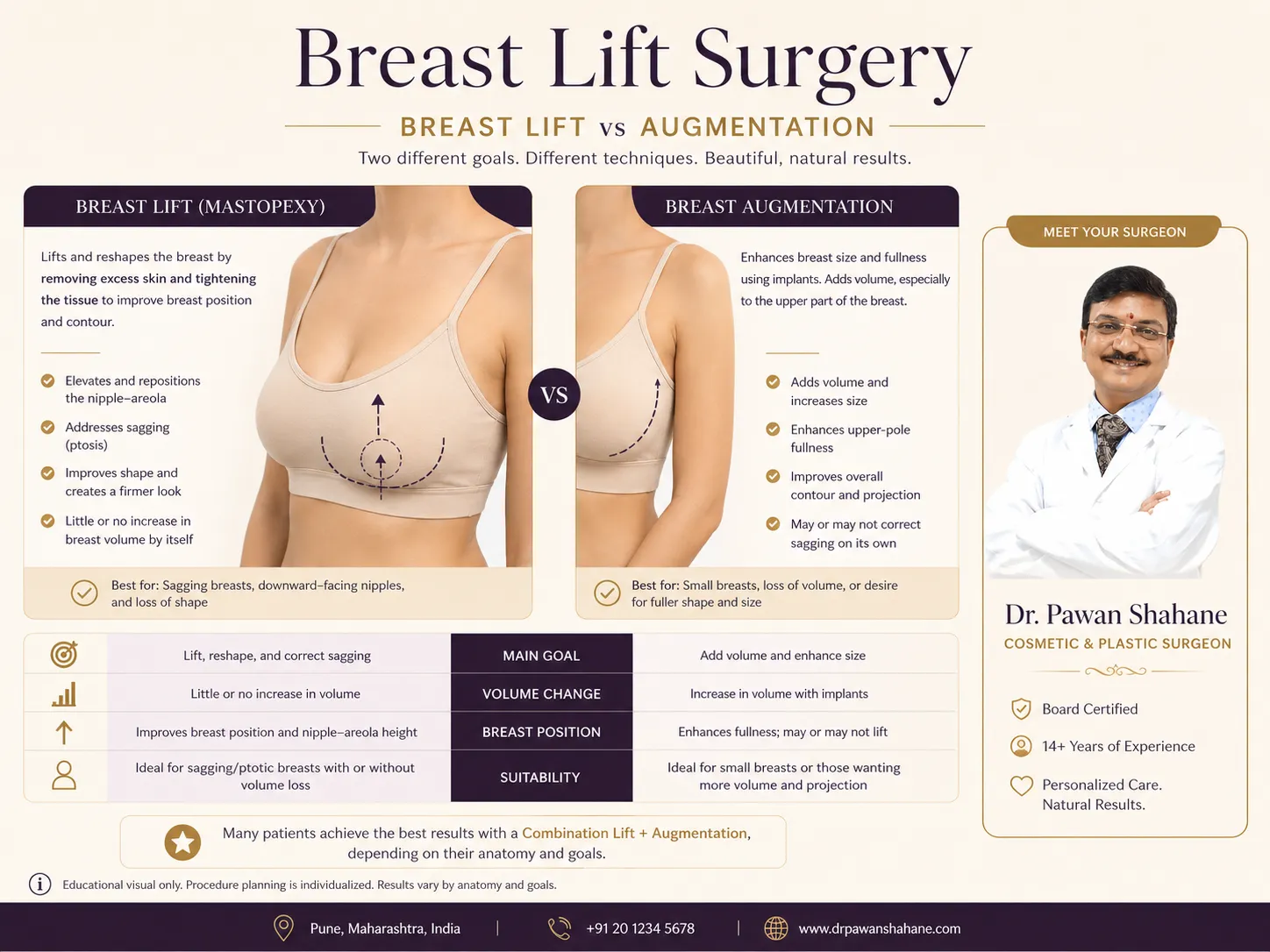
A lift mainly changes position, skin envelope and shape. It does not automatically make the breast much larger. When a patient wants substantial upper-pole fullness or increased volume, an implant or selected fat transfer may be discussed separately.
Assessment also includes skin quality, breast volume, lower-pole stretch, areola size, chest-wall asymmetry, previous surgery and the patient’s desired shape.
The nipple may remain at or above the fold while much of the breast tissue descends below it.
The nipple–areola complex lies approximately at the level of the inframammary fold.
The nipple is below the fold but is not at the lowest point of the breast contour.
The nipple–areola complex is at or near the most dependent point of the breast.
Fat transfer can add selected volume without an implant, but the increase is usually more limited and some transferred fat is naturally reabsorbed. It is a separate decision from the lift itself.
The scar pattern must control the actual excess skin. Choosing too little skin removal for the degree of ptosis can flatten the breast, widen the areola or allow early recurrent sagging.
Scar around the areola. Used only for limited skin excess or a small nipple–areola elevation. It may widen or flatten the areola if excessive tension is placed on it.
Scar around the areola and vertically to the breast fold. It permits more skin-envelope tightening and internal reshaping than a periareolar approach.
Adds a scar in the breast fold. It is used when greater vertical and horizontal skin reduction is needed, especially with more advanced ptosis or heavier tissue.

The nipple–areola complex is usually moved on a pedicle containing breast tissue, blood vessels and nerves. The goal is a proportionate position on the newly reshaped breast—not an artificially high position that may look unnatural as swelling settles.
Areola size can be reduced when stretched or asymmetrical. Natural asymmetry in the chest wall, breast footprint, fold height and tissue volume is recorded before surgery because perfect symmetry cannot be guaranteed.
Is the priority elevation, reduction, upper-pole fullness, symmetry, areola size or a combination? The answer determines whether lift alone, augmentation, reduction or staging should be discussed.
Measurements, breast footprint, fold level, nipple position, asymmetry, tissue quality and relevant breast history are documented. Imaging is arranged when indicated.
The surgical plan explains the likely scars, pedicle, skin removal, internal reshaping and whether an implant or fat transfer is appropriate, unnecessary or better staged.
Final markings are made while standing. Surgery is usually under general anaesthesia. The breast tissue is reshaped, the nipple–areola complex repositioned and the skin envelope tailored.
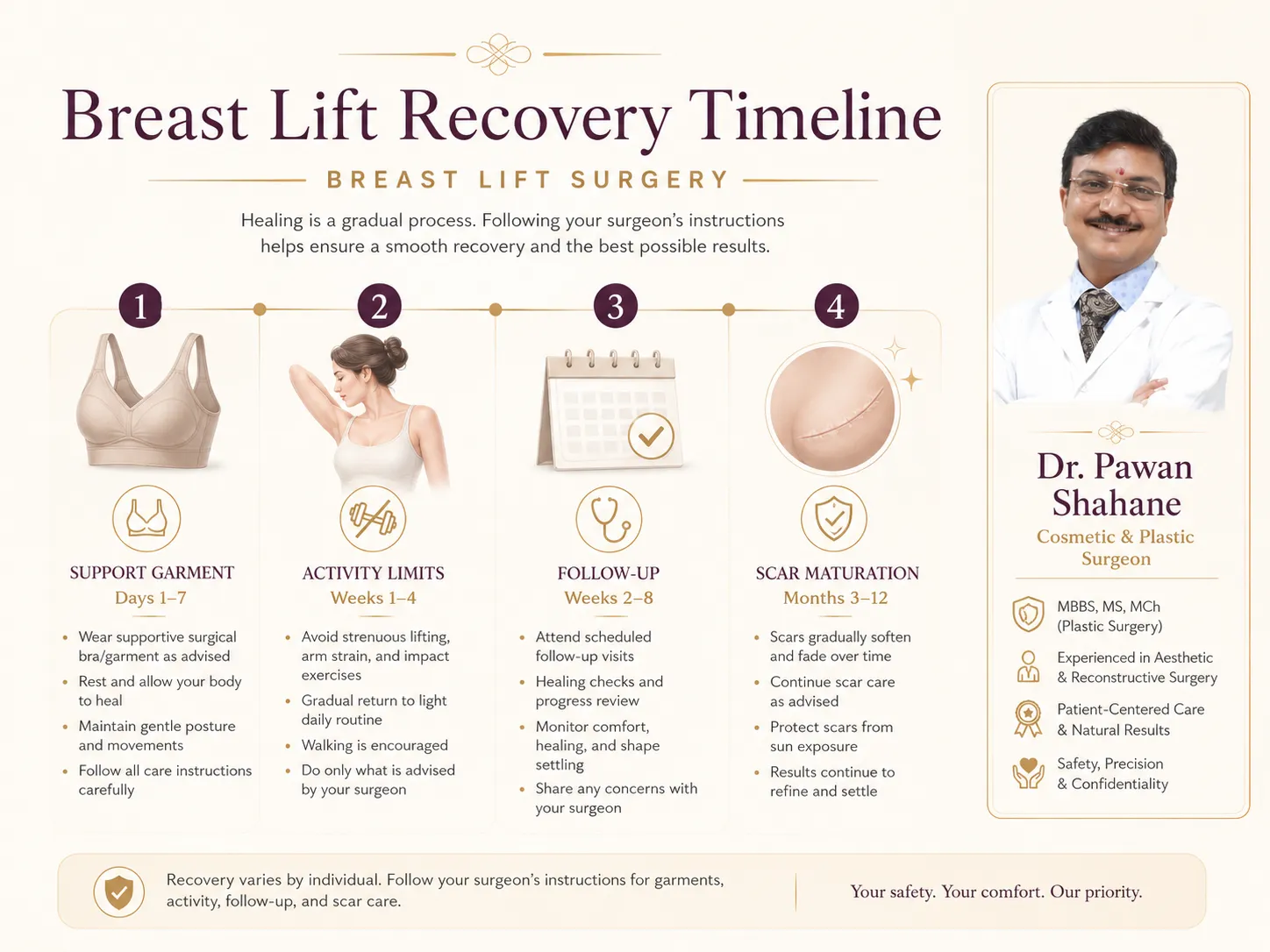
Swelling, bruising, firmness and temporary sensory change are expected. Dressings and a support bra are used as advised, with early walking and clear restrictions on lifting.
Wounds, shape, symmetry and sensation are reviewed. Exercise increases gradually only after clinical clearance; scar care begins once the incisions are fully healed.
The breast softens, swelling reduces and the lower pole settles. Scars continue to evolve, while pregnancy, weight change, gravity and tissue quality influence the longer-term shape.
Heavier breasts place more load on the lower pole and may stretch sooner than smaller, lighter breasts.
Future enlargement and deflation can stretch the skin again and alter the surgical result.
Major gain or loss changes fat volume and skin tension; stable weight before surgery supports more predictable planning.
When implants are used, larger volume can increase strain on the skin envelope and may influence future descent or revision needs.
A responsible quote follows examination because mastopexy can range from limited skin-envelope correction to a longer operation with extensive reshaping or combined augmentation.
No online calculator can determine the correct scar pattern, implant need or surgical complexity.
Request a consultationThese comments describe general cosmetic-surgery care and are not breast-lift-specific outcome claims. Individual results and recovery vary.
“Good experience. Highly skilled surgeon. Post op care and consultation was also done nicely. Husband and wife make a good team! Thanks.”Mahika GoelGeneral clinic review
“Dr. Shahane is best plastic surgeon. I am happy with results. I recommend him for cosmetic surgery. His staff are also good. Best clinic, honest and explains everything well.”Sandip BhudeGeneral cosmetic-surgery review
“Amazing experience with Dr Pawan Shahane. I recommend him for all cosmetic surgery. He is good in knowledge, his surgery results are awesome, and he is very kind in nature.”Jithin RajGeneral cosmetic-surgery review
Publish testimonials only with verified source and consent. Do not alter wording into a stronger outcome claim.
A breast lift reshapes the existing breast tissue, removes selected excess skin and repositions the nipple–areola complex to a higher, more proportionate position. It primarily changes position and shape rather than adding substantial volume.
Breast ptosis is assessed mainly by the relationship of the nipple–areola complex to the inframammary fold. Pseudoptosis and Grades I, II and III describe progressively different patterns, but surgery is planned from the complete examination rather than the grade alone.
A lift is primarily used for sagging, stretched skin and a low nipple–areola position. An implant primarily adds volume and upper-pole fullness; some patients need one procedure, while others may benefit from a combined or staged plan.
Yes. Mastopexy without implants is appropriate when the main concern is ptosis and the patient is comfortable with the available breast volume. The breast is reshaped using existing tissue, but a lift alone cannot reliably create a large increase in upper-pole fullness.
A combined augmentation-mastopexy may be considered when both sagging and volume loss are important concerns. The decision depends on skin quality, ptosis severity, implant size and tissue safety; in some situations a staged approach is more appropriate.
Possible patterns include a scar around the areola, a vertical or lollipop scar, and an anchor or inverted-T pattern. The minimum scar pattern that can safely control the skin envelope is chosen, but all surgical scars are permanent and mature gradually.
In standard mastopexy the nipple–areola complex usually remains attached to a tissue pedicle that carries blood supply and nerves while it is repositioned. The exact pedicle and technique depend on anatomy and the required lift.
Yes. Temporary or permanent sensation changes can occur, and breastfeeding ability cannot be guaranteed. The risk depends on the technique, extent of surgery, previous operations and individual healing.
Desk-based work is often resumed in about 7–10 days, while lifting, upper-body strain and vigorous exercise are restricted for several weeks. Swelling and shape settle progressively, and scar maturation commonly continues for 12–18 months.
A breast lift can produce a long-lasting improvement, but it does not stop ageing, gravity, pregnancy, weight fluctuation or tissue stretching. Larger or heavier breasts and weaker skin may change sooner.
Some recurrent ptosis or lower-pole stretching can occur over time. Stable weight, supportive garments during exercise, pregnancy planning and realistic implant selection when used may help protect the result, but cannot prevent all future change.
Surgery is usually postponed during pregnancy, active breastfeeding, active breast infection, unresolved breast symptoms, unstable medical conditions or major planned weight loss. Smoking and nicotine exposure also need careful management because they increase healing risk.
Cost depends on the degree of ptosis, scar pattern, operating time, anaesthesia, facility requirements and whether an implant, fat transfer or reduction is combined. A final written estimate should follow examination and a defined surgical plan.
References support general education and do not determine an individual treatment plan. Confirm the medical review date immediately before publication.
Discuss ptosis grade, lift without implant versus lift with implant, nipple–areola position, scar patterns, upper-pole fullness, recovery and long-term change before deciding on surgery.

What Is Acne Scar Correction? A Complete…
Who Is a Good Candidate for Lip…