First-time or revision
Revision surgery often involves scar tissue, altered support and fewer available cartilage options.

A useful rhinoplasty cost guide should answer more than “how much?” It should explain what is being corrected, who is operating, what the package includes, which expenses may be separate, and why a revision or breathing-related procedure can cost more than a limited first-time nose reshaping.


Choose a common question or type a short question about the cost guide.
This on-page question matcher uses prewritten, medically reviewed answers. It cannot examine your nose, diagnose a condition, recommend surgery, calculate candidacy, produce a personal quote, or replace consultation.
A patient requesting modest bridge smoothing is not undergoing the same operation as a patient with a broad bony vault, weak tip support, a crooked septum and breathing difficulty. Revision rhinoplasty is different again because previous surgery may have changed the anatomy and created scar tissue.
The final cost is usually determined only after the surgeon examines the external nose, septum, skin thickness, cartilage strength, airway, facial proportions, previous injury or surgery, medical fitness and the exact changes being considered.
This page therefore uses planning bands rather than a low “starting at” figure. The purpose is to help patients budget and compare like with like—not to create a binding surgical quote without examination.
These bands organize common levels of surgical complexity. They are not package promises, and a patient can move into a different band after examination.
| Planning category | Indicative range | What may be involved | Why the cost changes |
|---|---|---|---|
| Limited primary rhinoplasty First surgerySelected correction | ₹80,000–₹1,20,000 | Selected bridge smoothing, limited narrowing or modest tip work in suitable anatomy. | Shorter or less extensive correction may require less operating time, exposure and grafting. |
| Structural primary rhinoplasty Open or closedMultiple zones | ₹1,10,000–₹1,80,000 | Bridge, bones, middle vault, tip support, projection, deviation or alar-base work in one plan. | More detailed reshaping, longer surgery, stronger reconstruction and additional follow-up may be needed. |
| Septorhinoplasty Shape + breathingSeptal correction | ₹1,20,000–₹2,00,000+ | External nose reshaping combined with septal or airway-support correction. | Functional assessment, septal work and protection of nasal valves can increase complexity and duration. |
| Revision or complex reconstructive rhinoplasty Previous surgeryPossible graft harvest | ₹1,50,000–₹3,00,000+ | Scar tissue, asymmetry, collapse, grafting, support reconstruction or correction after previous surgery. | Altered anatomy, limited remaining cartilage, longer surgery and possible ear or rib grafting raise the cost. |
Not a quotation: these are broad planning bands derived from publicly available 2026 Indian/Nagpur estimates and common differences in surgical complexity. The written clinic quote controls.
Revision surgery often involves scar tissue, altered support and fewer available cartilage options.
Bridge, bones, septum, middle vault, tip and nostril base may each require different surgical work.
Combining shape correction with septal or airway work can add assessment, operating time and reconstruction.
The approach itself is not a price label; the complexity that makes an approach appropriate usually matters more.
Septal, ear or rib cartilage harvest, shaping and fixation can increase surgical time and facility needs.
Anaesthesiologist time, monitoring and the length of the operation are part of a safe surgical quotation.
OT standards, consumables, nursing, day-care observation and any additional stay affect the package.
Splint care, suture review, swelling checks and longer observation may differ between simple and complex cases.
“The quote should reflect the work required to protect nasal shape, support and breathing. A lower number is not useful if the plan, anaesthesia, facility or follow-up has quietly been reduced.”— Dr. Pawan Shahane, M.Ch. Plastic Surgery
Mayflower Clinic’s customized quotation is prepared after consultation. The following items are generally discussed so patients can understand the complete package rather than only the surgeon fee.
Planning, surgery and the operating surgeon’s direct involvement in the procedure.
Anaesthesiologist assessment, anaesthesia administration and intra-operative monitoring.
OT use, sterile setup, monitoring, routine instruments and planned facility resources.
Planned postoperative observation, nursing care and discharge readiness assessment.
Procedure-specific dressings, external splint or cast and routine surgical consumables as stated.
Scheduled clinic checks for splint or suture care, swelling, healing and activity guidance.
Blood tests, imaging, physician fitness or additional specialist review may be separate.
Discharge medicines, nasal care products or treatment outside routine recovery may be separate.
Extra stay, special graft material, unplanned treatment or additional procedures should be clarified.
Use this checklist before concluding that one rhinoplasty estimate is cheaper than another.
Purely cosmetic nose reshaping is generally an out-of-pocket procedure. When a patient has documented obstruction, trauma, septal deviation or another functional problem, an insurer may consider the medically necessary portion—but only according to the policy, exclusions, waiting periods, network rules, documentation and pre-authorisation.
Do not assume that the entire septorhinoplasty package will be covered because breathing is discussed. Cosmetic and functional components may be assessed differently, and the insurer—not the clinic website—makes the coverage decision.
Payment and finance arrangements can change. Confirm current terms directly with the clinic and read any lender agreement independently.
Bridge, width, tip, crookedness, nostril shape, breathing, previous injury or previous surgery are discussed without assuming that every concern needs an operation.
Skin thickness, cartilage support, septum, nasal valves, facial asymmetry and breathing are assessed because these findings change the plan.
The surgeon explains whether the plan is limited, structural, functional, reconstructive or revision, and which areas are included.
Open or closed access, likely duration, anaesthesia, day-care observation and facility requirements are matched to the case.
The package should identify inclusions, likely exclusions, payment schedule and any cost that cannot be known until additional assessment.
Patients often budget only for the operation. A realistic plan also accounts for time away from work or college, transport, a responsible adult on the day of surgery, accommodation for outstation patients, postoperative medicines and the possibility that spectacles or strenuous activity may need temporary adjustment.
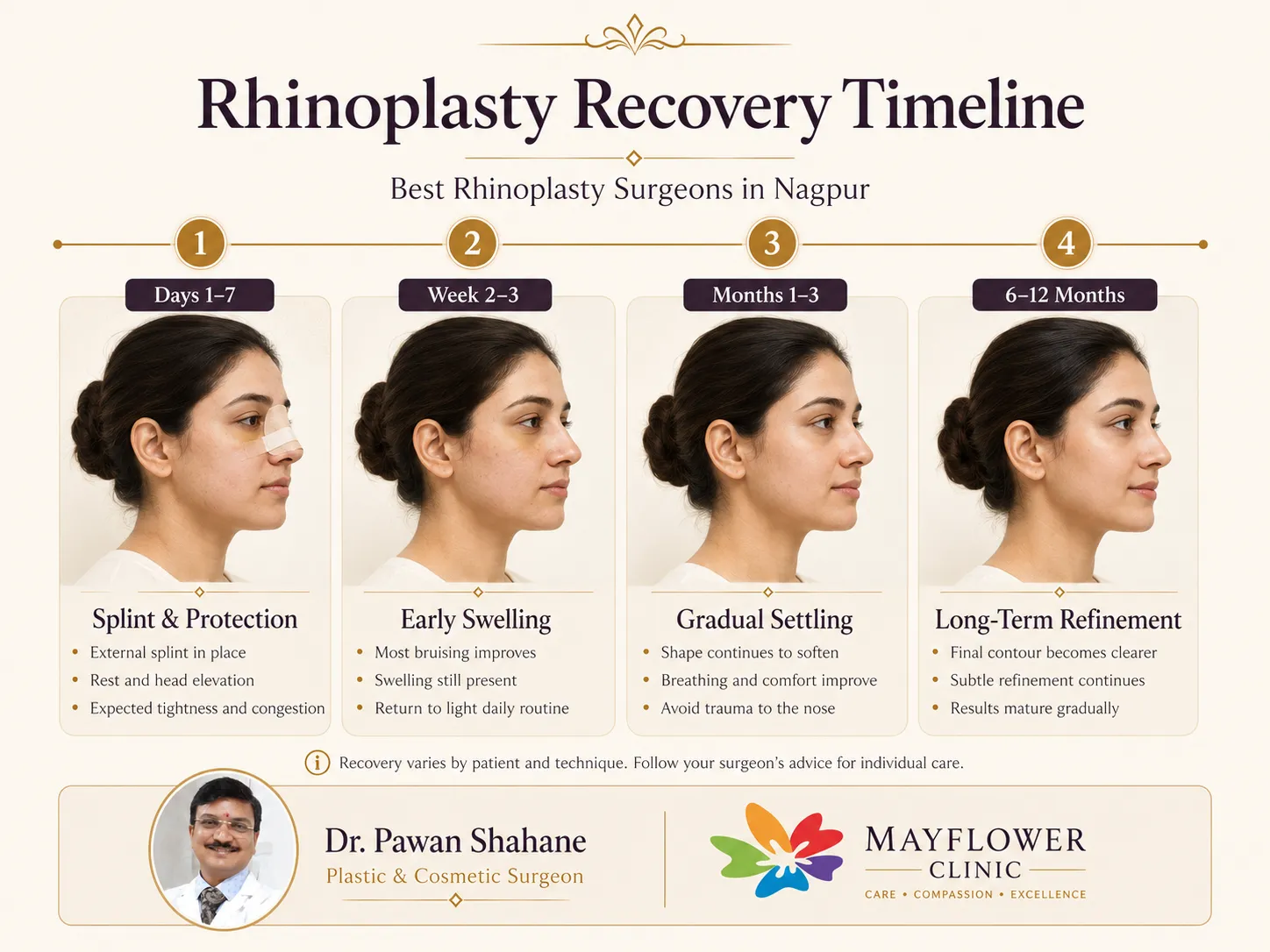
Many patients plan around one week for splint care and approximately one to two weeks for social recovery, but bruising and swelling vary.
Fine swelling and tip definition can continue changing for months. Do not budget for repeated travel based only on the first-week appearance.
Ask how long you should remain in Nagpur, when travel is safe and which reviews can or cannot be done remotely.
Although not routine, additional treatment, delayed healing or extra investigations can create costs outside a standard package.
These are short excerpts from individual Google reviews. They do not predict another patient’s result, cost, recovery or satisfaction.
“From the initial consultation to the post-operative care, Dr. Shahane demonstrated exceptional skill, professionalism, and a genuine care for my well-being.”
“My sister was having depressed nose and broad nose. We met with Dr. Shahane and discussed the issue. We got best result.”
“He explains everything and how to take care. He support at every stage and do the surgery as planned.”
Mayflower Clinic cosmetic, plastic and hair transplant services.
Visit home →Explore the wider surgical and non-surgical treatment hub.
Explore services →Browse procedure categories and patient education pages.
View services →Qualifications, training, memberships, publications and surgical experience.
Meet the surgeon →Clinic location, care pathway, facilities and contact information.
About the clinic →Call, WhatsApp or find the Dhantoli clinic location.
Contact clinic →Meet Dr. Pawan Shahane at Mayflower Clinic, Dhantoli, for assessment of nasal shape, breathing, surgical complexity, likely approach, recovery and the complete cost scope.

Case of the Month: Grade 3 Gynecomastia…

The Science of Facial Aging: Why Wrinkles,…