
Admission
Identity, consent, health changes, medicines, fasting, reports, vital signs and escort arrangements are checked. See the journey.

This is the detailed surgery-day guide: how preparation is checked, when markings are made, how anaesthesia and open or closed access are selected, how the framework is corrected, what dressings are used, and what must happen before you go home.


A typical rhinoplasty day moves through five safety gates: the plan is reconfirmed before anaesthesia; the patient and procedure are checked at admission; access and correction are individualized; dressings are selected rather than automatic; and discharge occurs only after recovery criteria and written aftercare are understood. The operation commonly takes about 1–3 hours, but complex functional, grafting or revision work may take longer.
Ask this page about the procedure day. The guide matches your words to prewritten, medically reviewed information already visible below.
This guide cannot examine you, diagnose a problem, recommend surgery, calculate candidacy or replace a consultation. Do not enter personal medical details.
Identity, consent, health changes, medicines, fasting, reports, vital signs and escort arrangements are checked. See the journey.
The plan is reviewed before anaesthesia, often with the patient upright, because position and infiltration can change appearances. Read more.
General anaesthesia is common for detailed surgery; selected limited cases may use sedation. See selection factors.
The access is chosen for the required visibility and work, not because one is always superior. Compare approaches.
Septum, bridge, bones, middle vault, tip and nostrils are addressed in an individualized sequence. See the sequence.
External tape and splint are common; internal packing or splints are selective. See what you may wake with.
Home is considered only after breathing, vital signs, comfort, bleeding and nausea are appropriately controlled. See criteria.
Healing, breathing, wounds, splints, sutures and aftercare are checked; it is not the final-result visit. See the first week.
“A well-run rhinoplasty day is a series of safety pauses: confirm the plan before anaesthesia, protect breathing while reshaping, and discharge only when the patient is stable and understands the first week.”— Dr. Pawan Shahane, M.Ch. Plastic Surgery / Founder, Mayflower Clinic, Nagpur
Rhinoplasty is planned before the day of surgery, but the operative day brings together several separate decisions: medical fitness, informed consent, anaesthesia, surgical access, the structural sequence, dressing selection and safe discharge. The patient should understand each stage before arriving.
This page does not replace the broader Rhinoplasty in Nagpur overview, the technique-focused Rhinoplasty Surgery in Nagpur page, or the separate Rhinoplasty Recovery Time guide. Its purpose is the narrow interval from final preparation to the first postoperative review.
At Mayflower Clinic, the planned operation is personally performed by Dr. Pawan Shahane. Anaesthesia, nursing and facility care are provided by the relevant qualified team. No website can state the exact operative order, discharge time or dressing for an individual patient before examination and anaesthetic assessment.
Follow the written instructions issued for your operation; do not substitute generic online advice.
The phases below are in a common order. The exact timing and sequence may change.
The team confirms your identity, procedure, surgeon, consent status and accompanying adult. Vital signs are recorded, reports are reviewed and the fasting history is checked.
Consent is not merely a signature. The agreed plan, alternatives, limits, scars, graft possibilities, airway considerations and important risks are reconfirmed. A new cosmetic goal should not be added casually on the morning of surgery.
The nose and face are reviewed in natural posture. Markings may identify bridge, bony sidewalls, tip, alar-base or asymmetry reference points. Photographs and markings help communication; they do not represent a guaranteed outline of the final nose.
The anaesthesia team reconfirms fasting, health status and airway plan. General anaesthesia is common for detailed rhinoplasty; selected limited cases may be performed with intravenous sedation and local anaesthesia. Monitoring continues throughout.
Closed rhinoplasty uses incisions within the nostrils. Open rhinoplasty adds a small incision across the columella and lifts the soft tissue for wider exposure. The chosen access must serve the correction rather than a marketing preference.
Bone, cartilage, septum, middle vault, nasal valves, tip and nostril structures are addressed according to the diagnosis. The surgeon repeatedly checks balance, support, symmetry and the relationship between appearance and breathing.
See the detailed structural sequence below ↓Incisions are closed and the skin is redraped. Tape and an external splint are commonly applied. Internal splints, soft packing or a small drip pad are used only when the operative plan requires them.
You are observed while waking. The team monitors breathing, oxygenation, blood pressure, pulse, comfort, nausea, bleeding and drainage. A blocked or tight nose and mouth breathing can be expected early, especially with swelling or internal supports.
Discharge is considered when you are awake, stable, able to drink as permitted, reasonably comfortable and not having concerning bleeding or vomiting. The responsible adult receives instructions, prescriptions, emergency contact details and the review plan.
The surgeon checks external and internal healing, swelling, wounds, splints, sutures and breathing. Packing or external sutures may be removed according to the plan; the external splint is often reviewed or removed around one week. This is a healing checkpoint—not the final-result assessment.
The same visible concern can require different access in different noses.
| Feature | Closed rhinoplasty | Open rhinoplasty |
|---|---|---|
| Incisions | Inside the nostrils | Inside the nostrils plus a small columellar incision |
| Exposure | More limited but sufficient for selected corrections | Wider direct exposure of tip and framework |
| May suit | Selected bridge, limited tip or less complex primary corrections | Complex tip work, crooked noses, major grafting, revision or reconstructive work |
| Visible scar | No external columellar incision | A small external scar that generally matures over time; individual healing varies |
| Key limitation | Less exposure for complex structural work | More dissection and early swelling can occur |
| Correct conclusion | Neither is automatically better. The correct approach is the least access that reliably permits the planned correction and safety checks. | |
Rhinoplasty has no universal set order. The surgeon may move between zones and re-check earlier work.
The soft-tissue envelope is elevated through the planned open or closed access while protecting skin, lining and blood supply.
When indicated, septal deviation is corrected and septal cartilage is preserved or harvested carefully for structural grafts. Valves and turbinates are considered separately.
A hump may be reduced, a low bridge augmented or a preservation method used in selected anatomy. Smooth dorsal lines and appropriate height are checked from several views.
Controlled bone mobilization may narrow a broad bridge, close an open roof or correct deviation. Osteotomies are not automatically needed in every rhinoplasty.
Spreader grafts, spreader flaps or other support may be used when needed to maintain dorsal lines and protect the internal nasal valve.
Tip projection, rotation, width and support are refined using sutures, conservative cartilage modification and selected grafts. Mayflower MX Lift Rhinoplasty is a clinic-specific planning framework for selected tip-support or smiling-tip concerns—not a standard manoeuvre for every patient.
Alar-base reduction or nostril adjustment is performed only when specifically planned. Over-reduction can create visible scars, distortion or breathing problems.
Symmetry, support, contour, skin tension and airway are reassessed. The skin is redraped, incisions closed and dressings selected for the completed work.
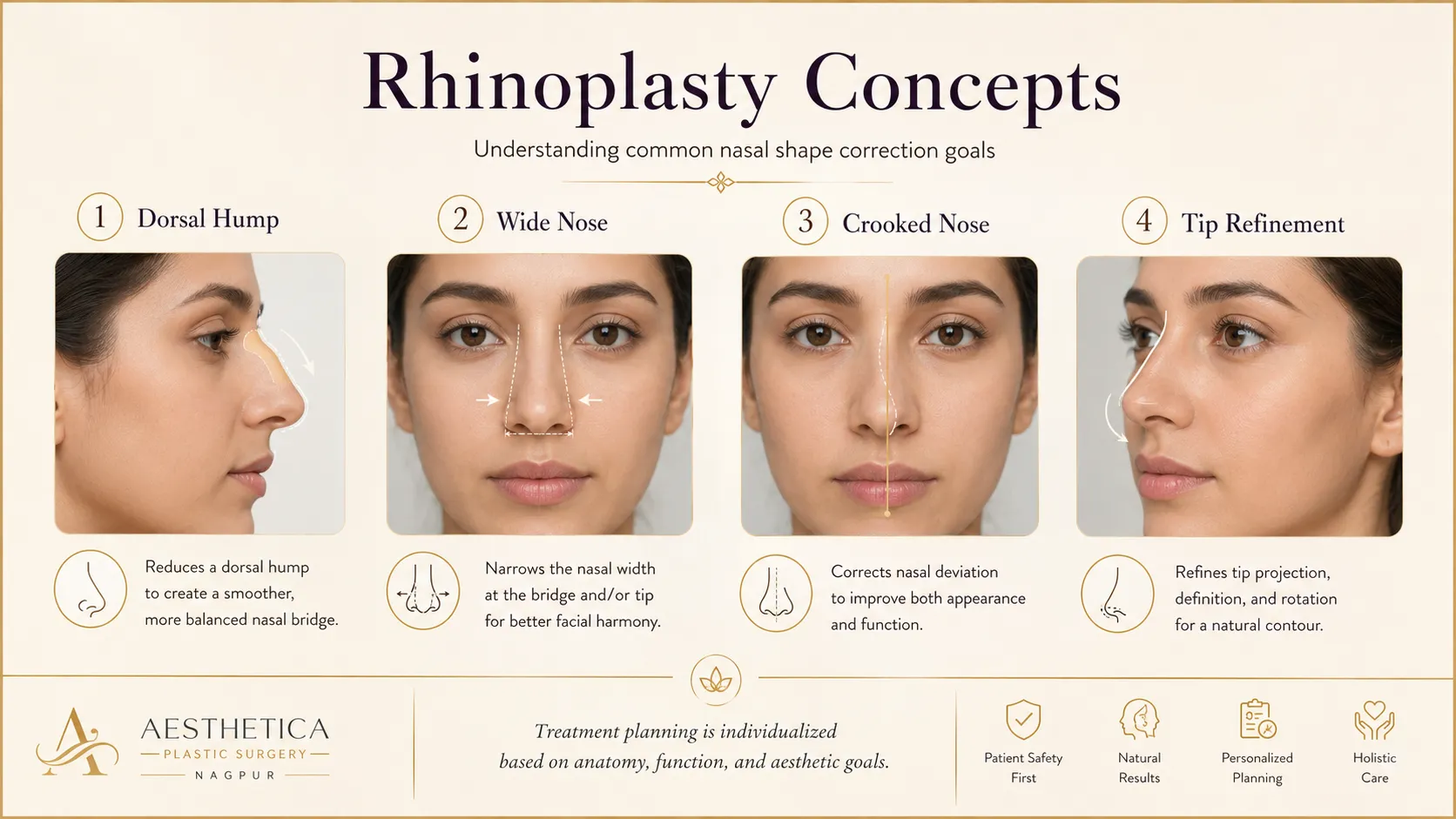
Bridge, bones, middle vault, septum, valves, tip and nostrils interact. Correcting one zone can change the appearance or function of another.

Profile lines, tip projection and facial balance are discussed before surgery. Markings guide orientation; they cannot predict healing to the millimetre.
Feeling blocked can be more noticeable than pain during the first hours.
Swelling, dried blood and internal supports can make nasal breathing limited. Do not remove or adjust splints yourself.
A small amount of blood-stained fluid can occur early. A drip pad may be changed as instructed without pressing tightly on the nose.
The head is kept raised to help limit swelling and bleeding. Continue the advised sleeping position at home.
Fluids and medicines are introduced according to recovery and anaesthesia instructions. Repeated vomiting needs attention because it can increase pressure and bleeding.
The external splint protects the early framework. Keep it dry and do not press, lift or re-tape it unless specifically instructed.
Instructions should cover medicines, food, sleep, nasal care, bathing, glasses, activity limits, emergency contact and review timing.
The exact review date depends on the operation and dressings. Some patients need early removal of packing or an earlier wound check. A routine first review commonly falls within the first postoperative week, with the external splint often assessed or removed at about one week.
Early asymmetry often reflects uneven swelling. The nose should not be judged, pinched, massaged or compared obsessively during this phase unless the surgeon has given a specific instruction.
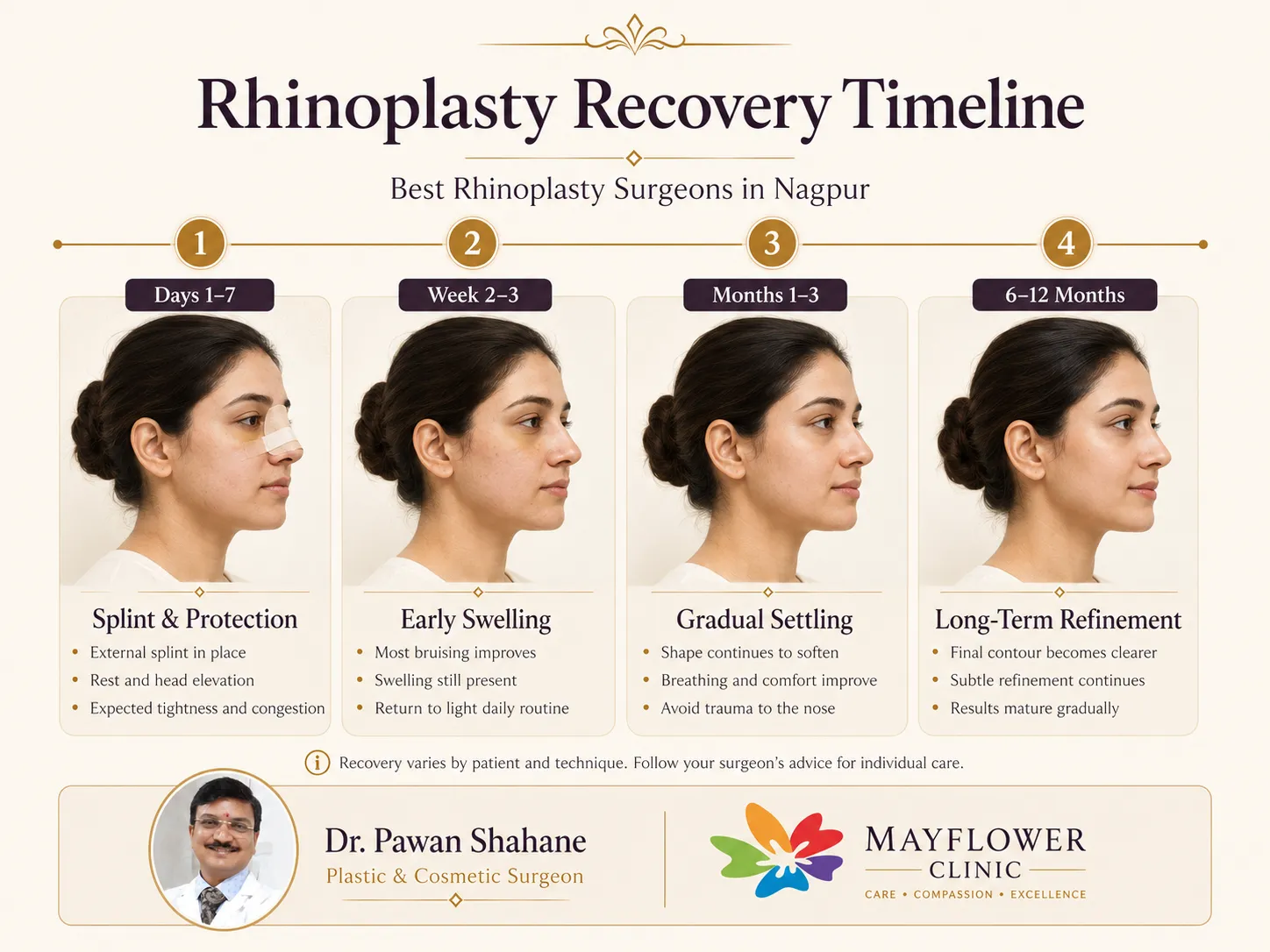
Splint removal reveals an early, swollen shape. Definition continues to change over weeks and months. Read the dedicated Rhinoplasty Recovery Time page for the full timeline.
Expected does not mean “ignore.” Follow the written instructions and report anything outside the pattern explained for your operation.
Excerpts are reproduced from the clinic’s verified review inventory. Individual experiences vary and do not guarantee outcomes.
“Hi I am from Pune and recently had nose surgery performed by Dr. Pawan Shahane, and I am absolutely thrilled with the results! From the initial consultation to the post-operative care, Dr. Shahane demonstrated exceptional skill, professionalism...”Nishant MenghareGoogle review · rhinoplasty
“Best experience of rhinoplasty, my sister was having depressed nose and broad nose. We met with Dr. Shahane and discussed the issue. We got best result. Thanks to Dr. Shahane. He is innovative and intelligent.”Ratnesh MudgalGoogle review · rhinoplasty
“Rhinoplasty, nose surgery done for my sister. We are very happy with results and strongly recommend Dr. Pawan Shahane sir for anyone seeking rhinoplasty. He explains everything and how to take care. He support at every stage...”Kunal ThakurGoogle review · rhinoplasty
The usual journey includes admission and safety checks, review of consent and the surgical plan, markings and photographs, anaesthesia, open or closed access, individualized structural correction, dressings, recovery-room monitoring and discharge when clinically stable.
Follow the written fasting and medication instructions from the surgeon and anaesthesia team, avoid smoking and alcohol as advised, remove jewellery and nail products if requested, pack reports and medicines, and confirm that a responsible adult will take you home.
Fasting is commonly required when general anaesthesia or intravenous sedation is planned. The exact cut-off for food, water and regular medicines must come from the treating anaesthesia team; do not apply a generic internet rule to your case.
Bring identification, medical reports, investigation results, a current medicine and allergy list, prescribed medicines, comfortable front-opening clothing, an eyeglass or contact-lens case if relevant, and the contact details of the adult accompanying you.
Markings and a final visual review are usually completed before anaesthesia while the patient is awake and, when useful, upright. They help confirm the agreed areas of work; they are not a drawing of a guaranteed final result.
Many detailed rhinoplasty operations are performed under general anaesthesia. Selected limited procedures may use intravenous sedation with local anaesthesia. The choice depends on the operation, health assessment, airway considerations and anaesthetist’s advice.
Closed rhinoplasty uses incisions inside the nostrils, while open rhinoplasty adds a small columellar incision for wider exposure. The choice depends on the correction required, previous surgery, grafting, tip work and the visibility needed—not on one approach being universally better.
There is no fixed order for every nose. A common structural sequence may address the septum and graft source, bridge and bony vault, middle-vault support, tip framework, nostril or alar-base changes, and repeated symmetry and airway checks, but the plan is individualized.
No. Grafts are used only when support, contour, airway stability or augmentation requires them. Septal cartilage is often considered first; ear or rib cartilage may be discussed in selected complex or revision cases.
No. Some patients have no packing, while others may have temporary gauze, soft internal splints or silicone supports according to bleeding control, septal work and the surgeon’s plan.
The nose may have skin tape and an external splint. Internal splints or packing are selective, and a small gauze drip pad may be placed under the nostrils for early drainage. The exact dressing depends on the operation.
You remain in recovery until you are awake, breathing safely, haemodynamically stable and comfortable enough, with nausea and bleeding appropriately controlled. The duration varies with anaesthesia, procedure length and individual recovery.
Many rhinoplasty patients can leave the surgical facility the same day with a responsible adult after discharge criteria are met. A short stay may be advised for complex surgery, significant medical needs, late recovery or other clinical reasons.
The first review commonly occurs during the first postoperative week, with earlier contact when internal packing or a specific concern requires it. The surgeon checks wounds, swelling, breathing, splints and sutures, reinforces aftercare and explains the next stage of healing.
Seek urgent advice for uncontrolled bleeding, increasing breathing difficulty, severe or rapidly worsening pain, repeated vomiting, fever or concerning discharge, fainting, chest pain, new visual symptoms or any deterioration that worries you. Follow the clinic’s written emergency instructions.
Clinic-specific timing, anaesthesia and aftercare always override general web information.
Drafted 20 July 2026 · Medical review required before publication and whenever the clinic’s protocol changes.
Bring your main appearance or breathing concern, previous nasal records and a full medicine list. The consultation should define the operation before the day of admission—not create the plan after you arrive.
Medical Disclaimer: All surgical procedures carry inherent risks, and individual outcomes vary based on anatomy, skin type and healing biology. Surgical results are not guaranteed. Formal in-person consultation with Dr. Pawan Shahane is required before any surgical decision. The preparation, anaesthesia, operative sequence, dressings, discharge and review described here are general educational pathways and may differ for an individual patient. This page does not constitute medical advice or a treatment recommendation.

Case of the Month: Grade 3 Gynecomastia…

The Science of Facial Aging: Why Wrinkles,…