
Is every round face caused by buccal fat?
No. Superficial fat, muscle bulk, loose tissue, cheekbone width, jaw shape and chin projection can all influence facial width.
See the anatomy assessment →
A round or wide face is not automatically caused by removable cheek fat. At Mayflower Clinic, Dr. Pawan Shahane assesses the deep buccal fat pad, superficial fat, masseter muscle, skin laxity, cheekbone width, jawline and chin projection before discussing any contouring treatment.

Important: Buccal fat removal is not a routine solution for every round face. Removing useful facial volume from the wrong patient can create unwanted hollowing as the face ages.

The most important decision is not how much fat to remove. It is whether fat is actually the main cause of the facial concern.
No. Superficial fat, muscle bulk, loose tissue, cheekbone width, jaw shape and chin projection can all influence facial width.
See the anatomy assessment →It mainly affects the lower cheek hollow. It does not directly remove a double chin, tighten jowls or change the jaw bone.
Compare treatment options →Yes. Over-removal or poor patient selection can create unwanted hollowness, asymmetry or an older appearance over time.
Check suitability factors →Buccal fat removal generally uses a small incision inside the mouth, so there is no external cheek scar from that approach.
See procedure planning →Early swelling is expected and improves gradually. Subtle contour maturation may continue for several weeks or months.
See the recovery timeline →The diagnosis, procedure, anaesthesia, facility needs, combined treatment and follow-up plan all affect the final quotation.
See cost factors →Choose a common question or type a few words. The answer is generated only from the medically reviewed content on this page.
The cheek is not one uniform fat pocket. Deep buccal fat helps create lower-cheek volume, while superficial fat lies closer to the skin. Facial width may also come from the masseter muscle, the underlying cheekbones and jaw, or the way soft tissues descend with age.
Because each cause responds differently, copying a celebrity facial shape or requesting a fixed amount of fat removal is not a safe treatment plan.
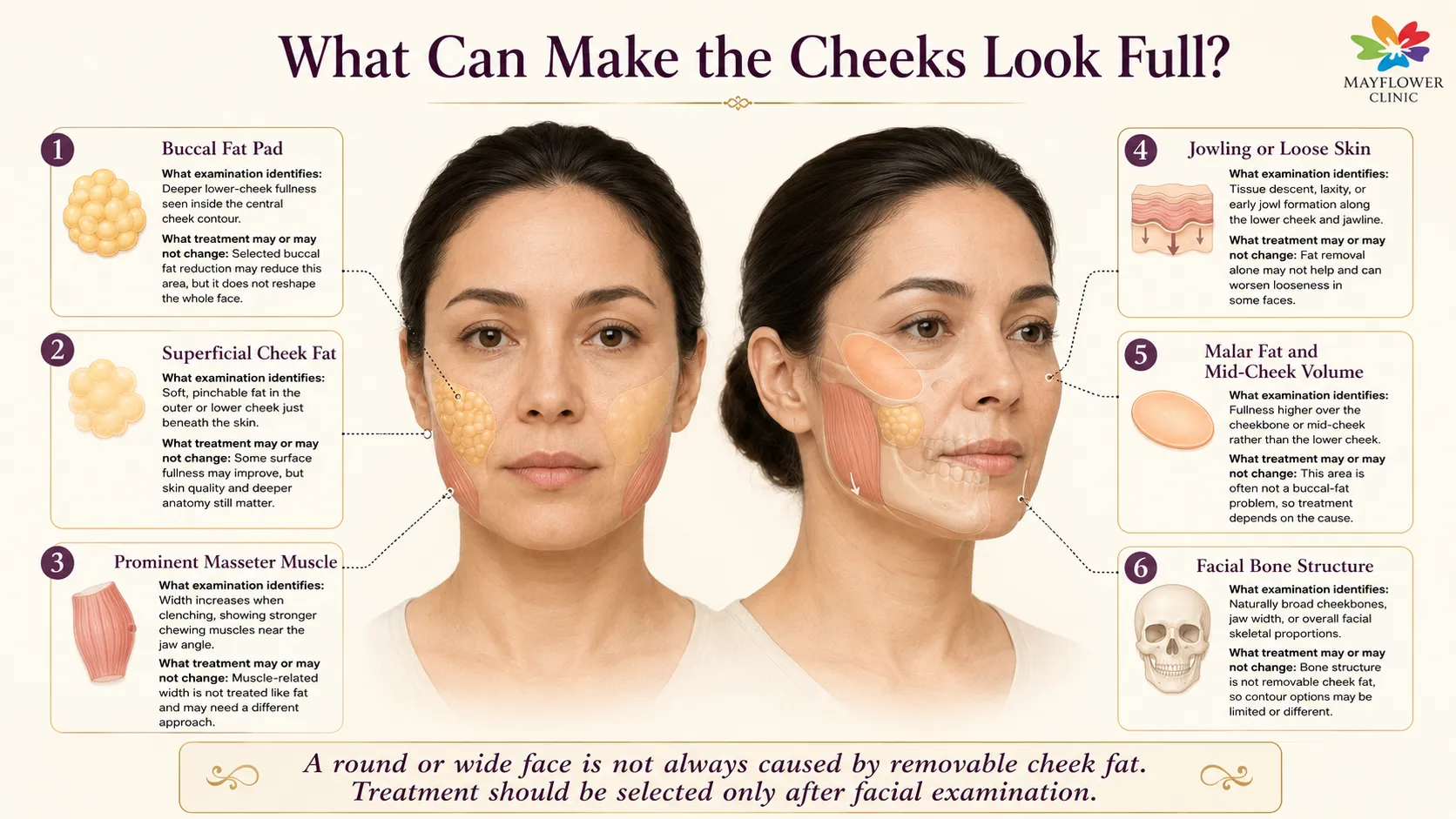
The method should follow the anatomy. Buccal fat removal, superficial liposuction, muscle treatment and lifting procedures solve different problems.
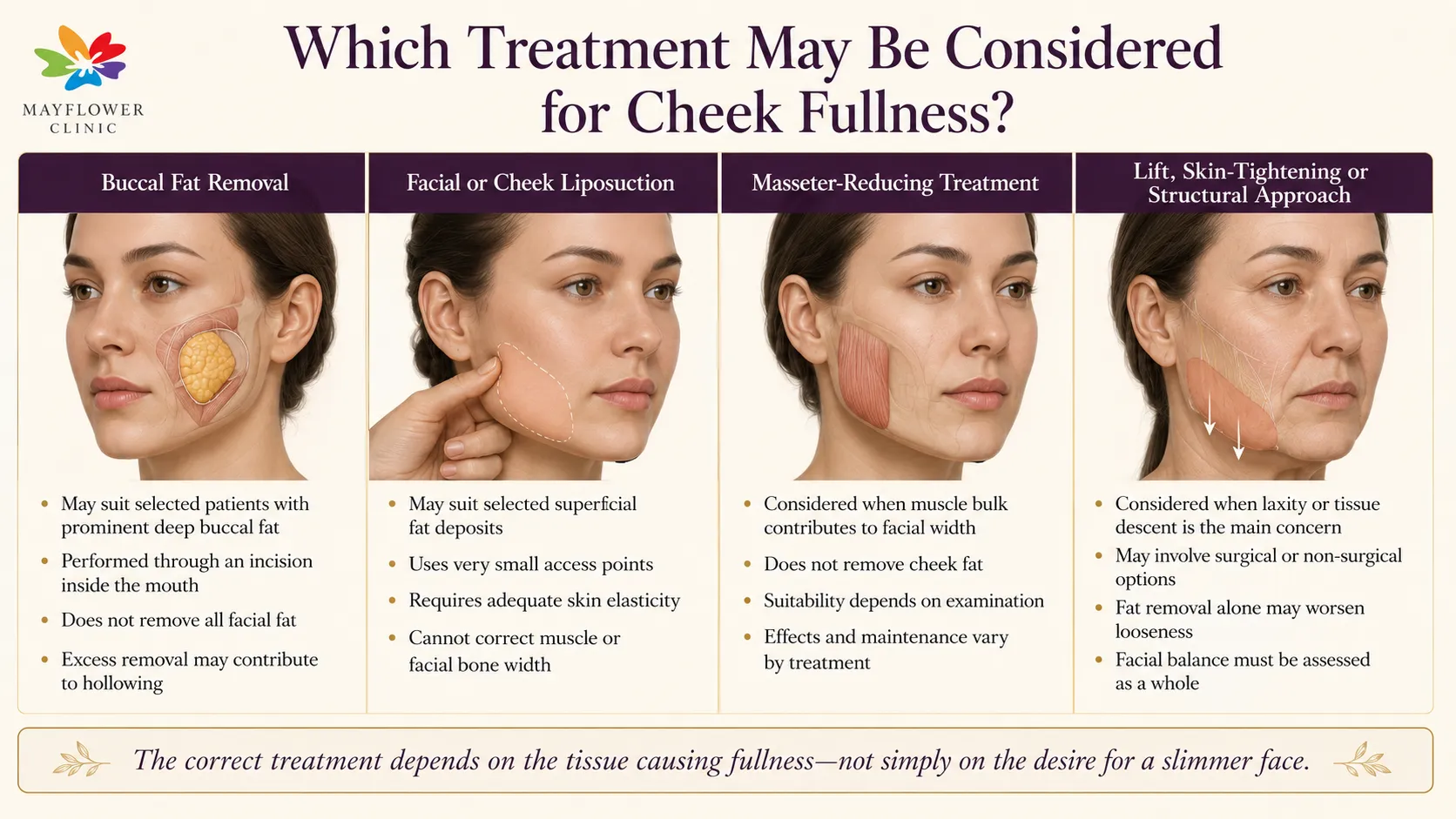
May be considered when persistent lower-cheek fullness is mainly caused by a prominent deep buccal fat pad.
May be considered for selected superficial, pinchable fat where skin quality and facial anatomy are suitable.
A broad lower face can be related to muscle bulk or jaw structure rather than cheek fat.
When tissue descent, loose skin, a weak chin or neck fullness dominates, fat removal alone may be incomplete or counterproductive.
When examination confirms that the deep buccal fat pad is contributing meaningfully to lower-cheek fullness, a conservative reduction may be discussed. The procedure is performed through a small incision inside the mouth. The buccal fat pad is gently identified and only an appropriate amount is considered for removal.
The two sides are assessed separately because facial anatomy and buccal fat-pad size are not always identical. The internal incision is usually closed with absorbable sutures. Anaesthesia is selected according to the procedure, patient factors and whether another treatment is being performed.
Not a “same amount on both sides” operation: natural asymmetry, facial width and existing hollows must guide the plan.
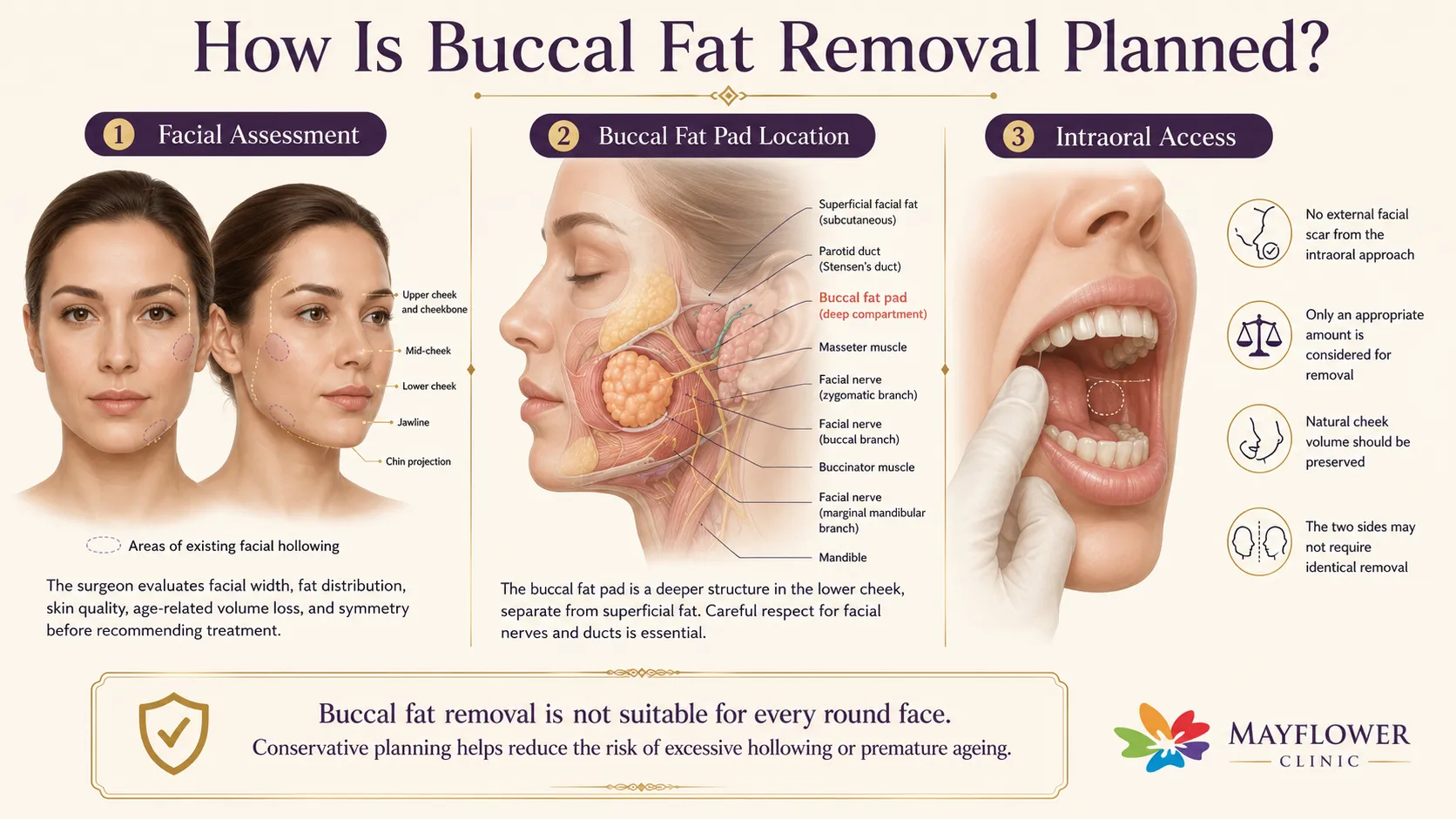
Ageing consideration: facial fat naturally changes with time. A face that tolerates removal today should still remain balanced as volume reduces in later years.
Every step is adapted to the individual diagnosis and procedure. Timelines vary when cheek treatment is combined with chin, jawline or neck contouring.
Discuss when the fullness appeared, weight changes, previous treatments, medical history, dental or jaw symptoms and the type of change you consider proportionate.
Dr. Shahane examines the cheeks, masseter muscles, jowls, chin, neck, facial skeleton, asymmetry, skin quality and existing hollows from front, profile and three-quarter views.
The plan may be buccal fat reduction, limited superficial contouring, another facial procedure, staged care or no procedure when removal is unlikely to remain flattering.
Pre-procedure instructions may address tests, medicines and supplements, nicotine, fasting, transport, oral health and arrangements for the first recovery days.
When buccal fat removal is performed, the pad is approached from inside the mouth and reduced carefully. Combined procedures follow the agreed operative plan.
Follow mouth-care, diet, medicines, sleeping-position and activity instructions. Report increasing one-sided swelling, fever or worsening symptoms promptly.
Early swelling can hide the change. Final assessment is made only after tissues soften and both sides settle, not from the first few postoperative photographs.
The following is general guidance, not a promise of an exact timetable. Your written instructions take priority.
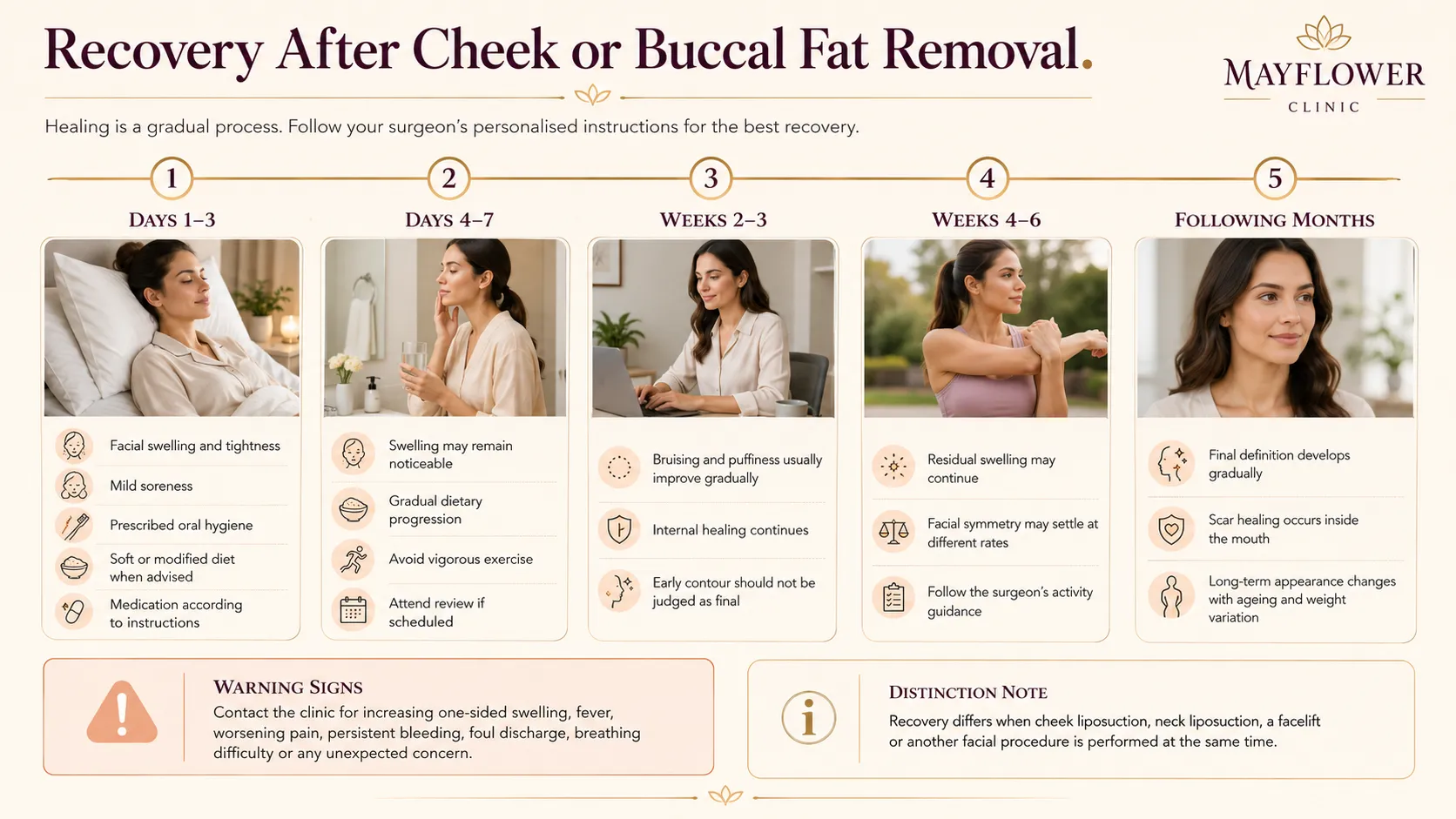
Swelling, tightness and mild soreness are common. Head elevation, prescribed medication, careful oral hygiene and a modified diet may be advised.
Daily activity usually becomes easier, but visible puffiness can remain. Avoid manipulating internal sutures or restarting strenuous activity without advice.
Swelling and asymmetry generally improve gradually. Exercise is reintroduced only after review. The face may feel firmer before tissues soften.
Subtle contour maturation continues as swelling resolves. Ageing, weight fluctuation and tissue descent can alter the long-term appearance.
Cheek contouring is elective surgery when an operation is chosen. Understanding what can go wrong is part of valid consent.
Increasing one-sided swelling, persistent bleeding, fever, worsening pain, foul discharge or taste, difficulty opening the mouth, new facial weakness, breathing difficulty, chest pain or any rapidly worsening symptom. Emergencies require immediate local emergency care.
A responsible quotation follows diagnosis. A low headline price is not useful if the selected procedure does not match the cause of fullness.
“The cheek is an area where restraint matters. Before removing volume, I assess whether that volume is creating the concern or protecting the face from looking hollow as it ages.”Dr. Pawan Shahane, M.Ch. Plastic Surgery · Mayflower Clinic, Nagpur
These answers provide general education. An in-person examination is necessary before any recommendation.
Cheek fat removal is a broad patient term for procedures intended to reduce selected facial fullness. The correct method depends on whether the fullness comes from the deep buccal fat pad, superficial fat, muscle bulk, loose tissue or facial structure.
Not always. Buccal fat removal specifically reduces part of the deep buccal fat pad through an incision inside the mouth. Superficial cheek or jawline fat, masseter muscle prominence and loose skin require different assessment and may need different treatment.
A suitable patient may have persistent lower-cheek fullness caused mainly by prominent buccal fat, stable weight, realistic expectations and enough surrounding facial volume to tolerate conservative reduction. Suitability can only be decided after facial examination.
It may be unsuitable for a naturally thin or narrow face, existing cheek hollowing, significant facial volume loss, unstable weight, untreated medical risk factors or expectations of an extreme facial change. Younger facial shape may also change as the face matures.
The usual buccal fat approach uses a small incision inside the mouth, so it does not create an external cheek scar. Internal healing, oral hygiene and follow-up remain important.
Yes. Excessive or poorly selected fat removal can produce unwanted hollowing, asymmetry or an older-looking appearance over time. Conservative planning and preservation of useful facial volume are important.
Buccal fat removal treats a deeper fat compartment inside the lower cheek. Facial liposuction treats selected superficial, pinchable fat through small skin access points. They are not interchangeable and neither corrects every cause of a round face.
External devices and injectable treatments do not selectively remove the deep buccal fat pad. Some non-surgical options may be considered for other facial concerns, but only after confirming the tissue and treatment area.
Swelling, tightness and mild soreness are expected early. A modified diet, prescribed mouth care and activity restrictions may be advised. Swelling improves gradually over several weeks, while contour maturation can continue for a few months.
Many patients resume light desk work within several days to about one week, depending on swelling, comfort and the procedure performed. Strenuous exercise should wait until Dr. Shahane reviews healing and gives individual clearance.
Risks can include bleeding, infection, prolonged swelling, asymmetry, numbness, persistent pain, poor healing, injury to a salivary duct or facial-nerve branch, minimal change, excessive hollowing and the possible need for revision.
Cost depends on the actual cause of fullness, the selected procedure, anaesthesia, facility requirements, whether another facial area is treated and the follow-up plan. Mayflower Clinic provides a procedure-specific quotation after examination.
Removed fat does not grow back in the same way, but the face continues to change with ageing, weight fluctuation and tissue descent. Long-term appearance therefore depends on more than the amount of fat removed.
Selected procedures may be combined when the overall profile, jawline and chin require a coordinated plan. Combination treatment is not automatically better; it must be based on anatomy, safety and realistic benefit.
Page content was medically reviewed for patient education on 25 July 2026. External references support general education and do not replace individual clinical assessment.
Bring front, profile and three-quarter photographs only if requested. Your consultation will assess facial volume, masseter width, skin quality, chin and neck balance before discussing whether fat removal—or no removal—is the safer option.

Case of the Month: Grade 3 Gynecomastia…

The Science of Facial Aging: Why Wrinkles,…