0712 6692706 / 0712 3551170 / +91 8087471244   |   contact@mayflowerclinic.in
Reconstructive Plastic Surgery · Nagpur

Tissue Expander Surgery in Nagpur — Gradual Tissue Creation for Staged Reconstruction

Tissue expansion is not a one-step cosmetic procedure. It is a planned reconstructive process in which a temporary expander is placed beneath suitable tissue and enlarged gradually, creating additional local skin and soft tissue that may later be used for reconstruction.

Dr. Pawan Shahane, M.Ch. Plastic Surgery
Clinical content reviewer: Dr. Pawan Shahane, M.Ch. Plastic Surgery Reconstructive & cosmetic plastic surgery · Ex-Assistant Professor · IAAPS Member This draft should be published only after final clinical review.
Plastic surgery consultation discussing tissue expander reconstruction in Nagpur
Mayflower Clinic · Dhantoli, Nagpur
M.Ch.Plastic Surgery
StagedReconstructive planning
Doctor-ledExpansion follow-up
Safety-firstRisks + red flags explained
Page Guide · Quick Answer

What should I understand first?

Quick answer Tissue expansion uses a temporary device to gradually stretch suitable local tissue. It normally involves placement surgery, repeated expansion visits, careful monitoring and a later reconstructive stage. The exact device, timing and number of visits cannot be decided online.
Understanding tissue expansion

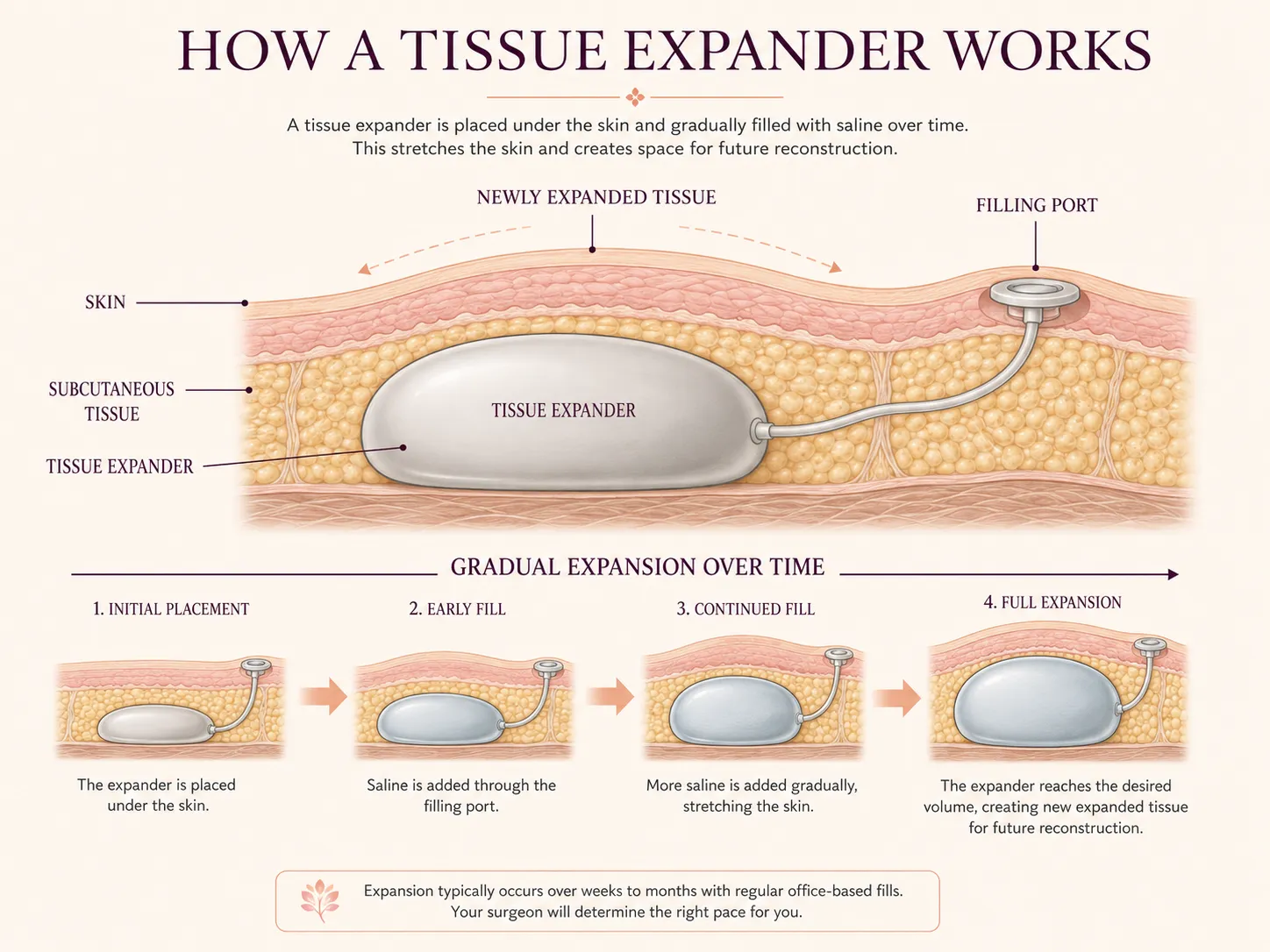
How does a tissue expander work?

A tissue expander is a temporary reconstructive device placed beneath suitable skin and soft tissue near the area that needs reconstruction. After the placement site has healed sufficiently, the expander is enlarged gradually during planned follow-up visits.

The controlled increase in volume places stretch on the overlying tissue. Over time, this provides additional local tissue that can be used during a later reconstructive operation. Because the expanded tissue comes from next to the defect, it may offer useful similarity in colour, texture and—in selected scalp reconstruction—hair-bearing quality.

Important distinction: a tissue expander is not simply another name for a permanent implant. Its main purpose is to create or prepare tissue for a later reconstructive stage.

Medical illustration showing how a tissue expander gradually stretches skin and soft tissue
Educational diagram: a temporary expander beneath the tissue is enlarged gradually rather than all at once.
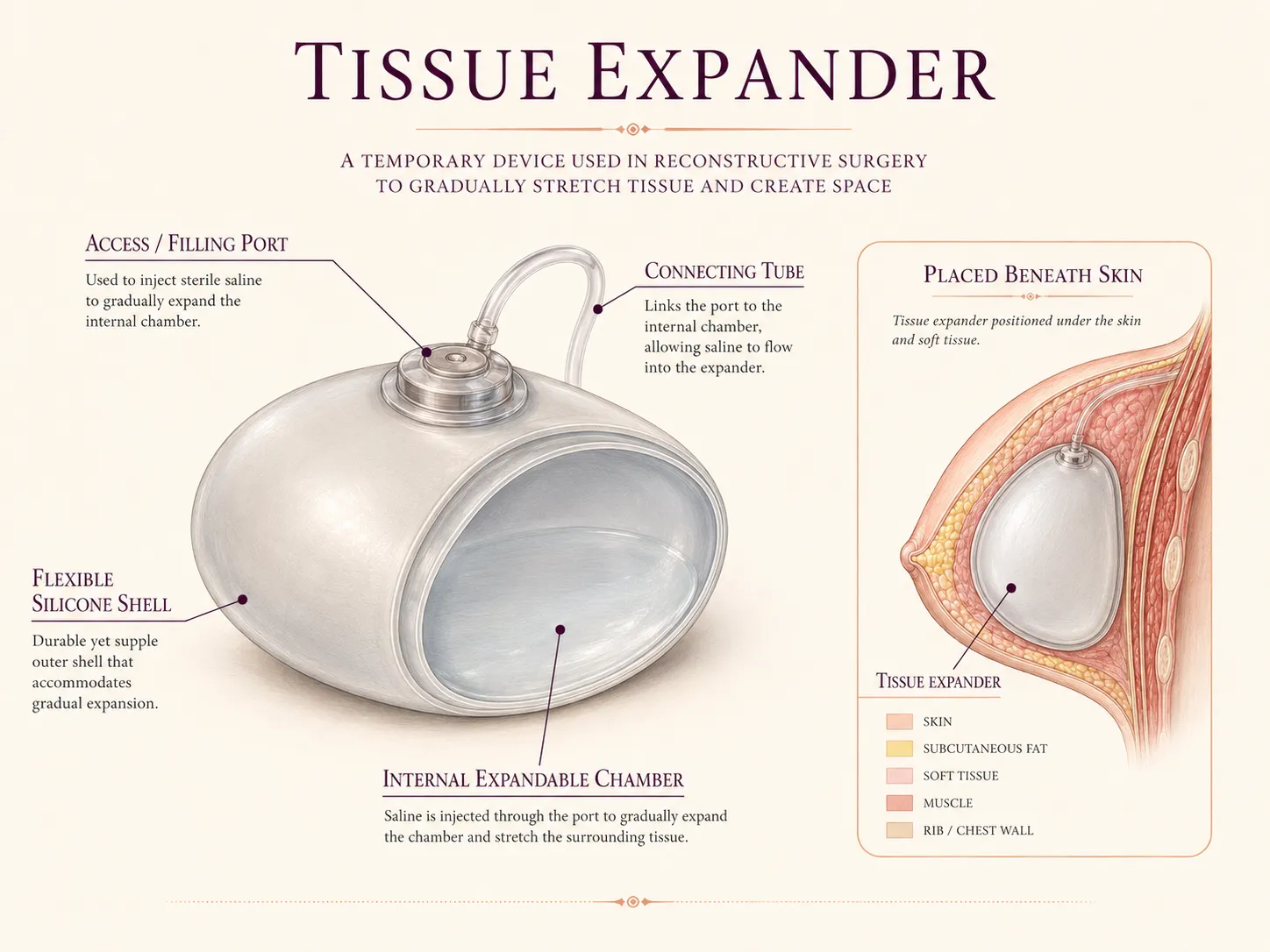
Tissue expander components including expandable chamber and filling port
Device anatomy varies by model. Expanders may include an expandable chamber and an access or filling port.
Device basics

What are the parts of a tissue expander?

Different expanders are designed for different reconstructive sites. In general, the system includes a flexible expandable chamber and a method of accessing that chamber for controlled filling. Some designs use an integrated or remote filling port connected by tubing.

Expandable chamber

The part that increases in volume gradually to stretch the overlying tissue.

Access port

Allows controlled expansion during follow-up according to the device design and surgical plan.

Shape & profile

Selected to match the reconstructive site, tissue available and planned direction of expansion.

Temporary role

The expander is generally removed during a later reconstructive stage once adequate tissue is available.

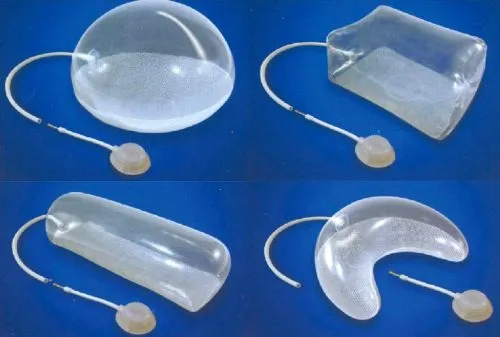
Authentic device photograph

Real tissue expanders come in different shapes and sizes

The photograph on this page shows real tissue expander devices in different shapes and sizes. Device selection is not based on choosing a “bigger” or “smaller” expander from a catalogue. It is a reconstructive planning decision.

Selection depends on the site to be reconstructed, the size and shape of the defect, the quality and mobility of surrounding tissue, the direction in which new tissue is needed, the location of scars, and the planned second-stage reconstruction.

Why this image matters: it shows actual expander hardware rather than a generic breast implant or an AI-generated product. The specific device used for any patient must still be chosen individually after examination.
Real tissue expanders in different shapes and sizes for reconstructive surgery planning
Actual tissue expanders showing variation in size and shape. Photograph is for patient education, not device selection.
When it may be considered

Which reconstructive problems can tissue expansion help address?

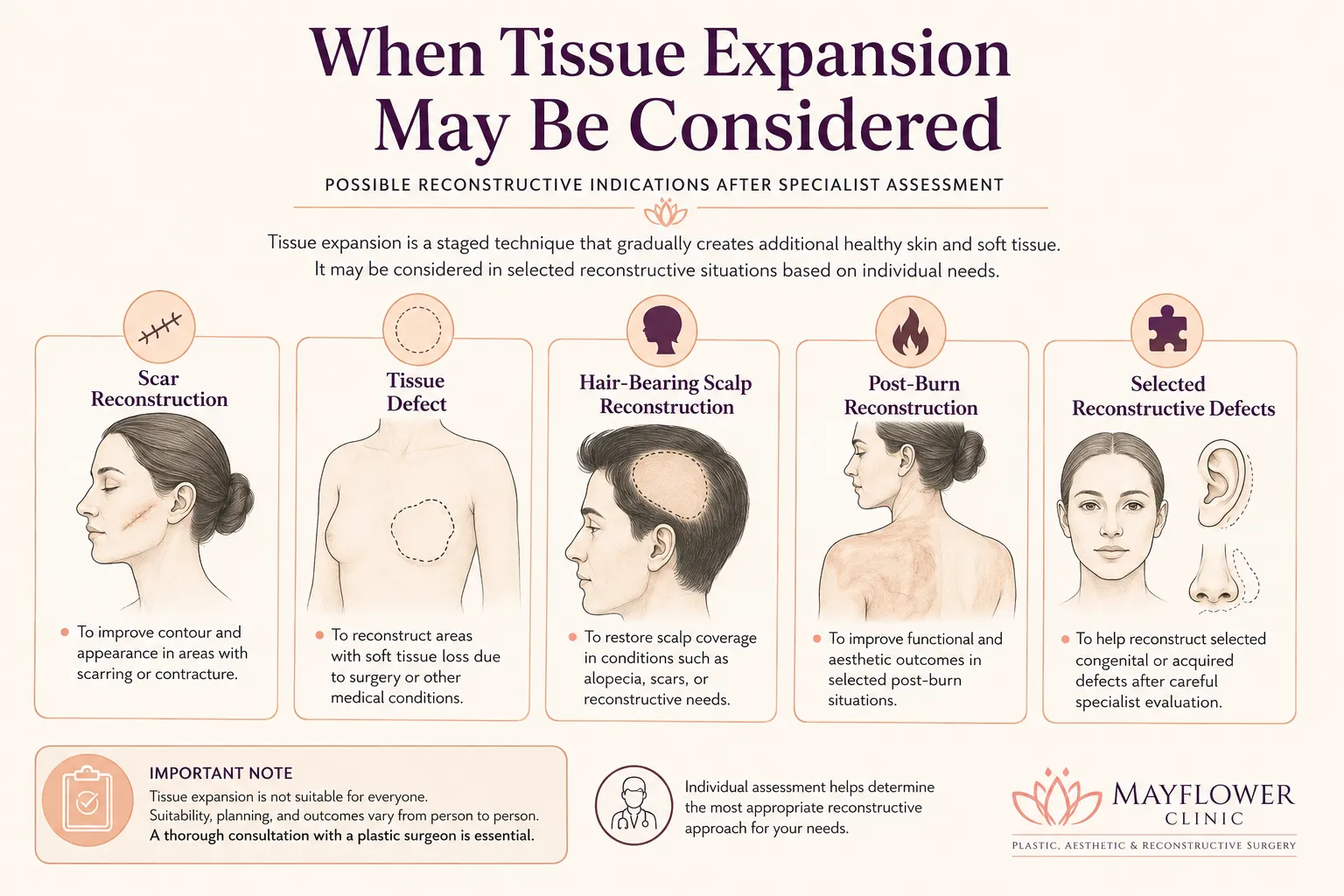
Tissue expansion is a reconstructive option, not a diagnosis. Whether it is appropriate depends on the defect and the quality of the tissue around it.

Reconstructive situations where tissue expansion may be considered after specialist assessment
Examples are illustrative only. Specialist assessment is required before deciding whether expansion is suitable.

Scar reconstruction

Selected scars or scarred areas where nearby healthy tissue can be expanded to assist reconstruction.

Tissue defects

Selected areas of tissue loss after surgery, trauma or other acquired defects.

Scalp reconstruction

Especially useful when hair-bearing scalp tissue is important to the reconstructive goal.

Post-burn reconstruction

Selected burn-scar problems when surrounding tissue quality and blood supply permit expansion.

Congenital defects

Some congenital conditions may require additional local tissue as part of staged reconstruction.

Other staged reconstruction

Including selected breast, face, neck, limb or other reconstructive pathways when clinically appropriate.

Candidacy

Who may—or may not—be suitable?

The key requirement is not simply “needing extra skin.” Tissue expansion depends on whether there is enough healthy, reliable surrounding tissue to expand safely and whether the patient can complete a staged process with repeated follow-up.

Factors that may support expansion

A reconstructive defect with usable adjacent tissue, a clear staged plan, reasonable healing capacity and ability to attend repeated reviews.

Factors that may make expansion difficult

Active infection, severely damaged or poorly vascularized tissue, very rigid scarred tissue, inability to protect the area or inability to complete follow-up may make another reconstructive option more appropriate.

Previous surgery or radiation

Prior treatment can change tissue quality and blood supply. It does not automatically rule tissue expansion in or out; it changes the planning discussion.

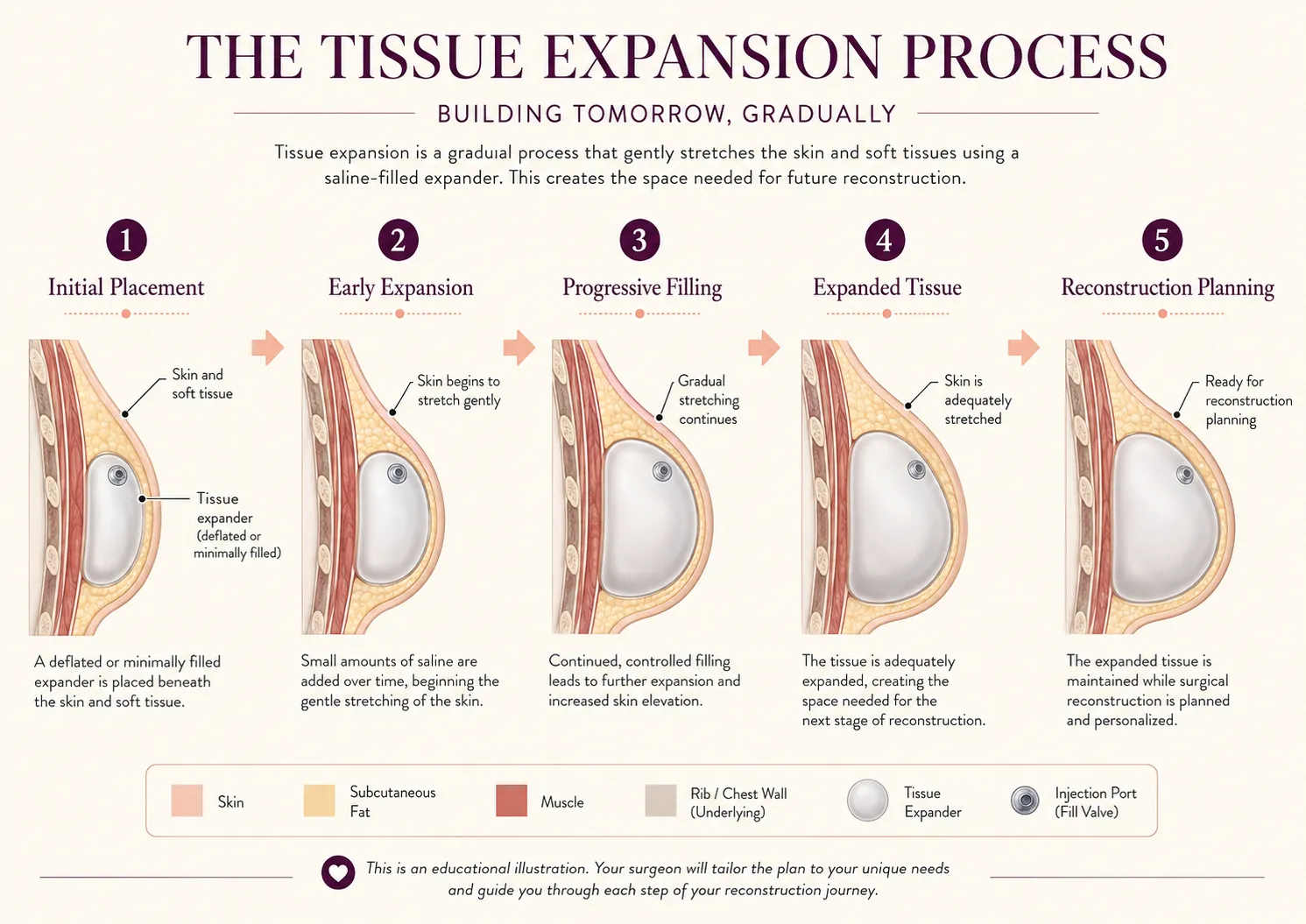
Stages of tissue expansion from placement through gradual expansion to reconstruction planning
Tissue expansion is progressive. The tissue must be monitored at each stage rather than expanded according to a fixed online schedule.
Gradual expansion

Why is tissue expansion done slowly?

The surrounding tissue needs time to adapt. Expansion that is too rapid or inappropriate for the local tissue can increase pressure and may compromise the skin or wound.

At each visit, the surgeon assesses the wound, skin colour and quality, tension, discomfort, expander position and the amount of additional tissue still required. The expansion plan can therefore change during treatment.

Key expectation

There is no universal “number of fills”

The number, interval and amount of expansion are individualized. A responsible plan follows tissue response rather than a fixed visit count promised in advance.

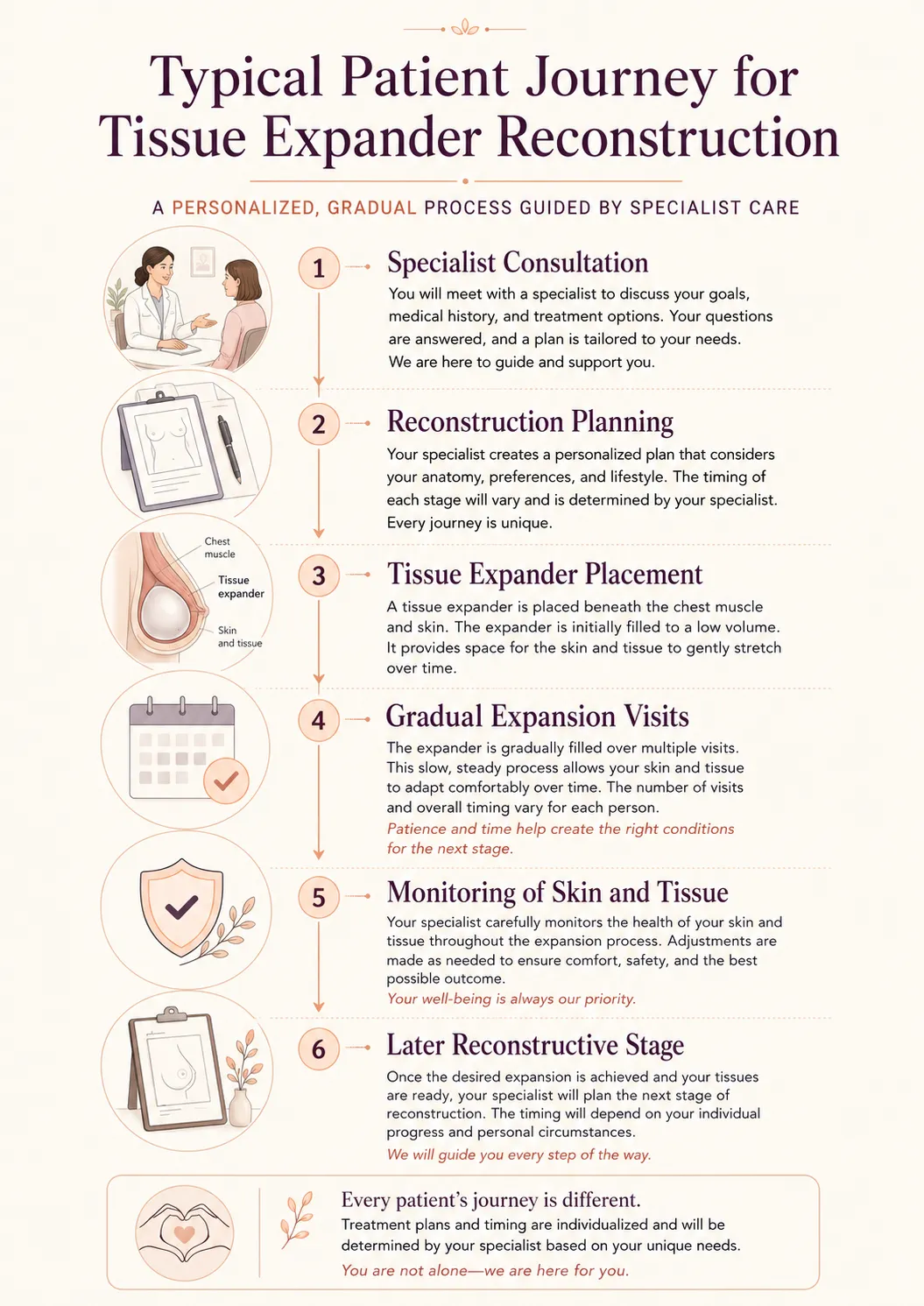
Typical patient journey

What does the tissue-expander treatment journey look like?

The exact sequence varies, but most plans include assessment, placement, gradual expansion, monitoring and a later reconstructive stage.

1
Stage 1

Specialist consultation

Define the reconstructive problem, examine nearby tissue, review previous operations or treatment and discuss realistic alternatives.

2
Stage 2

Reconstruction planning

Select the site, direction, shape and size of expansion and plan where scars and the access port may be positioned.

3
Stage 3

Tissue expander placement

The temporary expander is surgically placed beneath suitable tissue. Wound care and protection of the area begin immediately.

4
Stage 4

Gradual expansion visits

After sufficient healing, controlled expansion begins. The schedule is based on tissue response, not a fixed online protocol.

5
Stage 5

Skin and tissue monitoring

The surgeon monitors colour, tension, wound integrity, device position, discomfort and whether enough tissue is being created safely.

6
Stage 6

Later reconstructive stage

Once adequate tissue is available, the expander is removed and the expanded tissue is used according to the planned reconstruction.

Typical tissue expander reconstruction journey from consultation to later reconstructive stage
Illustrated journey. Timing and number of visits vary substantially between patients.
Aftercare

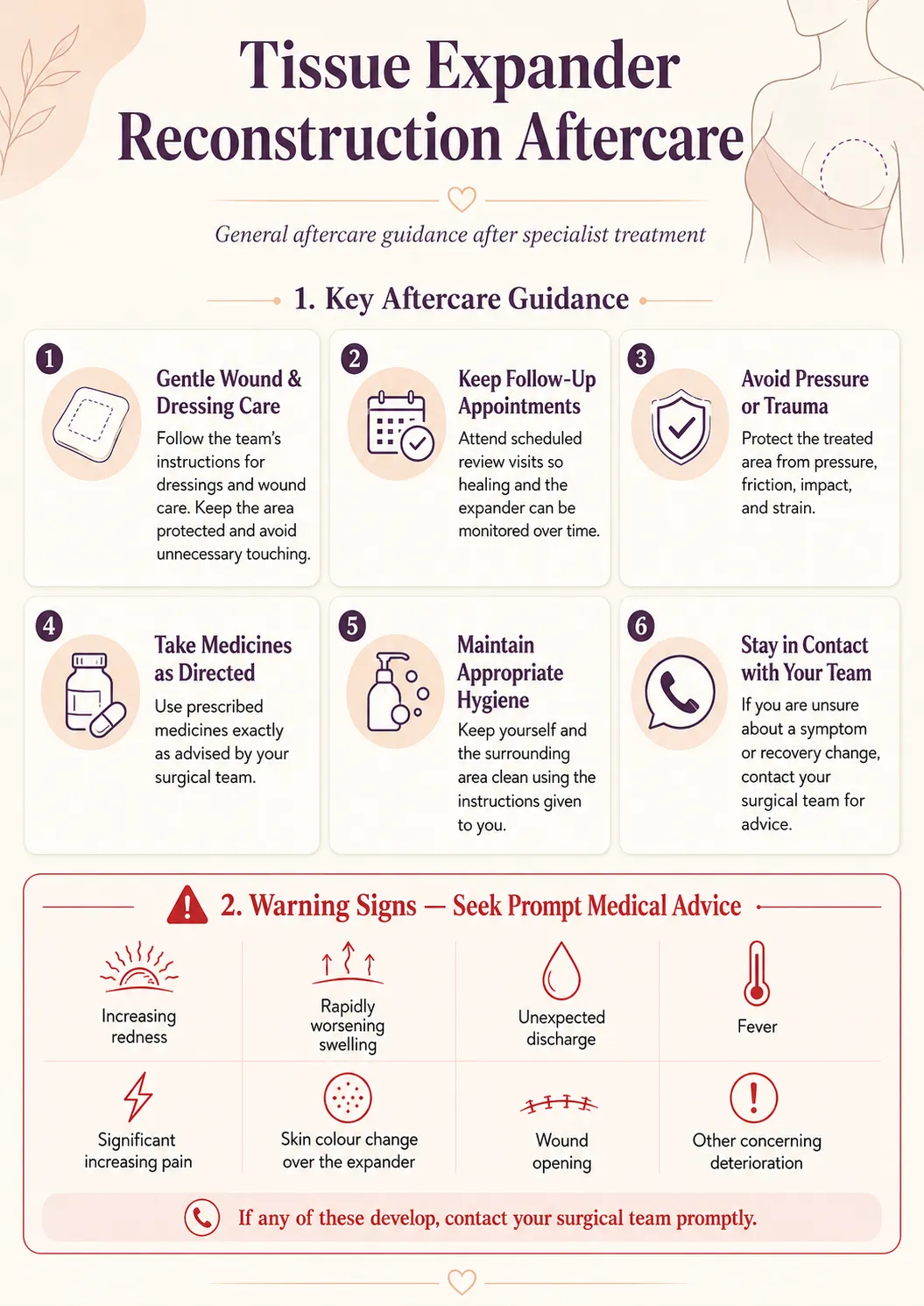
How do I care for the area while the expander is in place?

Aftercare has two goals: protect the surgical wound and protect the skin being expanded. Instructions vary by body site and stage, so the plan given by the operating surgeon takes priority over generic internet advice.

Wound & dressing care

Keep the area clean and dry as instructed and do not disturb dressings or sutures prematurely.

📅

Keep every follow-up

Expansion requires repeated review. Missing visits can delay recognition of skin or device problems.

🛡

Avoid pressure or trauma

Do not press, massage, puncture or manipulate the expander or access-port area unless specifically instructed.

💊

Use medicines correctly

Take prescribed medicines as directed and do not self-start antibiotics or pain medicines without checking when uncertain.

🚿

Hygiene matters

Follow the specific bathing, washing and activity instructions for the wound and anatomical site.

Report change early

Do not wait for the next scheduled fill if redness, swelling, discharge, wound opening or skin changes develop.

Read the Mayflower Patient Care Guide →

Aftercare guidance following tissue expander surgery and during gradual expansion
General aftercare framework. Your own wound, activity and expansion instructions may differ.
Safety & limitations

What risks and warning signs should I know?

Tissue expansion is useful because it can create local tissue, but it is still surgery involving a temporary implanted device and repeated expansion. Complications can interrupt or change the reconstruction plan.

Possible complications

  • Anaesthesia-related risks, bleeding, bruising or hematoma
  • Infection around the wound, port or expander
  • Seroma or other fluid collection
  • Delayed healing, wound separation or unfavourable scarring
  • Pain, pressure, altered sensation or discomfort during expansion
  • Expander leakage or rupture
  • Port malfunction, displacement or difficulty accessing the port
  • Expander movement, rotation or change in planned contour
  • Skin thinning, reduced blood supply, skin injury or tissue loss
  • Exposure or extrusion of the expander
  • Need to pause expansion, remove or replace the device, or perform additional surgery

Contact the surgical team promptly for

  • Increasing redness, warmth or rapidly worsening swelling
  • Unexpected discharge, pus, persistent bleeding or bad smell
  • Fever or feeling systemically unwell
  • Significant or steadily increasing pain
  • Marked colour change, blanching, darkening or unusual thinning of skin over the expander
  • Wound opening or visible device
  • A sudden unexpected reduction or change in expander fullness
  • Any rapid deterioration that worries you

Emergency note: WhatsApp and website forms are not emergency services. Severe or rapidly worsening symptoms require urgent medical assessment.

Limitations

What tissue expansion cannot promise

  • It cannot guarantee complete scar removal or perfect symmetry.
  • It may create a visible bulge while the expander is in place.
  • It requires time, repeated visits and usually more than one operation.
  • The skin may not tolerate the planned amount or speed of expansion.
  • Complications can force a pause, device removal or a different reconstructive plan.
  • Final contour, colour and scar appearance vary with the original defect and healing biology.
Alternatives

What alternatives may be discussed?

The best alternative depends on the defect. A plastic surgeon may compare tissue expansion with local or regional flaps, skin grafts, staged scar revision, fat grafting, free-tissue transfer, implants or prosthetic reconstruction, or simply no surgery when the expected benefit does not justify the burden or risk.

Tissue expansion can be attractive because it uses nearby tissue, but it is not automatically the best reconstructive method for every site.

Explore Reconstructive Plastic Surgery
Verified clinic review inventory

Patient feedback — presented without inventing a tissue-expander outcome

The clinic review inventory verifies these Google reviewer names. Because the source available for this page does not identify them as tissue-expander patients, no tissue-expander procedure or result is attributed to them.

★★★★★
Aarti Kate

Verified Mayflower Clinic Google reviewer. Procedure and outcome are not inferred on this page.

★★★★★
Shubhangi Chourasiya

Verified Mayflower Clinic Google reviewer. Procedure and outcome are not inferred on this page.

★★★★★
Bhagwan Singh

Verified Mayflower Clinic Google reviewer. Procedure and outcome are not inferred on this page.

Authenticity rule: Original review wording should be read at the clinic’s Google Business Profile. This page does not fabricate quotations, assign a reconstructive procedure to a reviewer, or use reviews as a guarantee of outcome. Read original Google reviews →
Questions patients ask

Tissue expander surgery FAQs

These answers are educational and cannot determine your individual suitability.

What is tissue expander surgery?
Tissue expander surgery is a staged reconstructive technique. A temporary expander is placed beneath suitable tissue and enlarged gradually so additional local skin and soft tissue can become available for reconstruction.
Is a tissue expander the same as a permanent implant?
No. A tissue expander is primarily a temporary device used to create additional tissue for a later reconstructive stage. The final reconstruction depends on the condition being treated and may or may not involve another implant.
Where can tissue expansion be used?
Tissue expansion may be considered for selected reconstructive problems involving scars, tissue loss, scalp or hair-bearing areas, post-burn reconstruction, congenital or acquired defects and some breast-reconstruction pathways. Suitability varies by site and tissue quality.
How is the expander enlarged?
After the placement wound has healed sufficiently, the expander is enlarged gradually during planned follow-up visits, commonly through an access port. The amount and timing of each expansion are individualized according to the tissue and reconstructive plan.
How many expansion visits will I need?
There is no fixed number. The number and spacing of visits depend on the expander, the amount of tissue required, the reconstruction site, tissue response, comfort and the surgeon's plan.
How long does the whole tissue-expansion process take?
Tissue expansion is usually a weeks-to-months process rather than a one-day treatment. The total timeline varies because placement, healing, gradual expansion and later reconstruction occur in stages.
Does tissue expansion hurt?
Placement is surgery and can cause temporary postoperative discomfort. Expansion visits may produce pressure or tightness for a period afterward. Significant or worsening pain should be reported rather than assumed to be normal.
What are the main risks of tissue expander surgery?
Risks can include bleeding, infection, wound-healing problems, fluid collection, pain, scarring, device leakage or rupture, port problems, expander movement, thinning or compromise of the overlying tissue, exposure of the device and the need for additional surgery or removal.
What warning signs should I report during tissue expansion?
Increasing redness or warmth, rapidly worsening swelling, unexpected discharge, fever, significant increasing pain, wound opening, marked skin colour change or thinning over the expander, device exposure or a sudden unexpected change in expander fullness should prompt contact with the surgical team.
Can badly scarred skin always be expanded?
No. Tissue expansion needs adequate, healthy tissue and blood supply. Heavily damaged, infected or poorly vascularized tissue may not be suitable, and another reconstructive method may be safer or more predictable.
Will tissue expansion remove all scars or restore the area perfectly?
No. Tissue expansion is a reconstructive method, not a guarantee of scar removal or perfect restoration. Existing and new scars, contour differences, colour differences and further procedures may still be part of the outcome.
How do I know whether tissue expansion is right for me?
A plastic-surgery consultation is required. The decision depends on the reconstructive defect, condition of nearby tissue, prior treatment, health and healing factors, alternatives, expected stages, risks and the patient's ability to attend repeated follow-up visits.
Medical references

Sources used for general patient education

  1. American Society of Plastic Surgeons. Tissue Expansion — What is tissue expansion? View source.
  2. American Society of Plastic Surgeons. Tissue Expansion Procedure Steps. View source.
  3. American Society of Plastic Surgeons. Tissue Expansion Risks and Safety. View source.
  4. American Society of Plastic Surgeons. Tissue Expansion Candidates. View source.

References support general education only. Individual reconstruction, device selection, timing and aftercare require an in-person plastic-surgery assessment.

Reconstructive consultation

Need to know whether tissue expansion is suitable for your reconstruction?

Bring prior operative notes, photographs or reports when available. Dr. Pawan Shahane can assess the defect, local tissue, previous scars and reconstructive alternatives before discussing whether staged tissue expansion is appropriate.

Medical Disclaimer: All surgical procedures carry inherent risks, and individual outcomes vary based on the original defect, tissue quality, blood supply, previous treatment, health and healing biology. Tissue expansion may require multiple visits and more than one operation, and complications can alter or stop the planned expansion. Surgical results are not guaranteed. Formal in-person consultation with Dr. Pawan Shahane is required before any surgical decision. This page is for general educational purposes only and does not constitute medical advice, diagnosis or a treatment recommendation.