
Observation and protection
A blocked feeling, mild blood-stained drainage, facial pressure and early swelling can occur while anaesthesia effects wear off.
- Arrange an adult escort.
- Do not drive.
- Keep the head raised.

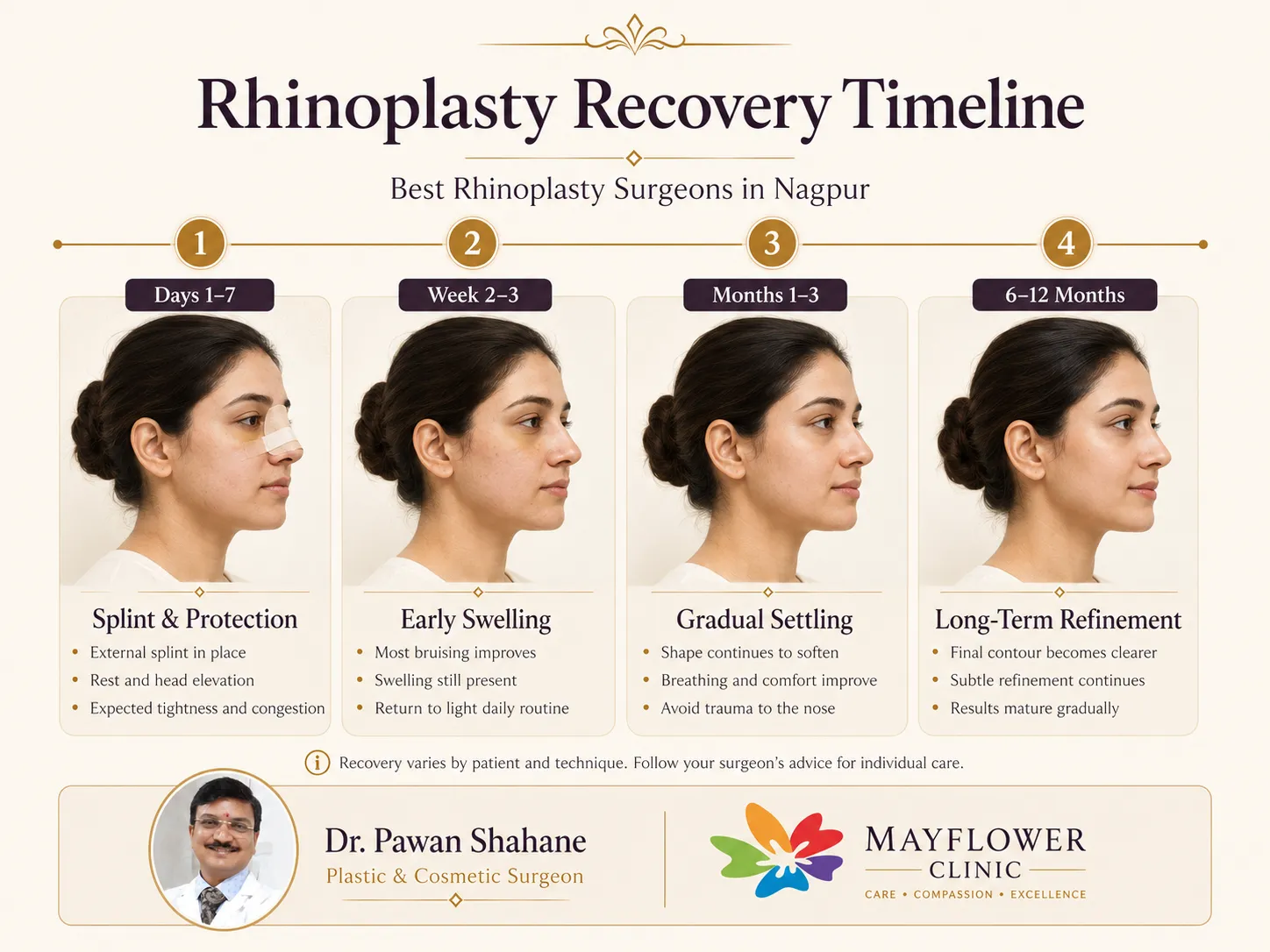
Most people look socially presentable before the nose is fully healed. This detailed guide separates splint recovery, return to work, exercise, swelling and final refinement so that you can plan surgery without mistaking an early appearance for the final result.
“A useful recovery plan explains three different clocks: when you feel functional, when you look presentable, and when the nasal tissues are mature enough for final judgment.”— Dr. Pawan Shahane, M.Ch. Plastic Surgery · Mayflower Clinic, Nagpur
For planning purposes, many patients reserve about 7–14 days for splint care, bruising and return to desk-based or public-facing work. That is only the visible early phase. Internal congestion, firmness and fine swelling continue to improve after the person has resumed normal daily life.
Specialty guidance notes that initial swelling improves over weeks, while nasal contour may continue refining for up to a year. A three-dimensional study of primary open rhinoplasty found that roughly two-thirds of measured postoperative oedema had resolved by one month, about 95% by six months and 97.5% by one year. Those figures describe a study group—not a promise for an individual patient.
Recovery can be longer after extensive bone repositioning, detailed tip work, multiple grafts, thick skin, combined septorhinoplasty or revision surgery. The safest timeline is therefore the one linked to the actual structures changed, not simply the label “open” or “closed.”
Ask a general question about this page. The answer is matched locally in your browser and links to the relevant section.
This page guide cannot examine you, diagnose a complication, recommend surgery, calculate candidacy or replace consultation. For individual symptoms, medication or activity clearance, contact the clinic.
The stages below describe a common pathway. Your operation may involve a different splint, internal support, suture plan, medication schedule or activity restriction.
A blocked feeling, mild blood-stained drainage, facial pressure and early swelling can occur while anaesthesia effects wear off.
Specialty patient guidance describes pain as commonly minimal to moderate, with more noticeable discomfort often concentrated in this period.
Swelling remains visible, congestion can still be significant and the external splint must remain protected.
The splint and selected sutures may be reviewed or removed, depending on the operation and wound condition.
Many patients return to desk work or college when bruising is manageable and energy has improved.
Bruising and redness are often much less obvious. Strenuous exercise is commonly restarted only after surgeon clearance.
The bridge often looks more settled, while the tip can remain firm, numb or less defined than expected.
Fine swelling and scar maturation continue. Thick skin, grafting or revision surgery can take longer than a straightforward primary case.
Bruising around the eyes can fade while tip oedema, tissue stiffness and internal congestion remain. Photographs taken a few weeks after surgery therefore show an interim stage—not a final contour.
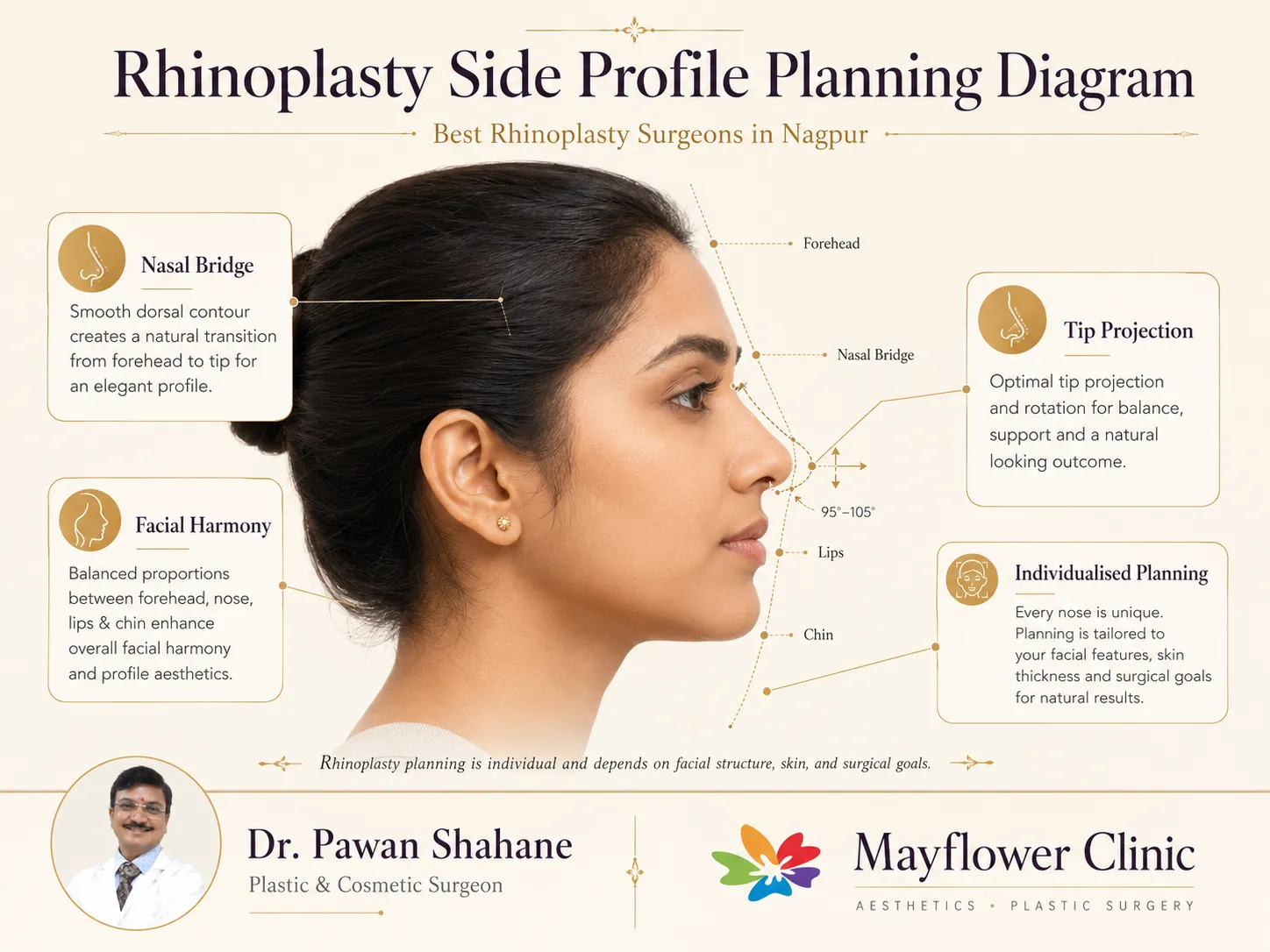
The tip may have thicker soft tissue and detailed cartilage work. Its projection, rotation and definition can therefore continue changing after the upper bridge looks relatively stable.
Use these ranges for calendar planning only. Clearance depends on bone work, grafts, breathing surgery, medication, dizziness, pain control and the risk of accidental impact.
| Activity | Common planning range | What changes the timing? | Practical caution |
|---|---|---|---|
| Desk work / online work | Often 7–14 days | Bruising, congestion, energy, public interaction and travel distance | Do not return while using sedating medicines or if bending/straining is unavoidable. |
| School / college | Often 7–14 days | Risk of crowd contact, sports, commute and ability to protect the splint | Tell staff that facial impact must be avoided. |
| Light walking | Often early, as advised | Dizziness, anaesthesia recovery and bleeding risk | Walk gently; stop if throbbing, bleeding or swelling increases. |
| Gym / strenuous exercise | Often 4–6 weeks | Osteotomies, blood-pressure rise, grafting and surgeon protocol | Restart progressively; heavy lifting and inversions may remain restricted. |
| Swimming | Often after wounds are healed and clearance is given | Incision status, infection exposure and vigorous activity | Do not rely on a generic date; obtain specific permission. |
| Contact sports | Longer restriction; individualized | Nasal bone stability and risk of impact | Helmet use does not remove all facial-impact risk. |
| Spectacles / sunglasses | Case-specific after bridge or bone work | Location of correction and pressure on healing nasal structures | Use taping, forehead support or another method only as demonstrated by the clinic. |
| Long-distance travel / flights | Discuss before booking | Anaesthesia recovery, bleeding, swelling, follow-up access and medical history | Patients travelling from outside Nagpur should plan the first follow-up and local support before surgery. |
| Wedding / major photography | Allow more than the minimum social downtime | Bruising, morning swelling and event pressure | Plan a buffer; the nose will not be at its final definition in the early months. |
Elevation may help control swelling and avoids direct pressure on the healing nose. Use the position and duration advised by the clinic.
Do not remove crusts, packing or internal supports. Sneeze with your mouth open and use only the cleaning method provided.
Do not wet, loosen or re-tape the splint yourself. Contact the clinic if it shifts, becomes soaked or causes unexpected pressure.
Heat and sunburn may worsen swelling or pigment healing. Ask when sunscreen, hats, hot showers and outdoor exposure can resume.
Heavy lifting, bending, vigorous exercise, crowded travel and playful children or pets can all create accidental pressure in early recovery.
Splint review, suture care, breathing assessment and serial photographs help distinguish normal change from a problem needing attention.
Expected does not mean “ignore.” Mention concerns at follow-up and follow the clinic’s instructions.
Osteotomies or correction of a crooked bony vault can increase bruising and require a more cautious return to impact-risk activities.
Detailed cartilage reshaping under thicker skin can mean prolonged tip swelling and slower visible definition.
Septal, ear or rib cartilage grafting can alter tenderness, firmness and the time needed for tissues to settle around new support.
Scar tissue and altered anatomy can make swelling less uniform and final refinement slower than in many primary procedures.
Septoplasty, turbinate or nasal-valve work can affect congestion, internal care and breathing recovery even when external bruising is modest.
Smoking, uncontrolled illness, unapproved medicines or supplements, missed follow-ups and accidental pressure may interfere with healing.
Mayflower Max Lift Rhinoplasty is Dr. Pawan Shahane’s clinic-specific name for an individualized structural approach that may use sutures, a columellar strut, a septal-extension graft or another support technique when appropriate. It does not mean that every nose is lifted maximally.
When additional tip support or grafting is used, the tip may feel firm, numb or swollen for longer than the patient expects from the appearance of the bridge. Early stiffness does not by itself define the final rotation or projection.
A generic internet timetable cannot reveal whether your nasal bones were repositioned, whether grafts were used, how the septum was treated or how your skin and scar tissue are responding. Follow-up therefore remains part of the operation—not an optional extra.
Individual experiences and outcomes vary. Excerpts are shortened from the clinic’s documented Google review inventory and do not predict another person’s recovery.
“He explains everything and how to take care. He support at every stage and do the surgery as planned.”
“I am very happy with my nose surgery, rhinoplasty. It’s been 3 weeks… I wanted a sharp tip, and I was having a broad nose.”
“From the initial consultation to the post-operative care, Dr. Shahane demonstrated exceptional skill, professionalism, and a genuine care for my well-being.”
These references support general education. The clinic’s written postoperative instructions remain the controlling advice for an individual operation.
Bring your medical history, current medicines, breathing concerns, prior injury or surgery records and any fixed work or event dates. The consultation should explain what will be changed, how that affects recovery and which restrictions apply to your case.

Case of the Month: Grade 3 Gynecomastia…

The Science of Facial Aging: Why Wrinkles,…