
Bridge or hump refinement
The bridge is assessed together with nasal length, tip position and the relationship between bone and cartilage.

Rhinoplasty can refine nasal shape, restore structural support, address selected breathing problems or correct changes after injury. The aim is not to copy another person’s nose, but to create a proportionate plan that respects your facial features and nasal function.

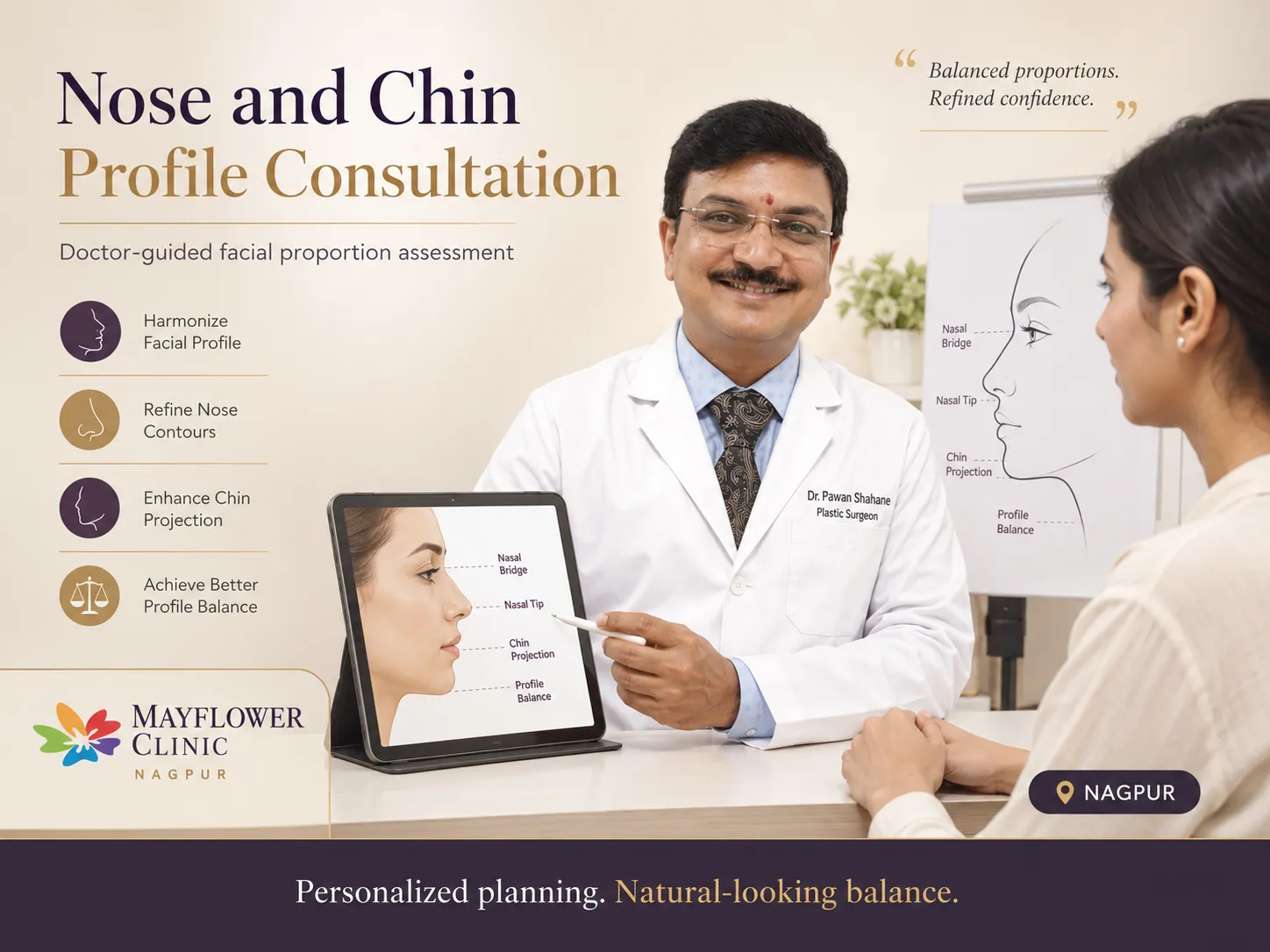
“A good plan does not chase an artificial template. It considers bone, cartilage, skin thickness, breathing, facial proportions and the patient’s priorities together.”— Dr. Pawan Shahane, M.Ch. Plastic Surgery · Mayflower Clinic, Nagpur
Rhinoplasty is a group of operations rather than one fixed technique. Depending on the person, surgery may reshape the bridge, nasal bones, tip, nostrils or internal support structures. Some patients seek cosmetic refinement; others require functional correction, post-traumatic reconstruction or a combined approach.
A careful consultation separates what is technically possible from what is proportionate and safe for the individual nose. Skin thickness, cartilage strength, previous surgery, septal deviation, allergies, smoking, general health and healing tendency all influence planning.
These illustrations are educational planning aids. They do not represent a promised result for any individual patient.
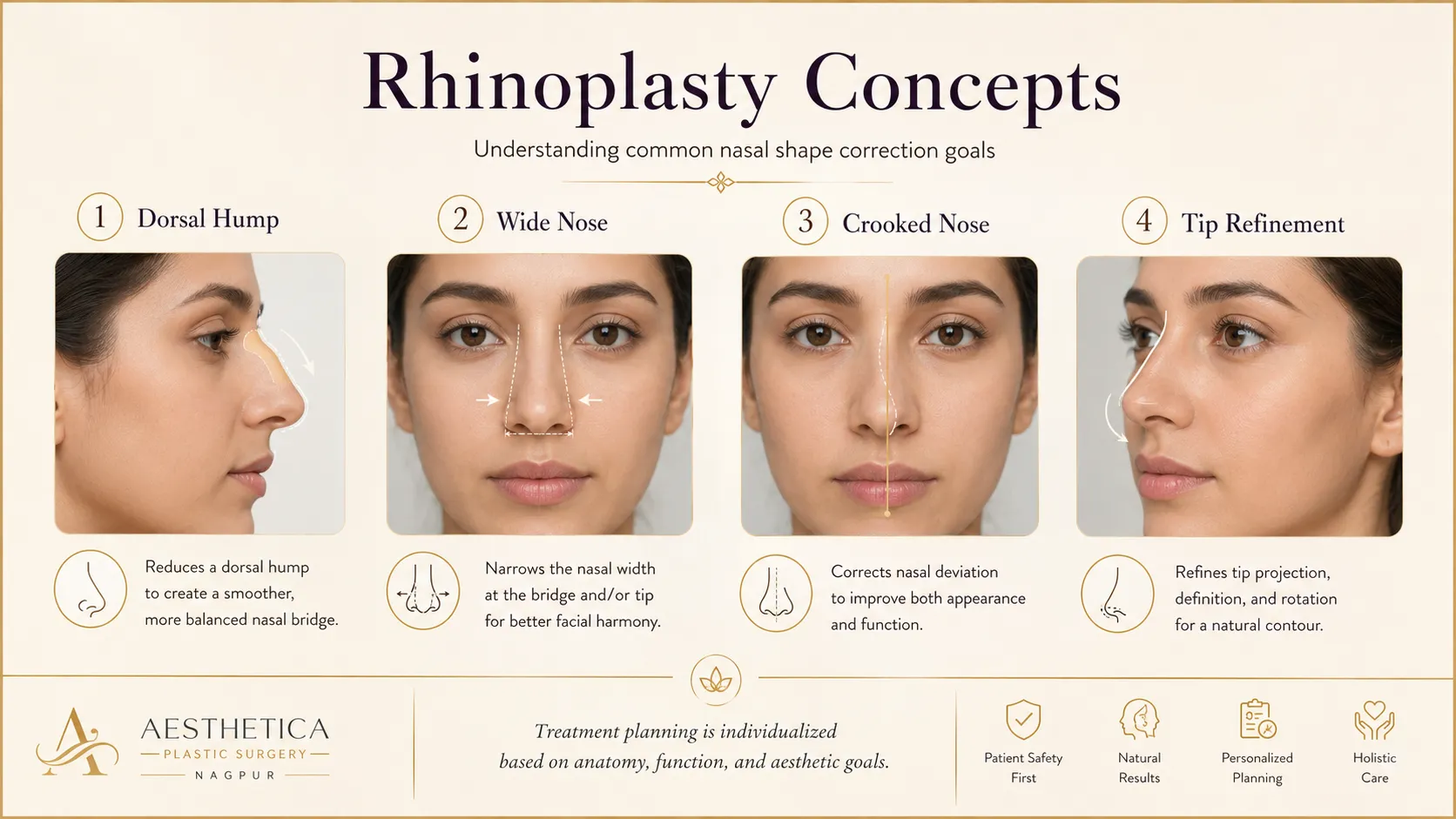
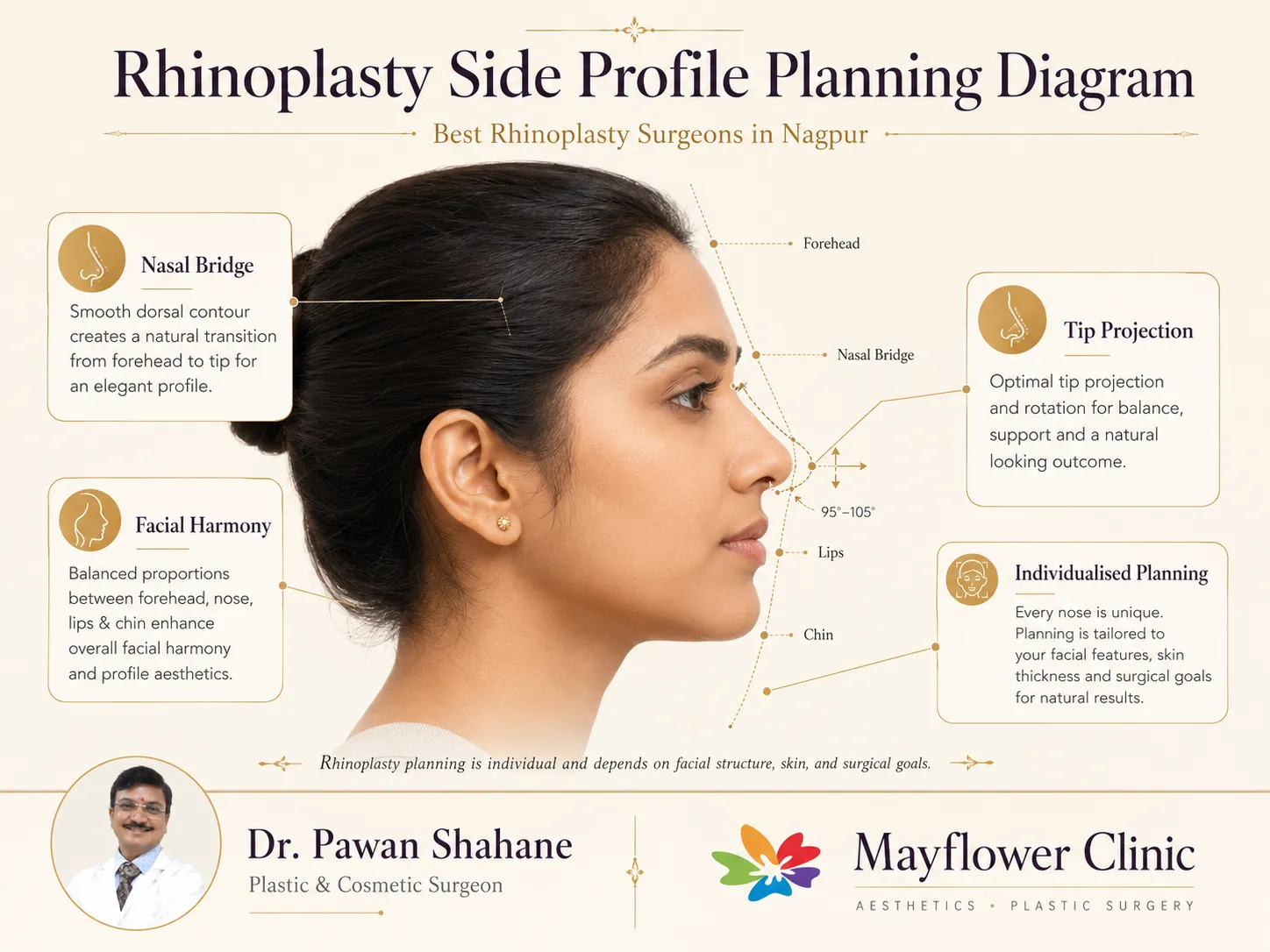
The bridge is assessed together with nasal length, tip position and the relationship between bone and cartilage.
Possible contributors include nasal bones, tip width, skin thickness and alar-base dimensions.
Cartilage shape, support, projection, rotation and skin envelope determine the available refinement.
External deviation may be associated with septal deviation, old trauma or unequal structural support.
Selected patients need external reshaping combined with septal or nasal-valve correction to support breathing.
Previous surgery may leave scar tissue, altered cartilage or reduced support, requiring more detailed planning.
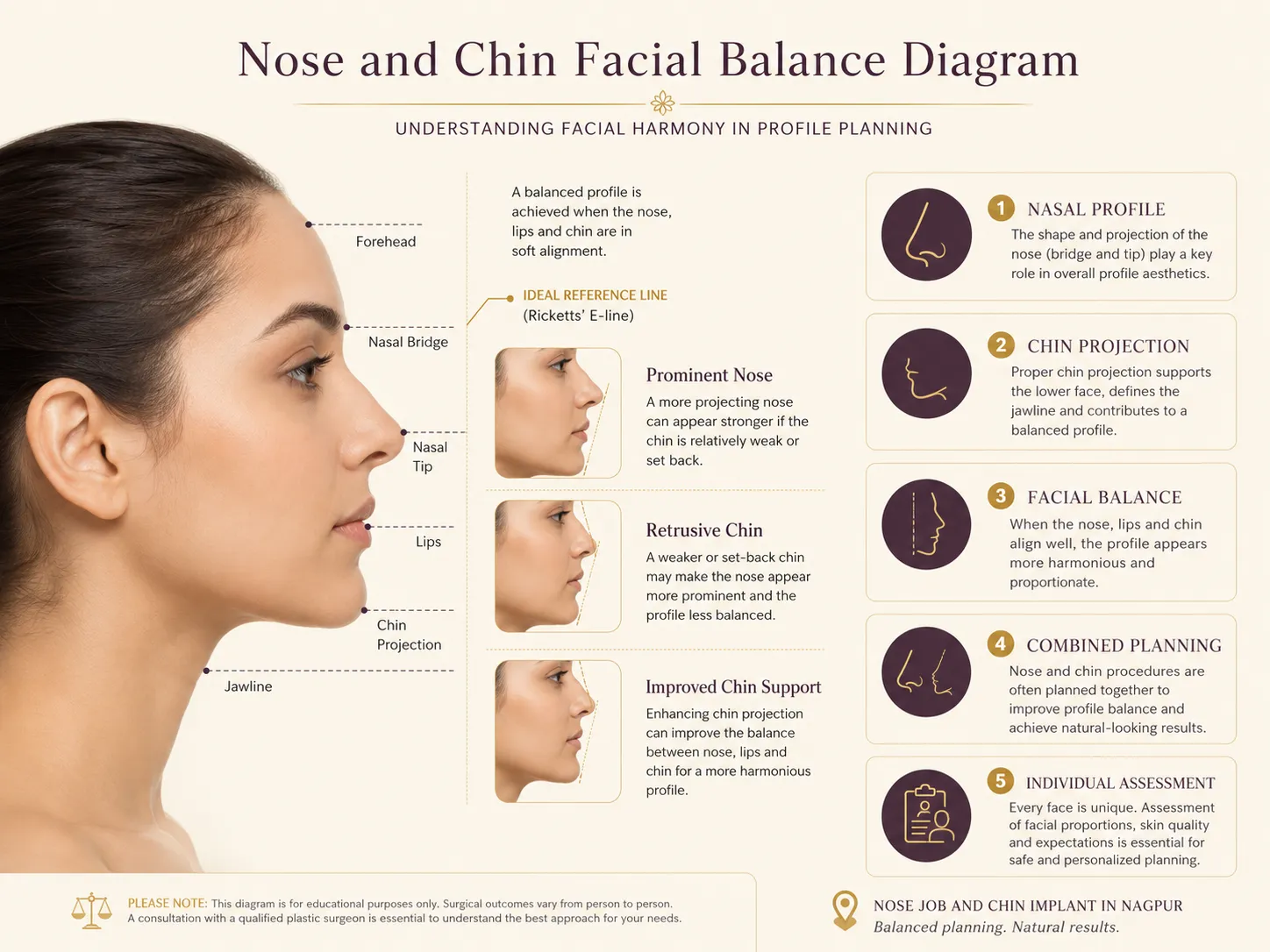
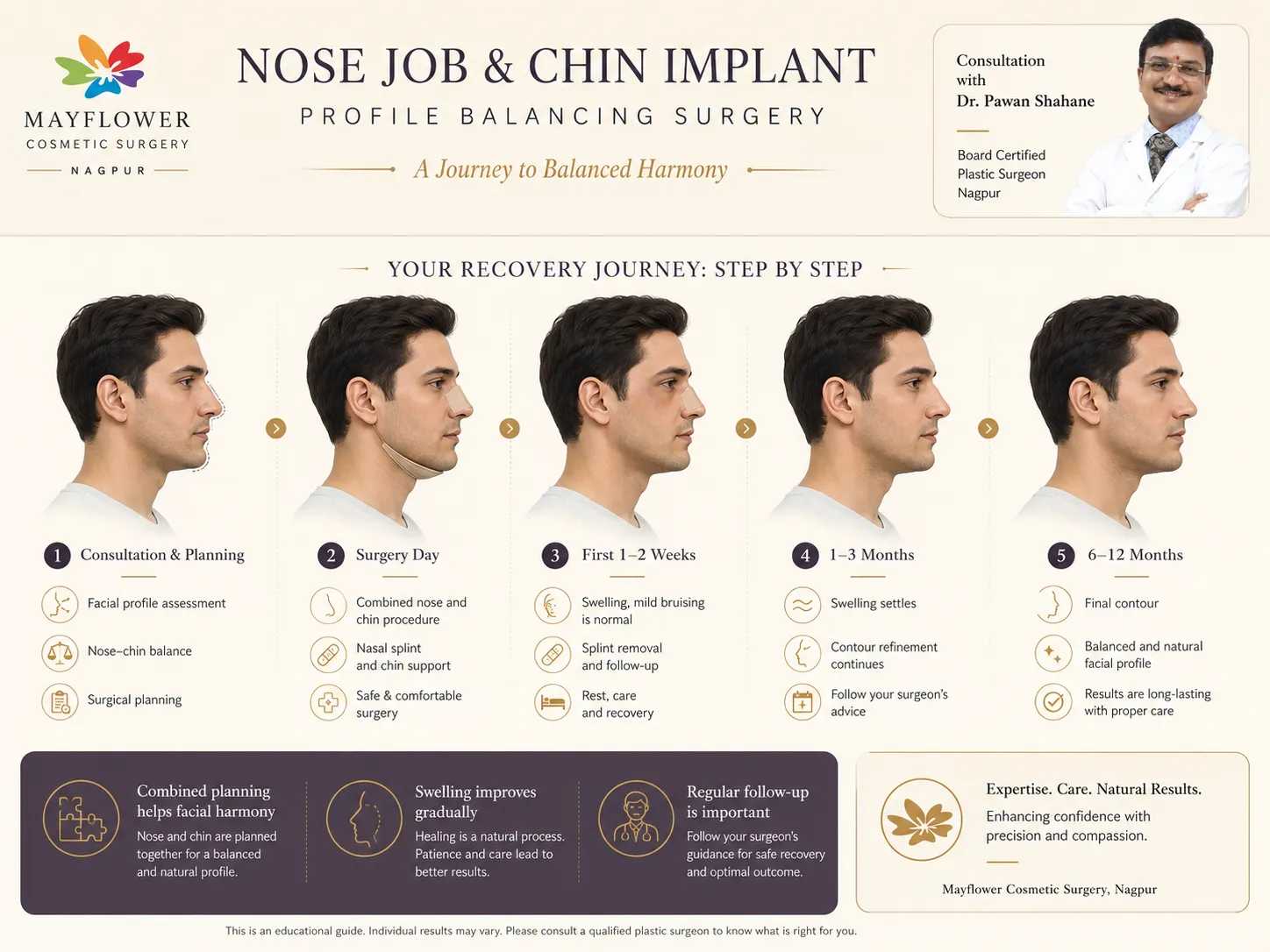
A prominent nose may appear stronger when the chin is under-projected, while a prominent chin can change how nasal length or projection is perceived. This does not mean every rhinoplasty patient needs chin surgery. It means the profile should be assessed as a whole before deciding where correction is truly required.
Provides broad exposure of the nasal framework and may be useful for complex tip work, asymmetry, reconstruction or revision cases.
Uses internal incisions and may suit selected changes where adequate access can be achieved without an external columellar incision.
Uses cartilage reshaping, sutures or grafts to improve support and contour according to the patient’s anatomy.
Combines external nasal correction with internal septal work when both form and function require attention.
Selected nostril-width concerns may be treated with carefully positioned incisions, with scar placement discussed beforehand.
May require additional cartilage, scar release or reconstruction. Predictability can be lower than in primary surgery.
Mayflower Max Lift Rhinoplasty is Dr. Pawan Shahane’s clinic-specific name for a structural approach to nose reshaping. The emphasis is on creating appropriate internal support before refining external contour, especially when a patient needs better nasal-tip projection, rotation or resistance to downward pull during healing.
“Max Lift” does not mean lifting every nose as much as possible. The intended tip position must suit the patient’s sex, facial proportions, skin thickness, cartilage strength, smile dynamics and breathing. Some patients need projection; others need deprojection, derotation, straightening or support without visible elevation.
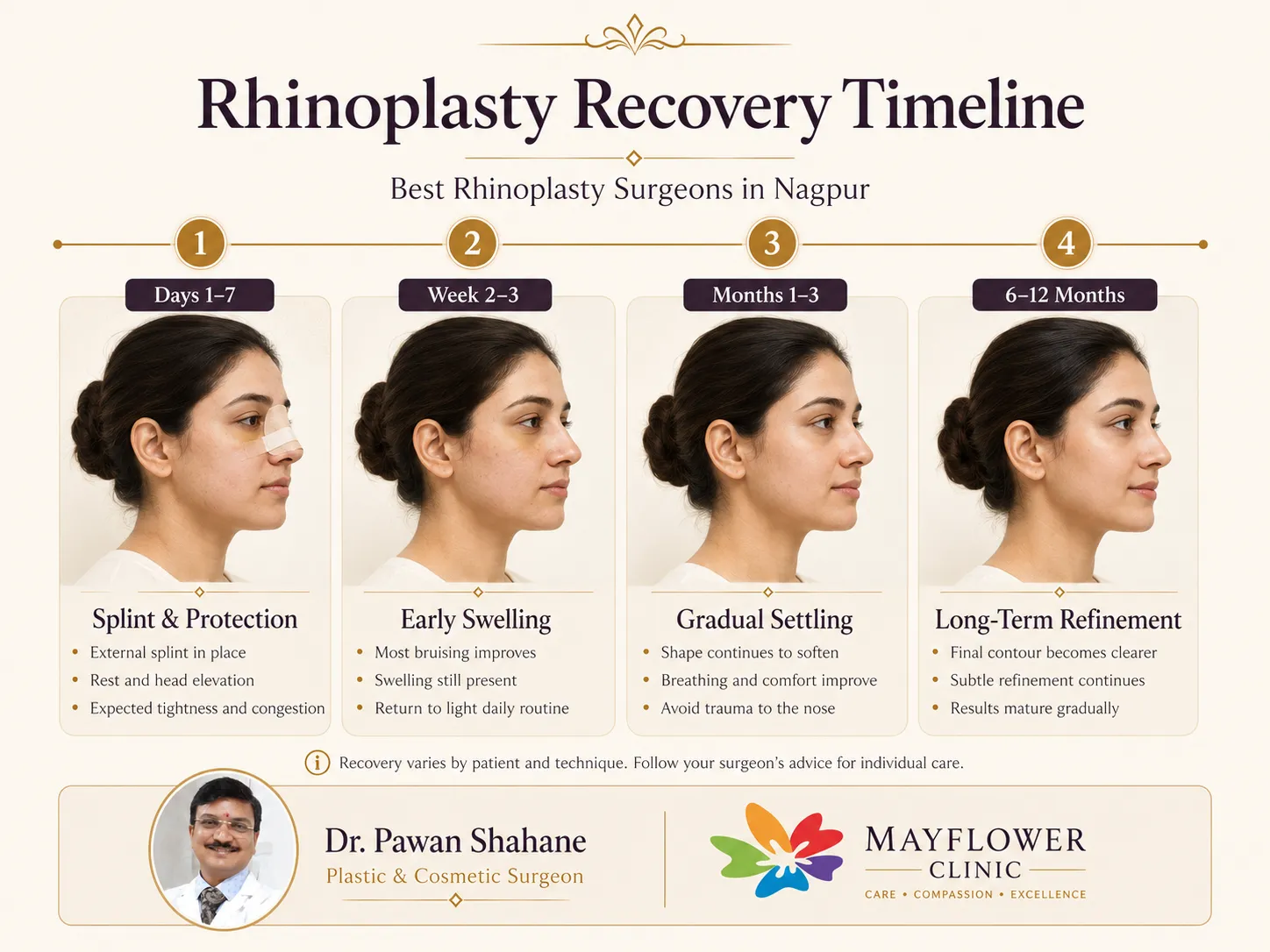
Bruising and visible swelling usually improve earlier than fine internal swelling. The nasal tip may remain firm or swollen for longer, and final refinement is judged only after tissues have settled.
Medical history, nasal examination, photographs and realistic priorities form the basis of planning.
Medication, smoking, anaesthesia fitness, fasting and post-operative support are reviewed.
The approach and extent of bone, cartilage, septal or tip work depend on individual anatomy.
Rest, head elevation, prescribed medicines and protection from accidental pressure are important.
Many people resume desk work when bruising and swelling are socially manageable, but strenuous exercise remains restricted.
The nose looks more settled, although tip definition and subtle asymmetry can continue to change.
Final evaluation is delayed until swelling and scar maturation are sufficiently complete.
Elevation may help swelling and protects the nose from pressure during early healing.
Keep dressings and splints dry and follow the clinic’s cleaning instructions.
Contact sports, bending, straining and strenuous activity are restarted only when cleared.
Sun protection is important while swelling and incision marks are settling.
Pressure from spectacles may need modification after nasal-bone work.
Splint removal, wound review and monitoring help identify problems early.
In selected cases, rhinoplasty is discussed alongside chin augmentation or another facial procedure. Combination surgery should be based on a genuine anatomical need, not on adding procedures unnecessarily.
Individual experiences and outcomes vary. Excerpts below are shortened from the clinic’s documented review inventory.
“From the initial consultation to the post-operative care, Dr. Shahane demonstrated exceptional skill, professionalism, and a genuine care for my well-being. My confidence has soared.”
“I am very happy with my nose surgery, rhinoplasty. It’s been 3 weeks and results are awesome. I wanted a sharp tip, and I was having a broad nose.”
“My sister was having depressed nose and broad nose. We met with Dr. Shahane and discussed the issue. We got best result. Thanks to Dr. Shahane.”
“He explains everything and how to take care. He support at every stage and do the surgery as planned.”
“I was always wanted to improve my nose but didn’t know where to go. Then I got to know about Dr. Pawan Shahane, plastic surgeon in Nagpur.”
“I’m very happy with my rhinoplasty surgery. Agar aap bhi soch rahe hai rhinoplasty surgery ka to please go with Dr. Pawan Shahane sir.”
Rhinoplasty is surgery that changes nasal shape, structure or support. It may address appearance, breathing, previous injury, congenital differences or a combination of concerns.
It may, when breathing difficulty is related to correctable structural problems such as septal deviation or nasal valve compromise. Functional assessment is required before planning.
Closed rhinoplasty uses incisions inside the nostrils. Open rhinoplasty adds a small incision across the columella to provide wider surgical exposure. The choice depends on anatomy and surgical goals.
Operating time varies with complexity and whether functional correction or additional facial procedures are planned. A personalised estimate is discussed after examination.
Many patients plan roughly one to two weeks away from public-facing work, although bruising, swelling and individual healing vary.
Early shape changes are visible after splint removal, but swelling settles gradually. Refinement can continue for many months, especially at the nasal tip.
Closed rhinoplasty has internal incisions. Open rhinoplasty uses a small columellar incision that usually fades with healing, though scar appearance varies between individuals.
Selected patients may benefit from changes to the nasal bones, tip framework or alar base. The plan must preserve facial balance, structural support and airway function.
A dorsal hump may be reduced or reshaped when appropriate. The bridge, tip, nasal bones and profile are assessed together rather than treating one feature in isolation.
They may be combined when both external shape and internal septal structure require correction. The need is determined by examination and functional assessment.
Risks include bleeding, infection, anaesthesia complications, altered sensation, asymmetry, contour irregularity, breathing problems, scarring and the possibility of revision surgery.
Mayflower Max Lift Rhinoplasty is the clinic’s name for an individualized structural approach that prioritizes controlled nasal-tip support and projection while also assessing bridge contour, facial balance and breathing. It is a planning concept rather than a guarantee of maximum elevation or a permanent result.
Cost depends on complexity, functional correction, anaesthesia, facility requirements, investigations and whether additional procedures are planned. A transparent written estimate follows consultation.
Bring your concerns, previous records, photographs of any old injury or surgery, and a clear description of what you hope to change. The consultation should help you understand suitability, limitations, recovery and alternatives before making a decision.

Case of the Month: Grade 3 Gynecomastia…
What Is Acne Scar Correction? A Complete…