
Will I look pulled or different?
The plan is to reposition deeper tissues and redrape skin without excessive tension—not to erase every line or change your identity.
Facelift surgery is not simply “tightening skin.” It is a personalised operation that may reposition deeper facial tissues, improve jowls and redefine the jawline while preserving recognisable facial character.


Quick guidance · Detailed explanations below. These short answers are educational and do not replace examination.
The plan is to reposition deeper tissues and redrape skin without excessive tension—not to erase every line or change your identity.
Usually it focuses on the cheeks, jowls, jawline and often the neck. Brows, eyelids, pigmentation and skin texture need separate assessment.
Fillers restore selected volume; they cannot remove significant loose skin or reliably correct advanced jowls.
Incisions are generally placed in the hairline and around the ear, with the exact pattern chosen according to the required lift.
Many patients plan about 2–4 weeks for visible recovery, while swelling and scars continue to settle for months.
Dr. Pawan Shahane personally assesses, plans and performs the surgery after formal suitability and anaesthesia evaluation.
A face lift, medically called rhytidectomy, is designed primarily for age-related descent and laxity of the cheeks and lower face. The operation may improve jowls, restore a clearer transition from cheek to jaw and reduce loose skin around the lower face. When neck laxity is part of the same ageing pattern, a face and neck lift may be discussed.
Modern surgery generally addresses the deeper support layer, often described as the SMAS, before the skin is redraped. This matters because excessive skin tension can produce an unnatural appearance and poorer scars. The exact plane, vector and extent are selected according to facial anatomy and surgeon assessment.
It is not a skin-quality treatment. Fine surface lines, pigmentation, acne scars, enlarged pores and sun damage may require separate skin treatments. It also does not automatically lift the brow or correct eyelid bags.
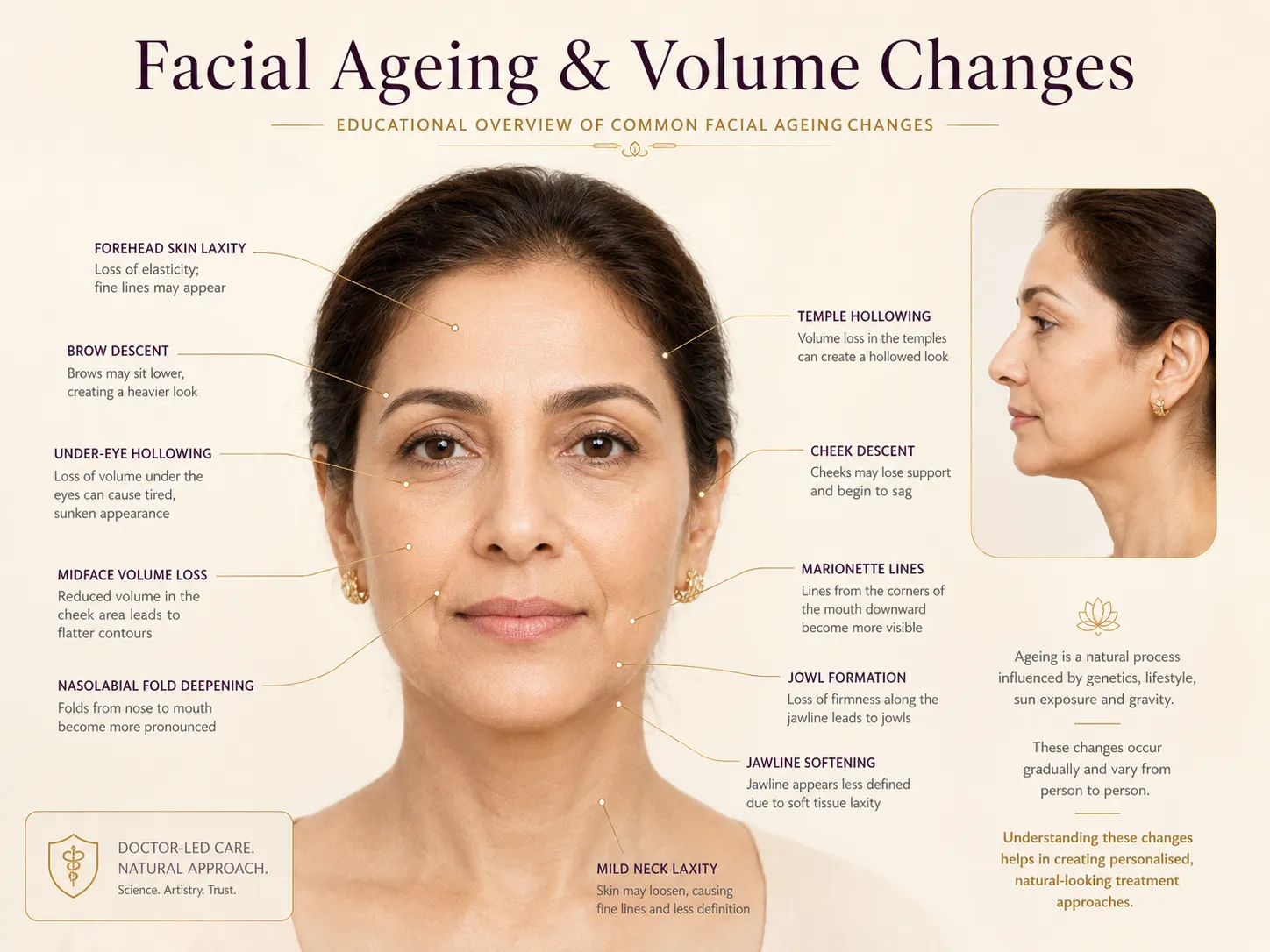
Ageing can involve several changes at once: skin becomes less elastic; facial fat compartments change; retaining structures loosen; and bone support changes gradually. A face lift is strongest at repositioning descended soft tissue and managing excess skin. It does not replace lost volume in every area or improve all surface texture concerns.
Responsive image alignment: gently side-cropped on wide screens and restored to a 4:3 view on mobile so the illustration remains centred.
No technique is automatically superior for every face. The operation should be matched to the area, degree of laxity, hairline, skin quality, previous surgery and recovery priorities.
For more established cheek descent, jowls and lower-face laxity. The deeper support layer is addressed so the skin is not relied upon as the only lifting structure.
A shorter, more limited operation for selected early or moderate lower-face laxity. It cannot deliver the same correction as a wider operation when laxity is advanced.
Combines lower-face correction with treatment of loose neck skin, submental fullness or platysmal banding when these concerns are anatomically connected.
Small-volume fat grafting may restore selected cheek, temple or pre-jowl volume when ageing includes deflation as well as tissue descent.
Blepharoplasty or brow lift may be planned separately or together when upper-face ageing is prominent; a lower-face lift alone does not correct those regions.
Resurfacing, peels, injectables or energy-based treatments may complement surgery for texture, pigmentation, expression lines or maintenance, but they are not substitutes for significant laxity.
They solve different anatomical problems. Choosing by recovery time alone can lead to the wrong treatment.
| Option | Best suited to | Cannot reliably do | Typical maintenance |
|---|---|---|---|
| Face lift surgery | Established lower-face descent, jowls and loose skin; neck work may be added. | Remove pigment, pores or every fine line; stop future ageing. | Long-lasting surgical change with normal ageing continuing. |
| Dermal fillers / fat transfer | Selected volume loss or contour deficiency. | Remove significant excess skin or advanced jowls. | Fillers are temporary; fat retention varies. |
| Thread lift | Carefully selected mild laxity seeking a temporary, limited lift. | Match the correction of a full surgical face lift. | Temporary; may need repeat treatment. |
| Botulinum toxin | Dynamic expression lines from muscle activity. | Lift heavy jowls or remove loose skin. | Repeat treatment is required. |
| Laser / peel / skin care | Texture, pigment, selected fine lines and skin quality. | Reposition descended deep tissues. | Course and maintenance depend on treatment. |
A safe operation begins with a realistic diagnosis and ends with structured follow-up—not merely the hours spent in theatre.
Goals, previous procedures, medical history, skin quality, hairline, ear anatomy, jowls, neck and facial volume are assessed. The discussion includes what surgery can and cannot change.
Blood pressure, medicines, supplements, smoking or nicotine use, allergies and relevant investigations are reviewed. Anaesthesia and facility needs are selected for the planned extent.
Dr. Shahane plans incision placement, vectors of lift, SMAS support, neck work and any complementary procedure. Photographs support communication and follow-up.
Incisions are placed in planned natural boundaries. Deeper tissues are repositioned or supported; the skin is then redraped and selected excess is removed without relying on tight skin pull alone.
A supportive dressing is usually applied. A small drain may be used in selected operations. Discharge may be the same day or after observation depending on anaesthesia and extent.
Wounds, swelling, bruising and facial movement are checked. Dressings, drains and sutures are managed according to the individual operation rather than a fixed online schedule.
Activity is increased gradually. Scar protection, sun avoidance and follow-up continue while sensation, swelling and tissue position mature over several months.
These are broad planning bands. Your surgeon’s instructions take priority because dressing, drain and suture schedules depend on the operation.
Dressings, swelling and tightness are expected. Keep the head elevated and take prescribed medicines correctly.
Bruising may be prominent. Wounds, facial movement, dressings and any drain are reviewed.
Many patients gradually return to desk or public-facing work when bruising and swelling allow.
Swelling continues to reduce. Exercise and hair or skin care resume only when cleared.
Residual swelling, sensation and scars continue to mature; the final appearance is judged later, not in the first weeks.
Facelift surgery has recognised complications even when performed carefully. Individual risk is affected by health, nicotine exposure, medicines, previous surgery and the extent of dissection.
Rapid swelling, severe one-sided pressure or bleeding requires urgent contact.
Infection, delayed healing, edge loss or skin loss can occur; nicotine substantially increases concern.
Temporary numbness is common; facial nerve weakness is uncommon but may be temporary or permanent.
Scars may widen, thicken or remain visible, and temporary or permanent hair loss may occur near incisions.
Residual laxity, asymmetry, irregularity or an unsatisfactory result can require observation or revision.
Anaesthesia reactions, infection, fluid collection, blood clots and cardiopulmonary complications are uncommon but important.
The aim is to understand whether the ageing concern is caused by tissue descent, skin excess, volume loss, surface change—or a combination. Once the diagnosis is clear, surgery can be limited to what is genuinely needed.Dr. Pawan Shahane, M.Ch. Plastic Surgery · Founder, Mayflower Clinic, Nagpur
These Google reviews relate to other procedures and are shown as evidence of consultation and follow-up experience—not as facelift outcome claims.
“Rhinoplasty, nose surgery done for my sister. We are very happy with results and strongly recommend Dr. Pawan Shahane sir… He explains everything and how to take care. He support at every stage and do the surgery as planned.”Kunal ThakurVerified Google review · Rhinoplasty
“From the initial consultation to the post-operative care, Dr. Shahane demonstrated exceptional skill, professionalism, and a genuine care for my well-being. My confidence has soared.”Nishant MenghareVerified Google review · Rhinoplasty
“Had a treatment for the injury and it was a great experience. It was like after removing stitches it looks as it was almost before the injury”Maroti NawghadeVerified Google review · Injury / reconstruction
Quotes are reproduced verbatim or shortened with an ellipsis. Individual outcomes vary.
Visible answers below match the FAQ structured data on this page.
A face lift, or rhytidectomy, is an operation that repositions sagging facial soft tissues, supports the deeper layer of the lower face and carefully removes or redrapes excess skin. It is most commonly used for jowls, a less-defined jawline, deep lower-face folds and loose skin extending toward the neck.
A conventional face lift mainly treats the cheeks, lower face, jowls and jawline, and it is often planned together with a neck lift when neck laxity or platysmal bands are present. It does not automatically correct forehead descent, eyelid bags, pigmentation, pores or every fine wrinkle.
The intention is not to pull the skin tightly. Modern planning focuses on repositioning and supporting deeper tissues, then redraping the skin without excessive tension. The achievable result still depends on anatomy, tissue quality, healing and the extent of surgery selected.
Incisions are commonly placed within or near the hairline, around the natural contours of the ear and, when a neck procedure is added, sometimes beneath the chin. Their exact length and position depend on the operation. Scars usually soften over months but cannot be made completely invisible.
A mini face lift uses a more limited approach for selected people with early or moderate lower-face laxity. A full face lift usually provides wider access to treat more substantial jowling, cheek descent and neck laxity. A smaller incision is not automatically the better operation; the choice should match the anatomy.
Non-surgical treatments may help selected concerns such as volume loss, expression lines or mild laxity, but they do not remove significant excess skin or reliably reposition advanced jowls. Adding too much filler to compensate for laxity can make the face look heavy. The options are compared during consultation.
Swelling, bruising, tightness and temporary altered sensation are expected early. Many people plan roughly 2 to 4 weeks away from public-facing work, while residual swelling, scar maturation and tissue settling continue for several months. Recovery varies with the operation and individual healing.
A face lift can create a long-lasting repositioning of facial tissues, but it does not stop ageing. Skin quality, sun exposure, smoking, weight change and natural biology influence how the face changes later. Results should be described as long-lasting rather than permanent.
Yes, selected patients may benefit from a combined plan when ageing affects more than one region. A neck lift may address neck laxity, blepharoplasty may address eyelid excess, and conservative fat transfer may restore selected volume. Combining procedures also changes operating time, recovery and risk, so it must be individualized.
Possible risks include bleeding or haematoma, infection, fluid collection, delayed wound healing, skin loss, visible or widened scars, numbness, asymmetry, temporary or permanent facial nerve weakness, hair loss near incisions, prolonged swelling, anaesthesia-related complications and the need for revision. Your personal risk profile is discussed before consent.
Cost depends on the extent of lower-face and neck correction, anaesthesia, facility requirements, whether another procedure is combined and the expected follow-up plan. Mayflower Clinic provides an itemised quote after examination rather than advertising one price for every patient.
Consultation, surgical planning and the operation are personally led by Dr. Pawan Shahane, M.Ch. Plastic Surgery. No website can confirm suitability; an in-person assessment and informed consent are required before any surgical decision.
Compare surgery with procedure-specific alternatives instead of treating every ageing concern as the same problem.
Bring photographs of how your face looked earlier if helpful, a list of medicines and supplements, and your questions about scars, anaesthesia, recovery and alternatives. The consultation is designed to determine whether surgery is appropriate—not to pressure you into treatment.

What Is Acne Scar Correction? A Complete…
Who Is a Good Candidate for Lip…