
Eye Bag Removal in Nagpur
Persistent under-eye puffiness is usually a structural issue — herniated fat pockets, weakened lower-lid support, or skin laxity — rather than a skincare problem. Dr. Pawan Shahane personally assesses whether scarless transconjunctival surgery, traditional lower blepharoplasty, or a filler-based approach is right for your anatomy.


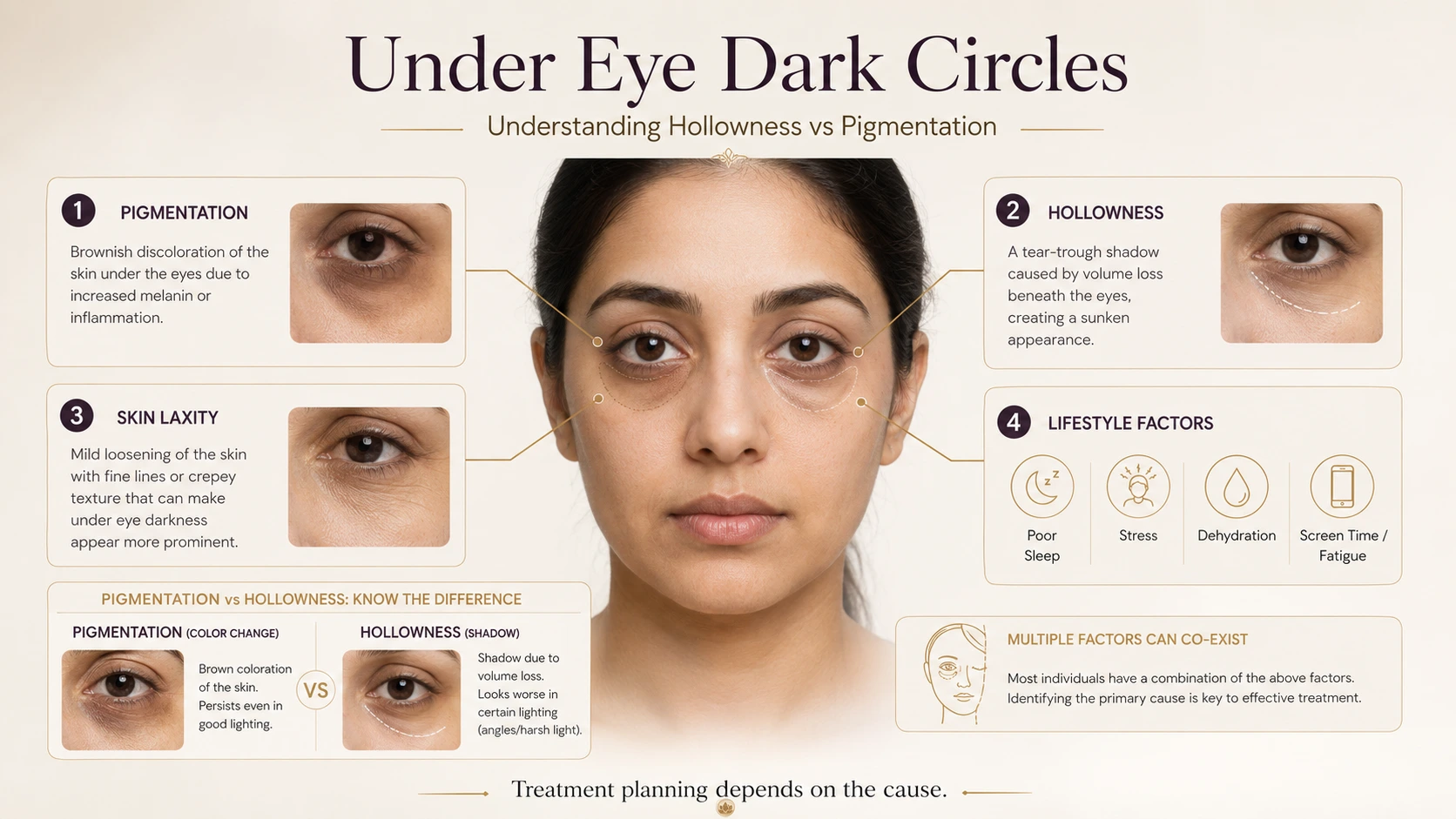
Is It Eye Bags, or Dark Circles?
Under-eye concerns are not all the same, and they are not all treated the same way. Knowing which one you actually have determines whether surgery, fillers, or skin-focused treatment is the right starting point.
This page covers eye bags — visible puffiness, swelling, or a pouch caused by a bulging lower-eyelid fat pad, fluid retention, or loose skin. This is a structural concern, and where significant, is best addressed surgically.
If your primary concern is brownish discoloration of the skin itself rather than a puffy or protruding area, that is pigmentation — read our dedicated guide to under-eye dark circles treatment instead. Many patients have a combination of both, which Dr. Shahane will identify during your consultation.
What Causes Eye Bags?
Under-eye bags develop when the orbital septum — the membrane that normally holds fat in place around the eye — weakens with age, allowing the fat pad beneath it to bulge forward and become visible as a pouch. This is a structural, mechanical change, not simply a skin-quality issue.
Genetics play a significant role — many patients develop prominent lower-eyelid fat pads in their twenties or thirties regardless of sleep or lifestyle. Fluid retention, allergies, and loss of skin elasticity with age can each add to the appearance, which is why an accurate assessment matters before choosing a treatment path.
- Transconjunctival approach available — no external scar for suitable candidates
- Traditional lower blepharoplasty for concurrent skin laxity
- Non-surgical tear-trough filler option where volume loss, not fat excess, is the cause
- Every consultation includes a hands-on assessment of fat, skin and muscle laxity
Matching the Treatment to the Cause
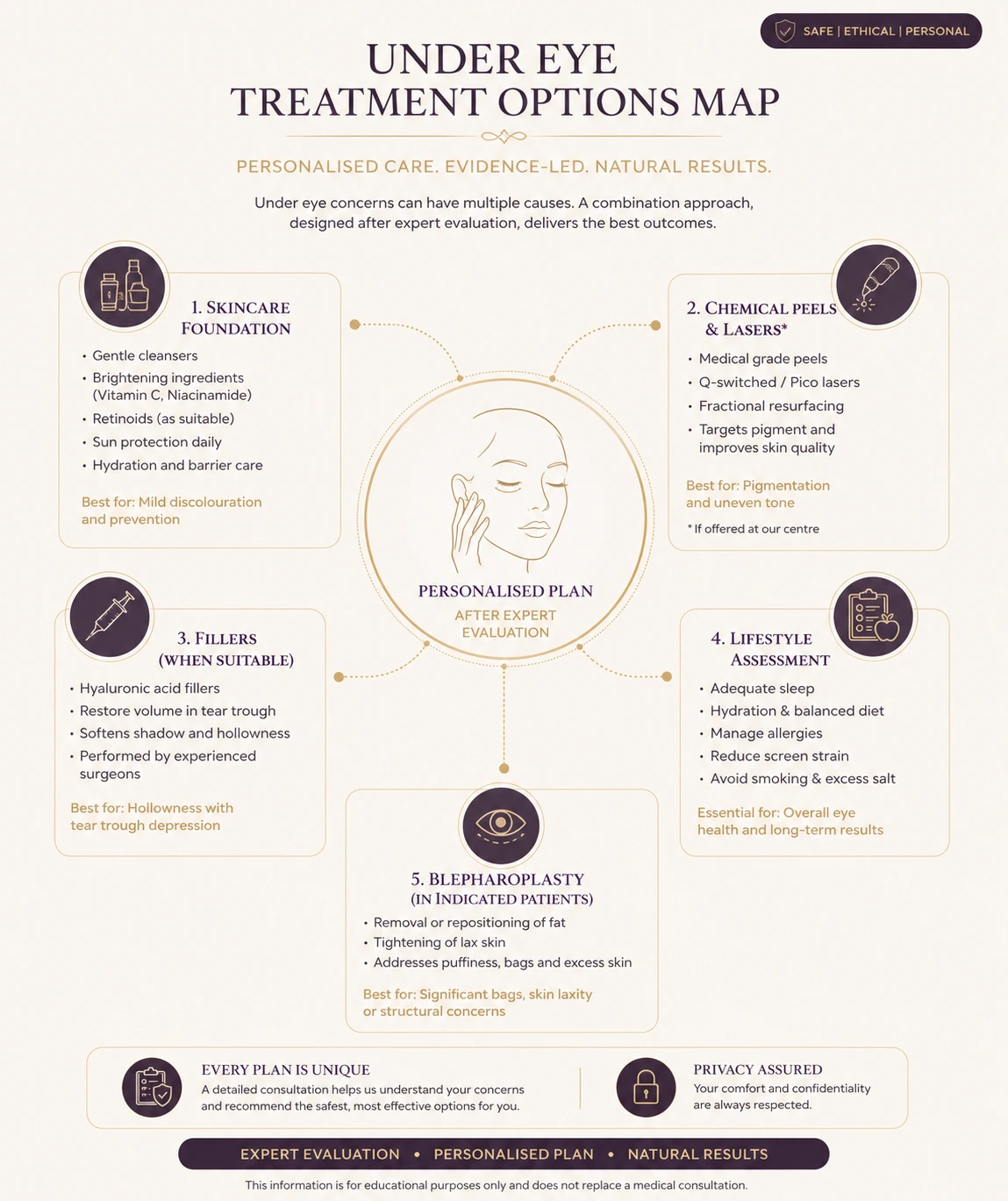
Under-eye treatments exist on a spectrum. Dr. Shahane's approach is to recommend the least invasive option that will genuinely resolve your specific concern — not to default to surgery.
Which Approach Is Right for You?
Candidacy depends on age, skin elasticity, and whether the concern is fat excess, volume loss, or both. This is determined through a physical examination, not a photograph.
Younger Patients, Good Skin Tone
Isolated fat pad prominence with minimal skin laxity is well suited to the scarless transconjunctival technique, accessed through the inner eyelid.
Fat Excess Plus Skin Laxity
When loose lower-lid skin accompanies the fat pad, traditional lower blepharoplasty with conservative skin tightening gives a more complete correction.
Hollowing Without True Fat Excess
If the "bag" is actually a shadow from volume loss along the tear trough, hyaluronic acid filler is often sufficient without surgery.
Good General Health
No uncontrolled systemic conditions, active eye infections, or dry-eye disease that would meaningfully increase surgical risk.
The Surgical Procedure, Step by Step
For patients proceeding with blepharoplasty, every stage is performed directly by Dr. Pawan Shahane.
Pre-Operative Assessment
Examination of fat pad prominence, skin elasticity (pinch test), lower-lid tone, and tear-film health to determine the best surgical or non-surgical approach.
Local Anaesthesia
The lower eyelid area is numbed with local anaesthetic. Patients remain awake and comfortable throughout the procedure.
Access Incision
A transconjunctival incision (inside the lower eyelid, no visible scar) is used where suitable; a small incision just below the lash line is used when skin excision is also required.
Fat Repositioning or Conservative Excision
The herniated fat pad is either redistributed to smooth the tear trough or conservatively trimmed, depending on the individual's anatomy.
Closure & Cold Compression
The incision is closed with fine sutures where external, and cold compresses are applied to minimise early swelling and bruising.
Recovery Timeline
What to realistically expect after surgical eye bag removal.
Swelling and bruising are most noticeable. Cold compresses and head elevation are advised.
Visible bruising fades significantly. External sutures, if used, are typically removed around day 5–7.
Most patients feel comfortable returning to work and light social activity; residual mild puffiness may persist.
Final settling of the lower eyelid contour, with the smooth result becoming fully apparent.
Frequently Asked Questions
Direct answers about eye bag removal, candidacy, and recovery at Mayflower Clinic.
Is eye bag removal painful?
The procedure is performed under local anaesthesia, so the treatment itself is not painful. Mild swelling, bruising or a sensation of tightness for a few days afterward is normal and manageable with routine care.
What is the difference between eye bag removal and full blepharoplasty?
Eye bag removal specifically targets the lower eyelid fat pads and puffiness. Full blepharoplasty can additionally include the upper eyelid and broader skin excision when hooding or significant excess skin is also present.
Am I a candidate for the scarless transconjunctival technique?
Transconjunctival blepharoplasty, performed through an incision inside the lower eyelid with no visible external scar, is best suited to younger patients with good skin elasticity whose main concern is fat pad prominence rather than loose skin. This is assessed during your consultation.
Will fillers work instead of surgery for my eye bags?
Tear-trough fillers work well when the appearance of a bag is actually a shadow created by volume loss beneath the eye, rather than true fat excess. If there is genuine fat pad herniation or skin laxity, fillers alone will not resolve it and surgery is the more definitive option.
How long do the results of eye bag removal last?
Surgical correction of the fat pads is long-lasting, since the repositioned or reduced fat does not typically return in the same way. Natural skin ageing continues over time, so results are best understood as long-lasting rather than permanent.
Who actually performs the surgery at Mayflower Clinic?
Every stage — assessment, the incision, fat repositioning or excision, and closure — is performed directly by Dr. Pawan Shahane, MCh Plastic Surgery, with no delegation to assistants or technicians.
What does eye bag removal cost in Nagpur?
Cost depends on whether a surgical or filler-based approach is recommended, and on the extent of correction needed. Mayflower Clinic provides a complete, itemised quote only after an in-person assessment, with no hidden charges.
Can eye bags come back after treatment?
Surgically corrected fat pads generally do not recur, though ongoing skin ageing can gradually change the area's appearance over many years. Non-surgical filler correction is temporary and requires periodic maintenance.
Related Procedures
Other treatments commonly considered alongside or instead of eye bag removal.
"Most patients who come to me about eye bags have already tried creams and serums with no change — because the cause isn't in the skin, it's a small fat pocket that has simply moved forward with age. My job is to tell you honestly whether that needs surgery, a filler, or nothing at all yet."
Ready to Take the Next Step?
Schedule a private consultation with Dr. Pawan Shahane to find out whether your under-eye bags call for surgery, fillers, or a combined approach — with transparent, itemised pricing from the start.
IMPORTANT MEDICAL DISCLAIMER: The information on this page is for general educational purposes only. All surgical procedures carry inherent risks, and individual outcomes vary based on patient anatomy, general health, and adherence to post-operative instructions. Results described are illustrative and do not represent a guarantee of similar outcomes for any individual patient. This content does not replace a formal surgical consultation — discuss your specific medical history, expectations, risks and alternatives directly with Dr. Pawan Shahane before making any treatment decision. Mayflower Clinic, Dhantoli, Nagpur.
Mayflower Clinic · Surdham Complex, Dhantoli, Nagpur 440012 · 0712 6692706 · Mon–Sat, 11 AM–6 PM
Latest Posts
-
Case of the Month: Grade 3 Gynecomastia in a 24-Year-Old Man After Weight Loss

Case of the Month: Grade 3 Gynecomastia…
-
The Science of Facial Aging: Why Wrinkles, Volume Loss & Sagging Develop

The Science of Facial Aging: Why Wrinkles,…

