

Case of the Month: Grade 3 Gynecomastia in a 24-Year-Old Man After Weight Loss
Quick case summary
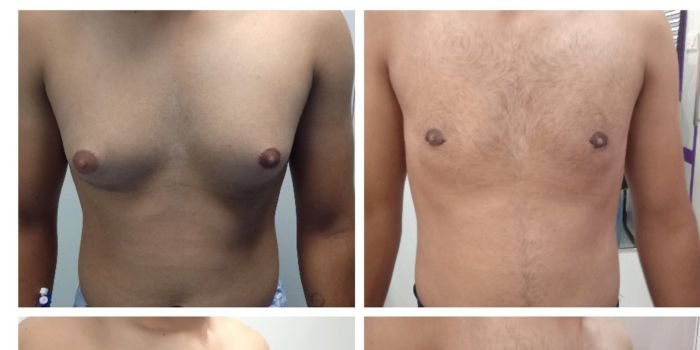
A 24-year-old man presented with Grade 3 gynecomastia that had been present for approximately 10 years.
He had previously been overweight. During the preceding year, he successfully lost a significant amount of body weight. Although the fatty component of his chest reduced with weight loss, the underlying breast gland remained prominent.
As the surrounding chest fat reduced, the gynecomastia became even more noticeable.
The right side was slightly larger than the left.
The condition had begun to significantly affect his confidence. He avoided tight-fitting T-shirts because the enlarged chest contour remained visible through clothing and felt very self-conscious when changing clothes or exposing his chest in front of others.
Why did the chest remain enlarged even after weight loss?
Weight loss can reduce the fatty component of the male chest, but established gynecomastia may also contain a significant amount of firm breast glandular tissue.
In this patient, weight loss improved his general body contour and reduced chest fat, but the residual gland remained.
The contrast between the leaner chest and persistent glandular enlargement actually made the gynecomastia appear more prominent.
This is an important point for patients:
Not every enlarged male chest will completely disappear with exercise or weight loss.
The treatment depends on whether the enlargement is predominantly due to fat, glandular tissue, skin excess or a combination of these factors.
Clinical concerns in this case
The important findings and concerns were:
- Long-standing gynecomastia for approximately 10 years
- Grade 3 enlargement
- Previous history of obesity
- Significant weight reduction during the previous year
- Persistent glandular enlargement despite fat loss
- Mild chest asymmetry, with the right side larger than the left
- Visible chest prominence even through clothing
- Difficulty wearing fitted T-shirts and tight clothing
- Significant self-consciousness related to chest appearance
The treatment plan was therefore based not simply on removing fat, but on addressing both the remaining fatty component and the persistent breast gland.
Treatment plan: liposuction with gland removal
After clinical assessment and discussion of treatment options, surgery was planned using a combination of:
Liposuction + removal of the enlarged breast gland
Liposuction helps contour the fatty component of the chest, while direct gland removal addresses the firmer glandular tissue that cannot reliably be removed by liposuction alone.
The objective was to create a more proportionate male chest contour while recognising the pre-existing right-left asymmetry.
Patients should understand that surgery aims for improvement rather than mathematical or perfectly identical symmetry between both sides.
Day-care gynecomastia surgery
The procedure was performed successfully as a day-care surgical procedure.
After appropriate postoperative observation, the patient could continue recovery according to the advised postoperative plan.
Day-care surgery does not mean that recovery is instantaneous. Proper postoperative care remains essential, particularly during the first few days following surgery.
Why postoperative compression is important
After gynecomastia surgery, the treated area contains a temporary space created by removal of fat and glandular tissue.
For this reason, postoperative dressing and a properly fitted pressure/compression garment form an important part of recovery.
The compression garment helps support the operated chest while the tissues settle during healing.
The patient was therefore advised appropriate dressing followed by regular use of the prescribed pressure garment.
Important complications we discuss with patients
Every surgical procedure carries potential risks.
Some of the important early complications discussed in gynecomastia surgery include:
Seroma
A seroma is a collection of fluid beneath the skin in the operated area.
Patients should report increasing swelling, fluid-like movement or unusual asymmetrical enlargement of the chest.
Hematoma
A hematoma is a collection of blood beneath the tissues.
Rapidly increasing swelling, significant asymmetry, increasing tightness or pain after surgery requires prompt medical evaluation.
Infection
Although infection is uncommon when surgery and postoperative care are performed appropriately, patients should watch for increasing redness, warmth, discharge, fever or worsening pain.
Proper dressing, hygiene, postoperative follow-up and following the surgeon’s instructions are important during recovery.
Recovery and early outcome
The operation and early postoperative period went well.
The patient was advised:
- Regular postoperative review
- Proper wound and dressing care
- Consistent use of the pressure garment
- Avoidance of unnecessary strain during the early healing period
- Monitoring for unusual swelling, increasing pain, redness or discharge
Chest contour continues to evolve as postoperative swelling settles and the tissues gradually adapt to their new position.
Therefore, the final result should not be judged immediately after surgery.
What can other patients learn from this case?
This case illustrates an important difference between chest fat and true gynecomastia.
Weight reduction is extremely valuable for patients who are overweight and may considerably improve overall chest contour.
However, when a persistent breast gland remains after weight loss, further dieting or chest exercise alone may not remove that glandular component.
For such patients, clinical examination helps determine whether the chest enlargement consists predominantly of:
- Fat
- Breast gland
- Loose skin
- Or a combination of these components
The surgical plan should then be individually tailored rather than applying the same technique to every patient.
When should someone with gynecomastia seek consultation?
A consultation may be useful when male breast enlargement:
- Persists despite achieving a healthy or stable body weight
- Has been present for several years
- Produces noticeable asymmetry
- Remains visible through clothing
- Causes discomfort or tenderness
- Significantly affects clothing choices or confidence
- Appears to contain a firm gland beneath the nipple-areola region
Clinical evaluation is also important because not every male breast enlargement should automatically be assumed to be routine gynecomastia.
Gynecomastia treatment at Mayflower Clinic, Nagpur
At Mayflower Clinic, treatment planning is based on the individual patient’s chest anatomy, degree of glandular enlargement, fatty component, skin quality, asymmetry and personal concerns.
Depending on the findings, treatment may involve liposuction, removal of glandular tissue or a combination of techniques.
The exact surgical approach can only be decided after examination.
Learn more
Link these naturally in the post:
Gynecomastia & Male Chest Treatment Guide
Gynecomastia Surgery in Nagpur
Best Gynecomastia Surgeon in Nagpur – How to Choose a Surgeon
Important warning signs after surgery
Patients should contact their treating surgeon promptly if they develop:
- Rapidly increasing swelling of one or both sides of the chest
- Severe or increasing pain
- Excessive bleeding
- Fever
- Increasing redness
- Pus or unusual wound discharge
- Sudden marked asymmetry
- Any other unexpected postoperative concern
Medical disclaimer
This case is presented for patient education. Every patient’s anatomy, medical history, severity of gynecomastia, surgical plan, recovery and outcome can differ.
This case should not be interpreted as a promise or guarantee of similar results in another patient. An individual consultation and clinical examination are necessary before deciding whether surgery is appropriate.
Patient Privacy
Patient Privacy: Clinical details have been presented in an educational manner while protecting the patient’s identity. Clinical photographs are published with appropriate patient consent for educational purposes.

