
Do I need a brow lift or eyelid surgery?
A brow lift repositions a descended eyebrow. Blepharoplasty removes selected excess eyelid skin. Some patients need one procedure; others may need both.
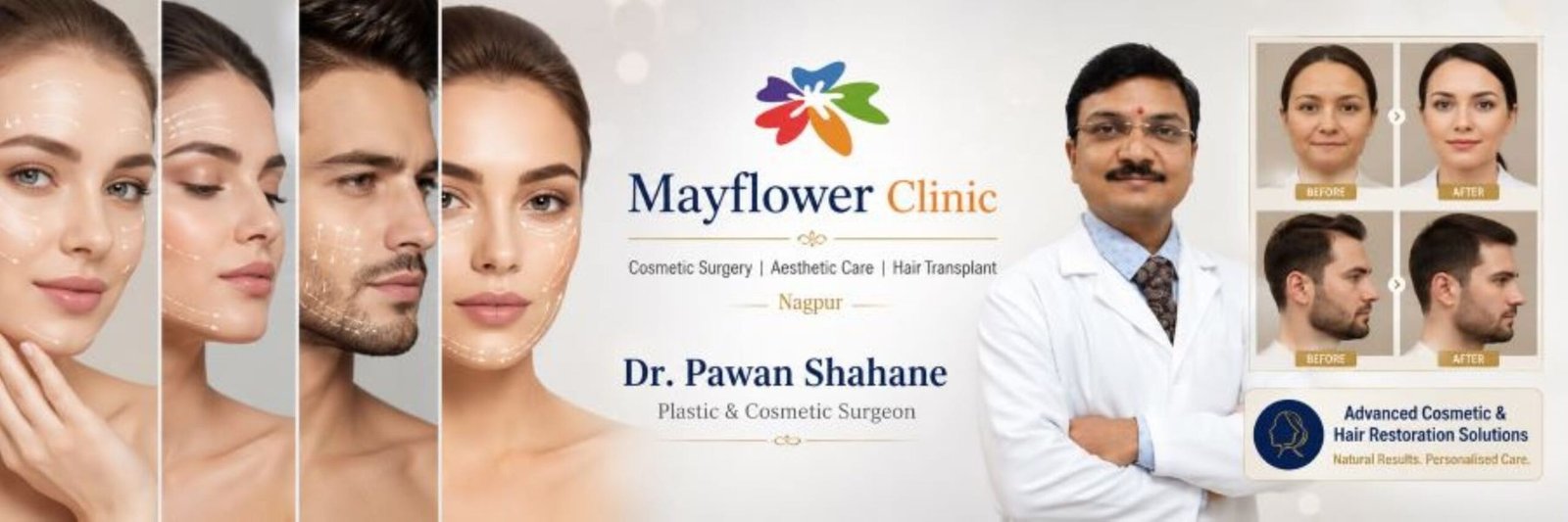
A low brow can create upper-eyelid hooding, outer-eye heaviness or an unintentionally tired expression. The right treatment begins by separating true brow descent from excess eyelid skin, forehead muscle activity and age-related volume change—because each requires a different plan.


Common questions about eyebrow lift treatment, answered briefly before the detailed medical explanation.
Start here: eyebrow heaviness can come from a low brow, excess eyelid skin, eyelid ptosis, or a combination. Treatment should be selected only after the brow and eyelids are examined together.
A brow lift repositions a descended eyebrow. Blepharoplasty removes selected excess eyelid skin. Some patients need one procedure; others may need both.
They may create a small, temporary change in carefully selected patients. They cannot remove excess skin or reproduce surgical tissue repositioning.
Depending on technique, incisions may be within the scalp, at the hairline, in the temple, or directly above the eyebrow. Every surgical technique creates a scar.
Many patients plan about 10–14 days before public-facing work. Swelling, tightness, itching, or altered sensation may continue settling for several weeks or months.
“The aim is not to create a permanently surprised face. We first identify where the brow has descended, how the eyelid is compensating and how much correction the forehead can accept while preserving the patient’s natural expression.”Dr. Pawan Shahane, M.Ch. Plastic Surgery · Founder, Mayflower Clinic, Nagpur
An eyebrow lift, also called a brow lift or forehead lift, repositions tissues of the upper face when the eyebrow has descended. Lateral brow descent is especially common because the outer brow has less direct support from the frontalis muscle. The result may appear as heaviness at the outer upper eyelid, flattening of the eyebrow arch or a tired expression even when the person feels well.
The operation may also reduce selected forehead or frown lines by altering tissue position and muscle balance. It does not erase every line, change bone structure or stop future ageing. A carefully planned correction should preserve movement and avoid an exaggerated, uniformly high eyebrow.
These procedures treat different anatomical levels. A brow lift moves a descended eyebrow and forehead tissue; upper blepharoplasty removes selected excess eyelid skin. Pulling the forehead upward with the fingers may temporarily reveal how much hooding comes from the brow, but an in-person examination is needed because over-lifting the brow or over-removing eyelid skin can create dryness, incomplete closure or an unnatural appearance.
The forehead, eyebrow and upper eyelid work as one unit. This diagram helps explain why the brow should be assessed before deciding on eyelid surgery.
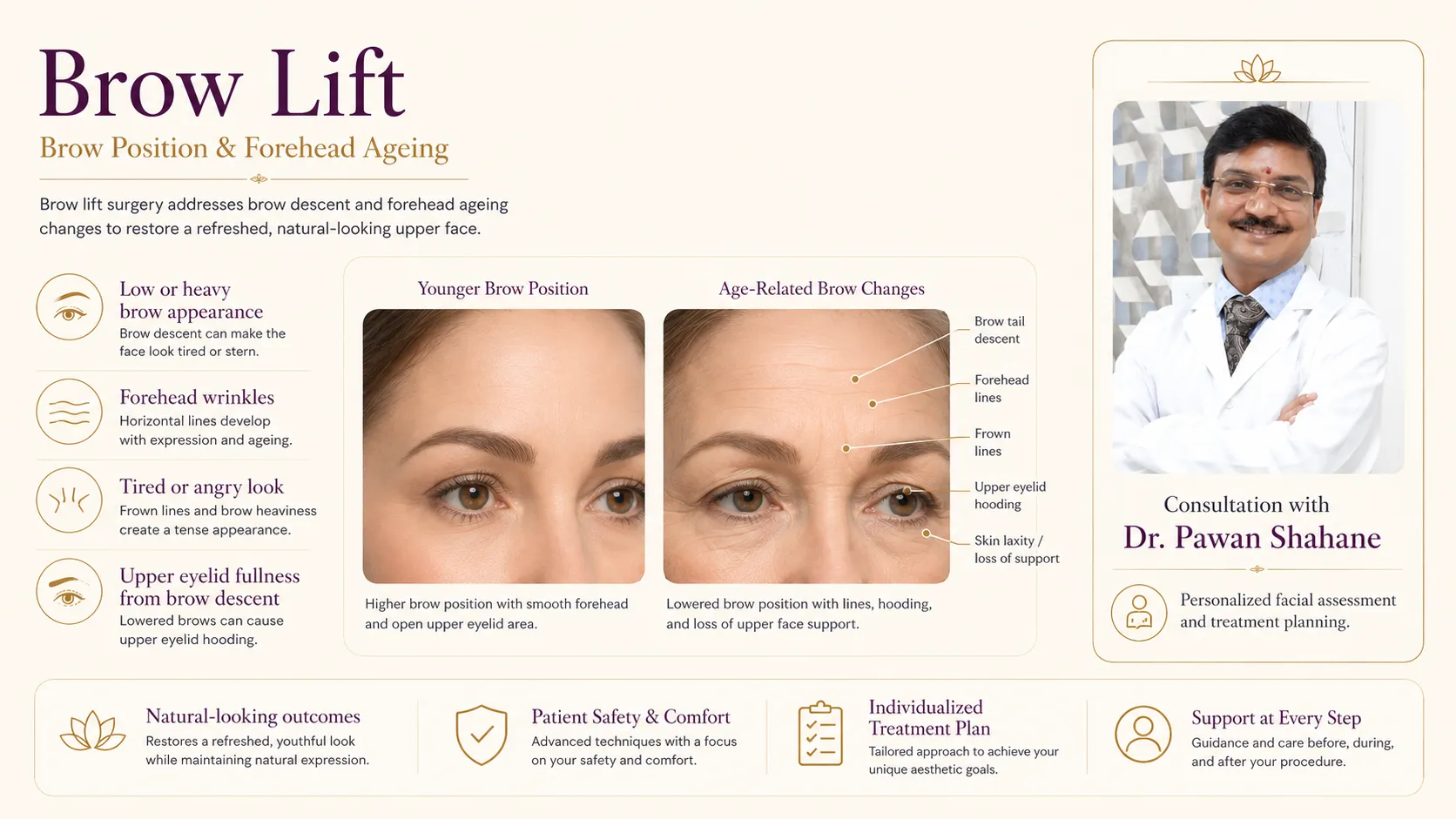
Technique selection is based on anatomy, not only on the amount of lift requested.
Medial and lateral brow height, shape, asymmetry and how much the forehead is compensating at rest.
Upper-eyelid skin, true eyelid ptosis, eye closure, dry-eye symptoms and whether blepharoplasty is needed separately.
Forehead height, hair density, hairline shape, previous hair procedures and where scars can be placed responsibly.
Skin thickness, sun damage, prior scars, tendency to pigmentation or raised scars and realistic scar visibility.
Frontalis, corrugator and orbicularis activity, dynamic asymmetry and whether a limited temporary injectable option is reasonable.
Blood pressure, diabetes, smoking, anticoagulants, supplements, previous surgery and anaesthesia considerations.
Non-surgical treatments may suit mild, temporary goals. They are not interchangeable with surgical tissue repositioning.
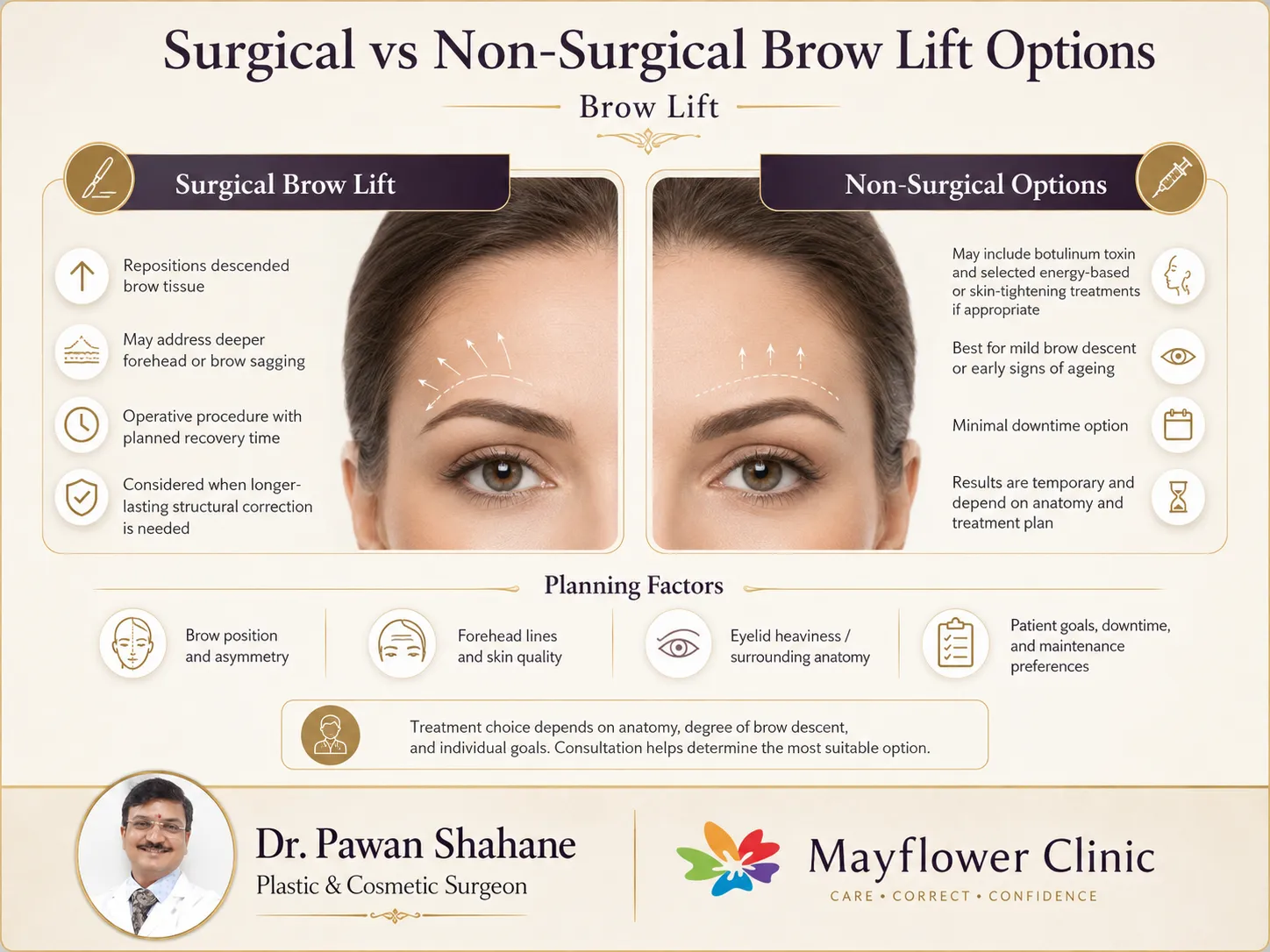
| Option | What it mainly does | Where incisions or treatment occur | Best suited to | Important limitations |
|---|---|---|---|---|
| Endoscopic brow lift | Mobilizes and repositions forehead and brow tissues with endoscopic visualization. | Several small incisions within the scalp. | Selected patients needing broader brow elevation with suitable hairline and tissue quality. | Still surgery; requires fixation, healing and carries risks of numbness, asymmetry, hair loss and nerve injury. |
| Temporal or lateral brow lift | Targets the outer brow and temple region. | Shorter incisions in the temporal hair-bearing scalp. | Predominantly lateral brow descent or outer-eye heaviness. | Limited effect on the central brow or deep central forehead lines; lift can relax over time. |
| Pretrichial or hairline lift | Elevates the brow while allowing selected forehead shortening. | At or just behind the frontal hairline. | Selected patients with a high forehead and stable hairline. | Hairline scar, possible hairline irregularity, numbness or hair loss near the incision. |
| Coronal or classic lift | Provides broad forehead exposure and repositioning. | Longer incision within the scalp. | Selected patients needing wider correction where the hairline and scalp permit. | Longer incision, potential hairline elevation, numbness, itching and alopecia risk; not suitable for every patient. |
| Direct brow lift | Allows precise lift immediately above the eyebrow. | Incision along the upper brow margin. | Selected patients needing direct control, including some functional or reconstructive cases. | Visible-scar trade-off must be accepted; not usually the first cosmetic choice in younger patients. |
| Botulinum toxin brow shaping | Temporarily changes muscle balance to create a small lift or improve dynamic asymmetry. | Strategic injections around the forehead and outer eye. | Mild concerns and patients seeking a limited temporary change. | Cannot remove skin or reproduce surgical lift; incorrect balance can worsen heaviness, asymmetry or eyelid droop. |
| Thread-based lift | Provides limited mechanical support with absorbable threads. | Small entry points beneath the skin. | Carefully selected mild laxity where modest temporary change is acceptable. | Not equivalent to surgery; risks include dimpling, palpability, asymmetry, infection, extrusion and early loss of effect. |
The eyebrow has moved lower and contributes to outer-eye heaviness, hooding or an unwanted tired expression.
The aim is a balanced, rested appearance rather than a fixed height, perfect symmetry or complete removal of forehead lines.
General health, blood pressure, medicines, smoking status, eye health and recovery support are compatible with the planned procedure.
Weakness or descent of the eyelid margin itself needs an eyelid-specific assessment; lifting the brow alone may not correct it.
Active infection, poorly controlled medical illness, unstable blood pressure, untreated eye-surface disease or inability to pause smoking may increase risk.
Surgery should not proceed when the desired shape is anatomically unsafe, repeatedly changing or being demanded by another person.
The exact steps vary with technique and whether another facial procedure is combined.
Dr. Shahane examines the brow at rest, eyelid skin, eye closure, hairline, muscle activity and pre-existing asymmetry.
The proposed lift vector, scar position and whether upper-eyelid surgery is needed are explained. A temporary injectable option may be discussed when the expected change is small.
Investigations and anaesthesia review are individualized. Medicines and supplements are reviewed rather than stopped without medical advice. Smoking cessation and transport arrangements are discussed.
Incisions are made according to the selected technique. Forehead and brow tissues are released and fixed in a planned position. The operation is personally performed by Dr. Pawan Shahane.
Head elevation, gentle hair and wound care, prescribed medicines and activity restrictions are followed. Swelling may move toward the eyelids before improving.
Many patients are socially presentable around 10–14 days, but residual tightness, numbness, itching or mild asymmetry during settling can last longer.
Scar maturation, tissue relaxation and recovery of sensation continue. Final assessment should not be based on the early over-corrected or swollen phase.
These are broad planning bands, not promises. Technique, combination surgery and individual healing change the timeline.
Forehead tightness, bruising and eyelid swelling may be most noticeable. Rest with the head elevated and avoid bending or straining.
Incisions are checked. Bruising starts fading, but scalp numbness, itching or a firm sensation can remain.
Many patients can return to desk work or social activity when swelling and bruising are acceptable and the surgeon agrees.
Exercise and hair treatments resume gradually according to the incision and fixation method. Residual swelling may still fluctuate.
Brow position, sensation and incision lines continue to settle. Ageing continues, and minor natural asymmetry may remain.
Sleep with the head raised as advised during the early swelling phase; avoid pressure or rubbing over incisions.
Apply cool compresses only where and how instructed. Do not place ice directly on numb skin or fresh incisions.
Washing, drying, colouring and salon treatments resume according to incision healing, not simply by calendar date.
Gentle walking supports circulation. Heavy lifting, inverted yoga, forceful bending and strenuous exercise wait for clearance.
Once healed, use physical shade and surgeon-approved sunscreen to reduce prolonged redness or pigmentation.
Follow-up is needed to assess healing, remove sutures or clips when appropriate and identify problems early.
No brow-lift technique is risk-free. The likelihood and relevance of each risk depends on the approach, anatomy, medical history, smoking, previous surgery and whether other facial operations are performed at the same time.
Bleeding, infection, seroma, delayed healing, widened or visible scars and pigmentation changes.
Temporary or persistent numbness, itching, scalp sensitivity and localized hair loss near incisions.
Undercorrection, overcorrection, recurrent descent, altered arch, asymmetry or a need for revision.
Dryness or irritation, incomplete closure, facial nerve weakness, persistent pain and anaesthesia-related complications.
Natural asymmetry is common before surgery. Improvement may be possible, but exact mirror-image symmetry is not a realistic guarantee.
There is no responsible one-price figure for every brow lift because a limited temporal lift, an endoscopic forehead lift and a combined brow-and-eyelid operation involve different time, anaesthesia, facility and follow-up requirements.
The written quotation follows examination and should state what is included. Mayflower Clinic does not present a fixed package before the technique and safety needs are known.
These verbatim Google reviews describe general experience with Dr. Pawan Shahane and Mayflower Clinic. They are not presented as eyebrow-lift outcome claims.
“Good Work on Cosmatic surgery.”
Verified Google review“Had a treatment for the injury and it was a great experience. It was like after removing stitches it looks as it was almost before the injury”
Verified Google review“Best cosmetic surgeon, I strongly recommend, him for all plastic surgery. He is very intelligent and guides you very well.”
Verified Google review · Excerpt retained verbatimQuick guidance · Detailed explanations below.
An eyebrow lift, also called a brow lift or forehead lift, is surgery that repositions descended brow tissues. It may also soften selected forehead or frown lines, but the plan is based on the patient’s brow shape, hairline, eyelids and facial balance.
A brow lift addresses a low or descended eyebrow, while upper blepharoplasty removes selected excess upper-eyelid skin. Some patients have one problem and others have both, so the brow should be examined in its relaxed position before eyelid surgery is planned.
Strategically placed botulinum toxin may create a small temporary change in brow position by altering muscle balance. It cannot remove excess skin or reproduce the amount and duration of a surgical lift, and unsuitable placement may worsen heaviness or asymmetry.
No. Threads may provide a limited temporary lift in selected patients, but they do not reproduce the tissue release, repositioning or durability of surgery. Suitability, expected benefit and thread-related risks require individual assessment.
There is no single best technique for everyone. Endoscopic, temporal, hairline, coronal and direct approaches have different indications, scar positions, lifting patterns and trade-offs. The choice depends on anatomy and the correction required.
Every surgical brow lift creates incisions. Many techniques place them within the scalp or at the hairline, while a direct lift places an incision just above the brow in selected patients. Scar visibility varies with technique, hair pattern, skin biology and healing.
Swelling and bruising are most noticeable early. Initial wound healing commonly takes about 10 to 14 days, and many patients plan roughly one to two weeks away from public-facing work. Residual swelling, tightness or altered sensation may take longer to settle.
Surgical repositioning can be long-lasting, but it does not stop ageing. Tissue quality, technique, muscle activity, sun exposure and time continue to influence the forehead and brow, so results should not be described as permanent.
A brow lift may improve selected asymmetry, but natural facial asymmetry is common and exact symmetry cannot be guaranteed. The consultation should document pre-existing differences and whether muscle activity, eyelid position or skeletal anatomy contributes.
Risks include bleeding, infection, fluid collection, poor healing, visible or widened scars, hair loss near incisions, numbness or itching, asymmetry, undercorrection, overcorrection, elevated hairline, dry-eye symptoms, facial nerve injury, anaesthesia complications and revision surgery.
It can be combined in selected patients when more than one facial region contributes to the concern. Combining procedures changes anaesthesia, recovery and risk, so it should be recommended only after a full facial assessment rather than as a standard package.
Cost depends on the chosen technique, anaesthesia, operating facility, investigations, whether another procedure is combined, medicines and follow-up. Mayflower Clinic provides an itemised quotation after examination rather than advertising one fixed price for every patient.
References support general educational statements. They do not replace an individual examination or establish that every technique is offered or suitable at Mayflower Clinic.
Bring photographs of your usual resting expression if helpful, but expect the decision to be made from an in-person examination of the brow, eyelids, hairline, muscle activity and eye health—not from a single selfie.

Case of the Month: Grade 3 Gynecomastia…

The Science of Facial Aging: Why Wrinkles,…